



Antique Teapoys
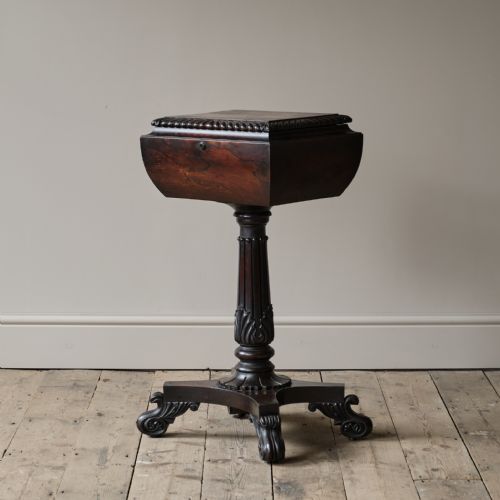
A teapoy is a lidded tea chest raised on its own pillar or tripod stand, made to sit beside a drawing room chair and hold caddies of tea while tea was still costly enough to keep locked.
Antique Teapoys
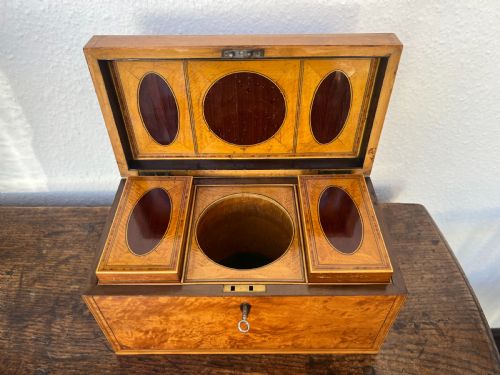
The form is a box on a stand rather than a box on a table. A lidded chest, often with tapering sides, sits on a turned pillar and tripod or a turned column on a platform base. Inside, the box was fitted with caddies for tea and often a mixing bowl.
The name comes from an Indian word for a three-legged stand, and its link to tea is a coincidence of sound. The form became fashionable in Britain in the early 19th century, and nothing in this archive sits outside roughly 1800 to 1860.
Rosewood is the defining timber, appearing in more titles than any other, with mahogany second. Between them the two woods account for around two-thirds of everything listed. Regency and William IV pieces dominate, so the teapoy you are most likely to meet on Sellingantiques is a rosewood or mahogany box on a turned pillar and tripod.
Beyond those two timbers sit burr walnut, burr elm, pollard oak, satinwood, burr maple and plain oak, woods that are scarce in small furniture generally. One burr elm example is recorded as Swedish, the only non-British origin claimed in the whole archive. Period labels in dealer entries are loose: twenty listings say no more than 19th century, and several marked Victorian describe William IV pieces.
Where Value Sits
Brass inlay is the clearest divider. Only four titles carry it, brass line or foliate work let into rosewood, and every one of them sits in the upper reaches of the range, three near the very top. It is a small, consistent minority rather than a common feature.
Timber does the next most work. The lowest listings are plain walnut, oak and mahogany; rosewood occupies the middle and upper bands, and the figured woods, burr elm, pollard oak, burr maple and satinwood, cluster above the plain pieces. A name helps too: five listings carry a workshop attribution or stamp, and those sit mid-range and above.
How much a title says tracks the price. A bare "Teapoy" or "Victorian Oak Teapoy" sits low, while entries naming period, timber, inlay and interior fittings together sit high. Only one title specifies its four-caddy interior, and one alone names the box shape as sarcophagus.
Antique Teapoys Retail Price Guide 2026
Typical UK retail prices for teapoys, calculated from the Sellingantiques database of over a million retail prices indexed since 2003. This retail price guide relies exclusively on Sellingantiques data; no external sources or auction records are used, so the figures do not describe the wider market.
Gillows is the workshop name that turns up most in teapoy listings on Sellingantiques.

The Antique Teapoys Glossary
- Teapoy
- A lidded tea chest raised on its own pillar or tripod stand. Dealers also write it "tea-poy" and "tea poy".
- Caddy
- A compartment or lidded container inside the box for tea. One listing here specifies a four-caddy interior.
- Pillar and tripod
- A turned central column standing on three feet, the commonest support in this category. One entry is catalogued simply as a tripod table teapoy.
- Sarcophagus shape
- A box with sloping, tapering sides, the classic Regency chest form. Named in one title.
- Burr
- The swirled figure cut from a tree burl. Burr walnut, burr elm and burr maple all turn up in these titles.
- Pollard oak
- Oak from a tree cut back repeatedly, which gives dense, knotty figure. Used for one teapoy in the archive.
Antique Teapoys: Frequently Asked Questions
How often do teapoys come up for sale?
Only about six a year reach the market on Sellingantiques, so the category moves slowly.
Thirty-nine different dealers have listed one over the life of the archive. Most carry a single example and then wait years before another comes through their hands.
What wood are teapoys usually made from?
Rosewood leads, in more than a third of titles, with mahogany second at about a quarter. Together they cover roughly two-thirds of the category.
The rest spread across burr walnut, walnut, burr elm, pollard oak, satinwood, burr maple and oak.
Which periods do teapoys come from?
Everything in this archive falls between about 1800 and 1860. Regency and William IV descriptions are the most common.
Only twelve of the fifty-six listings carry a clean year, and the 1850s is the busiest single decade. Twenty say no more than 19th century.
Are any teapoys by named makers?
Five listings carry a workshop name or attribution. Three are Gillows, one of those recorded as stamped.
One Scottish example is attributed to William Trotter, and a London one to Druce & Co. The rest of the archive is unnamed.
Why are some teapoys catalogued as work tables?
The raised-box forms shade into one another. Three titles here use work table or work box, and one piece is described as converted.
The most expensive item in the archive isn't a tea chest at all: it's a burr maple spirits table with a glasses stand, catalogued as a teapoy.
What does brass inlay mean on a teapoy?
Brass line or foliate work let into the timber, usually rosewood, in the Regency taste.
Four titles carry it, and all four sit in the upper part of the range.