17,337  PAGES BROWSED TODAY PAGES TODAY 34 ANTIQUES UPLOADED TODAYNEW ARRIVALS
34 ITEMS ADDED TODAY
Sort Order
Items Per Page
Browse Categories
Sort order
Relevant Links
Items per page
ID #SA1201390
FOR SALE
£1,250
Email
Save
Hever Castle Tunbridge Ware Rosewood Tea Caddy by Henry Hollamby
Baggott & Co.
for sale €1,463     $1,588
£1,250
Baggott & Co.

Baggott & Co.

Sellingantiques Verified Since Feb 2019
View Dealers Stock Page
  • About Us
    Dealers in antiques and decorative interiors based in the cotswolds and scotland
Id #SA1201390
PDF SHARE
SAVE

Hever Castle Tunbridge Ware Rosewood Tea Caddy by Henry Hollamby

19th century
For Sale by Baggott & Co.
Description

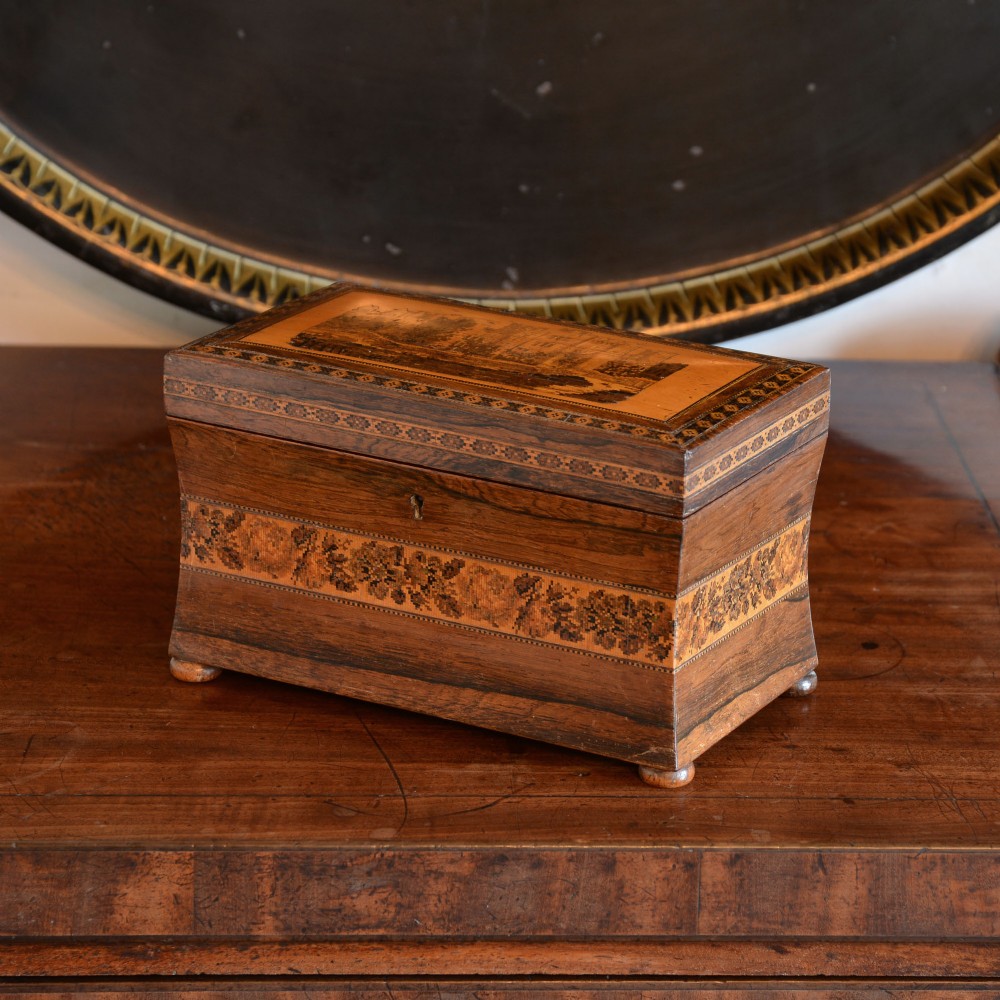
Tunbridge Ware rosewood tea caddy attributed to Henry Hollamby

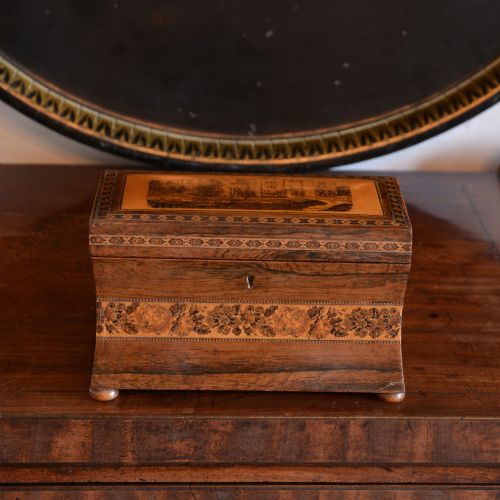
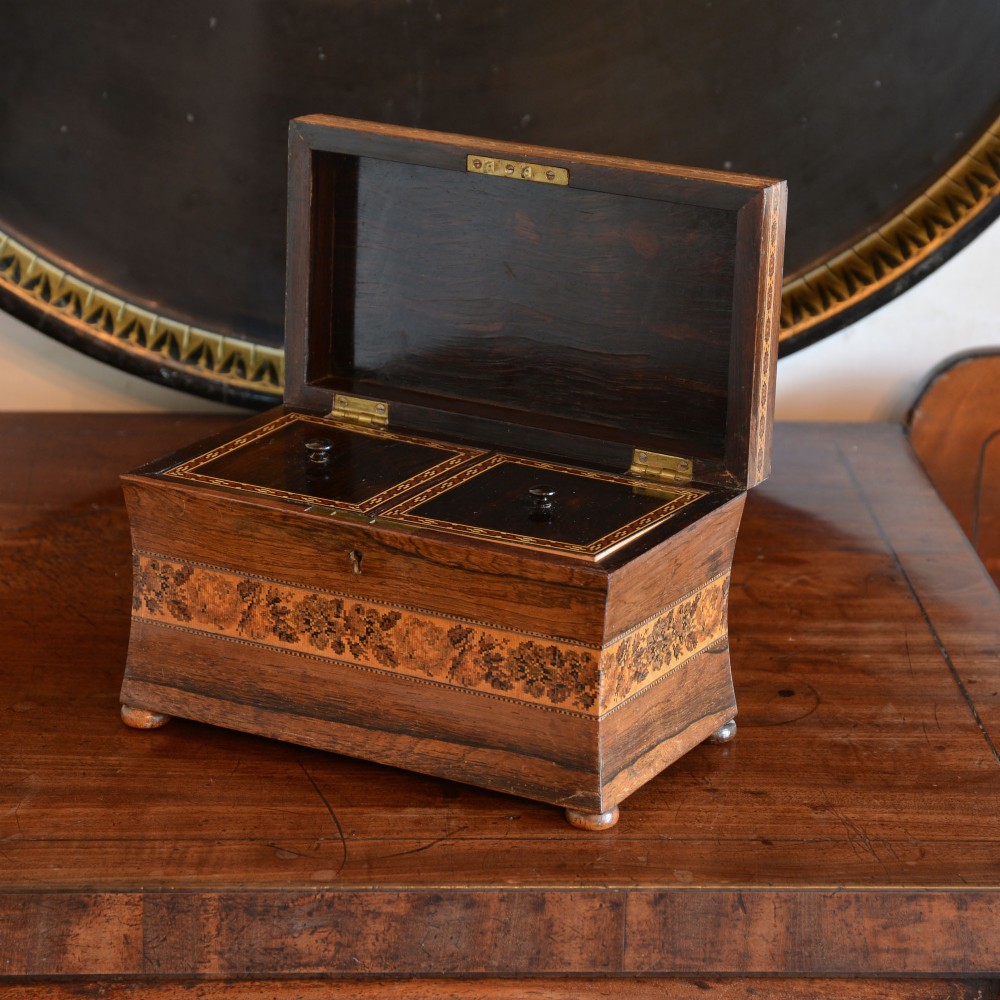
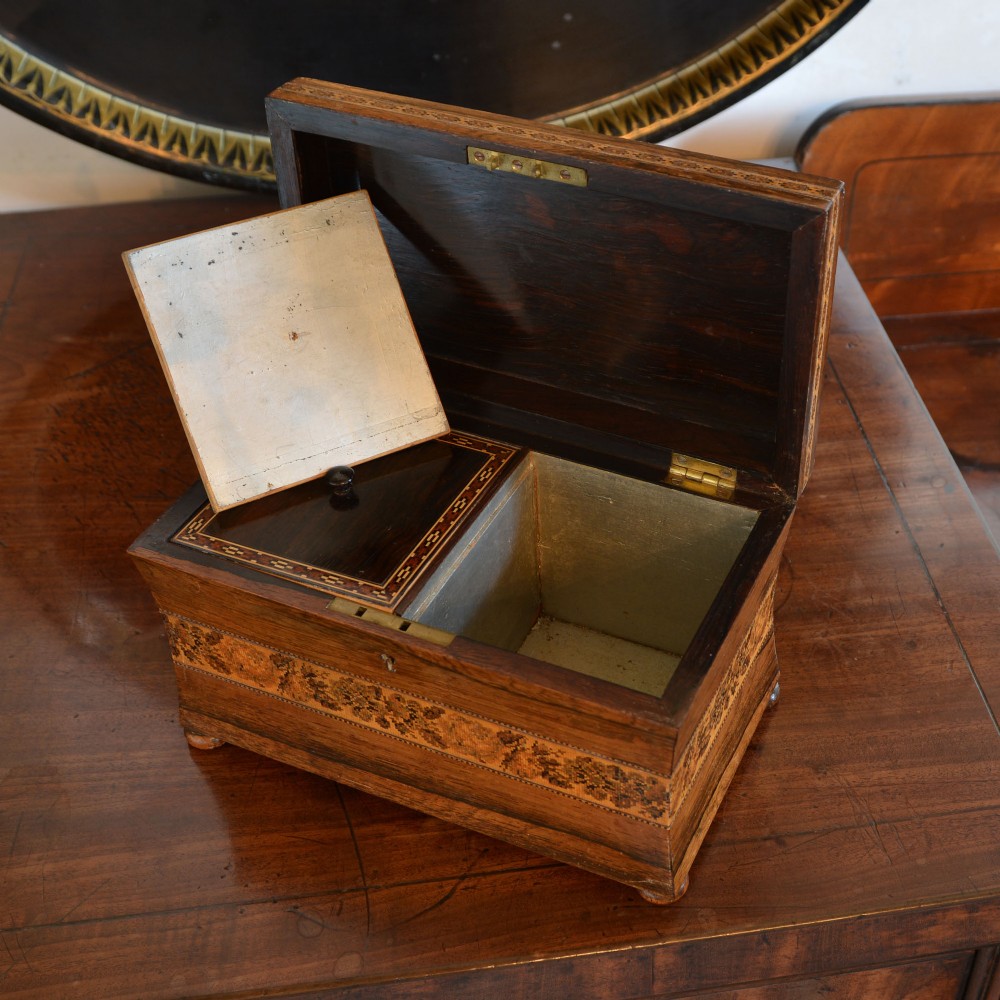
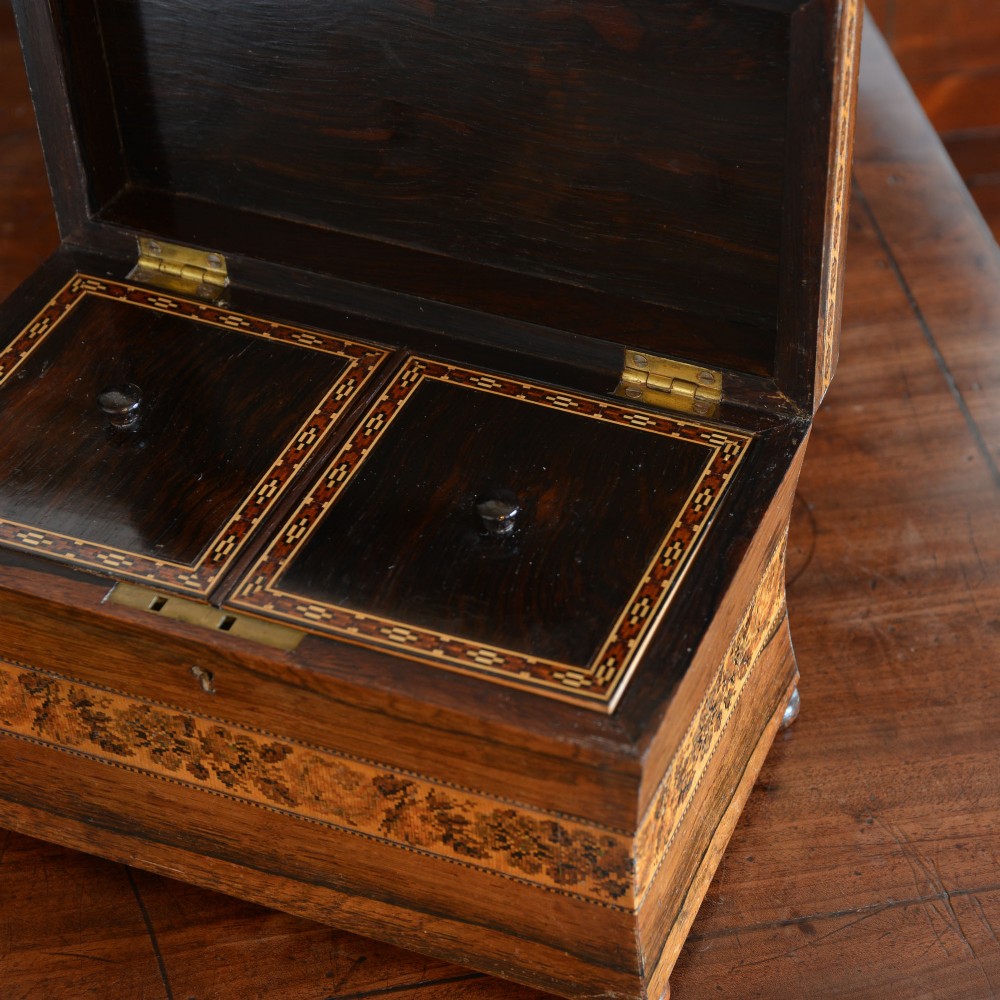
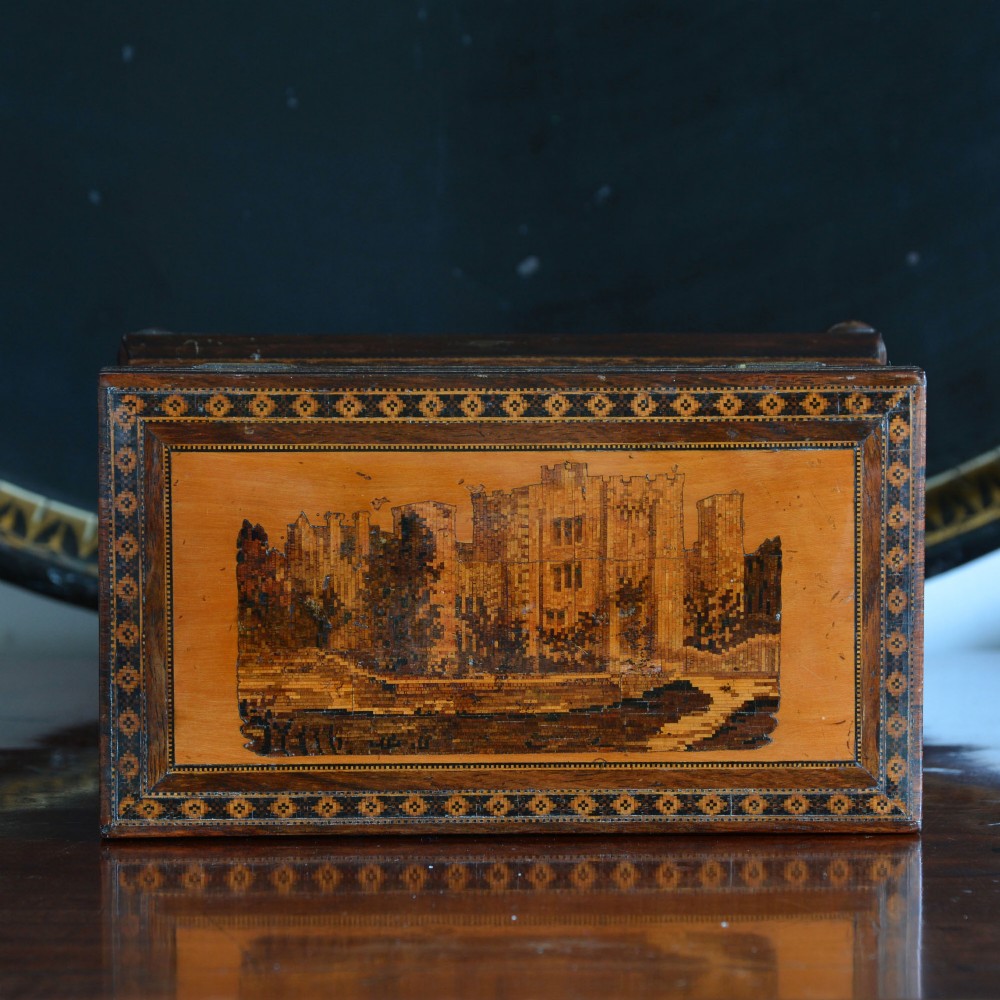
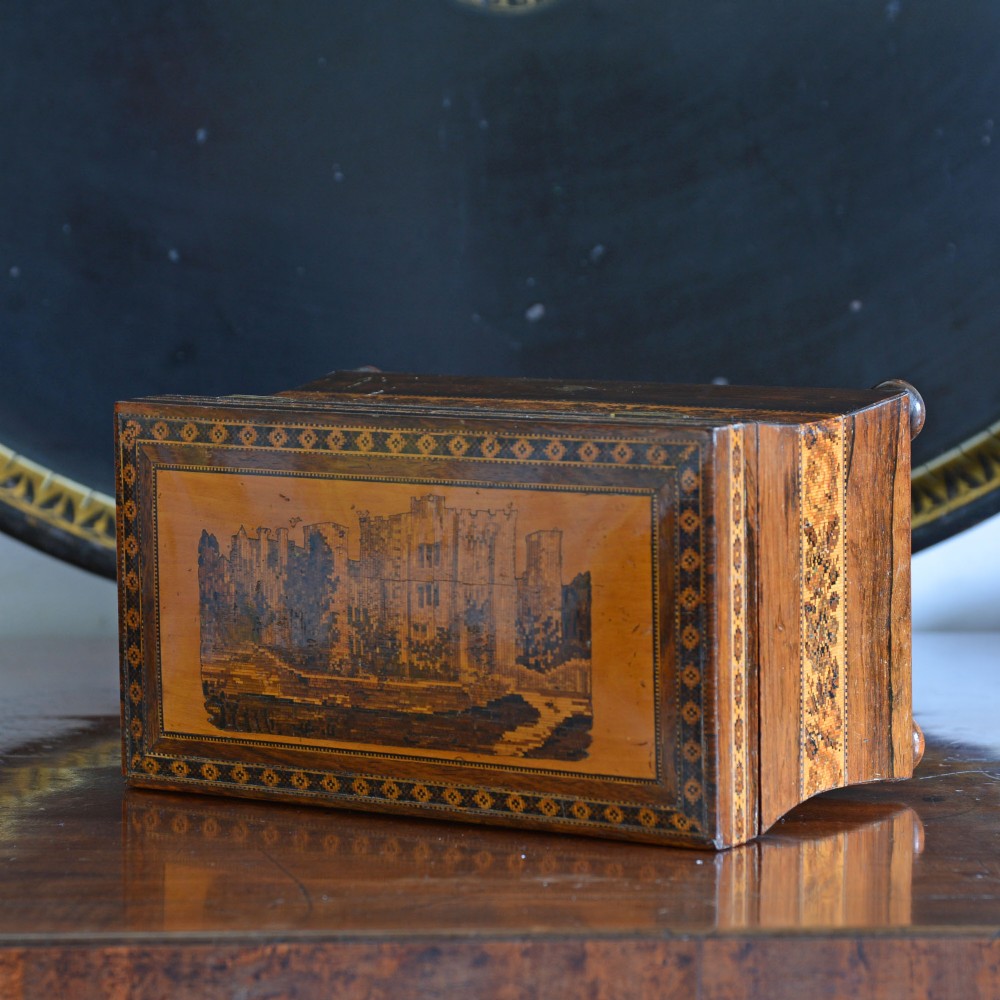
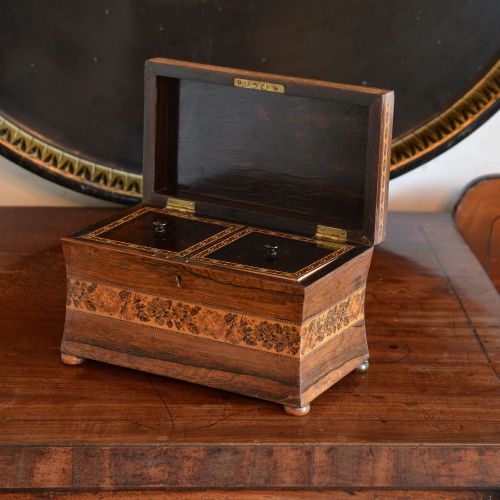
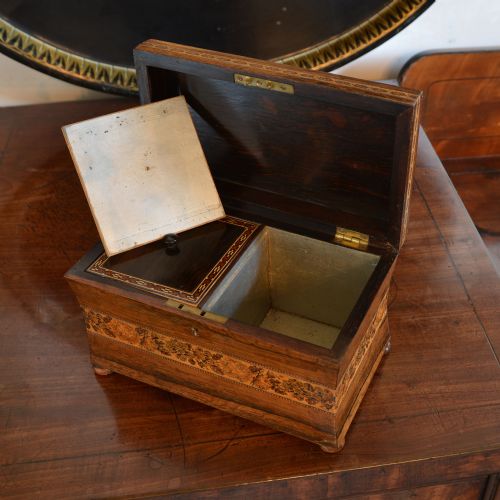
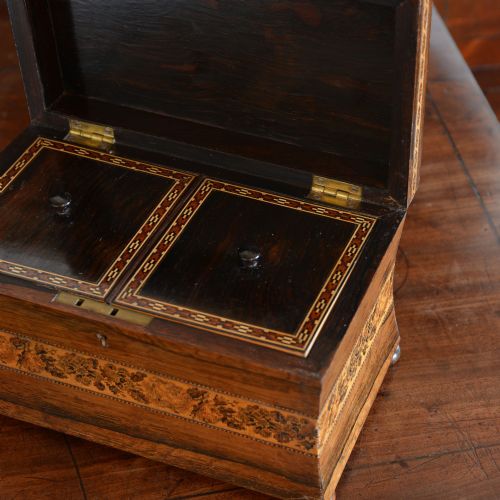
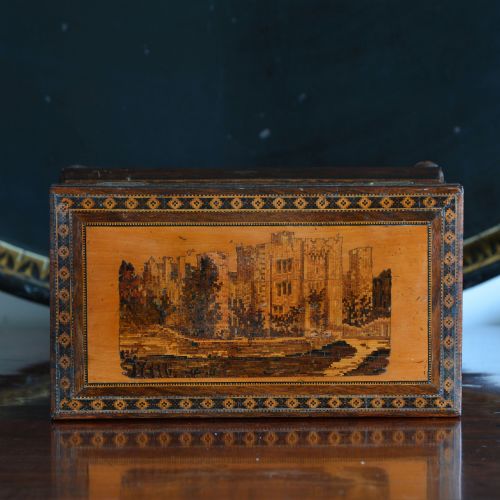
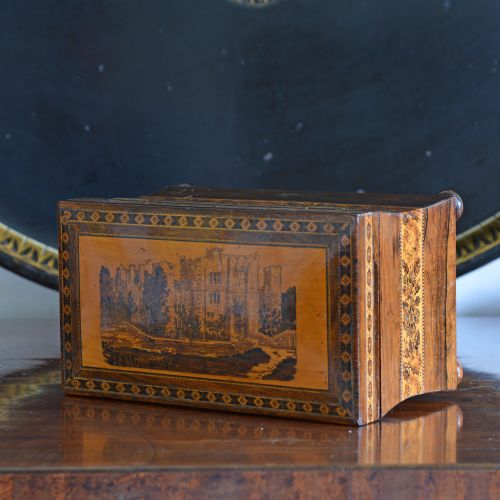
Of concave sarcophagus form with tessellated and floral inlay, the lid with central panel depicting Hever Castle, opens to an interior with two lidded foil lined tea boxes. Stands upon turned bun feet.

English, circa 1860-1890

Dimensions: H: 5" (13cm), W: 8.5" (21.5cm), D: 5" (13cm).

Tunbridge ware is the collective term given to a form of decorative inlaid woodwork in which small pieces of different coloured woods are used to form a mosaic or geometric pattern. As its name suggests, the technique was developed in the historic Kent town of Tunbridge Wells from the mid 18th century.
Tea caddy attributed to Henry Hollamby (1819-1895

The Hollamby family was involved in the Tunbridge Ware industry in the very early part of the nineteenth century. At the age of 12 in 1831, Henry was apprenticed to George & James Burrows, and, by the age of 26, was running his own business at 6 Edgar Terrace in the High Street. Ten years later he had premises in both Chapel Place and on the Parade along with a manufactory employing upwards of twenty people in Frant Road, Tunbridge Wells.
Hollamby specialised in the portrayal of famous buildings and places on his work which was both retailed and wholesaled to other sellers in the town, and pictorial blocks were also sold to other towns in both England and Ireland. He exhibited at both the Crystal Palace Exhibition of 1851 and the 1862 Great Exhibition with considerable success The business closed in 1891.
Hever Castle, Kent, England

Hever a 14th century medieval defensive moated castle, about 10 miles from Tunbridge Wells, with its gatehouse and walled bailey, was built in 1383. In the 15th and 16th centuries it was the home of one of the most powerful families in the country, the Boleyns, who modernised the existing dwelling within the walls.
The Castle was to become the childhood home of Anne Boleyn, King Henry VIII’s second wife, who became Queen of England for just 1,000 days. It was Henry’s love for Anne and her insistence that she became his wife rather than his mistress that led to the King splitting from the Church in Rome and creating the Church of England, forever altering the course of English and European history.
Hever later passed into the ownership of another of Henry VIII’s wives, Anne of Cleves, and from 1557 onwards it was owned by a number of families including the Waldegraves, the Humphreys and the Meade Waldos.

[Ref: Hever Castle website]

Physical Dimensions
Height
13cm (5.12")
Width
21.5cm (8.46")
Depth
13cm (5.12")
Declaration

Baggott & Co. has dated this Tunbridge Ware Tea Caddy to the Victorian era.

Reference Numbers
Sellingantiques Reference
SA1201390
Dealers Internal Reference
BCSL2180
Dealers Notes

If you would like to order this item online please go to our website: www.baggottandcompany.com, search for the item with the ‘Internal Ref’ shown below. We have a full checkout with shipping for most items to the UK. If for any reason you cannot find it please just get in touch and we can answer any questions, quote for delivery and take payments.

Small items can be posted internationally using a tracked and signed service, parcels can be sent by courier both to the UK and internationally and for deliveries of furniture and larger items internationally please contact us for a quote.

We offer a refund if for any reason you wish to return an item, delivery charges are non refundable.

England:

Huntsman’s Yard, Sheep Street, Stow on the Wold, GL54 1AA

01451 830 370

Scotland:

Keepers House, Auchencairn, Castle Douglas, DG7 1QZ

07881 823 369

Description
Tunbridge Ware rosewood tea caddy attributed to Henry Hollamby
Of concave sarcophagus form with tessellated and floral inlay, the lid with central panel depicting Hever Castle, opens to an interior with two lidded foil lined tea boxes.
Baggott & Co.

Stands upon turned bun feet.

fig 1. A rectangular Victorian rosewood tea caddy featuring concave sides, small bun feet, an inlaid floral border, and a top lid panel depicting Hever Castle in wood mosaic.
fig 1. Hever Castle Tunbridge Ware Rosewood Tea Caddy by Henry Hollamby

English, circa 1860-1890

Dimensions: H: 5" (13cm), W: 8.5" (21.5cm), D: 5" (13cm).

Tunbridge ware is the collective term given to a form of decorative inlaid woodwork in which small pieces of different coloured woods are used to form a mosaic or geometric pattern. As its name suggests, the technique was developed in the historic Kent town of Tunbridge Wells from the mid 18th century.

fig 2. A rectangular Victorian rosewood tea caddy featuring concave sides, small bun feet, an inlaid floral border, and a top lid panel depicting Hever Castle in wood mosaic.
fig 2. Hever Castle Tunbridge Ware Rosewood Tea Caddy by Henry Hollamby

Tea caddy attributed to Henry Hollamby (1819-1895

The Hollamby family was involved in the Tunbridge Ware industry in the very early part of the nineteenth century. At the age of 12 in 1831, Henry was apprenticed to George & James Burrows, and, by the age of 26, was running his own business at 6 Edgar Terrace in the High Street. Ten years later he had premises in both Chapel Place and on the Parade along with a manufactory employing upwards of twenty people in Frant Road, Tunbridge Wells.

fig 3. A rectangular Victorian rosewood tea caddy featuring concave sides, small bun feet, an inlaid floral border, and a top lid panel depicting Hever Castle in wood mosaic.
fig 3. Hever Castle Tunbridge Ware Rosewood Tea Caddy by Henry Hollamby

Hollamby specialised in the portrayal of famous buildings and places on his work which was both retailed and wholesaled to other sellers in the town, and pictorial blocks were also sold to other towns in both England and Ireland. He exhibited at both the Crystal Palace Exhibition of 1851 and the 1862 Great Exhibition with considerable success The business closed in 1891.

fig 4. A rectangular Victorian rosewood tea caddy featuring concave sides, small bun feet, an inlaid floral border, and a top lid panel depicting Hever Castle in wood mosaic.
fig 4. Hever Castle Tunbridge Ware Rosewood Tea Caddy by Henry Hollamby

Hever Castle, Kent, England

Hever a 14th century medieval defensive moated castle, about 10 miles from Tunbridge Wells, with its gatehouse and walled bailey, was built in 1383. In the 15th and 16th centuries it was the home of one of the most powerful families in the country, the Boleyns, who modernised the existing dwelling within the walls.

fig 5. A rectangular Victorian rosewood tea caddy featuring concave sides, small bun feet, an inlaid floral border, and a top lid panel depicting Hever Castle in wood mosaic.
fig 5. Hever Castle Tunbridge Ware Rosewood Tea Caddy by Henry Hollamby

The Castle was to become the childhood home of Anne Boleyn, King Henry VIII’s second wife, who became Queen of England for just 1,000 days. It was Henry’s love for Anne and her insistence that she became his wife rather than his mistress that led to the King splitting from the Church in Rome and creating the Church of England, forever altering the course of English and European history.

fig 6. A rectangular Victorian rosewood tea caddy featuring concave sides, small bun feet, an inlaid floral border, and a top lid panel depicting Hever Castle in wood mosaic.
fig 6. Hever Castle Tunbridge Ware Rosewood Tea Caddy by Henry Hollamby

Hever later passed into the ownership of another of Henry VIII’s wives, Anne of Cleves, and from 1557 onwards it was owned by a number of families including the Waldegraves, the Humphreys and the Meade Waldos.

[Ref: Hever Castle website]

Height
13cm (5.12")
Width
21.5cm (8.46")
Depth
13cm (5.12")
Date of Manufacture

Baggott & Co. has dated this Tunbridge Ware Tea Caddy to the Victorian era.

Reference Numbers
Sellingantiques Ref
SA1201390
Dealers Internal Ref
BCSL2180
Baggott & Co.
Baggott & Co.
Sellingantiques verified Since Feb 2019

Dealers in antiques and decorative interiors based in the cotswolds and scotland

Dealer Profile

You can view the stock and full dealer information on the Baggott & Co. Profile Page
PDF SHARE
SAVE
A rectangular Victorian rosewood tea caddy featuring concave sides, small bun feet, an inlaid floral border, and a top lid panel depicting Hever Castle in wood mosaic.
1 / 7
Archive I A rectangular Victorian rosewood tea caddy featuring concave sides, small bun feet, an inlaid floral border, and a top lid panel depicting Hever Castle in wood mosaic.

Hever Castle Tunbridge Ware Rosewood Tea Caddy by Henry Hollamby
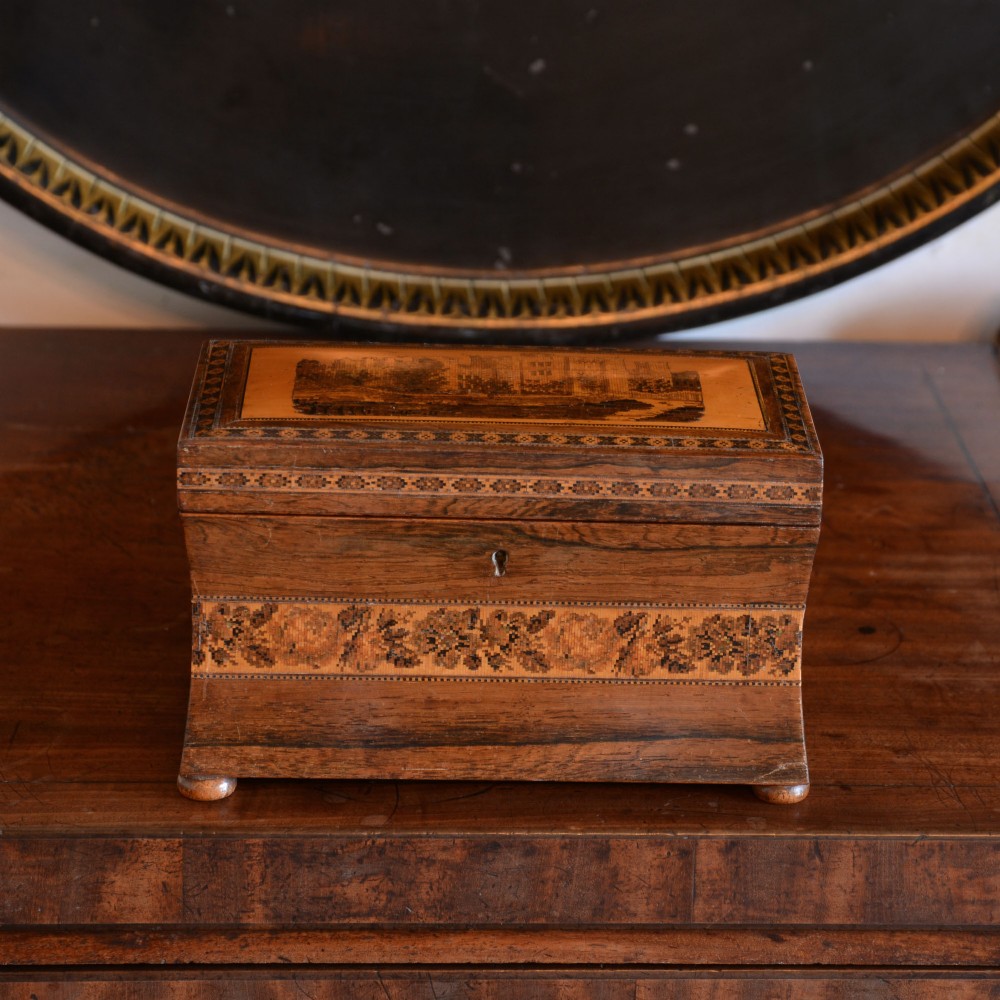
Archive II A rectangular Victorian rosewood tea caddy featuring concave sides, small bun feet, an inlaid floral border, and a top lid panel depicting Hever Castle in wood mosaic. View II
Archive III A rectangular Victorian rosewood tea caddy featuring concave sides, small bun feet, an inlaid floral border, and a top lid panel depicting Hever Castle in wood mosaic. View III
Archive IV A rectangular Victorian rosewood tea caddy featuring concave sides, small bun feet, an inlaid floral border, and a top lid panel depicting Hever Castle in wood mosaic. View IV
Archive V A rectangular Victorian rosewood tea caddy featuring concave sides, small bun feet, an inlaid floral border, and a top lid panel depicting Hever Castle in wood mosaic. View V
Archive VI A rectangular Victorian rosewood tea caddy featuring concave sides, small bun feet, an inlaid floral border, and a top lid panel depicting Hever Castle in wood mosaic. View VI
Archive VII A rectangular Victorian rosewood tea caddy featuring concave sides, small bun feet, an inlaid floral border, and a top lid panel depicting Hever Castle in wood mosaic. View VII
Enlarged Archival View
Telephone 07881 823 369
Location
Two locations:

Huntsmans Yard
Sheep Street
Stow-on-the-Wold
Gloucestershire
GL54 1AA

The Keepers House
Auchencairn
Castle Douglas
DG7 1QZ

United Kingdom
Verified Since Feb 2019
Items For Sale 252
Items Sold 9
Baggott & Co.
Baggott & Co.
Verified Since Feb 2019
View Dealer Info
Location: Two locations:, , Huntsmans Yard, Sheep Street, Stow-on-the-Wold, Gloucestershire, GL54 1AA, , The Keepers House, Auchencairn, Castle Douglas, DG7 1QZ, , United Kingdom
Verified
Feb 2019
For Sale
252
Sold
9
A rectangular Victorian rosewood tea caddy featuring concave sides, small bun feet, an inlaid floral border, and a top lid panel depicting Hever Castle in wood mosaic.
Hever Castle Tunbridge Ware rosewood tea caddy by Henry Hollamby
Ref: SA1201390
A rectangular Victorian rosewood tea caddy featuring concave sides, small bun feet, an inlaid floral border, and a top lid panel depicting Hever Castle in wood mosaic.
Detail View 1
Detail View 2
Detail View 3
Detail View 4
Detail View 5
Detail View 6
Archival Detail
Every single antique dealer on our platform is individually approved by our internal team. We verify their professional trade history, ethical standards, and photographic quality to ensure a secure, high-standard buying environment. Upon joining, every dealer agrees to a strict 9-point code of conduct. While issues can occasionally arise, our dealers typically resolve them swiftly and directly with the buyer. In fact, since our founding in 2002, Sellingantiques has only had to step in to help resolve an issue on roughly five occasions—a true testament to the quality of our dealers and their dedication to your happiness.
Our dealers are highly experienced in packing and shipping fragile, high-value antiques. Because you are in direct contact with the dealer, you will be able to easily go through all available shipping and insurance options together to ensure your item arrives safely.
Antiques are the ultimate green purchase. By choosing historical pieces over newly manufactured goods, you completely eliminate the carbon footprint of modern mass production while preserving exceptional, timeless craftsmanship.

Tunbridge Ware is a form of decorative inlaid woodwork developed in Royal Tunbridge Wells, Kent, during the eighteenth and nineteenth centuries. The technique uses tiny, square-cut strips of variously coloured natural woods glued together into blocks, which are sliced to produce repetitive tessellated geometric patterns or detailed topographical scenes.

Makers utilised native British hardwoods such as holly, yew, sycamore, plum, and oak, alongside exotic imported timber like rosewood and mahogany for the primary casing. The colours in the mosaic imagery rely on the natural grain and shade of untreated wood rather than artificial dyes.

Authentic pieces exhibit end-grain timber mosaic panels rather than surface-printed designs or modern veneers. Look for slight irregularities in the wood tesserae, period-correct brass escutcheons, original keyholes, concave sarcophagus profiles, and evidence of historical hand-sawing on internal surfaces.

A decorative box can be positioned as a focal accent on a hall console, bookshelf, or sideboard. It functions both as an art object showcasing historic craftsmanship and as functional desktop storage for small trinkets, stationery, or keys.

Keep the wood away from direct sunlight, central heating radiators, and damp conditions to prevent cracking or lifting of the delicate veneer blocks. Clean gently using a dry microfibre cloth and apply a high-grade beeswax polish sparingly along the grain.
items
Add keywords to the filter
Price
£100
£250000
Era
Movements
Material
Origin
Stock Location
Freshness
Online Payments
Categories