



Inlaid Rosewood Caddy
An inlaid rosewood caddy is a small, decorative wooden container built to store dry leaf tea securely, featuring contrasting timber and metal ornamentation.
Inlaid Rosewood Caddy
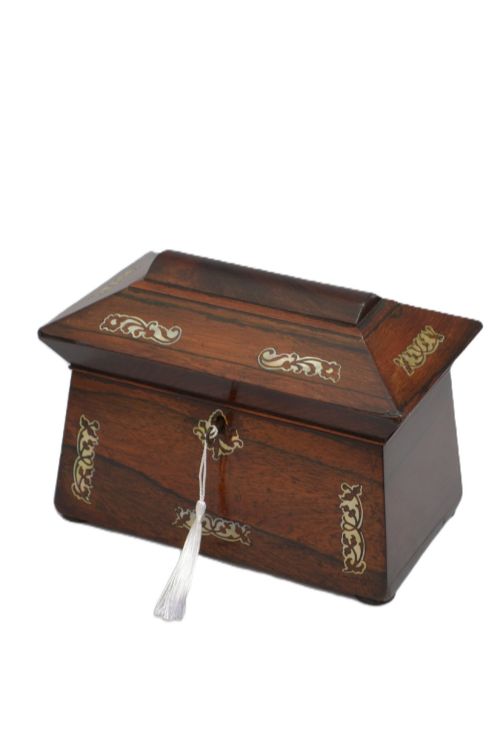
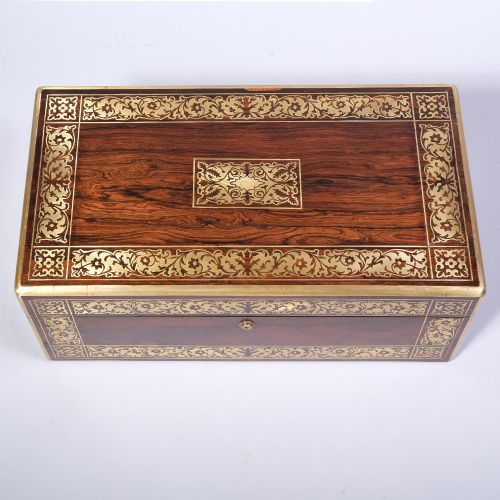
An inlaid rosewood caddy is a domestic container made during the Georgian, Regency, and Victorian periods for storing tea leaves securely under lock and key. The pieces seen here span tea caddies, larger teapoys on stands, and occasional related storage boxes like sewing or writing caskets.
The most common version met on this page is the Regency or early Victorian sarcophagus-shaped tea caddy, featuring crisp brass inlay, ring handles, and internal lidded compartments for different tea varieties.
How they were made
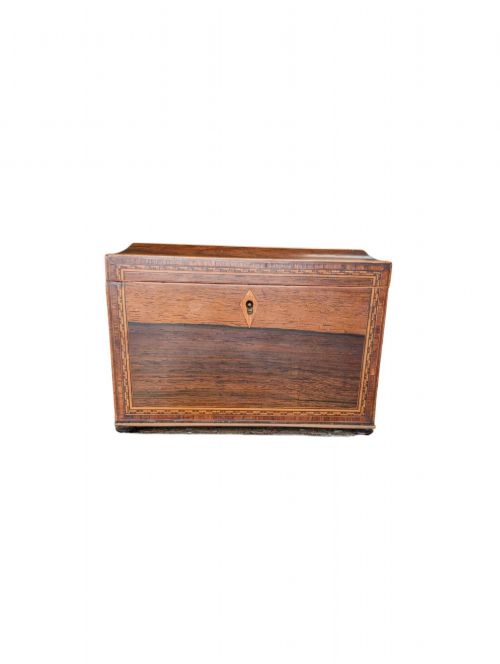
Cabinetmakers constructed the carcase from dense tropical rosewood, often veneered onto a secondary timber substrate, before cutting precise channels into the surface for decorative motifs. Into these recesses they fitted thin strips of brass, mother-of-pearl, boxwood, or satinwood, securing them with animal glue.
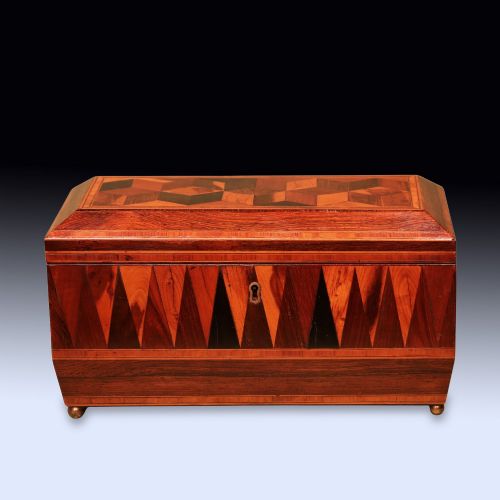
Tunbridge Ware examples required a different technique entirely, assembling thousands of tiny coloured wood blocks into mosaic geometric panels or pictorial scenes before slicing them into thin veneers for application to the rosewood box.
Sarcophagus shapes and standalone teapoys appear frequently among these offerings, often retaining their original internal lidded compartments and glass mixing bowls.
What varies in quality
The distinction between ordinary and exceptional examples lies in the crispness of the joinery and the complexity of the inlay work. Finer pieces demonstrate meticulous hand-engraving on the brass stringing and floral motifs, alongside well-figured rosewood grain that has been polished to a deep, warm lustre.
Interior fittings also dictate standard; superior boxes retain their original crystal mixing bowls, matching internal compartment lids with working ivory or bone knobs, and functioning brass locks stamped by period makers.
Henry Hollamby
The Inlaid Rosewood Caddy Glossary
- Sarcophagus form
- A box shape featuring a domed or stepped lid sloping outward toward a wider base, resting on bun or bracket feet. This architectural silhouette was particularly popular during the Regency period.
- Tunbridge Ware
- A type of decorative woodwork originating from Kent, characterised by intricate mosaic patterns made from many naturally coloured British and foreign timbers. Each pictorial or geometric motif is built from countless tiny wood prisms.
- Teapoy
- A heavy tea caddy mounted on a central pillar with a platform base or tripod legs, standing independently on the floor rather than resting on a table. These often housed mixing bowls and multiple interior caddies.
- Stringing
- A narrow strip of contrasting wood or metal inlaid into shallow channels around the edges and panels of a box to create a delicate border. It defines the geometric panels of Regency furniture.
- Mixing bowl
- A glass or crystal vessel fitted inside the centre of a tea caddy, used historically for blending different grades of loose tea leaves before brewing.
Inlaid Rosewood Caddy: Frequently Asked Questions
What was inside an old tea caddy?
These boxes typically contained two or three lidded internal canisters to keep green and black teas separate and aromatic. Many also featured a central well that held a glass bowl for blending leaves.
Because tea was a precious commodity in Georgian and Victorian households, the entire chest remained locked, with the key kept securely by the master or mistress of the house.
How do I tell Regency from Victorian pieces?
Regency caddies generally display bold architectural forms, such as sarcophagus shapes with crisp brass inlay and lion mask ring handles. They favour sharp geometric lines and classical restraint.
Victorian variants often embrace more exuberant ornamentation, incorporating mother-of-pearl floral mosaics, Tunbridge Ware pictorial scenes, or softer domed lids without the crisp brass stringing of the earlier era.
Can I still use these for storing tea?
While the internal compartments are historically designed for loose leaf tea, modern collectors generally use them to store small keepsakes, jewellery, or stationery. The original foil linings have usually degraded or been removed over the centuries.
To preserve the dry wood and antique interior papers, it is best to keep them away from direct sunlight and damp environments rather than storing consumables inside them today.