


Wooden Tea Canister
A wooden tea canister holds loose leaves securely, offering Georgian and Victorian craftsmanship designed to preserve precious dry goods with style.
Wooden Tea Canister
Wooden tea canisters bridge domestic utility and cabinet-making artistry, appearing primarily in formats designated as tea caddies and teapoys across this page. Buyers seeking a wooden tea canister encounter small portable boxes and larger pedestal forms originating from the 18th century through the Victorian era.
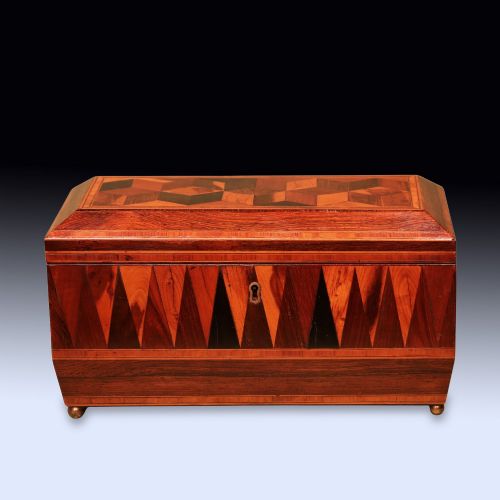
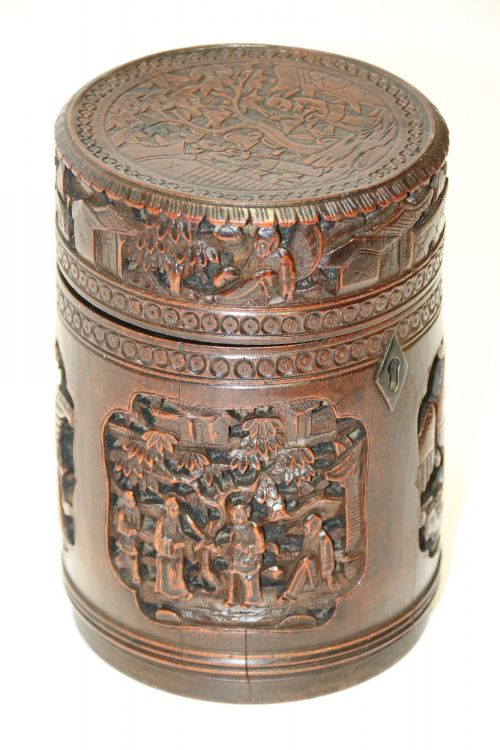
The selections span simple rectangular mahogany boxes alongside sarcophagus-shaped double caddies and intricate Tunbridge Ware mosaics. Regional variations range from English cabinet pieces in walnut and rosewood to carved Chinese bamboo and export items.
Most examples date from the Georgian, Regency and Victorian periods, reflecting a time when tea was a luxury stored under lock and key. Surviving specimens often retain internal compartments, mixing bowls or original canisters made from metal or glass.
Materials and construction
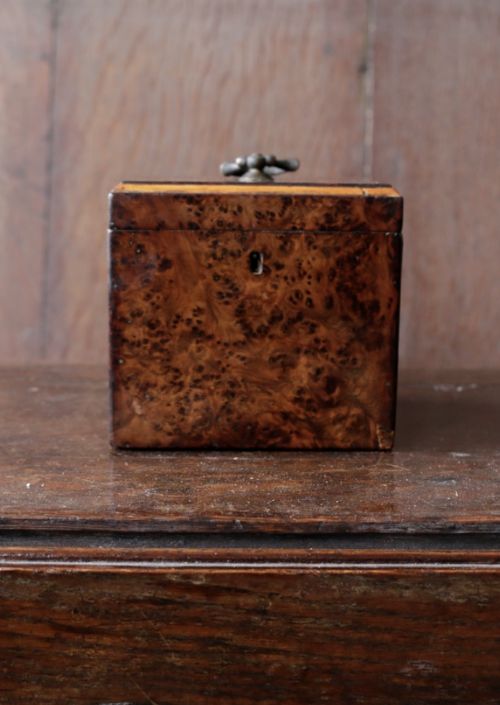
Cabinet makers utilised dense hardwoods including mahogany, rosewood, walnut, satinwood and harewood, frequently applying veneers of burr yew, burr maple or flame mahogany. Decorative surfaces incorporate parquetry, marquetry, shell inlays and ebony stringing to create geometric or pictorial patterns.
Specialised techniques distinguish regional outputs, such as the meticulous mosaic wood cubes characteristic of Tunbridge Ware or the intricate carving found on Chinese bamboo and wooden bodies. Internal fittings combine fitted wooden partitions with brass hardware, bone escutcheons, glass mixing bowls and metal canisters.
Wooden Tea Canister Retail Price Guide 2026
Typical asking prices for wooden tea canister among the pieces listed under this phrase on Sellingantiques today, from the lower quarter to the upper quarter. They describe what is for sale here now, not the wider market.
Period styles represented across the inventory include Georgian, George II, George III, Regency, Qing Dynasty and Victorian.
Gradations in quality
Quality rests upon the selection of timber veneers and the precision of decorative inlays like parquetry, marquetry and shell motifs. Finer pieces demonstrate superior joinery in carcass construction and employ more exotic hardwoods such as burr walnut, tortoiseshell or padouk.
The survival of internal components heavily influences standing, particularly complete sets of interior canisters, original glass mixing bowls and functioning locks with matching keys. Masterwork output is further distinguished by sophisticated architectural silhouettes, such as sarcophagus forms or decagonal shapes.
Henry Hollamby·Gillows
The Wooden Tea Canister Glossary
- Tea caddy
- A small box or chest designed for storing loose tea leaves securely. These containers often featured internal compartments to separate different varieties of tea.
- Teapoy
- A pedestal table or large standing caddy equipped with internal tea storage canisters. They originated during the Georgian period for use in fashionable drawing rooms.
- Parquetry
- A geometric mosaic of wood pieces used for decorative veneer on box surfaces. This technique creates repeating patterns using contrasting timbers.
- Tunbridge Ware
- A distinct form of British woodwork characterised by mosaic designs built from thousands of tiny tinted wood blocks. It takes its name from the town of Tunbridge Wells.
- Sarcophagus form
- A cabinet shape featuring a domed or sloping lid atop a heavy rectangular base, popular during the Regency era. This silhouette emulates classical stone tombs.
Wooden Tea Canister: Frequently Asked Questions
What is a wooden tea canister?
A wooden tea canister is a domestic storage box designed to keep expensive tea leaves dry, fresh and secure.
These vessels utilise dense hardwoods and often feature multiple internal compartments or separate metal canisters for different tea varieties.
How were tea caddies used?
Tea was an expensive commodity in the 18th and 19th centuries, requiring strict household management.
The mistress of the house kept the caddy locked, dispensing the leaves personally for each tea service.
Why do some caddies have glass bowls?
The central glass bowl served as a mixing vessel for blending different tea grades or for washing spoons.
Some examples also incorporated small mixing sticks alongside these glass containers.
How do I identify a Regency caddy?
Regency pieces often display sarcophagus silhouettes, bold rosewood grains, brass lion paw feet and ring handles.
Cabinet makers during this era favoured classical architectural forms and elaborate parquetry work.