




A 2026 Guide by Sellingantiques
Victorian commerce created massive demand for purpose-built workspace seating. Clerks needed posture support for long shifts at ledgers.
Look for patents from the mid-nineteenth century covering tilt and swivel movements. Inventors solved the problem of reaching different parts of a large desk without standing.
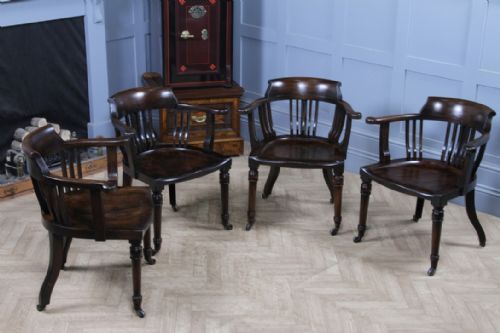
Early forms borrowed heavily from domestic library chairs. Windsor traditions adapted well into sturdy seating for the commercial floor.
Typewriters forced a redesign in antique office chairs. The lack of arms allowed operators to sit close to the keyboard and move freely.
Thomas Warren patented an influential centripetal spring chair in 1849. His iron and velvet designs allowed tilting in any direction.
W.H. Gunlocke Chair Company produced standard wooden office seating from the early twentieth century. Their stamped marks sometimes survive on the underside of the seat.
Try turning the base upside down. Makers often attached brass trade labels to the iron mechanism rather than the timber frame.
The 2026 retail price guide for Antique Office Chairs is drawn from a proprietary archive of over 1.1 million retail prices indexed by Sellingantiques since 2003. This guide relies exclusively on their own internal data; no external sources or auction records are used.
Analysing nearly 25 years of UK antique market history alongside current retail values, the data indicates that typical UK retail prices for Antique Office Chairs range between £400 and £1,300. Entry-level prices generally fall under £400 and premium examples upwards of £1,300.
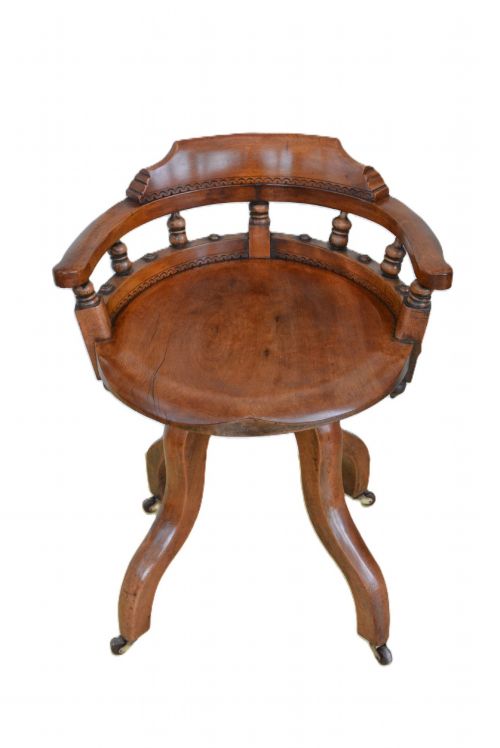
Central threaded columns dictate the height. You simply spin the seat to raise or lower the sitting position.
Check the tension springs under the seat block. They allow the sitter to lean back and return safely upright.
Swept back legs usually splay wider than the seat itself. This footprint stops the user overbalancing when reaching for a dropped pen.
Early examples relied on traditional mortise and tenon joints pegged for strength. Steam-bending later allowed continuous curved armrests out of single ash or elm lengths.
Machine carving replaced hand shaping on mass-produced models. You feel the difference on the underside of a seat where the cutter leaves regular ridges.
Heavy buttoning in leather upholstery requires a strong jute webbing foundation. The craftsman tied the springs individually before building up the horsehair padding.
"Hollowed wooden seats actually promote better posture than flat foam. The carved contours distribute weight evenly over a long shift."
"Many original iron bases retain traces of factory paint finishes. They often highlight the cast maker's marks or patent dates hidden underneath."
"Restoring an original horsehair padded seat keeps a lost trade alive. Traditional upholstery breathes better than modern synthetic padding."
Based on almost 25 years of Sellingantiques UK antique market data, Antique Office Chairs appeared 1558 times (out of 1,100,000 antiques) which gives it a rarity score of 73/100.
This score measures scarcity within the Sellingantiques archive only and is not a survey of the entire antiques market, so these statistics may not be indicative of the general availability of Antique Office Chairs elsewhere.
Most antique office chairs rely on a central threaded rod. You adjust them by physically rotating the seat clockwise or anticlockwise.
Some later models feature a locking collar. You need to loosen this nut before spinning the seat.
A slight rock is standard for seating with tilt mechanisms. The heavy iron springs under the seat lose some tension after decades of daily use.
Check the bolts connecting the iron spider to the wooden frame. Tightening these fixings often resolves excess movement without needing mechanical intervention.
If the central threaded spindle clunks loudly, the iron casing might be worn. Heavy grease sometimes dampens the noise.
Changing broken castors is a standard repair. Most original brass wheels sit on steel pins hammered into the wooden legs.
Modern replacements fit the same socket holes. Sourcing period-correct brass cup castors improves the overall stance and protects wooden floors from old metal edges.
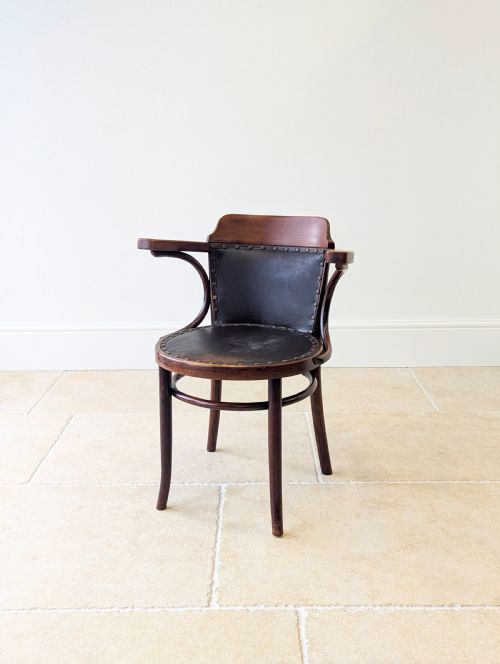
You are describing a typical typist's or operator's chair. The armless design emerged as keyboards became standard in commercial spaces.
Clerks needed freedom of movement for their elbows while typing or operating early telephone switchboards. A low back provides lumbar support while keeping the shoulders unhindered.
These models usually lack the deep tilt mechanism found on a manager's chair. The focus remained on upright task work rather than relaxed reading.
Please note: This Antique Office Chairs guide and its associated pricing data are provided for general informational purposes only. It does not constitute formal financial, investment, or appraisal advice and should not be relied upon as the sole basis for any commercial activity, purchasing, or sales decisions. Sellingantiques.co.uk accepts no liability for any actions taken in reliance on this information. Always consult with a qualified professional or independent appraiser.
