





Antique Ladies Chairs
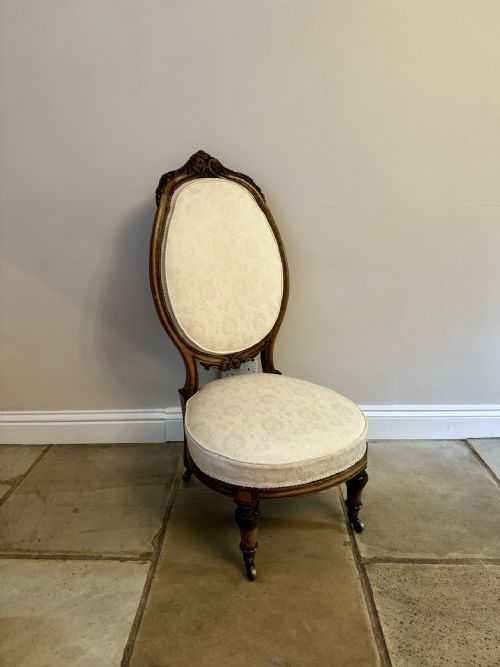
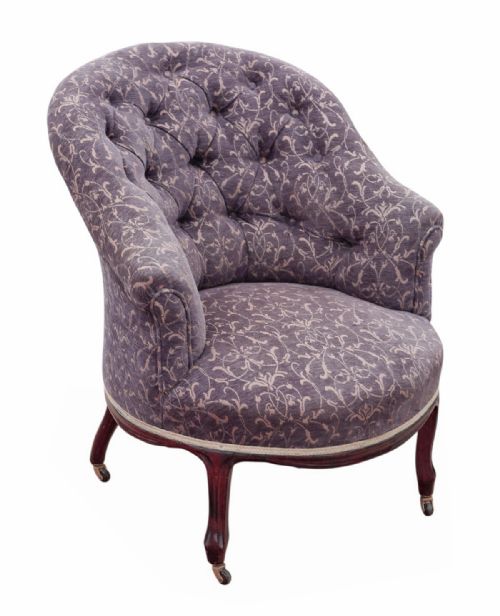
A ladies chair is the low, narrow, usually armless upholstered seat from a Victorian drawing room, made lower than its taller gents companion so it could be sat in wearing full skirts.

Antique Ladies Chairs
The form belongs to the 19th century drawing-room suite. Lighter and lower than the gentleman's chair it was made to sit beside, open at the sides or with short arms, and upholstered on a polished timber show frame. Salon chair, parlour chair and drawing room chair all describe the same thing.
Victorian dominates. The word appears in ninety-nine of a hundred and fifty-five titles, walnut in sixty-nine, and "carved walnut" in twenty-eight, which is why so many descriptions read almost word for word alike. Spoon backs, balloon backs and button backs recur throughout. Mahogany is the second timber, with rosewood behind it.
A quarter of listings are pairs, and dealers name them every way going: ladies and gents, lady and gentleman, his and hers. Multi-piece suites appear too, including a seven-piece walnut cameo back and an eight-piece button back.
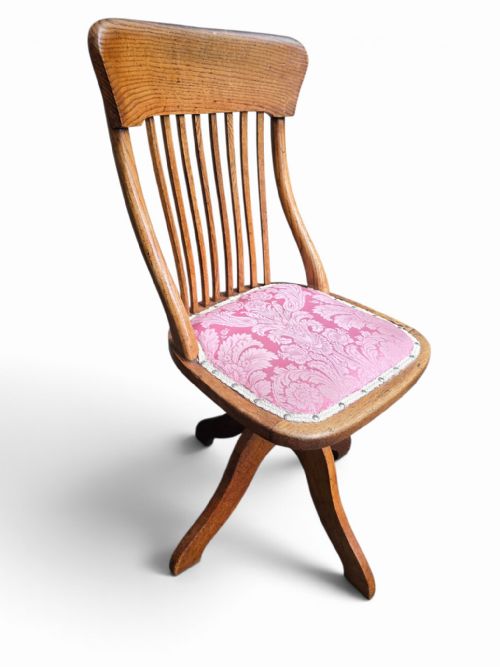
Dating runs from 1770 to 1930, though the 1860s swallow the category with thirty listings. Around one in ten is Edwardian or early 20th century, bedroom, desk and wing forms among them. A small tail sits outside the drawing room altogether: three Orkney chairs with straw-hooded backs, a 17th century oak wainscot chair offered in a ladies or child's size, a French campaign folding chair.
Where The Range Splits
Carving does most of the work. It appears in thirty-six titles, and the carved walnut frames cluster in the upper part of the range while plain mahogany and unspecified frames sit at the bottom. Timber follows the same line, walnut and rosewood upward, plain mahogany down.
A named back lifts a chair above a plain one. Spoon, cameo, shield, balloon and button backs all sit higher in the sample order than listings that say only "ladies chair". Inlay does the same, and the inlaid shield-back Edwardian chairs and a walnut inlaid Victorian example come near the top.
Survival as a pair is the other big divider. Singles are the everyday trade, but matched ladies-and-gents pairs are a quarter of the listings and push upward, with country-house pairs and full drawing room suites at the top of the range.
Antique Ladies Chairs Retail Price Guide 2026
Typical UK retail prices for ladies chairs, calculated from the Sellingantiques database of over a million retail prices indexed since 2003. This retail price guide relies exclusively on Sellingantiques data; no external sources or auction records are used, so the figures do not describe the wider market.
Dates on Sellingantiques ladies chairs run from 1770 to 1930, and the earliest is a George III mahogany lady's wing armchair of about 1770.
The Antique Ladies Chairs Glossary
- Show frame
- The polished timber frame left exposed around the upholstery. Dealers also write showood or showwood for the same thing.
- Spoon back
- A back curved in profile to follow the sitter's spine, named in several titles across the archive.
- Button back
- Upholstery drawn into a pattern of buttons, recurring on both Victorian and Edwardian examples.
- Gents chair
- The taller, wider companion piece to the ladies chair, named in a good number of titles.
- Cameo back
- An oval framed back panel, used here of a walnut drawing room suite.
- Orkney chair
- A Scottish vernacular chair with a hooded straw back, appearing three times in a ladies size.
Antique Ladies Chairs: Frequently Asked Questions
Why are ladies chairs lower than other armchairs?
The type was made for the drawing room in the 19th century, in a lighter, lower form intended to accommodate wide skirts.
It was usually paired with a taller, broader gentleman's chair, so the two read as a set with a deliberate difference in height and width.
Are they usually sold as pairs?
A quarter of listings on Sellingantiques are pairs. The rest are singles, and about half the category is a single Victorian walnut show-frame chair.
Dealers name pairs in several ways: ladies and gents, lady and gentleman, his and hers, ladies and gentlemen's. Full suites turn up too, including seven- and eight-piece drawing room sets.
What timber are most of them made from?
Walnut leads, naming sixty-nine of the titles in the archive. Mahogany is second, and rosewood shows up in a handful of listings.
Carved walnut is the single commonest phrase of all, which is why so much of the category reads almost identically.
What period do they date from?
The dated field runs from 1770 to 1930, but the weight sits firmly in the mid-Victorian years. Thirty listings are dated to the 1860s, the largest single decade by some way.
A third of the dating is a period label rather than a year: forty-nine say simply Victorian, fifteen say only 19th Century. Edwardian and early 20th century pieces account for around one in ten.
Is a nursing chair the same thing?
Nursing chair describes a very low-seated chair, and some titles use it interchangeably with ladies chair.
The same goes for salon, parlour and drawing room chair, three dealer terms for the same reception-room seating.
Which makers turn up in this category?
None consistently. Sixty different dealers have handled a ladies chair on Sellingantiques, and the listings are described by form, timber and period rather than by name.
Around sixteen come up a year, so no single workshop or trade specialism owns the form.