


Antique Corner Chairs
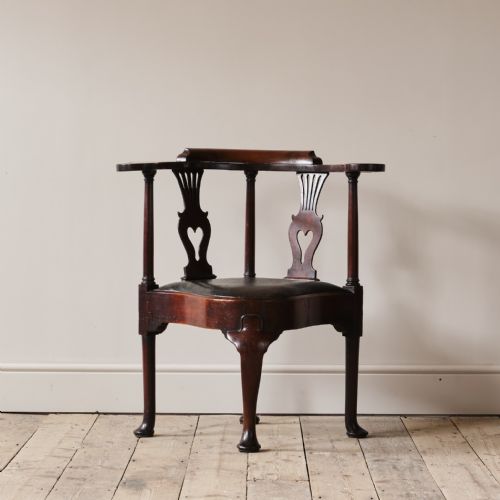
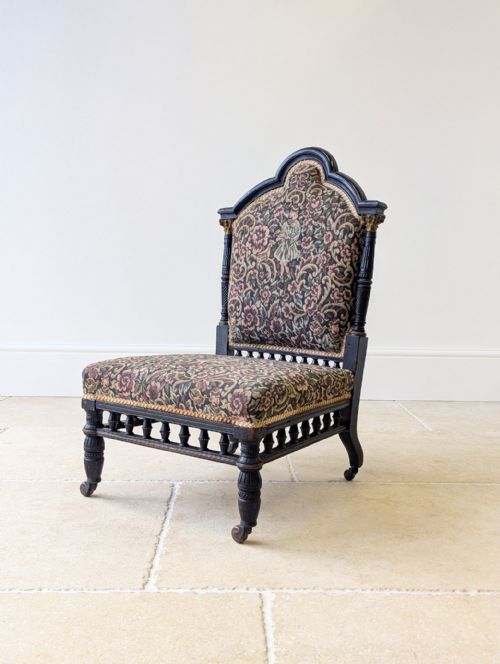
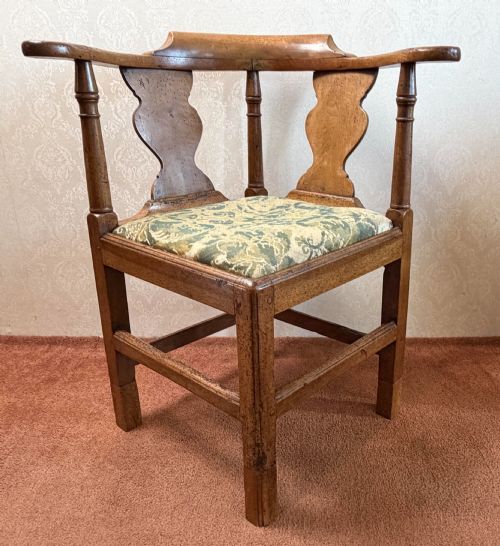
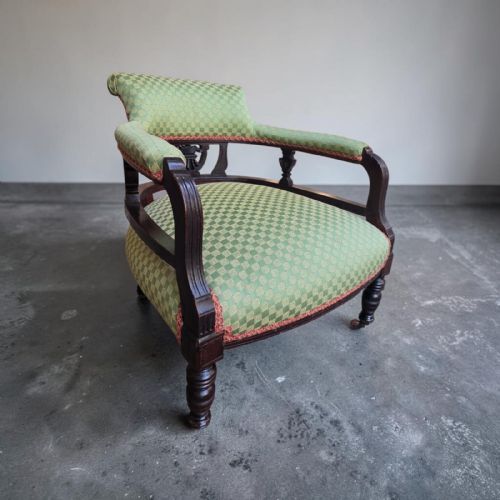
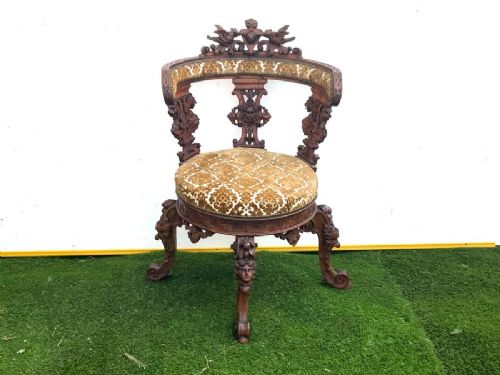
A corner chair is built on the diagonal, its back running round two adjoining sides above a squarish seat set corner-forwards, and it began life as a chair to write, read or sit at a desk in.
Antique Corner Chairs
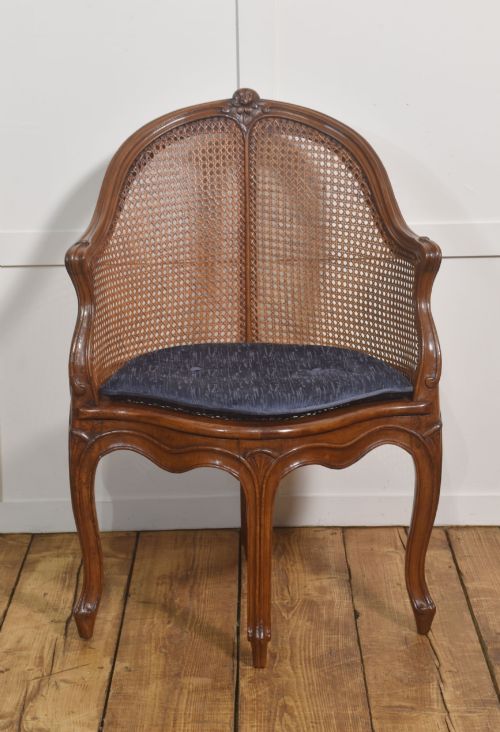
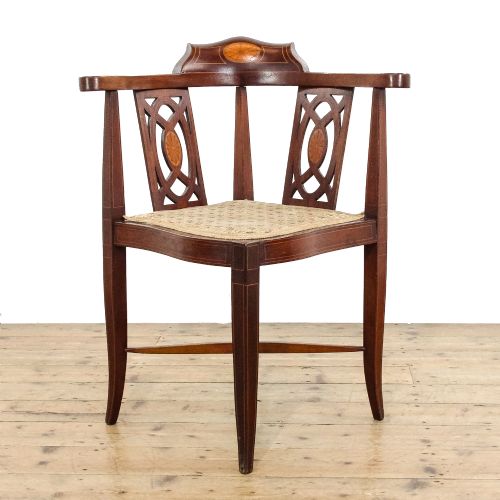
The form is easy to read once you know it. The back turns round two sides of the seat, arms fall to left and right, and one leg stands out at the front while the other three sit at the corners behind. Early eighteenth-century makers built it as a writing, reading or desk chair, so the sitter could straddle a corner. Later it became an occasional and bedroom chair, and it was revived in quantity around 1900.
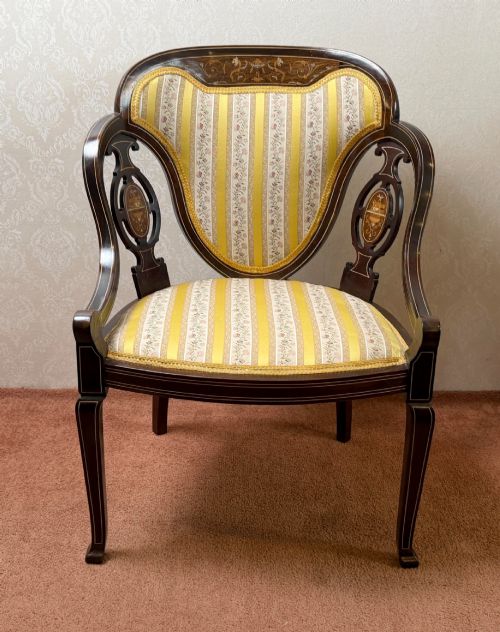
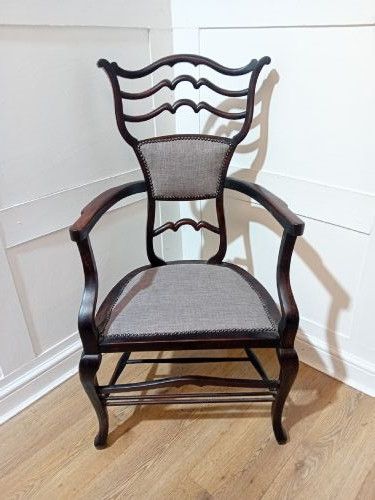
Two quite different populations sit under the heading. One is the solid timber-framed chair in oak, elm, walnut or mahogany, carved or turned, often with a rush seat. The other, and the thing you're most likely to meet, is the lighter Edwardian salon chair in mahogany, commonly described as inlaid. Mahogany leads the titles, with Edwardian and inlaid close behind, and the three words often travel together.
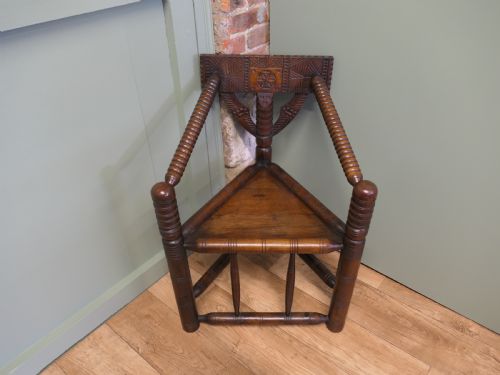
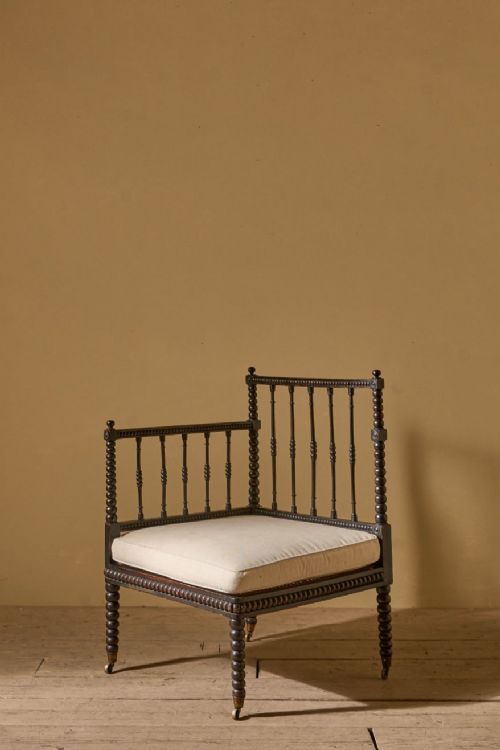
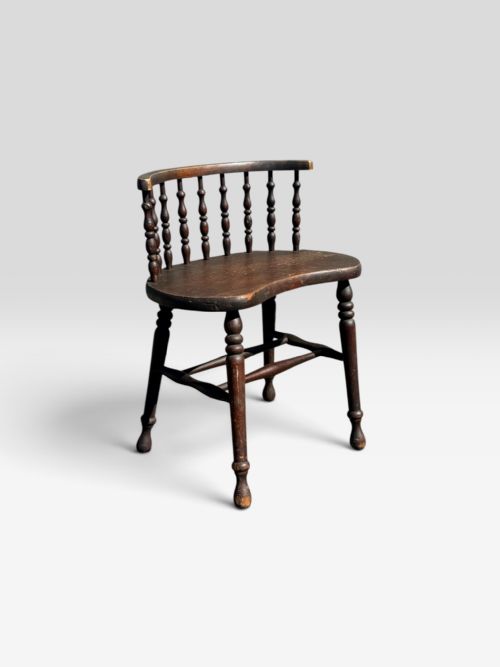
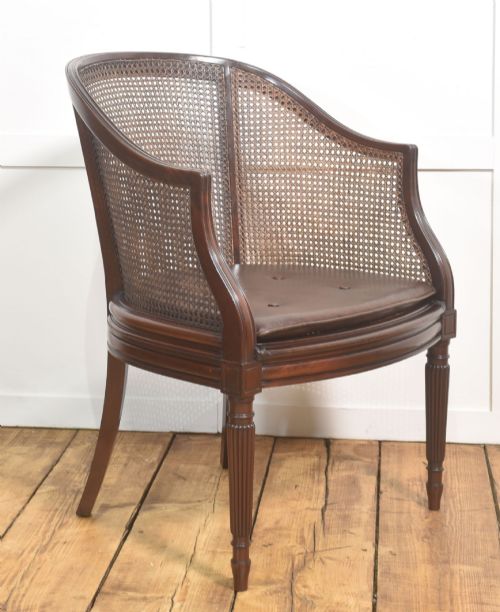
Behind the Edwardian group sits the oak end, carrying the Victorian and country chairs, carved or bobbin-turned, sometimes in elm, ash or fruitwood. Georgian walnut and mahogany desk and reading chairs form a third strand, taking in George I, George II and later George III examples. Bobbin turning runs as its own small tradition, in oak, beech and black lacquer, often with rush or cane seats.
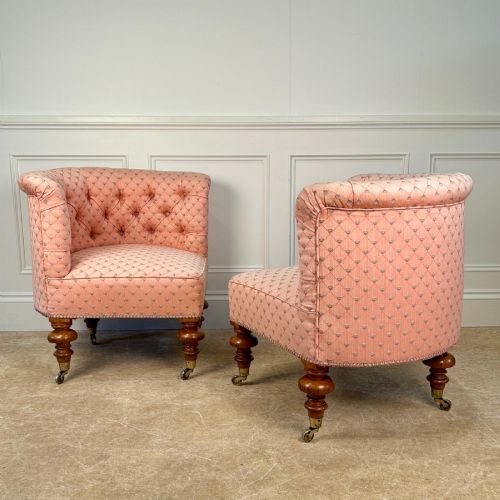
Pairs are a real feature rather than an oddity, appearing in a sixth of titles, with one pair described as clipping together to make a small sofa and a single listing offering a set of four. A persistent minority of listings are adjacent forms sold alongside: tub chairs, turner's or "Old Saxon" chairs, spinning chairs, prie-dieu, lambing and gaming chairs. Dating is often given as a century or a reign rather than a year, and some titles carry a "style" or "revival" qualifier.
Where The Range Splits
Timber and date do most of the work. Walnut clusters at the upper end, in George II red walnut, eighteenth-century English examples and carved Italian walnut, and figured mahogany sits near it. Beech-framed and plainly upholstered chairs sit low. Eighteenth-century and early Georgian pieces occupy the upper reaches; Edwardian inlaid mahogany fills the middle and the bottom.
After that it's labour. Deep carving, figural work, marquetry, parquetry and full bobbin turning all lift a chair well above a plain Edwardian mahogany frame. Carved and inlaid each appear in a substantial share of titles, so the words alone tell you little; what matters is how much of the surface the decoration covers and how far it's cut.
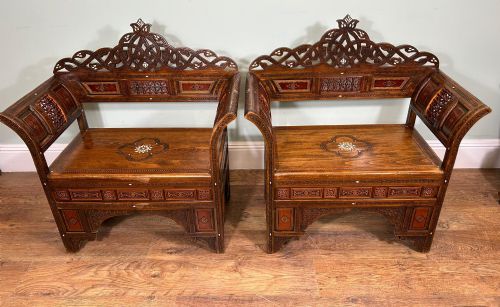
Two chairs beat one. Pairs of Edwardian mahogany, oak and Moorish chairs sit noticeably higher than singles of the same description. Unusual origin does the same, only harder: Chinese export hardwood and rosewood, Damascus and Syrian inlaid armchairs, Levantine parquetry, Italian and Irish work, and the odd desk, reading or gaming chair reach the top.
Antique Corner Chairs Retail Price Guide 2026
Typical UK retail prices for corner chairs, calculated from the Sellingantiques database of over a million retail prices indexed since 2003. This retail price guide relies exclusively on Sellingantiques data; no external sources or auction records are used, so the figures do not describe the wider market.
Titles on Sellingantiques sell the form for at least six jobs: desk chair, reading armchair, dressing seat, bedroom, boudoir and salon chair.
The Antique Corner Chairs Glossary
- Corner chair
- A seat with the back carried round two adjoining sides, one leg standing at the front and the seat set corner-forwards.
- Elbow chair
- An open-arm chair. Nine titles use it for corner chairs with arms rather than the usual word.
- Splat
- The flat vertical board in the back. "Splat back" turns up in the titles.
- Drop-in seat
- An upholstered seat frame that lifts out of the chair rails, as against a rush or cane seat woven into them.
- Bobbin turned
- Legs and stretchers turned as a row of beads. Twenty-one titles use it, often with rush or cane seats.
- Turner's chair
- A chair built almost entirely of turned members, sometimes labelled "Old Saxon" and once "Warwick".
Antique Corner Chairs: Frequently Asked Questions
Why is it called a corner chair?
The seat sits corner-forwards and the back runs round two adjoining sides, so one leg stands at the front. The name describes the geometry of the chair, not a place it was meant to stand.
That shape gave the sitter a corner to straddle with an arm to either side, which is why the early ones were made as desk and reading chairs.
What are most of them made from?
Mahogany leads by a wide margin in the titles, usually Edwardian and usually described as inlaid. Oak comes next and carries the Victorian and country chairs.
Walnut appears in a smaller group, mostly Georgian, and elm, ash, beech and fruitwood turn up in the country end. A few bobbin-turned examples are in black lacquer.
How old are corner chairs on the market?
The dated field runs from 1700 to 1930. The earliest sampled pieces are an Italian carved walnut audience armchair of 1700 and a walnut corner chair given as circa 1710.
Victorian and Edwardian lead the period labels, with broad "19th Century" and "18th Century" buckets behind them. Fewer than a third of listings carry a clean year, so a century or a reign is the usual answer.
Do corner chairs come in pairs?
More often than the name suggests. Two chairs are offered in a sixth of titles, and pairs sit noticeably higher in the range than singles of the same description.
One pair was described as clipping together to form a small sofa. A set of four appears once.
What else gets sold as a corner chair?
Tub chairs, turner's or "Old Saxon" chairs and upholstered occasional chairs make up a persistent minority of the listings.
One-offs include a prie-dieu prayer chair, a child's lambing chair, a gaming chair in mahogany and red leather, a spinning chair, a Burgermeister's chair and a Dutch-style dolls chair dated 1796.
How many turn up for sale each year?
Around thirty-seven come to market on Sellingantiques in a year.
A hundred and twenty separate dealers have listed one, so the form is spread thinly rather than held in depth by a few specialists.