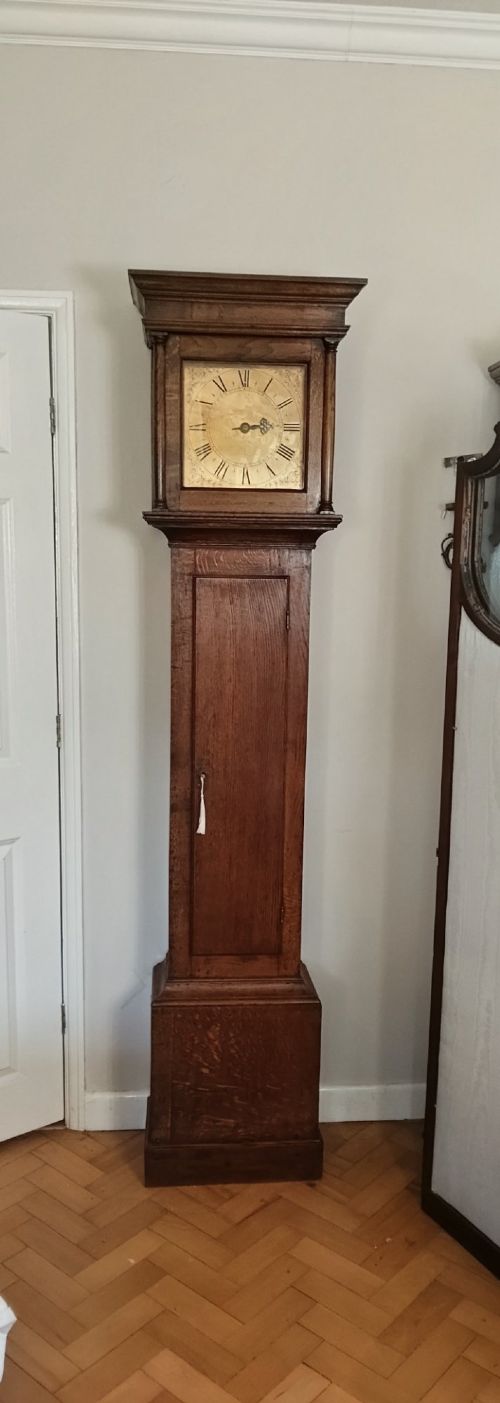
Heydays Antiques has dated this Oak Longcase Grandfather Clock to the Georgian era.
Durham, Staffordshire, Devon, Somerset, Scotland, Wales and also abroad like Amsterdam.

Thomas Herbert (Whitehall) CC 1676 is listed as being ‘Clockmaker to the King’ and in 1703 petioned the Queen for payment of arrears of monies owed for restoration of the late King’s clocks in 1701-2 and recieved £79.

There is no Clockmakers specifically listed working out of Haversham. Which now is part of Milton Keynes, Buckinghamshire. There was a clockmaker called Henry Harbert who moved from Hackney to Chesham also Buckinghamshire.

This clock is fitted with a W Francis of Birmingham ‘False Plate’. These were used to allow different Dials to be fitted to different movements, clock being more factory manufactured than earlier clock. William Francis was working between 1810 and 1831 and was succeeded by his wife Sarah.

The Small Oak Case is in Good Solid Condition with Attractive Tiger Graining & Patination typical of Early 19th Century Clock Cases. Being of Small Size of only 73.75in or 187.5cm with Long Trunk Door with Shaped Top and Raised on a Straight Plinth.
The 8 Day Bell Striking Movement with Good Quality Enamel Dial with Attractive Floral or Harvest & Geometric Coloured Decoration to the 4 Corners. Fully working Date Aperture & Seconds Chapter Ring.
Heydays Antiques has dated this Oak Longcase Grandfather Clock to the Georgian era.
Specialising in personal attention for 17/18/19th c traditional longcase clocks & early 20th c triple weight quarter chiming musical clocks
You can view the stock and full dealer information on the Heydays Antiques Profile Page

Herbert of Haversham Oak Small Grandfather Longcase Clock