


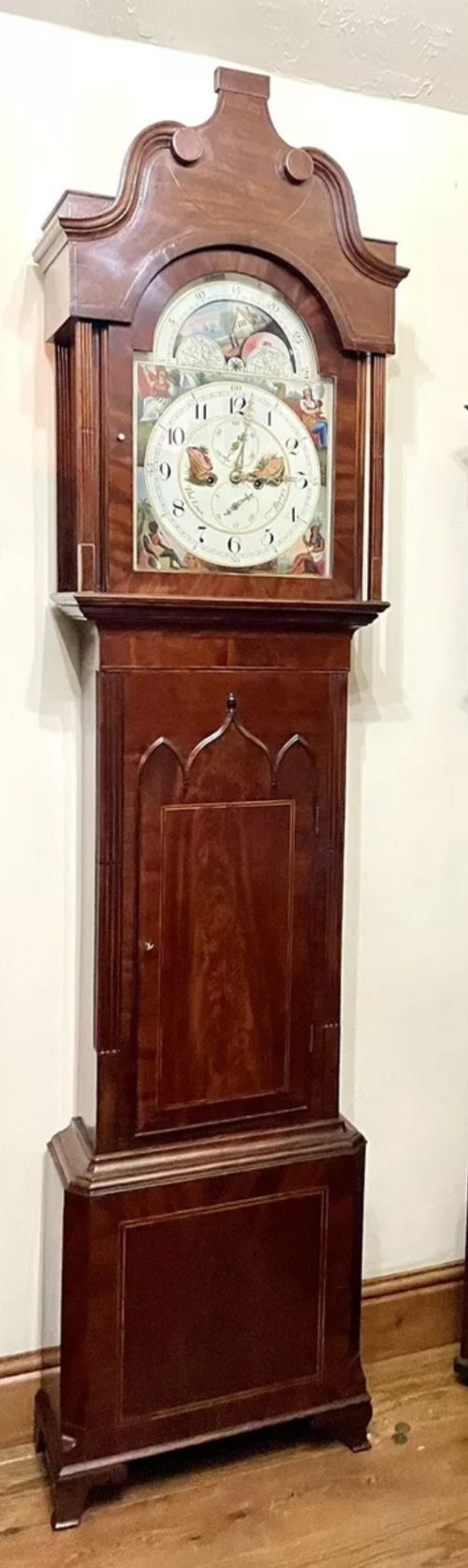


Moon Phase Clocks
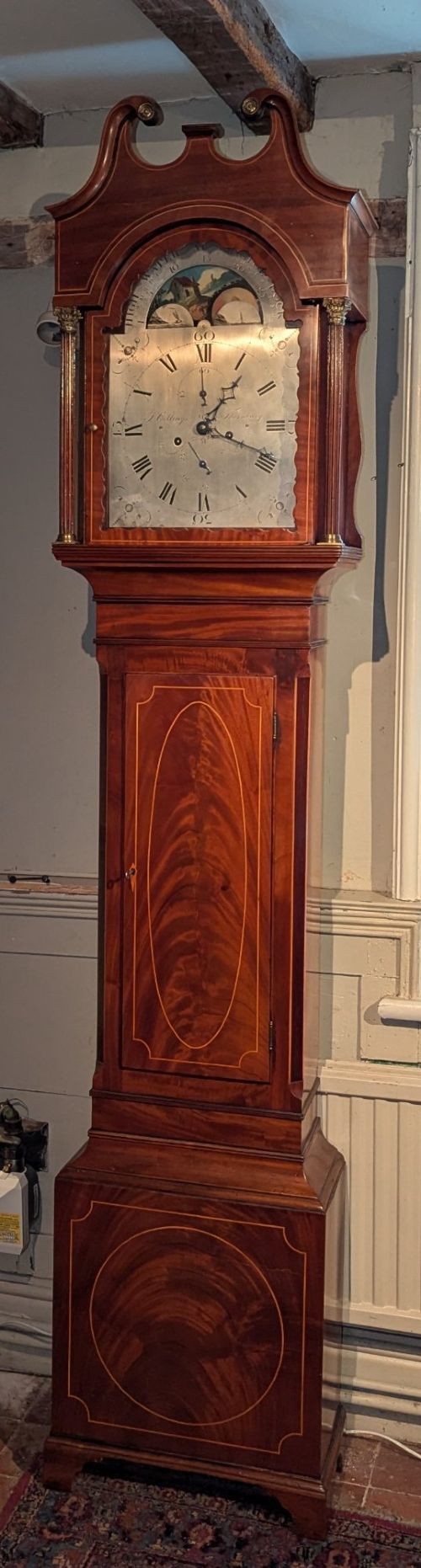
A moon phase clock is a clock with a rotating lunar disc in the arch of its dial, showing the age and phase of the moon for judging tides and travelling by night.

What Are Moon Phase Clocks?
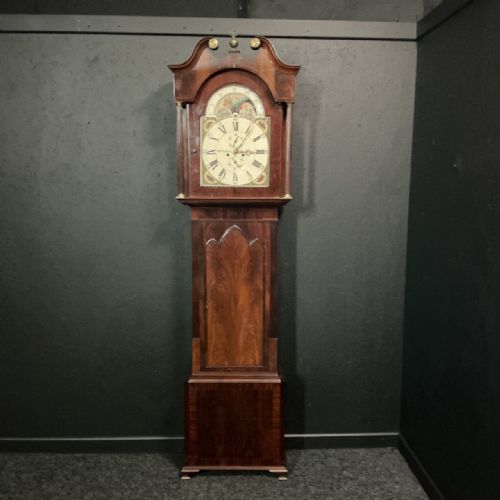
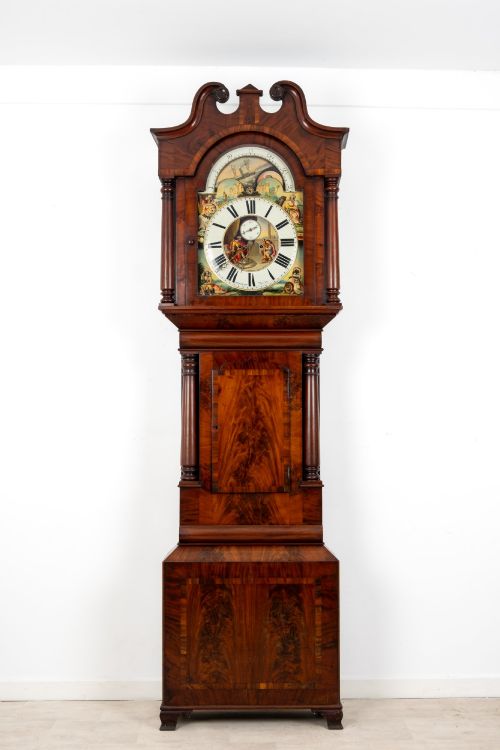
Almost all of them are English longcase clocks, the sort usually called grandfather clocks. Of the 88 listings on Sellingantiques, 69 titles say longcase and 33 say grandfather, and the cases are mahogany or oak, often described as both in the same title.
The lunar disc turns in the arched top of the dial, above the hours. Dealers name it six different ways across titles: moon phase, moon dial, rolling moon, moon roller, penny moon and Halifax moon. They all describe the same idea, a disc marked with the moon's face and its progress through the month.
Longcase clocks with lunar work were made from the late 17th century onward, and the moon disc became common on English provincial clocks through the 18th and early 19th centuries. Titles here tend to name a maker and a town rather than a case style. Bristol appears in nine of them, with Halifax, Liverpool, Manchester, Nantwich, Newcastle, Plymouth and Chester among the rest.
A small remainder are different objects that happen to show the phases: French carriage clocks, a garniture set built round a penny moon dial, a four-glass mantel regulator, a slate perpetual calendar, and one ebonised verge bracket clock with alarum. Reign labelling leans Georgian, with 19 listings given simply as Georgian and 15 as George III.

Where The Range Sits
Case timber does much of the work. Figured and inlaid mahogany, and carved oak, sit above plain oak, and the descriptions that reach highest in the sampled range are carved or figured mahogany. Titles mentioning fan inlay, Tunbridgeware-style inlay and carving cluster in the upper part.
Movement duration separates the ends cleanly. Eight-day runs through the middle and upper part of the range, while the one clock described as thirty-hour, wound daily, sits at the very bottom. Where duration is given at all, eight-day is the norm.
Beyond that, extra work pushes upward: musical trains, nine-tube chiming, bells, grand sonnerie, repeating, seconds and date dials, perpetual calendar and equation of time all appear among the highest-priced titles. A signed dial with a named town also sits above anonymous, and the two London-signed clocks and one attributed to a Lancaster cabinetmaking firm sit well up the range.
Retail Price Guide 2026
Typical UK retail prices for moon phase clocks, calculated from the Sellingantiques database of over a million retail prices indexed since 2003. This retail price guide relies exclusively on Sellingantiques data; no external sources or auction records are used, so the figures do not describe the wider market.
1800s is the period label used most for moon phase clocks on Sellingantiques, with Georgian next and 18th Century third.

The Moon Phase Clocks Glossary
- Longcase
- The tall floor-standing case. Titles use longcase, long case and grandfather for the same thing, sometimes two of them at once.
- Moon dial
- The rotating lunar disc, usually set in the arch above the main dial. Also written moon phase, and described by its motion as a rolling moon or moon roller.
- Eight-day
- A movement that runs a week and more on one winding, and the usual specification where duration is stated. Thirty-hour movements are wound daily and appear once in the titles.
- Painted dial
- An iron dial with painted decoration, as against a brass one. Both turn up in titles across the category.
- Penny moon
- A small moon aperture roughly the size of a penny, named in three listings, one of them a French garniture.
- Halifax moon
- A moon shown through twin apertures behind a shaped plate, named once in the samples.
Frequently Asked Questions
How many come up for sale each year?
Around eleven a year come to market on Sellingantiques, and 29 different dealers have listed one, so no single stockist defines the category.
The archive runs to 88 listings in total.
What does the moon disc actually show?
It shows the age and phase of the moon, turning through the lunar month in the arch of the dial.
Before street lighting that was practical information, useful for judging tides and for deciding whether a night journey was worth making.
Are these all English?
The great majority are English longcase clocks signed for provincial makers and towns. Bristol leads the signatures with nine titles, none of them in current stock.
A small handful are French or continental: carriage clocks, a garniture, a four-glass mantel regulator and a slate perpetual calendar with equation of time.
What period do they date from?
The dated field spans 1750 to 1960, though only 36 of the 88 listings carry a clean year. Much of the labelling is broad rather than exact, with 23 under 1800s and 12 each under 18th and 19th century.
Georgian and George III labels dominate the archive, against three Victorian and one Regency. The live stock leans away from the Georgian end.
Do any date from the 20th century?
Three do. All are mid-20th-century French-style carriage clocks dated 1960, each with moon phase work, and they form the only 20th-century group in the archive.
Everything else sits in the 18th and 19th centuries.
Which unusual examples have appeared?
A few things turn up once and nowhere else. An ebonised verge bracket clock with phases of the moon and alarum, and a musical longcase, are both one-offs.
So is a miniature longcase regulator. At the very top of the sampled range sits a carved mahogany case with nine-tube chiming.