





Antique Spelter Clocks
A mantel clock with its case or figure cast in spelter, a zinc alloy patinated or gilded to look like bronze, made to sit on a chimneypiece.
Antique Spelter Clocks
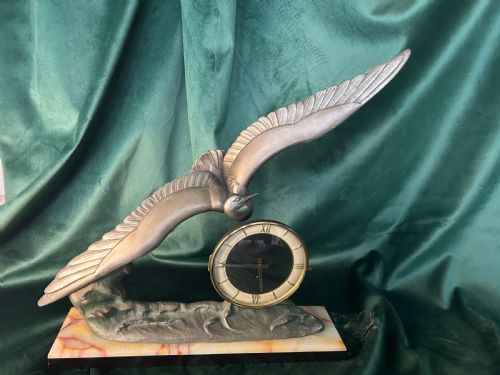
Spelter is cast zinc alloy. It came into wide use for decorative clock cases and figures in the second half of the 19th century, giving the look of bronze sculpture at a much lower cost, and it stayed a standard material for mass-produced mantel and figural clocks into the Art Deco years.
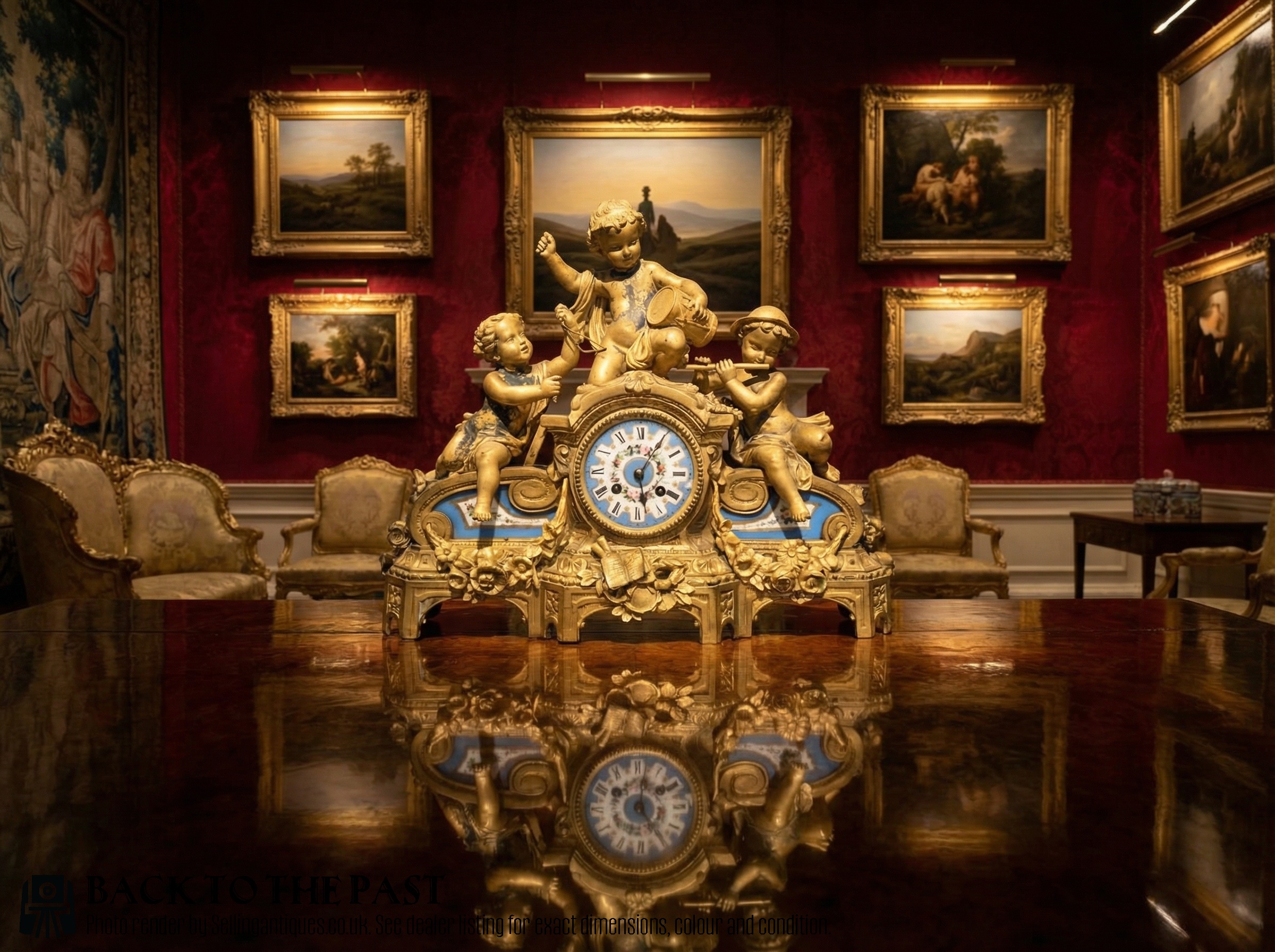
The form you are most likely to meet is a French mantel clock with a figure or figure group, standing on a marble, rouge marble or onyx base. 'French' appears in over half the titles on Sellingantiques, and marble, rouge marble or onyx in seven of the twenty-six sampled.
The archive falls into two waves with little between them. Roughly half is 19th-century French figural work, labelled 19th Century, Victorian or by decade in the 1860s to 1880s. About a third is Art Deco figure groups from the 1910s to 1930s, with the dated field running 1860 to 1930.
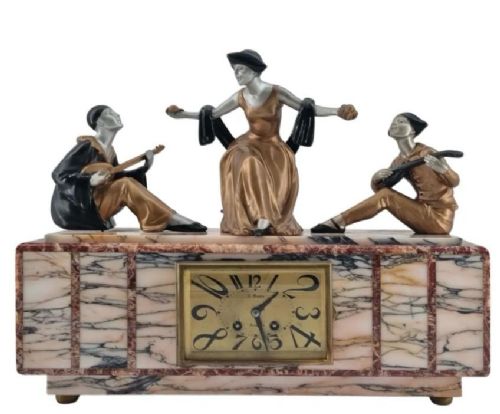
Sets are common: garniture, three-piece or clock set wording covers seven or eight of the sampled listings, meaning the clock arrives with matching side pieces. Subjects named in titles get specific, from Pierrot and Columbine and the sea-goddess Amphitrite to a Roman chariot race and an elephant with tigers. One-offs include a mystery clock, an illuminated clock with a vase lamp, and a spelter and marble centrepiece.
The Range
Completeness does most of the work. Clocks sold with their matching side pieces sit disproportionately in the upper half of the range, and the very top of the archive is an Art Deco elephant clock set rather than a single case. A clock that has lost its garniture reads as a clock; a set reads as a scheme for a chimneypiece.
Named modelling lifts a piece too. A handful of titles cite a sculptor or a foundry, and those cluster from the middle of the range upward, though no name appears from more than one dealer and some are given only as 'after' another sculptor's composition. Scale pulls the same way, with 'large and imposing' wording attached to pieces near the top.
Then the stone. Onyx turns up only three times and each time in the upper half, while plain marble and rouge marble are the usual partners and occur lower down. Mechanical or lighting novelty also carries weight: the mystery clock and the illuminated clock both sit above the middle.
Antique Spelter Clocks Retail Price Guide 2026
Typical UK retail prices for spelter clocks, calculated from the Sellingantiques database of over a million retail prices indexed since 2003. This retail price guide relies exclusively on Sellingantiques data; no external sources or auction records are used, so the figures do not describe the wider market.
About three spelter clocks are listed on Sellingantiques each year, and 18 different dealers have listed one - close to one dealer per clock.

The Antique Spelter Clocks Glossary
- Spelter
- Cast zinc alloy, patinated or gilded to resemble bronze. It is the defining material of the category, and bronze is named in only one mixed-material title.
- Mantel or mantle clock
- A clock made to stand on a chimneypiece. Both spellings appear in titles, and one or the other covers a third of them.
- Garniture
- The side ornaments sold with the clock as a set, usually urns, candelabra or figures. A three-piece clock set is the clock plus a matching pair of side pieces.
- Figural
- A case that incorporates a modelled figure or figure group. This is the commonest specific type in the archive, in both the 19th-century and Deco waves.
- Rouge marble
- Red-veined marble used for bases and plinths. Onyx, a banded stone, does the same job in a smaller number of listings.
- Mystery clock
- A clock where the movement or motion is concealed, so the mechanism is not apparent. One appears in the archive.
Antique Spelter Clocks: Frequently Asked Questions
Is spelter the same as bronze?
No. Spelter is cast zinc alloy, finished with a patina or gilding so it takes on the appearance of bronze sculpture.
It was adopted for decorative clock cases and figures in the second half of the 19th century because it gave that look at a fraction of the cost of bronze.
How old are these clocks?
The dated field on Sellingantiques runs from 1860 at the earliest to 1930 at the latest, with 18 of 26 listings carrying a clean year.
The dating is often broad rather than exact. '19th Century' is the single most common label, with 'Victorian' and 'Circa 1870' alongside decade tags.
What does garniture mean in the title?
It means the clock came with matching side ornaments, typically urns, candelabra or figures, and is being offered as a set.
Garniture, three-piece or clock set wording appears in seven or eight of the twenty-six sampled listings, so sets are a regular part of the category rather than an exception.
Are most of these French?
The majority are. 'French' appears in more than half the titles, and no other country of manufacture shows up in the archive.
About a third of titles are explicitly Art Deco, and those form the later of the two period clusters.
What subjects do the figures show?
They get oddly specific. Titles name Johannes Gutenberg and the invention of printing, Pierrot and Columbine, the sea-goddess Amphitrite, and a Roman chariot race called 'Course Romaine'.
An elephant with tigers or panthers appears as an Art Deco group, and that set sits at the top of the range.
How often do spelter clocks come up for sale?
About three a year across this marketplace.
Eighteen different dealers have listed one, which is close to one dealer per listing, so no single seller dominates the category.