



Antique Banjo Clocks
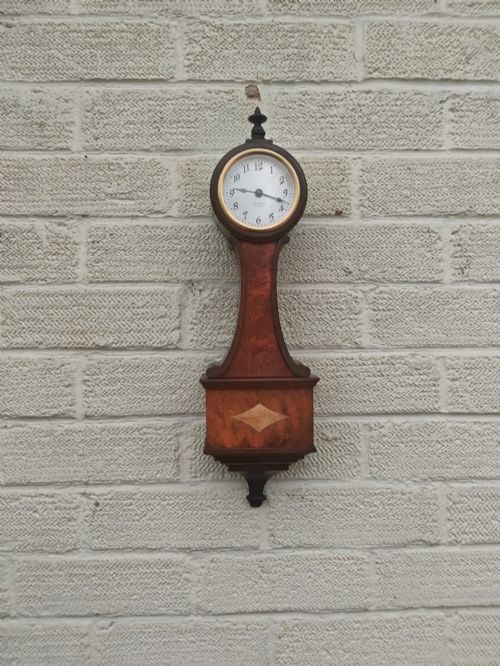
A wall clock whose case runs from a round dial down a narrow waist to a wider base, made as a compact alternative to a floor-standing movement.

Antique Banjo Clocks
The shape does the naming. A circular dial sits at the top, the case tapers through a throat, then widens into a box base, and the whole thing hangs on the wall. That outline appeared around the turn of the nineteenth century, and it was taken up as readily for barometers as for clocks.
Which is why the heading here covers more than timepieces. Of the seven listings recorded on Sellingantiques, four pair a clock with a barometer in one banjo case, and one of those adds a thermometer as well. The combination wall instrument is the version you are most likely to meet.
The remaining three go their own ways: a small 8-day wall clock, a French grandfather clock whose trunk is described as banjo-cased, and a single clock wheel sold as a component rather than a going clock. Six dealers account for the seven pieces, so almost every one came from a different source.
Dating is thin. Only three of the seven carry a clean year, and the dealer-entered dates run from 1800 to 1900, with two entries saying no more than "19th Century" and one giving Regency as a style label in place of a date. Read it as a nineteenth-century category with one entry touching 1900.
Where The Money Sits
A name on the dial separates the top from everything else. The two highest listings in the group are the two that carry a maker's name, one of London and one of Liverpool, and they sit well clear of the rest of the sample.
After that it is how much the case is doing. The combination instruments, clock with barometer, take the upper half of the range, while the plain 8-day wall clock sits at the bottom. Carved oak is the only case timber any title names, and that piece sits above the plainer wall pieces.
One listing is a single toothed wheel from a movement rather than a clock at all. It is sold on its own merits as a component and cannot be read against complete pieces on any of these counts.
Antique Banjo Clocks Retail Price Guide 2026
Typical UK retail prices for banjo clocks, calculated from the Sellingantiques database of over a million retail prices indexed since 2003. This retail price guide relies exclusively on Sellingantiques data; no external sources or auction records are used, so the figures do not describe the wider market.
Carved oak is the only case timber any banjo clock title on Sellingantiques bothers to name.
The Antique Banjo Clocks Glossary
- Banjo case
- A round dial above a narrow tapering waist and a wider base, made to hang on a wall.
- Clock/barometer
- One wall case carrying both a timepiece and a barometer; four of the seven listings recorded are this pairing.
- 8-day
- A movement that runs a week or more between windings.
- Carved oak
- The only case timber named in any of these titles, and the piece described that way sits above the plainer wall clocks.
- Clock wheel
- A single toothed gear out of a movement, offered as a part rather than a working clock.
- Regency
- A style period, used in a dealer's dated field in place of a year.
Antique Banjo Clocks: Frequently Asked Questions
Why do so many listings include a barometer?
The banjo outline was adopted for wall barometers as readily as for clocks, so combination instruments in that case shape are common.
Four of the seven pieces recorded pair a clock with a barometer, and one of those four adds a thermometer set into the case as well.
How often do these come up for sale?
Around seven pieces in total have passed through on Sellingantiques, which is a trickle rather than a supply.
Six different dealers account for those seven, so almost every piece has come from a separate source. This is a category you wait for.
What period are they from?
The dealer-entered dates run from 1800 at the earliest to 1900 at the latest.
Only three of the seven carry a clean year. Two say just "19th Century", one says "1800s", one "1900s", and one gives Regency as a style label instead of a date. One is undated altogether.
Can a grandfather clock be a banjo clock?
One French floor-standing clock in the group is described as having a banjo-cased trunk, so the term follows the case shape rather than the wall mounting.
It appears once and nowhere else, and it is the only floor-standing piece recorded.
What makes some examples cost far more?
A maker's name on the dial. The two highest listings are the two that name one, one of London and one of Liverpool.
Beyond that, the combination clock-and-barometer pieces sit above the plain timepiece, and the one case described as carved oak sits above the plainer wall pieces.
Are parts sold separately in this category?
One entry in the archive is a single clock wheel rather than a complete clock, attributed to a High Street, Bloomsbury address.
It is sold as a component on its own merits, so it sits outside any comparison with the working clocks.