


Antique Skeleton Clocks
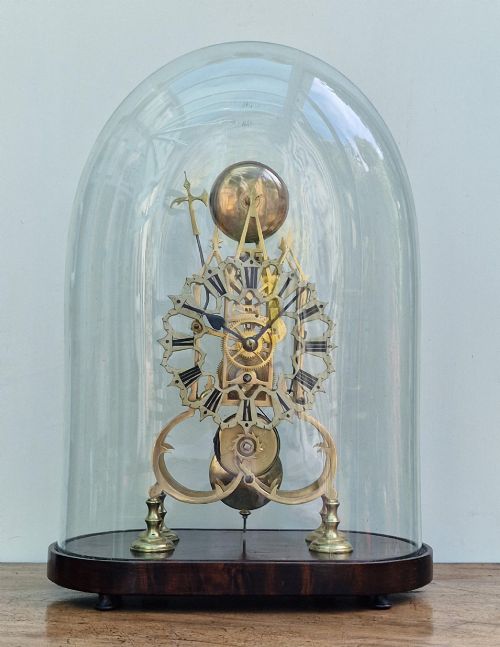
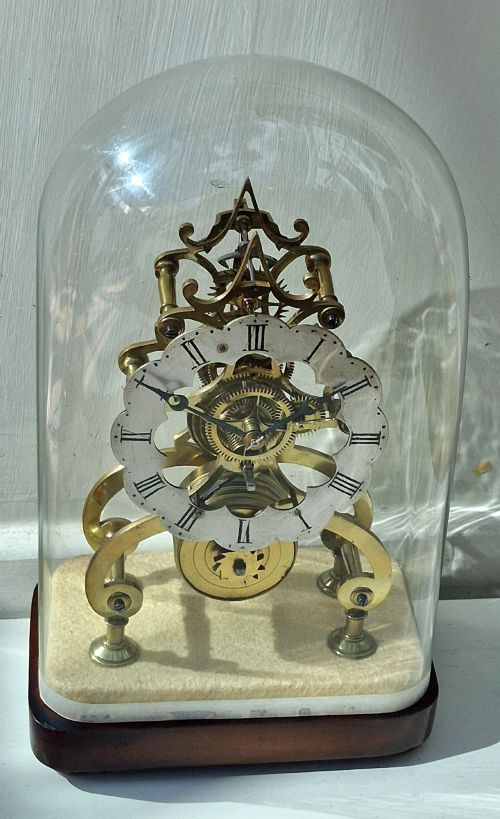
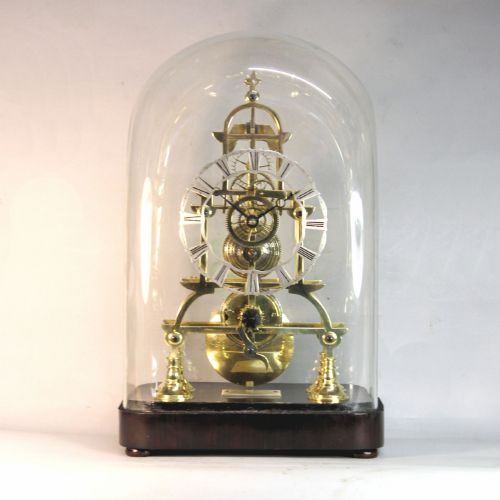
A skeleton clock is a clock built with its movement left open to view, the frame plates pierced or shaped so the wheels can be watched, standing on a plinth under a glass dome on a mantel or library table.
What Are Skeleton Clocks?
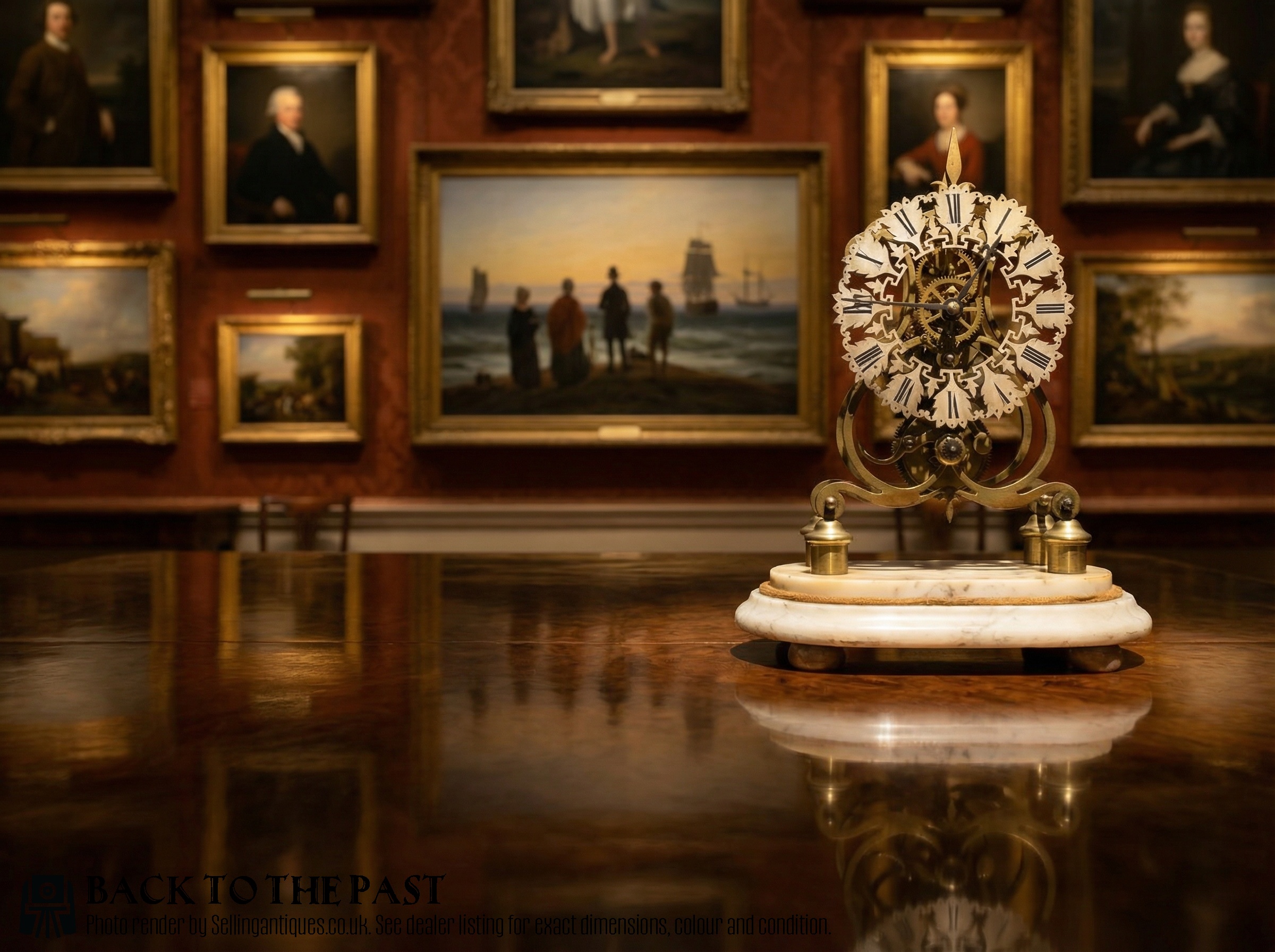
The form goes back to the late 18th century, when clockmakers began cutting the plates away so the wheelwork became the decoration. It settled into an English domestic and exhibition piece through the middle decades of the 19th century, and that is what fills this heading on Sellingantiques: small brass-framed mantel and library clocks, fusee-driven, running eight days.
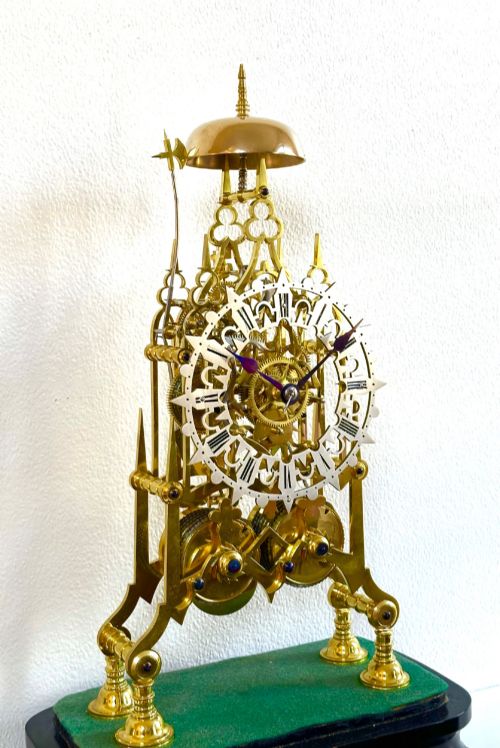
The one you are most likely to meet is a Victorian single-fusee timepiece. Fusee is named in around a third of titles and Victorian in about the same share, and single-train examples outnumber double-train ones by roughly two to one. A single fusee keeps time without counting the hours, though many carry a passing strike, one blow on a bell.
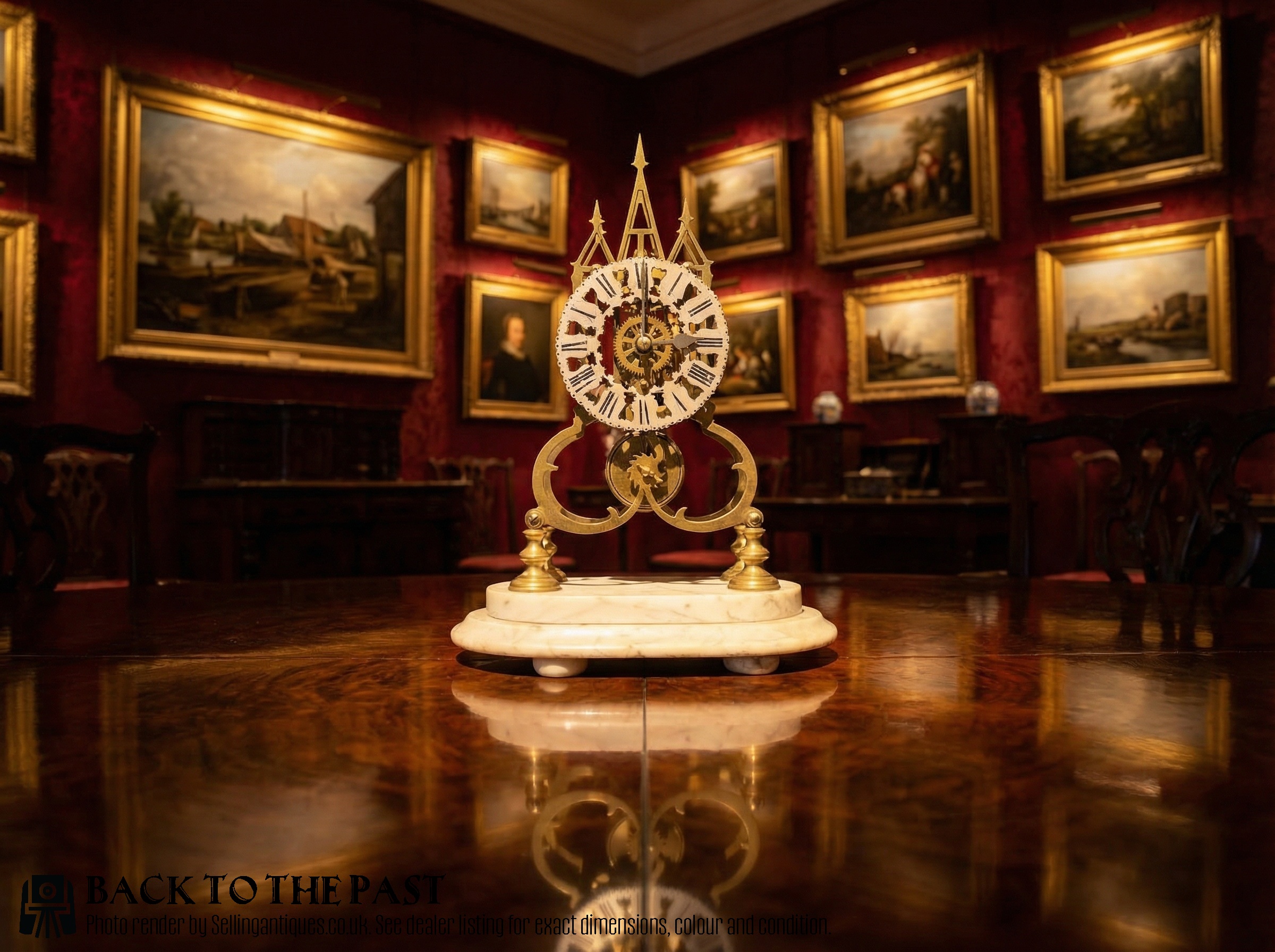
Above that sit the double-fusee striking clocks, some repeating, and the frames built as named monuments. Cathedral and memorial models turn up as a recurring minor strand, along with lyre-shaped plates and frames simply described as architectural. Smaller groups include miniature and French timepieces, where alarm work is a French speciality in these listings.
Dating tends to be a bracket rather than a year. Victorian is entered on its own for 43 listings and 19th Century for 25, against 15 for the busiest decade, the 1870s. Pre-1840 material is close to absent. A second cluster sits in the 20th century, where the same heading carries open-framed, electric and torsion clocks under glass.

Range And Ambition
Trains and complication set the first rung. Plain single-fusee timepieces cluster through the middle of the range, while double-fusee striking, repeating work, alarm, chiming and the one example fitted with a music box all sit above them. What the clock does is priced before what it looks like.
Frame design does the rest of the lifting. A plain scroll frame is the baseline; the cathedral models, the Scott memorial, Great Exhibition frames, lyre and Lyle-shaped plates all push upward. A signature and a place name on the movement lifts a clock into the upper half, and every one of those signatures in these listings is a one-off rather than a familiar workshop.
At the very top come the escapement oddities: a coup perdu detent escapement, a helical balance spring, a seconds dial, six-spoke wheelwork, a miniature English fusee running on a platform escapement. Originality of the dome and plinth is priced in throughout, which is why titles say under the original dome or original marble plinth.
Retail Price Guide 2026
Typical UK retail prices for skeleton clocks, calculated from the Sellingantiques database of over a million retail prices indexed since 2003. This retail price guide relies exclusively on Sellingantiques data; no external sources or auction records are used, so the figures do not describe the wider market.
Skeleton clocks have been listed on Sellingantiques since 2007.
The Antique Skeleton Clocks Glossary
- Fusee
- A spiral-grooved drum with gut or chain drive that evens out the pull of the mainspring as it unwinds. Named in 52 of the titles here.
- Single fusee
- One train only, so the clock keeps time but does not strike the hours. Often paired with a passing strike, a single blow on a bell.
- Double fusee
- Two trains, one for going and one for striking the hours.
- Timepiece
- The trade term for a clock with no strike at all. It appears in nine titles.
- Dome
- The glass cover the clock stands under, sometimes square rather than round. The plinth beneath it turns up in marble, rosewood, burr walnut and mahogany.
- Lyre plates
- Frame plates shaped like a lyre, one of the recurring named frame outlines alongside the cathedral and memorial models.
Frequently Asked Questions
Do skeleton clocks strike the hours?
Some do. Double-fusee examples have a second train for striking, and repeating versions appear among them.
Many do not. Single-fusee clocks outnumber double by roughly two to one in this archive, and a good number of those are described as timepieces, meaning no strike at all. Between the two sits the passing strike, one blow on a bell at the hour rather than a counted strike.
What period do most of these come from?
The dated listings run from 1820 to 1960, but the weight falls in the mid-to-late 19th century. Where decades are given, the 1870s lead, followed by the 1850s and 1860s.
Dating is often loose. Victorian on its own covers 43 listings and 19th Century another 25. Titles using early or early Victorian generally mean the 1840s and 1850s rather than anything earlier.
Why are some called Lichfield Cathedral or Scott Memorial?
Those are frame models. Victorian makers built skeleton frames as miniature buildings and monuments, and the names stuck as model names rather than maker names.
Cathedral frames, the Scott memorial and Great Exhibition frames all appear in these listings, along with lyre-shaped plates. They form a small but steady strand, and they sit toward the upper part of the range.
Are French skeleton clocks listed too?
Yes, as a handful. They show up as miniature and small French skeleton timepieces.
Alarm work is where they concentrate. Every alarm-fitted skeleton timepiece in the samples is French, miniature, or both.
How many skeleton clocks come up for sale?
Around 20 a year on Sellingantiques, spread across 38 dealers. No single dealer defines what turns up.
The archive holds 158 listings in all, 79 of them carrying a clean year.
What unusual types appear under this heading?
Genuine oddities surface once each: a torsion year clock, a rolling ball clock, a great wheel clock complete with dust cover, a skeleton wall clock, an acrylic-framed one and a music-box example.
The 20th century brings its own group. Open-framed, electric and torsion clocks under glass account for roughly one in six of the dated listings, clustering in the 1920s, 1950s and 1960s.