
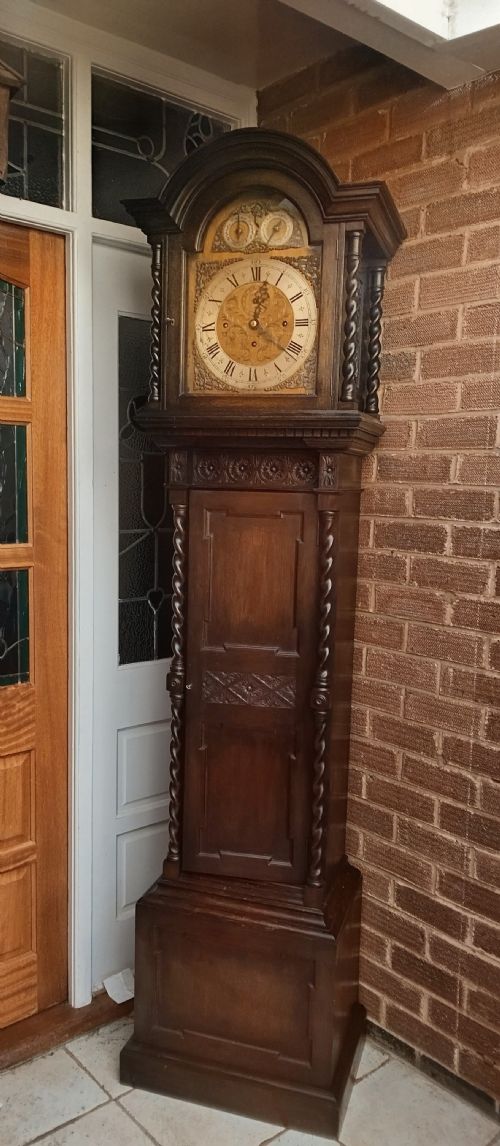


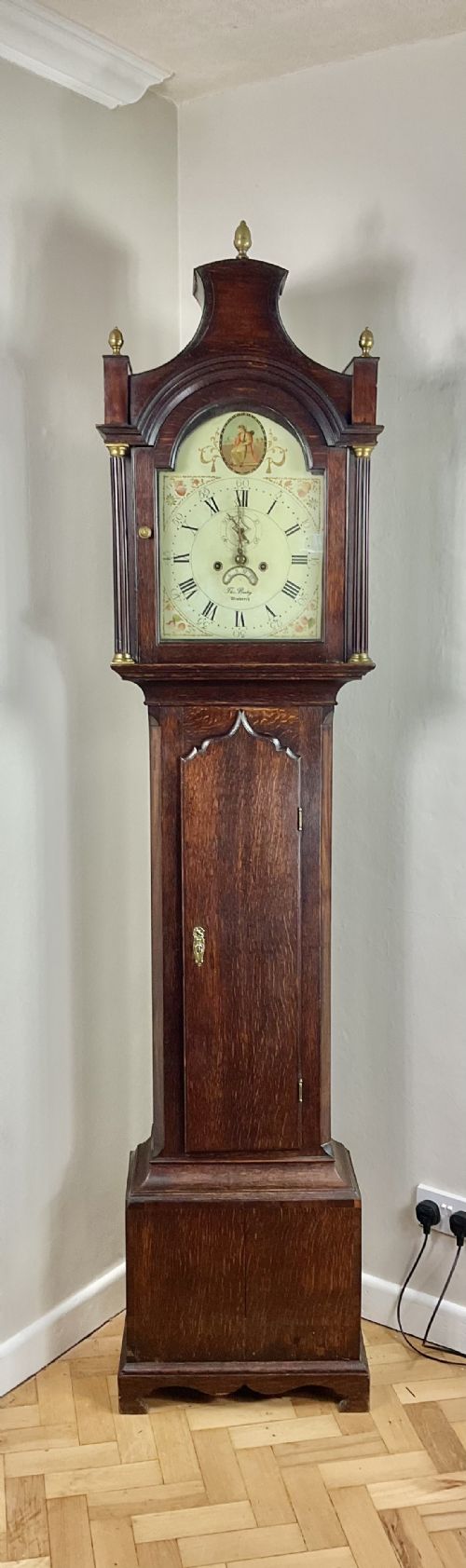


Traditional Oak Hall Clock
A traditional oak hall clock brings solid proportions and reliable movement into a domestic interior, offering the quiet gravity of fitted timber and measured time.
What they are
A traditional oak hall clock stands as a commanding presence in domestic architecture, traditionally positioned in entrance halls or principal rooms. These tall timepieces measure time through pendulum swings housed within upright timber cases, serving both a practical function and a display of domestic stability.
The selections available here span the Georgian, Regency, and Victorian periods, alongside specific dates such as the mid-eighteenth century. Forms include longcase clocks, grandfather clocks, and smaller variations, all sharing the structural characteristic of a tall wooden trunk protecting the weights and pendulum.
Most pieces encountered on this page date from the Georgian era or the Victorian period, constructed primarily from oak with fitted brass or painted iron dials. These floor-standing instruments represent generations of domestic timekeeping, uniting architectural joinery with mechanical clockwork.
How they were made
Cabinetmakers constructed the tall cases using solid oak, sometimes applying carved ornamentation to the hood or trunk surfaces to add decorative depth. The timber was seasoned and joined to accommodate the height of the pendulum and the weight drops.
Faces combine brass and glass elements with painted iron dials, housing mechanical movements designed to keep hours and minutes across extended periods. Metalworkers engraved brass dials or painted iron surfaces with numerals and maker details, protecting them behind glazed doors.
Retail Price Guide 2026
Typical UK retail prices for traditional oak hall clock, calculated from the Sellingantiques database of over a million retail prices indexed since 2003. This retail price guide relies exclusively on Sellingantiques data; no external sources or auction records are used, so the figures do not describe the wider market.
Some Victorian clock hoods feature carved wooden ears that look like they are listening intently for the next hour to strike.
What varies in quality
The distinction between standard examples and finer pieces lies in the crispness of the oak joinery and the detail found in the carved elements. Superior cases display thoughtful proportion and careful timber selection, whereas simpler builds rely on plain boards and minimal shaping.
Dial execution similarly separates the output, with finely engraved brass or carefully painted iron faces indicating a higher grade of workshop production. The integration of movement and case demonstrates the maker's skill, where movement fit and dial legibility reflect the original commissioning standard.
Richard Northen·Herbert of Haversham·Thomas Baker of Malling
The Traditional Oak Hall Clock Glossary
- Longcase clock
- A tall, floor-standing pendulum clock enclosed in a wooden case, commonly known as a grandfather clock.
- Georgian
- The period spanning the reigns of the four Georges, noted in these pieces for sturdy oak construction and classical proportions.
- Regency
- The stylistic era following the Georgian period, characterised by refined architectural lines in furniture and timepieces.
- Victorian
- The nineteenth-century period associated here with heavier proportions and carved decorative detailing on clock hoods and trunks.
- Painted iron
- A dial material introduced to replace or supplement brass faces, often featuring decorative numerals and floral corners.
Frequently Asked Questions
How do I tell a Georgian oak hall clock from a Victorian one?
Georgian examples generally exhibit simpler architectural lines and restrained proportions suited to eighteenth-century interiors. Victorian pieces frequently incorporate heavier carved decoration upon the oak case and hood.
Examination of the dial and interior joinery further distinguishes the production era of the piece. Earlier dials often utilise engraved brass, while later variations include painted iron faces.
Where should I place an oak hall clock in my home?
These tall timepieces require a stable, level floor and a secure wall fixing to ensure the pendulum swings correctly. Hallways and principal rooms provide the traditional setting for such instruments.
Avoid positioning the timber case in direct sunlight or beside active heat sources to protect the oak from warping. Stable atmospheric conditions preserve both the wooden housing and the metal movement.
What is the difference between a longcase clock and a grandfather clock?
The terms describe the same floor-standing timepiece structure, with longcase being the historical trade term. Grandfather clock became the popular domestic descriptor over subsequent generations.
Both forms utilise a tall oak trunk to enclose the weight drops and pendulum beneath a glazed dial hood. Variations in height and dial style reflect the period of manufacture rather than a mechanical distinction.
How do the painted iron dials differ from brass dials?
Brass dials feature engraved numerals and decorative spandrels fixed at the corners of the clock face. They represent an earlier tradition of metalworking applied to timepieces.
Painted iron dials provide a smooth surface for hand-painted numbers and subsidiary chapter rings, becoming common by the late eighteenth and nineteenth centuries. Both dial types sit behind protective glass within the hood door.