
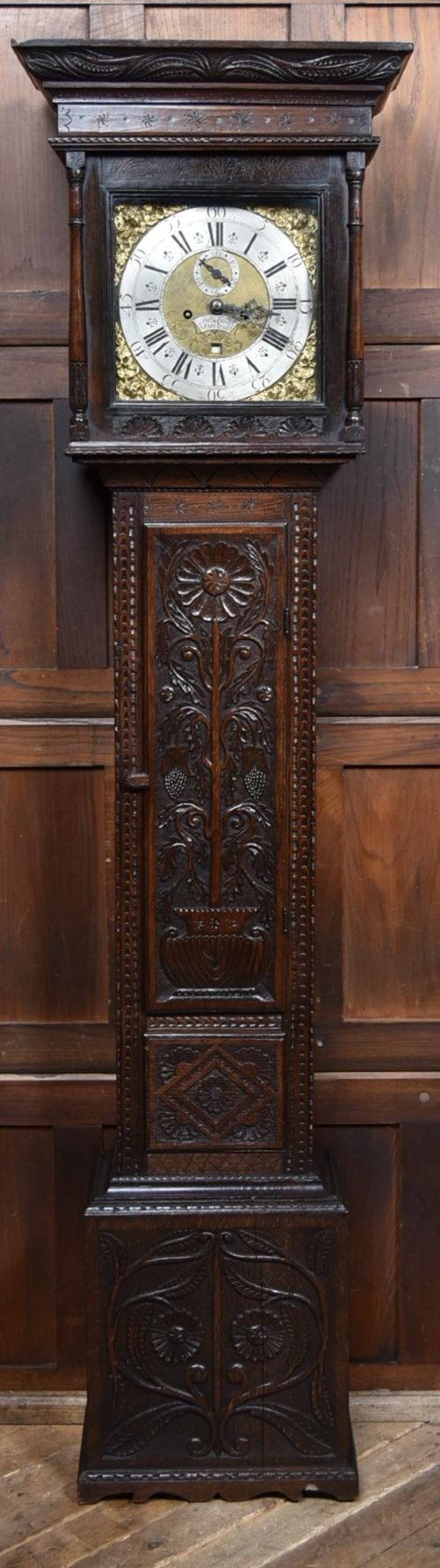
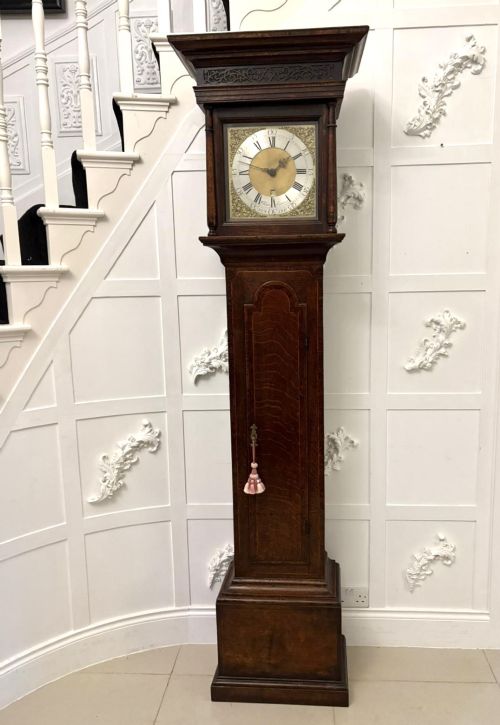
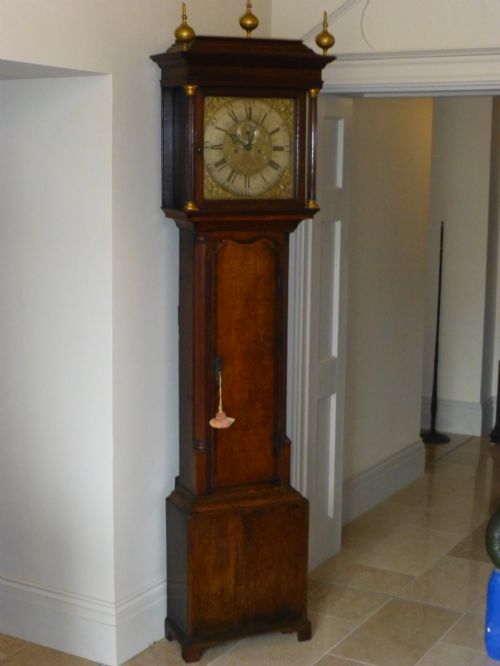
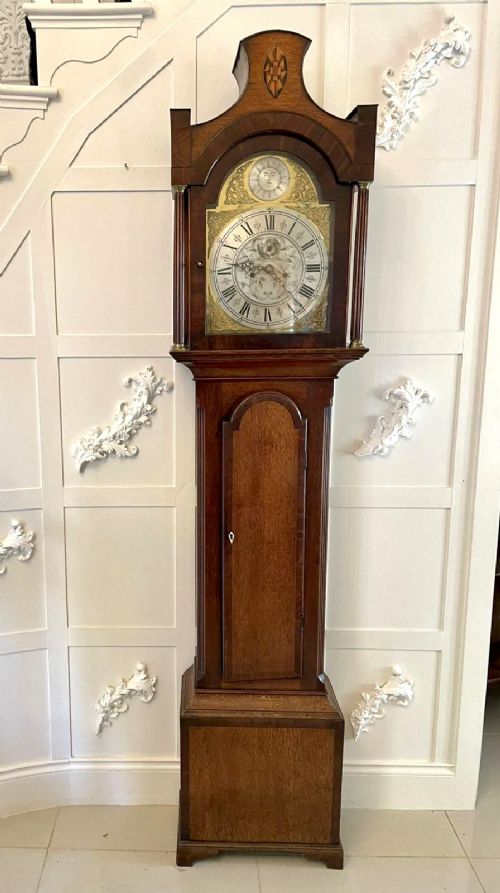



Brass Face Longcase Clock
A brass face longcase clock anchors a room with mechanical life and centuries of local craftsmanship.

The brass face longcase clock
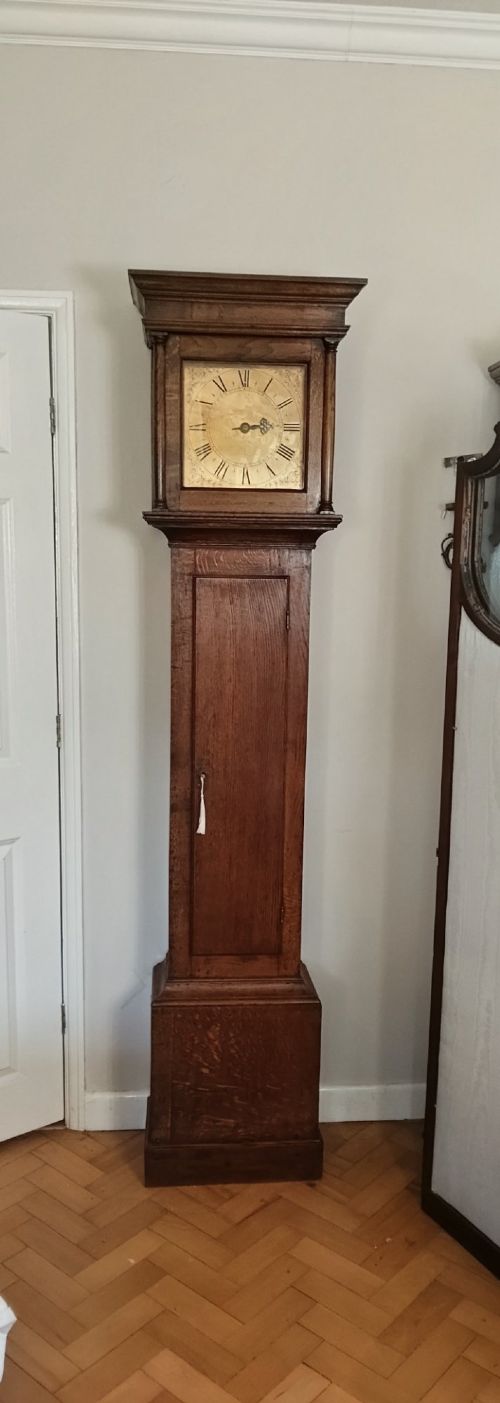
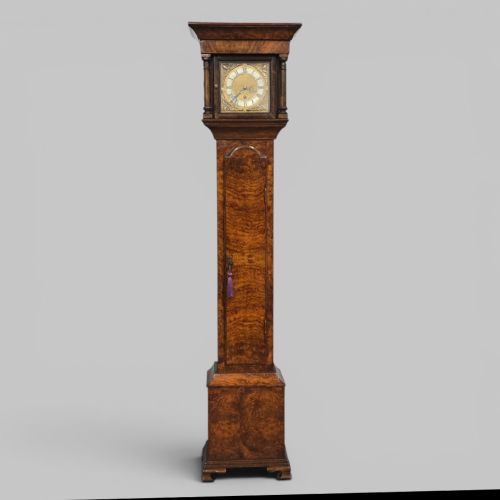
A brass face longcase clock stands tall as a piece of functional furniture, housing a weight-driven movement inside a tall wooden trunk. When seeking a brass face longcase clock, buyers encounter examples primarily from the Georgian and 18th Century periods.
Most entries on this page consist of oak or mahogany cases paired with brass dials, often featuring regional provincial makers from locations such as Crediton, Ecclefechan, and London. Smaller formats and country workshop pieces appear alongside grander metropolitan examples.
The form spans early Georgian origins through to George III interpretations, demonstrating varied regional cabinetry and movement complexity from simple thirty-hour clocks to eight-day mechanisms.

Materials and construction
Cabinetmakers built the tall cases predominantly in solid oak and mahogany, occasionally incorporating burr oak or decorative carving, while housing the fragile internal gears behind glass panels in the hood. Wood selection dictated the presence of rich natural warm tones and figure across the trunk.
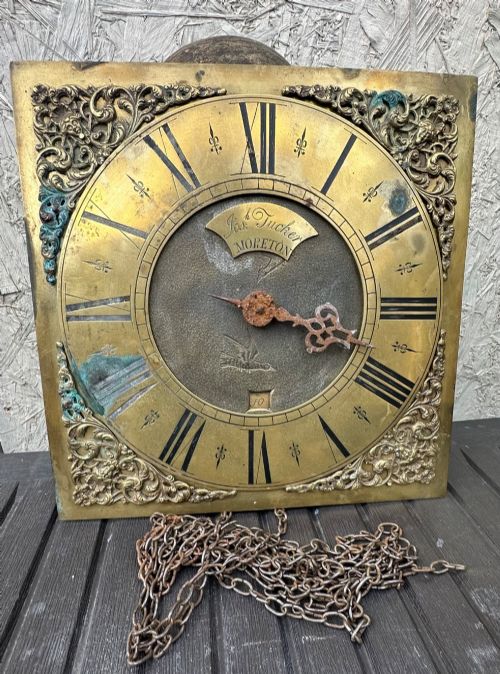
Clockmakers cast and engraved the brass dials by hand, mounting them with cast brass spandrels in the corners and protecting the visible pendulum and weights within the wooden casing.
Retail Price Guide 2026
Typical UK retail prices for brass face longcase clock, calculated from the Sellingantiques database of over a million retail prices indexed since 2003. This retail price guide relies exclusively on Sellingantiques data; no external sources or auction records are used, so the figures do not describe the wider market.
Some provincial clock faces record remote village addresses where the local maker's hammer rang out daily.
Evaluating the range
The distinction between standard country pieces and higher-end examples lies in the crispness of the brass engraving, the presence of signed dial plates by known regional makers, and the sophistication of the timber figure in the oak or mahogany case. Carved details and burr veneers elevate the visual weight of the cabinetry.
Movement duration and complexity further separate the selection, with eight-day gear trains and three-train chiming mechanisms representing a higher level of horological ambition than simpler thirty-hour variants.

Joseph Gibson Ecclefechan·John Pollard of Crediton·Jonathan Blake Fulham·Thomas Baker of Malling·Benjamin Reeves Lamberhurst·John Simpson London·Hugh Lough Penrith·Owen of Llanrwst·James Sandiford of Manchester·John Cain Luton
The Brass Face Longcase Clock Glossary
- Longcase clock
- A tall pendulum clock enclosed in a wooden case, commonly known as a grandfather clock.
- Spandrel
- An ornamental metal corner piece fixed to the dial around the chapter ring, often cast in brass.
- Movement
- The mechanical inner workings of the clock, comprising gears, weights, and escapement.
- Dial
- The face of the clock where time is indicated by hands moving across a graduated circle.
- Trunk
- The main vertical section of the clock case that protects the descending weights and swinging pendulum.
Frequently Asked Questions
How do I wind an eight day longcase clock?
Use the winding key on the dial face every week to draw the weights back up to the top of the trunk.
Take care not to over-wind the movement once tension is felt on the key.
Where should I place my longcase clock?
Position the clock against a solid interior wall away from direct sunlight, central heating vents, and damp exterior walls.
A stable floor ensures the pendulum swings evenly without catching the sides of the case.
How do I tell an 18th century clock apart from later pieces?
Examine the timber construction methods, dial engraving style, and the specific joinery visible inside the hood and trunk.
Provincial 18th century dials often feature handwritten signatures and cast brass spandrels characteristic of the Georgian period.
Why does my clock need to be level?
The escapement mechanism relies on a symmetrical drop of the anchor onto the escape wheel teeth to keep accurate time.
If the case leans, the tick becomes uneven and the clock will eventually stop running.