29,055  PAGES BROWSED TODAY PAGES TODAY • 99 ANTIQUES UPLOADED TODAYNEW ARRIVALS
GIFTS
99 ITEMS ADDED TODAY
Sort Order
Items Per Page
Browse Categories
Sort order
Relevant Links
Items per page
ID #SA1244311
FOR SALE
£1,350
Email Phone
Save
Antique French Ormolu and Cloisonne Enamel Jewellery Casket, 19th C
For sale by Regent Antiques
for sale €1,580     $1,715
£1,350
Regent Antiques

Regent Antiques

Sellingantiques Verified Since Sep 2016
Browse dealers 658 items
  • About Us
    We specialise in english and continental furniture, silver, porcelain and decorative items.
  • Trade Associations
    Regent Antiques is a registered member of LAPADA  CINOA
Id #SA1244311
PDF SHARE
SAVE

Antique French Ormolu and Cloisonne Enamel Jewellery Casket, 19th C

19th century
For Sale by Regent Antiques
Description

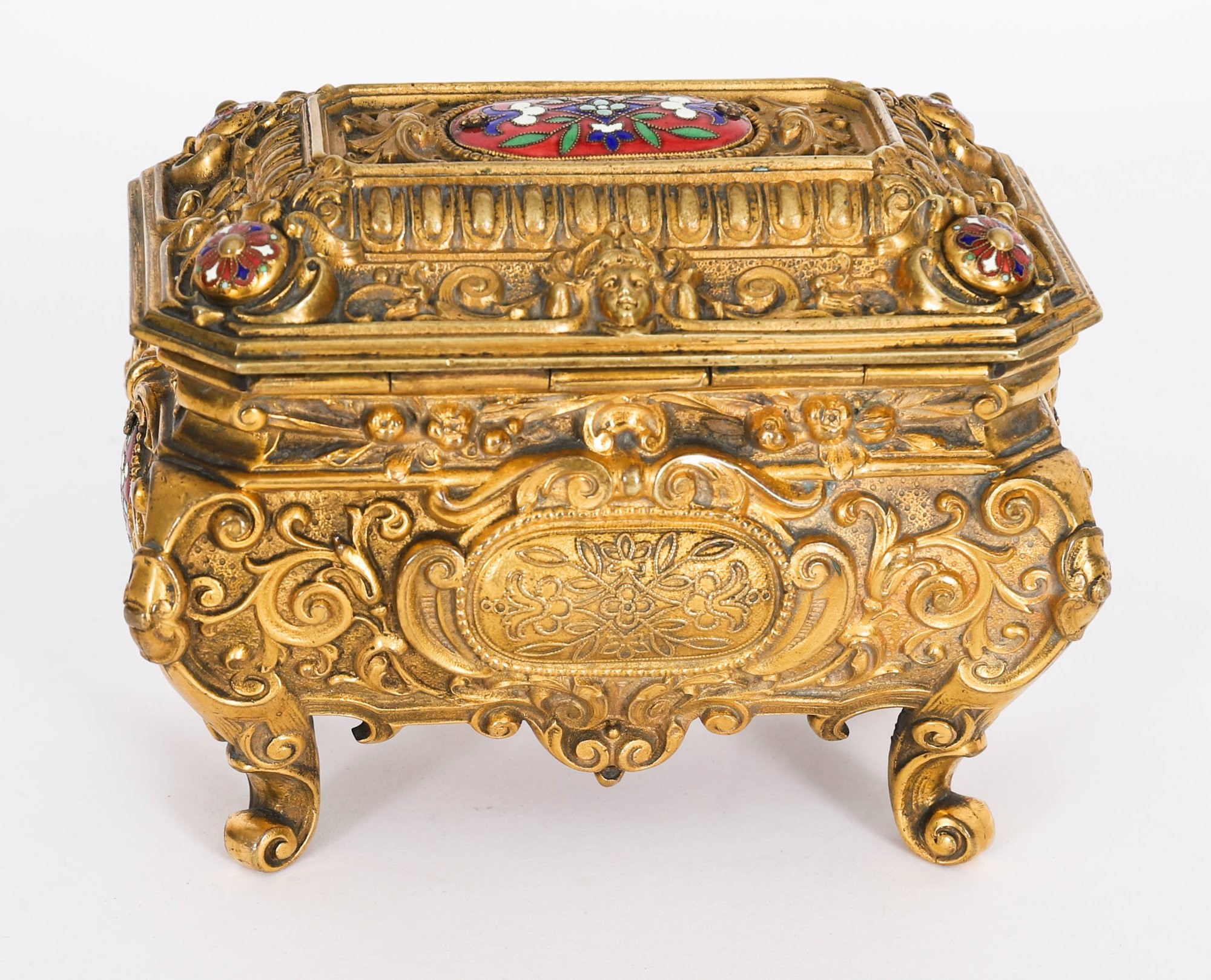
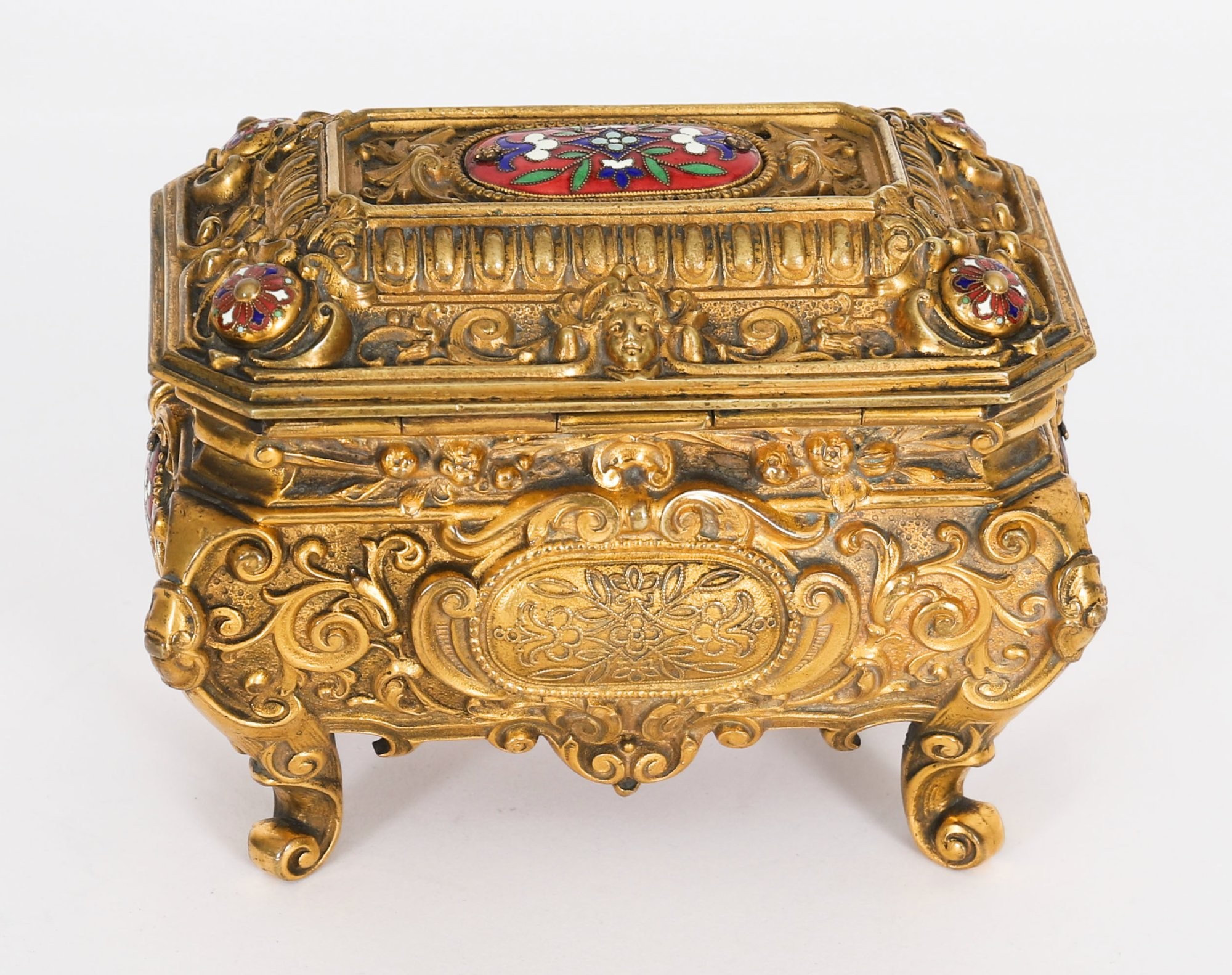
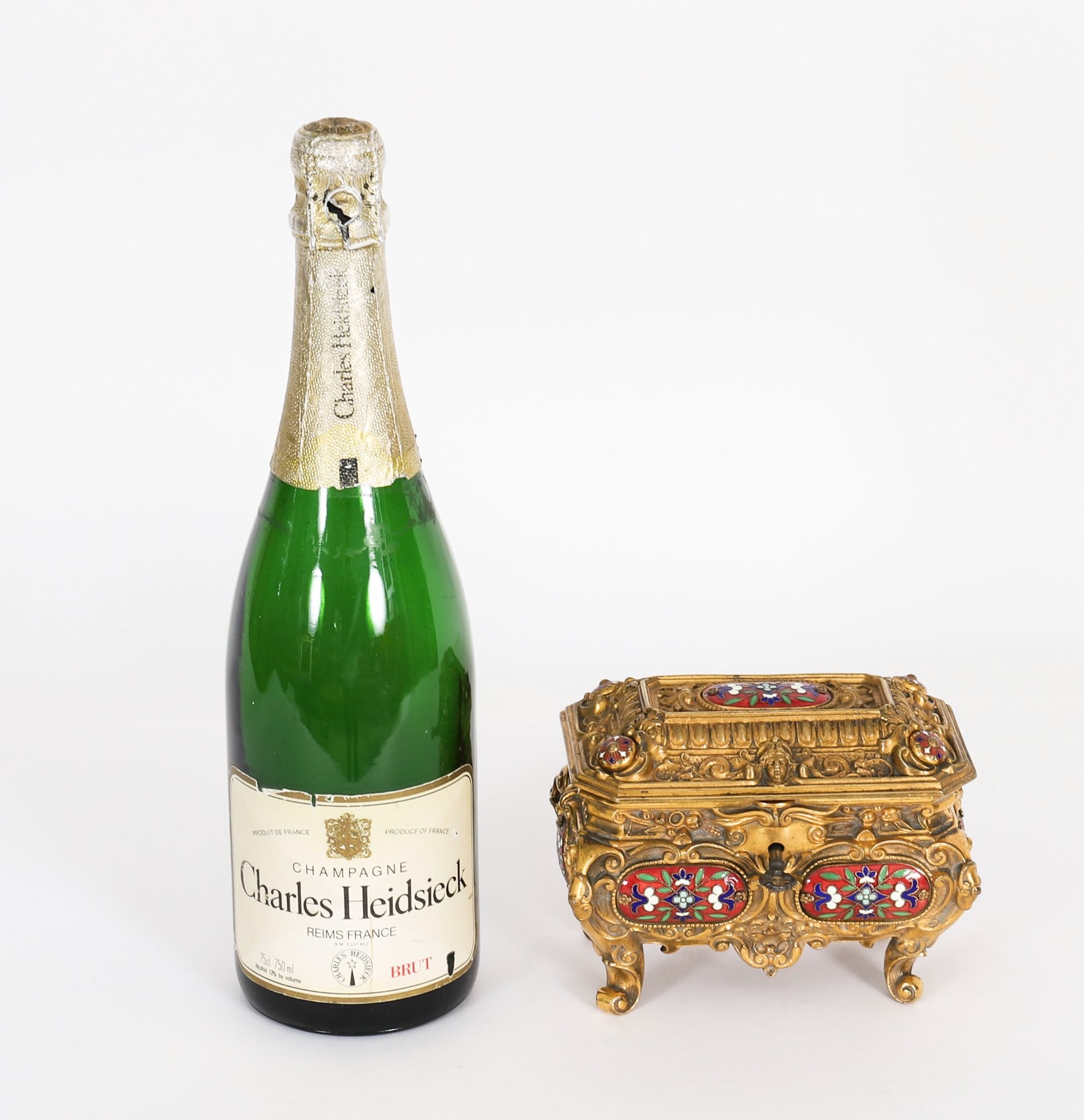
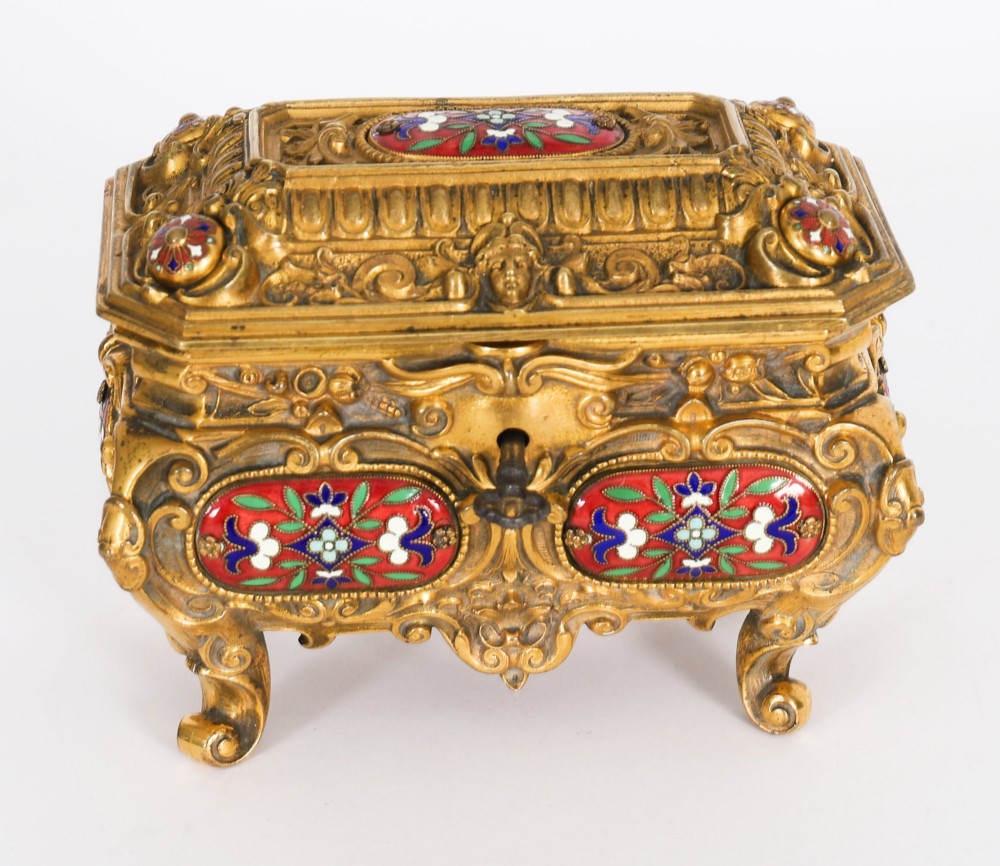
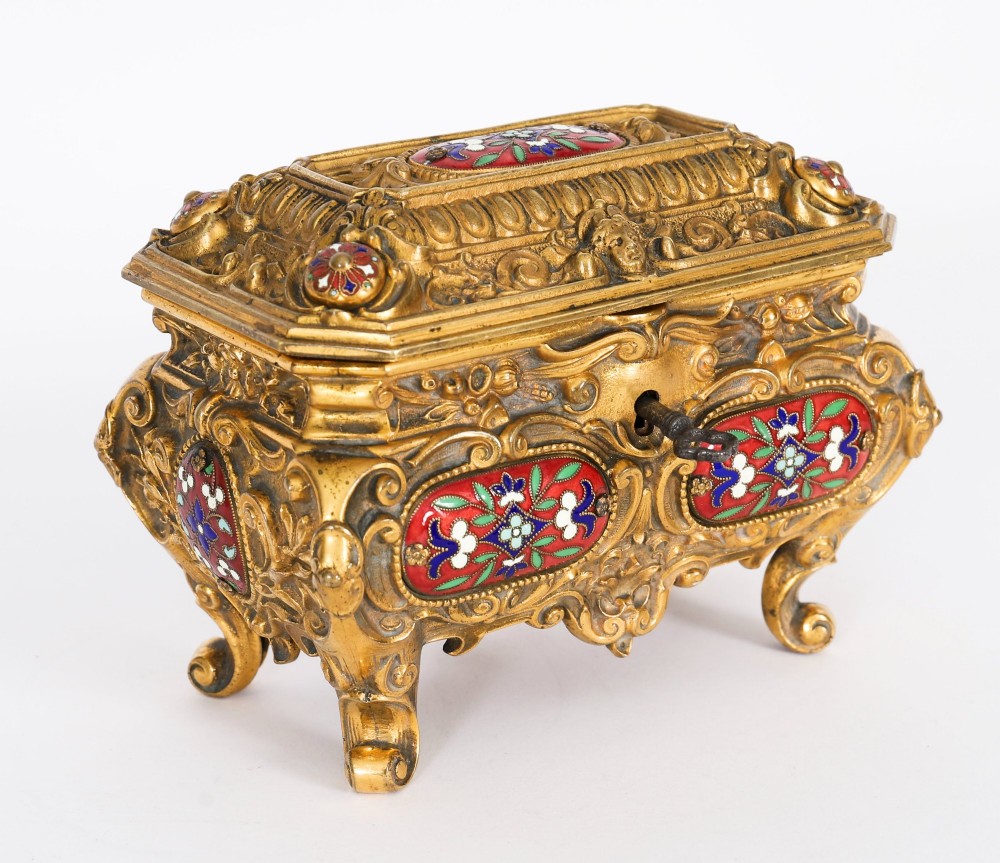
A superb quality French Louis XIV Revival ormolu and cloisonné enamel jewellery casket, circa 1870 in date.


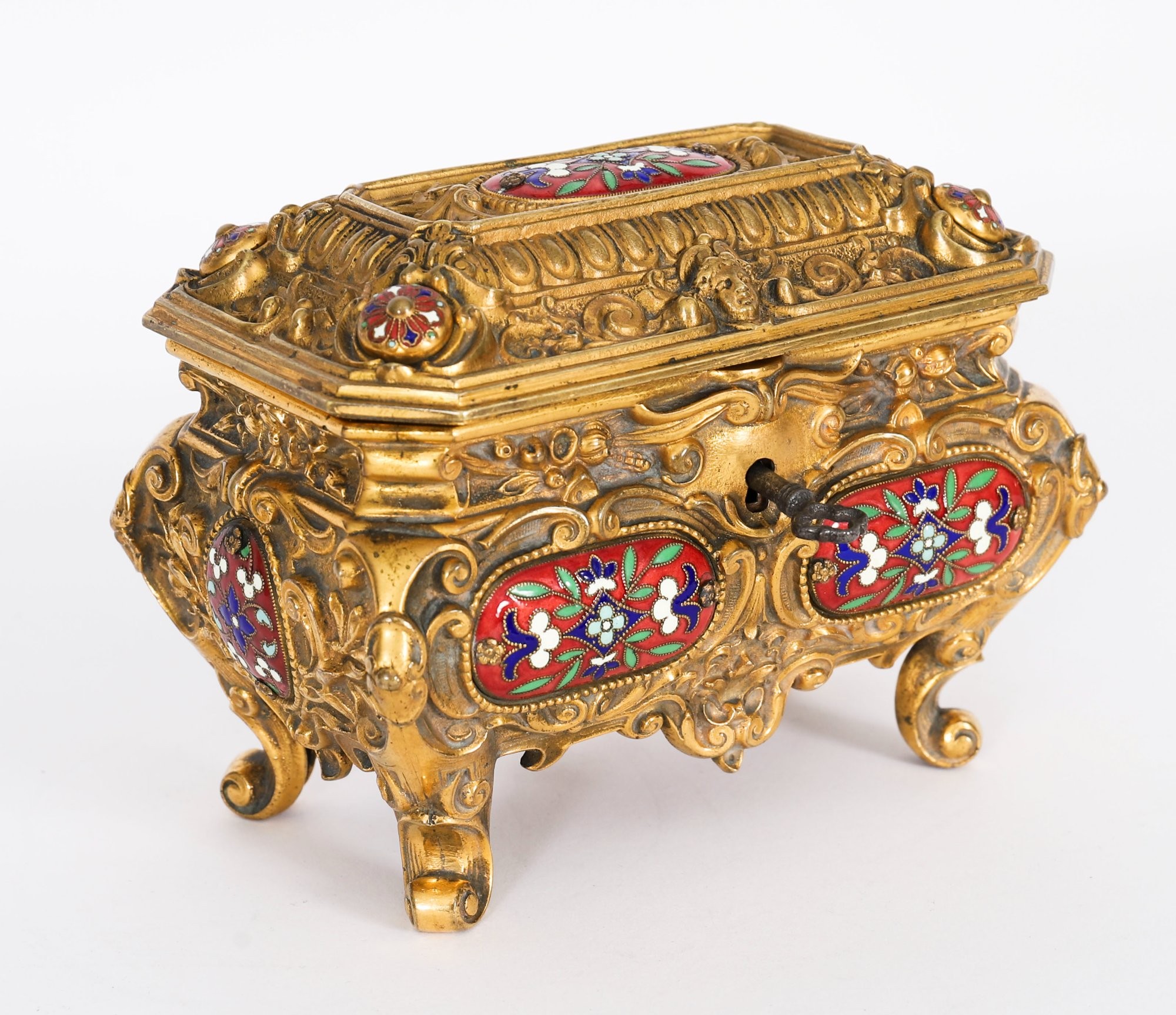
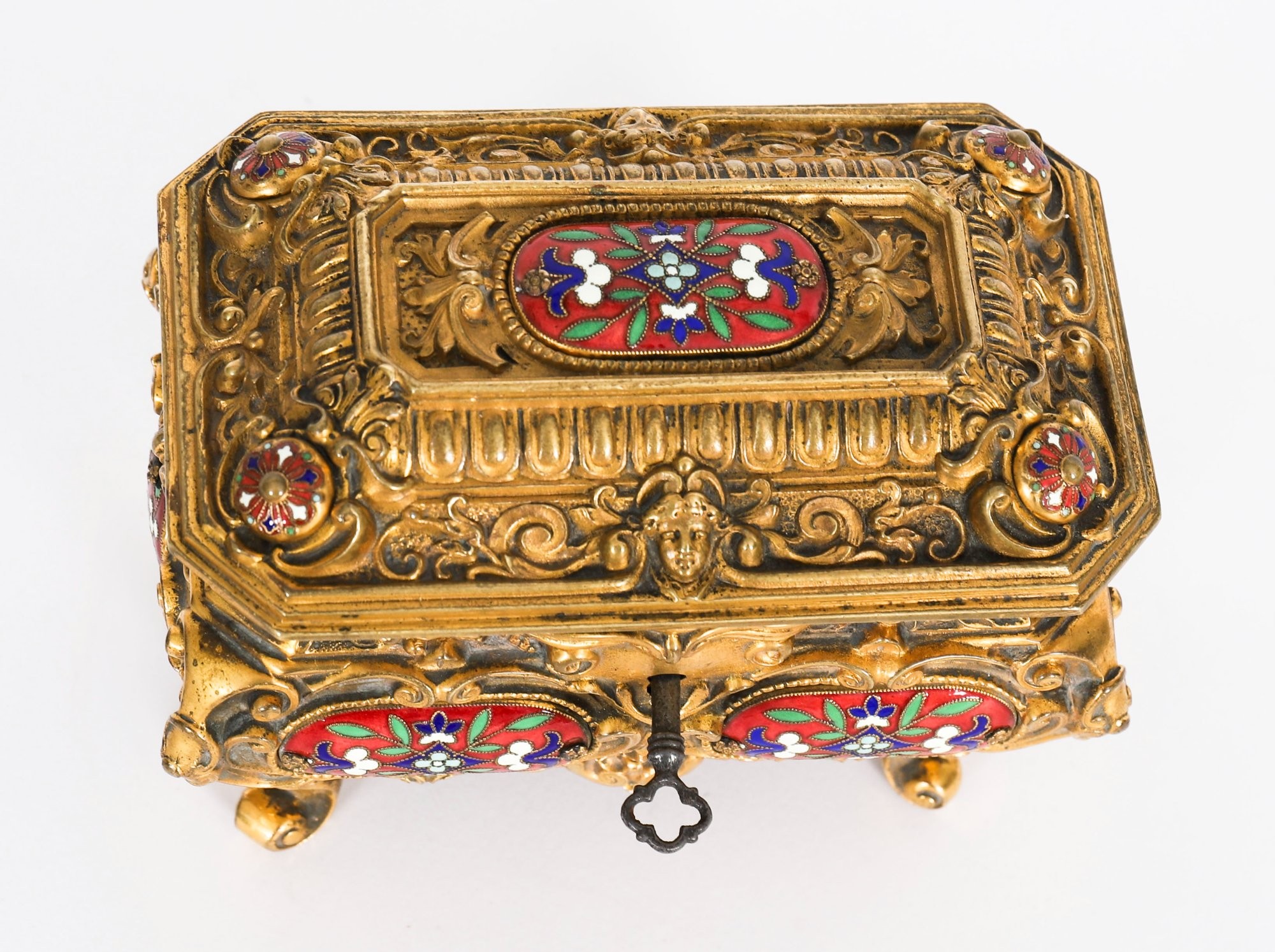
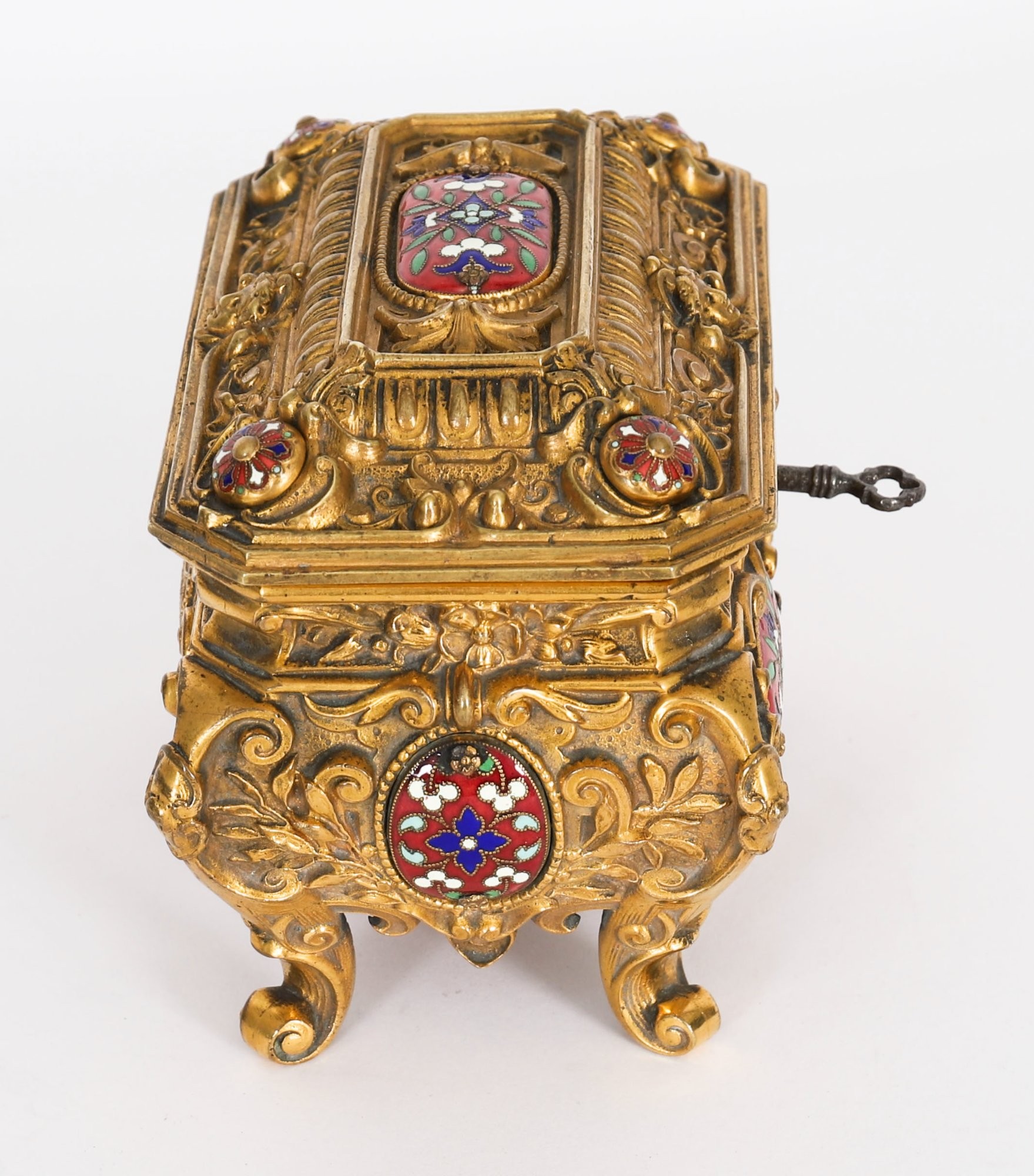
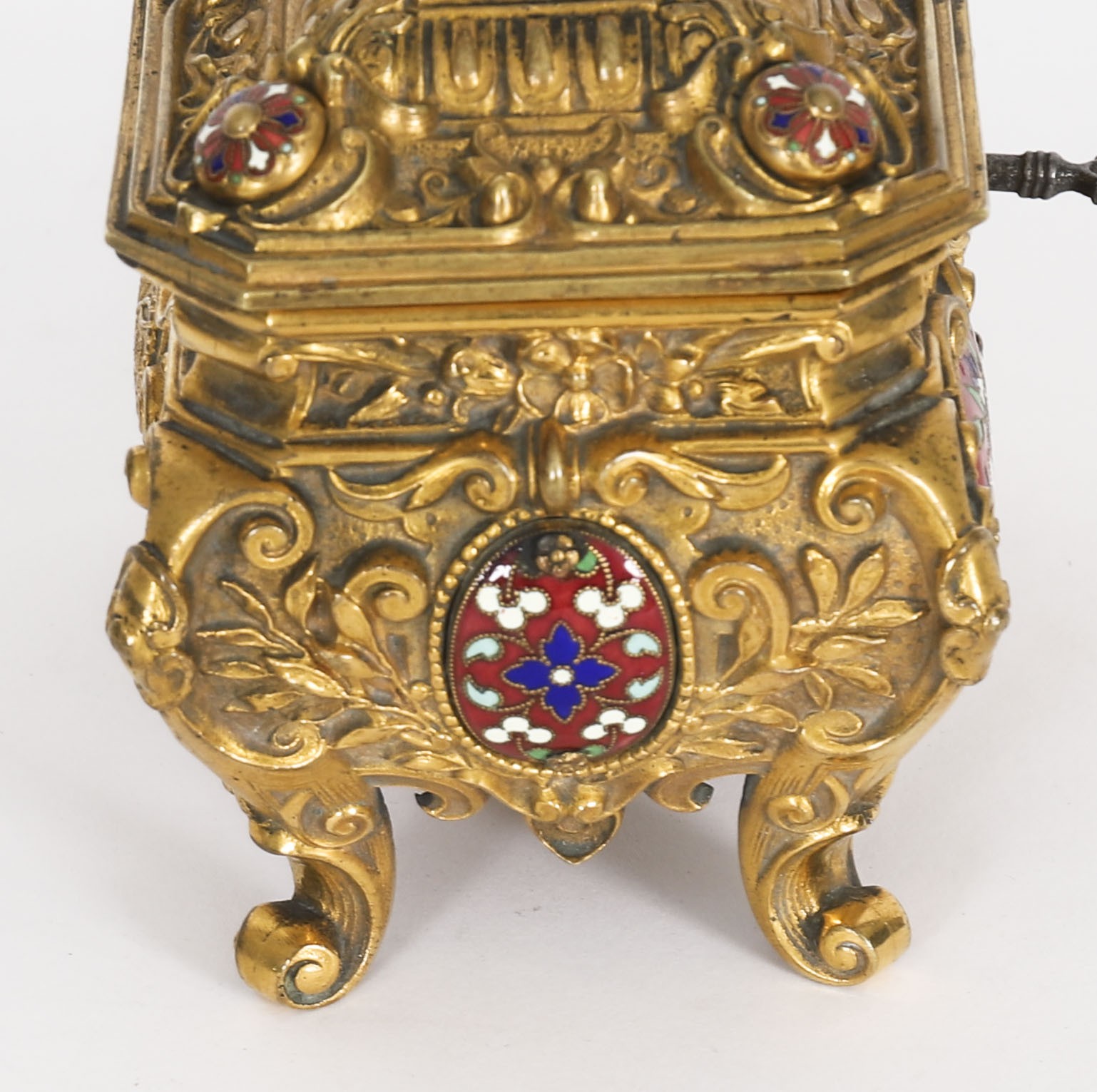
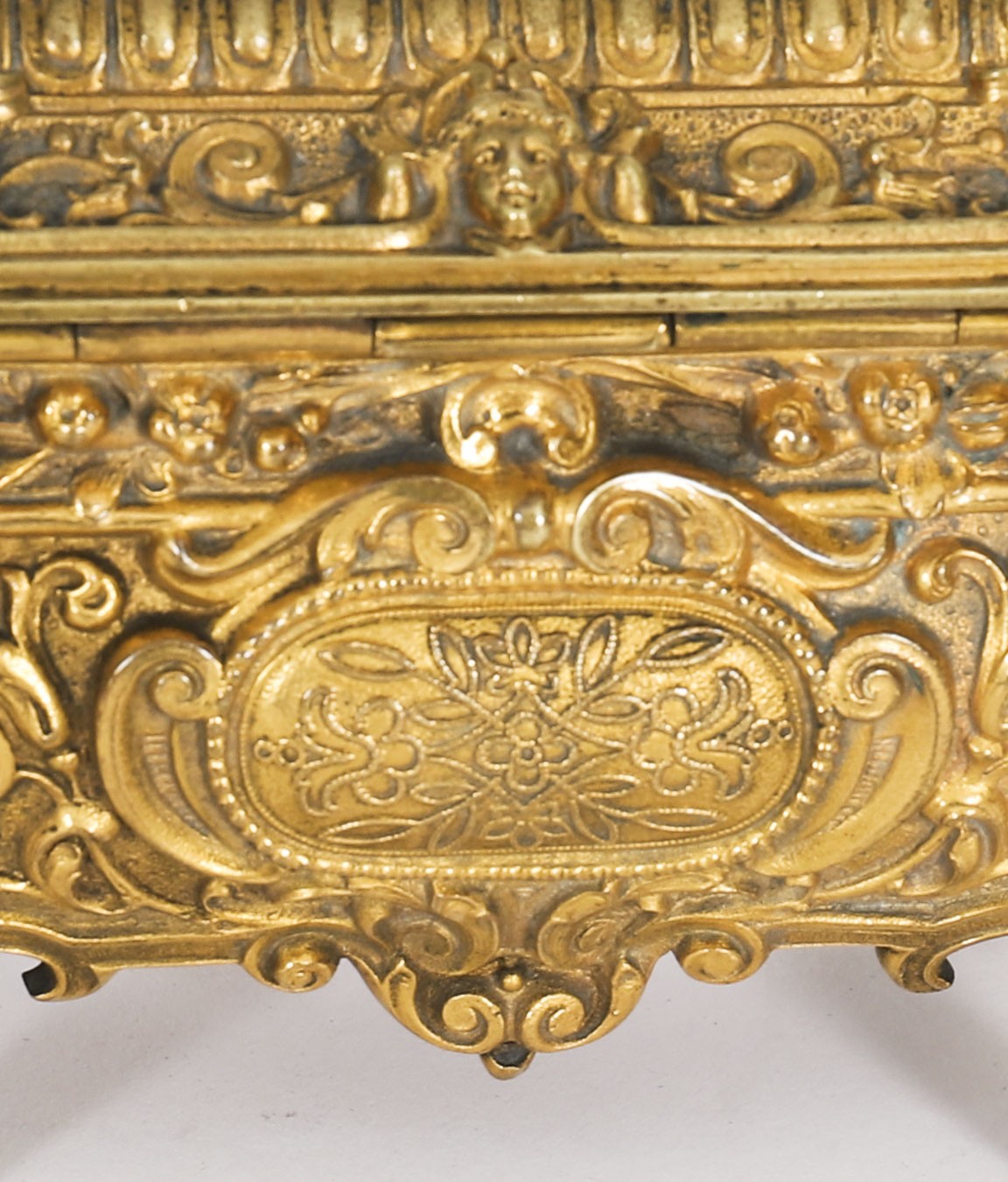
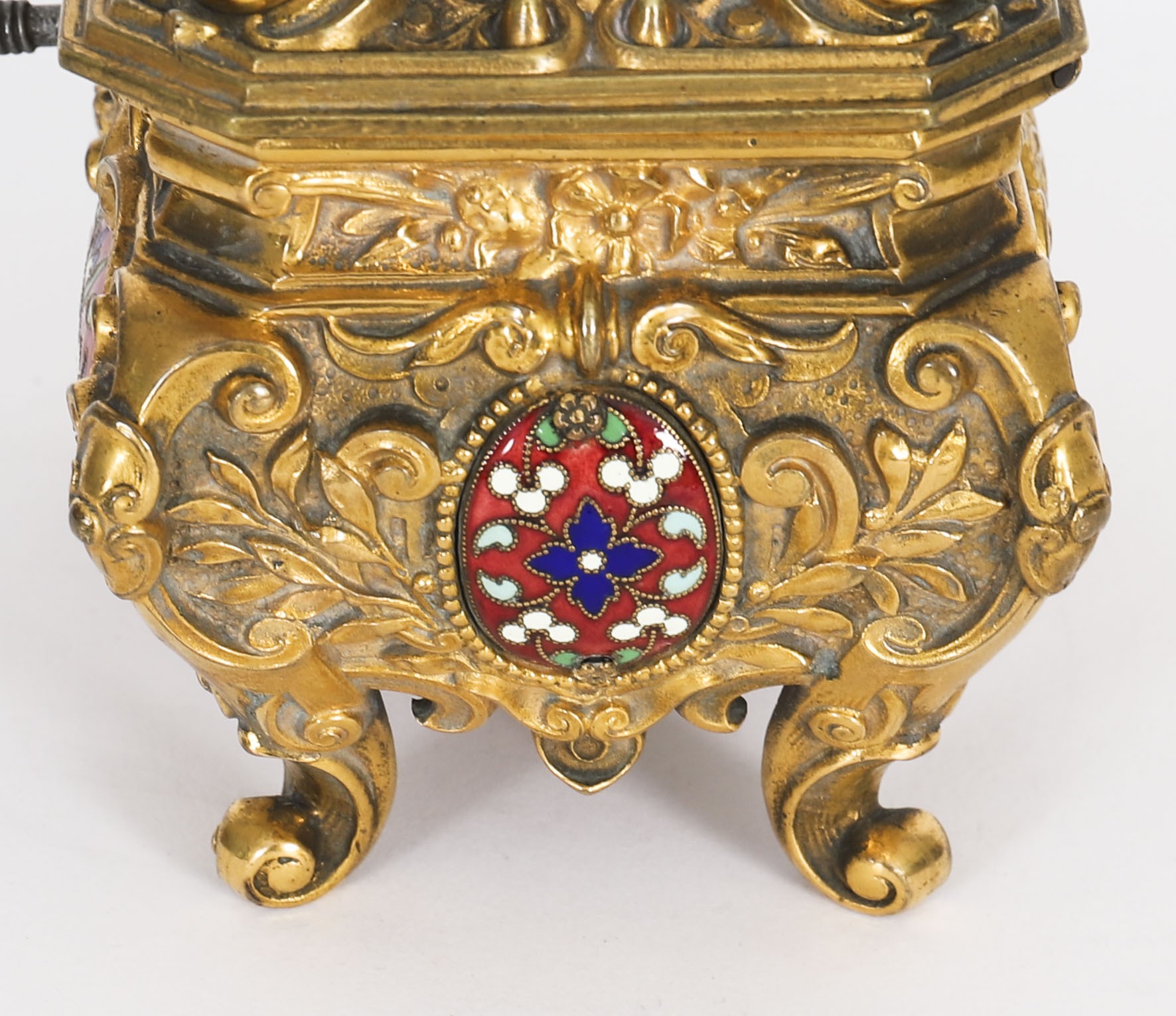
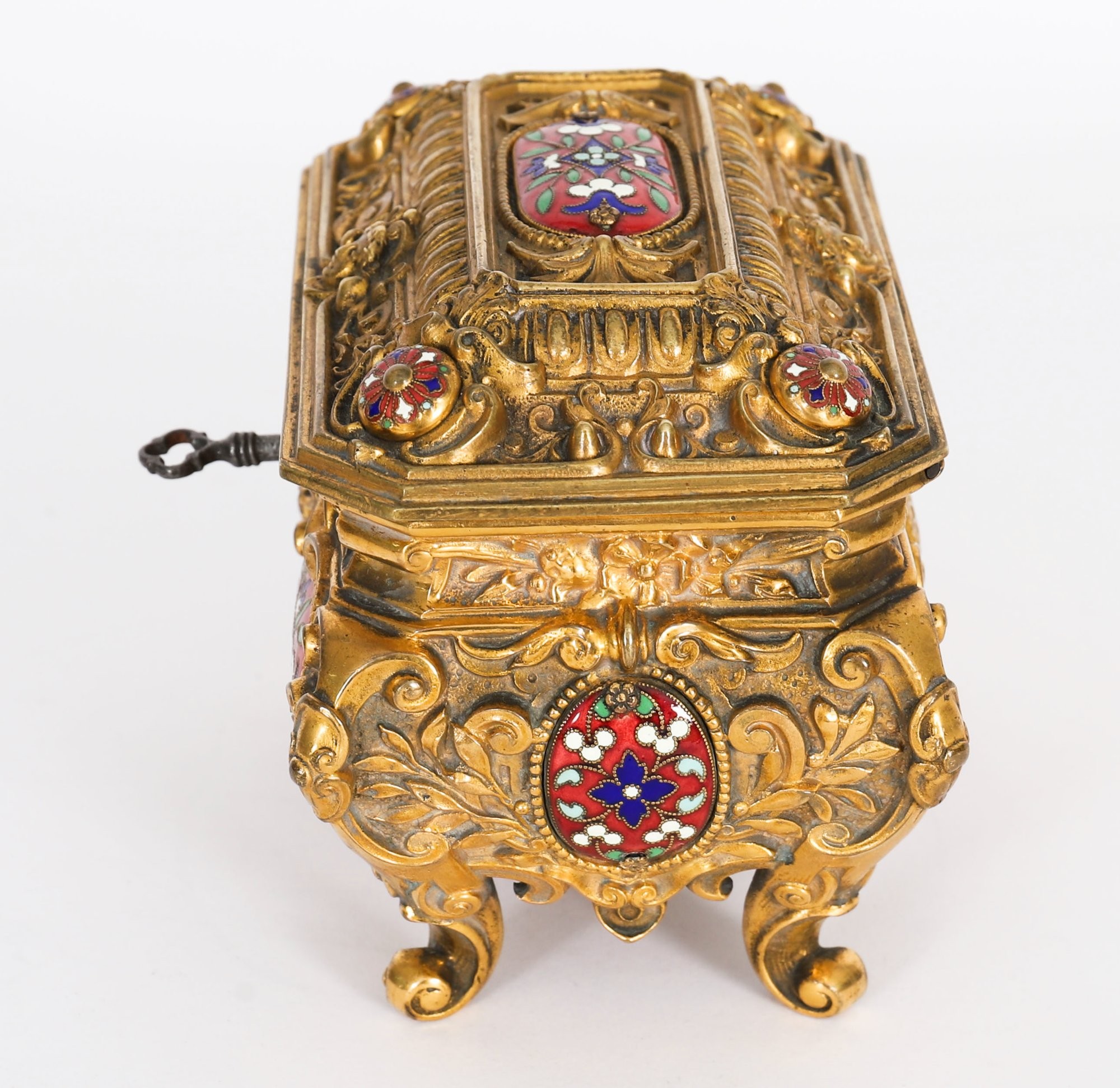
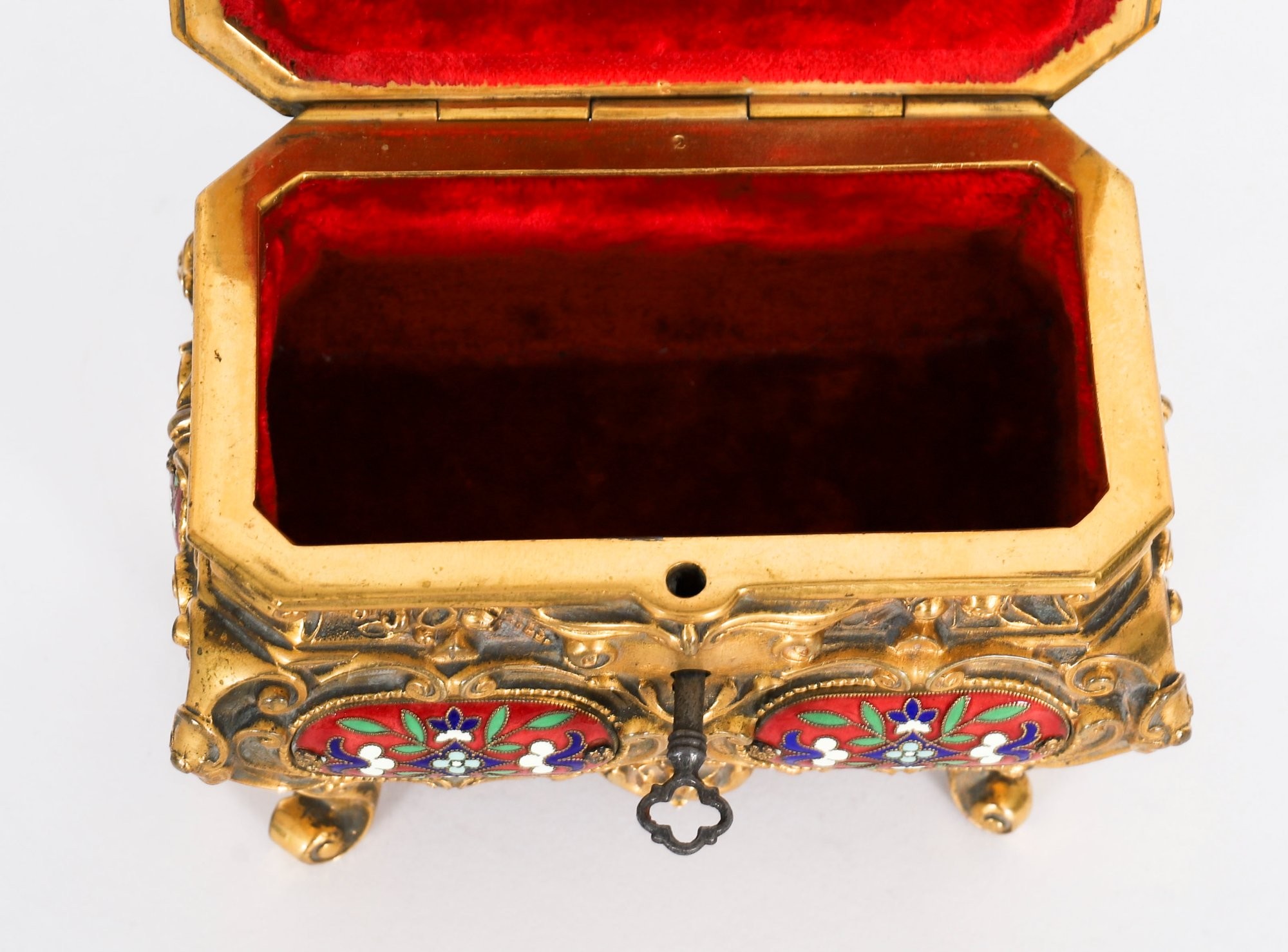
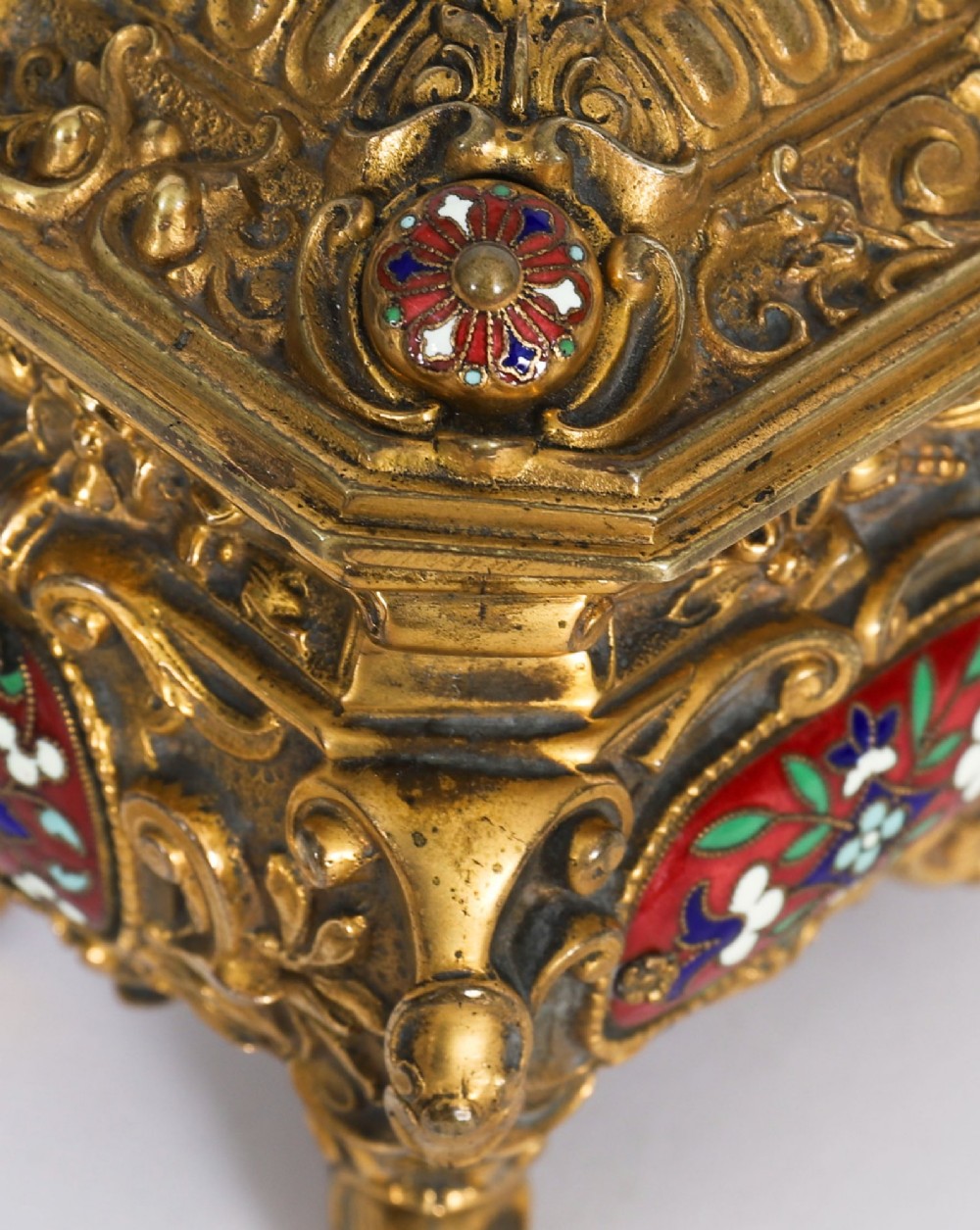
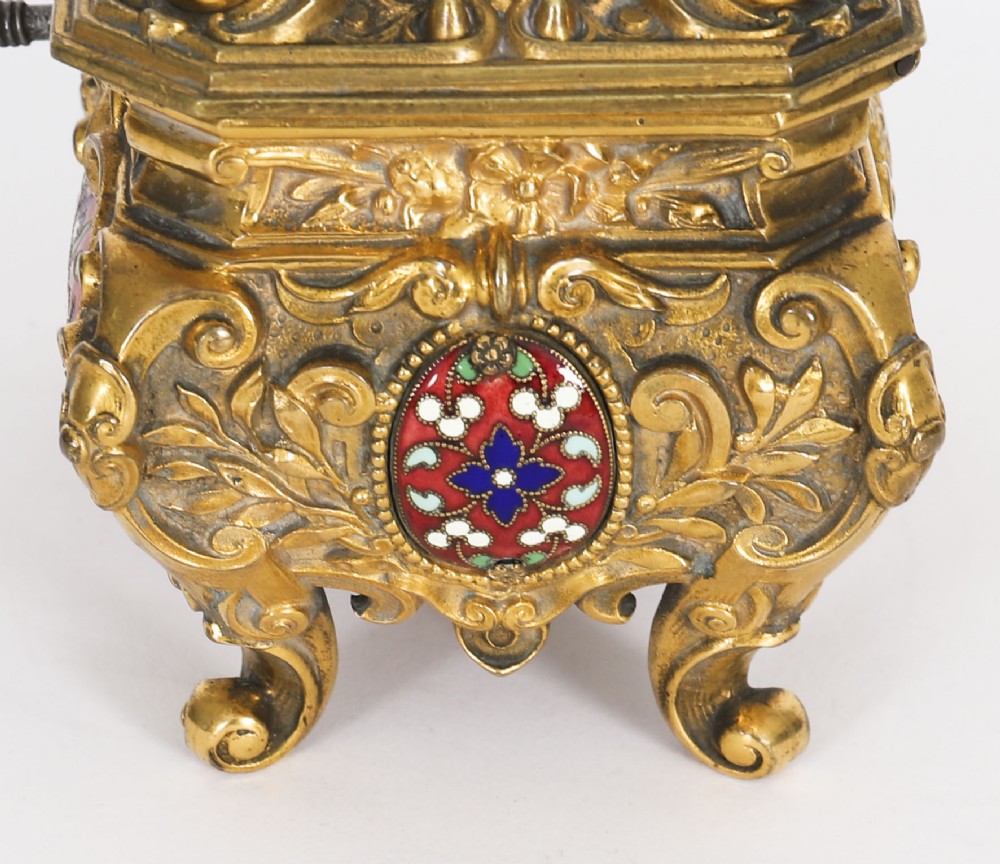
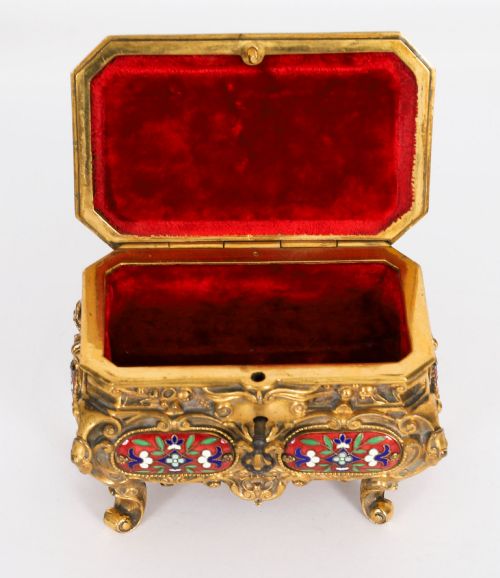
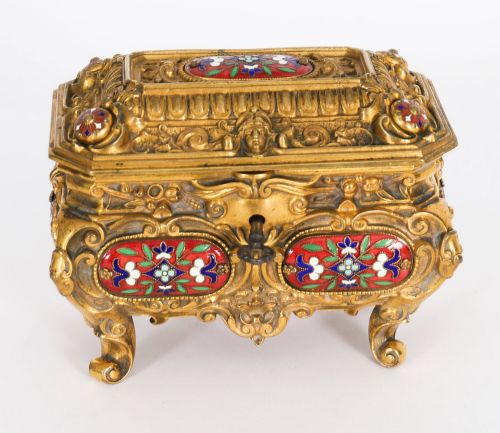
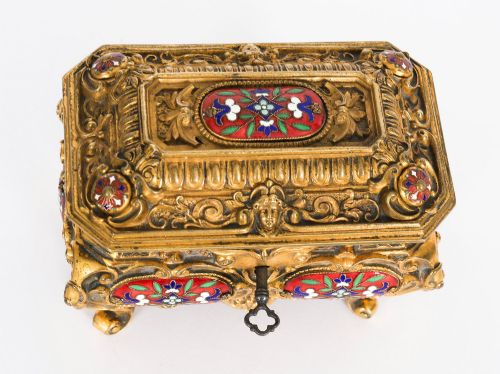
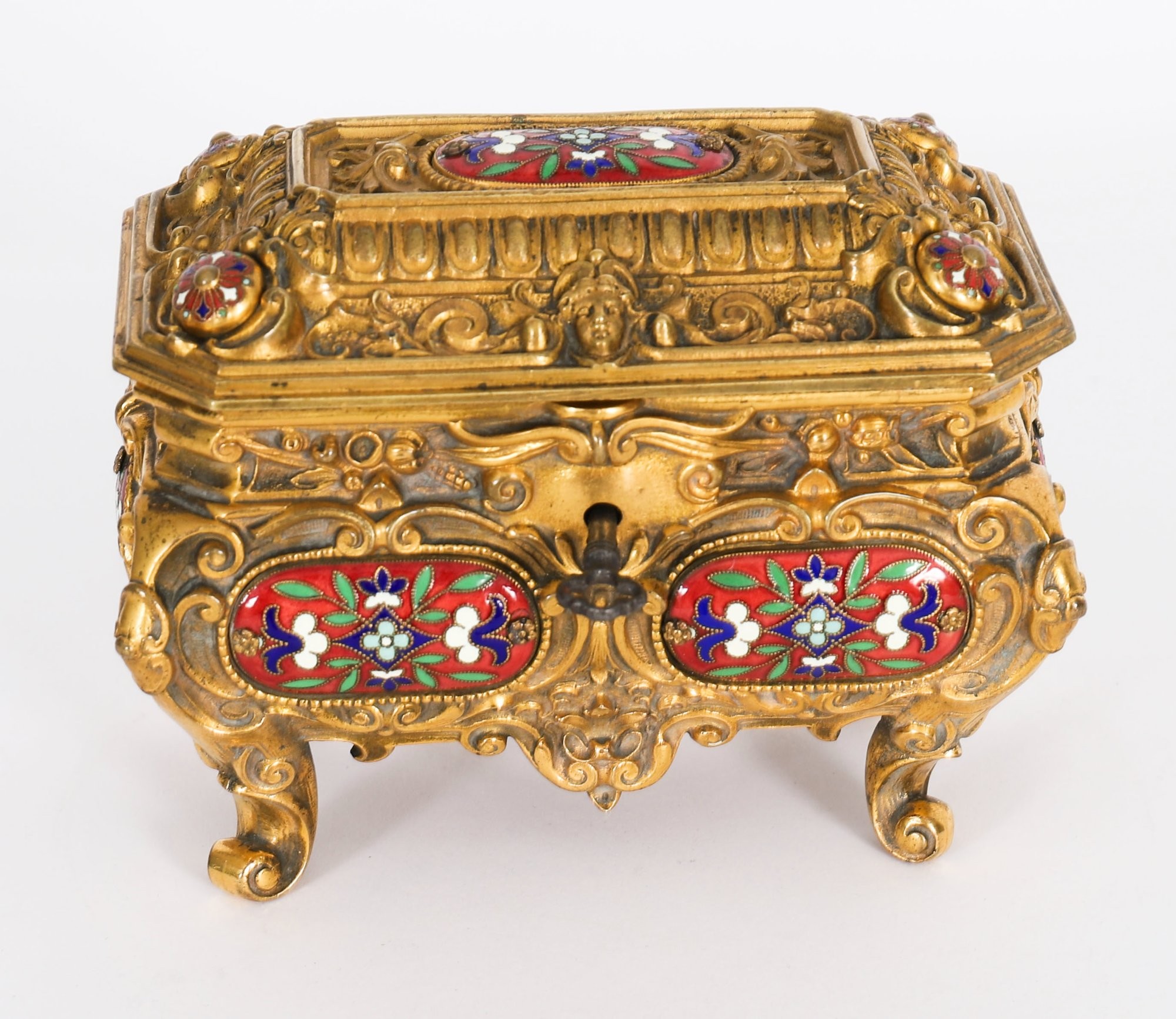
The stunning casket is of bombé rectangular form richly cast in relief with scrolls, masks and laurel branches and inset with oval cloisonné enamel panels of flowers in blue, white and green upon a red ground within beaded borders, the hinged cover with canted angles and a further panel, the interior lined in red velvet, upon four scroll feet, with a key.
 

It is a lovely piece which is functional as well as being highly decorative.

Complete with lock and original key.


Condition:

In excellent condition; please see photos for confirmation.

Dimensions in cm:
Height 12 cm x Width 15 cm x Depth 9.5 cm

Dimensions in inches:

Height 5 inches x Width 6 inches x Depth 4 inches

Cloisonné

is a decorative enamel technique where thin metal wires (called cloisons, French for “partitions” or “cells”) are attached to a metal base to create little compartments, which are then filled with powdered glass or enamel paste and fired.

The technique goes back to the Byzantine Empire and the Near East, where it was used on religious objects and jewelry. It reached China around the 14th century, where it became famous (in Chinese, it’s called jingtailan, after the Jingtai era of the Ming dynasty, and the Chinese pieces are often blue). Japan developed its own refined tradition in the 19th century, with exquisite work by makers like Namikawa Yasuyuki. It’s still practiced today in China, Japan, Russia, and elsewhere.
Ormolu - Gilt Bronze (from French 'or moulu', signifying ground or pounded gold) is an 18th-century English term for applying finely ground, high-carat gold in a mercury amalgam to an object of bronze. The mercury is driven off in a kiln, leaving behind a gold-coloured veneer known as 'gilt bronze'.
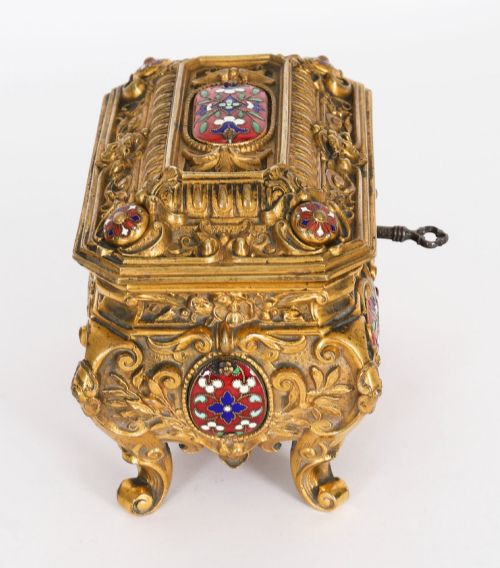
The manufacture of true ormolu employs a process known as mercury-gilding or fire-gilding, in which a solution of nitrate of mercury is applied to a piece of copper, brass, or bronze, followed by the application of an amalgam of gold and mercury. The item was then exposed to extreme heat until the mercury burned off and the gold remained, adhered to the metal object.
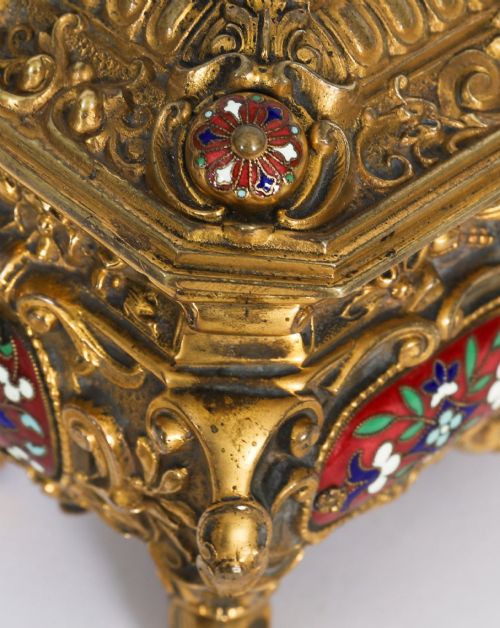
After around 1830, because legislation had outlawed the use of mercury, other techniques were used instead. Electroplating is the most common modern technique. Ormolu techniques are essentially the same as those used on silver to produce silver-gilt.

Our reference: A5475

Date of Manufacture

Regent Antiques has dated this French Ormolu Jewellery Casket to the 1870s.

Independent Date Check ID 09710177
Dealer's Item Date1870s
Sellingantiques Date1870s
Sellingantiques agingItem 140-165 years old
Test ResultsPassed dating check
Why Sellingantiques dated this piece to THE 1870s:
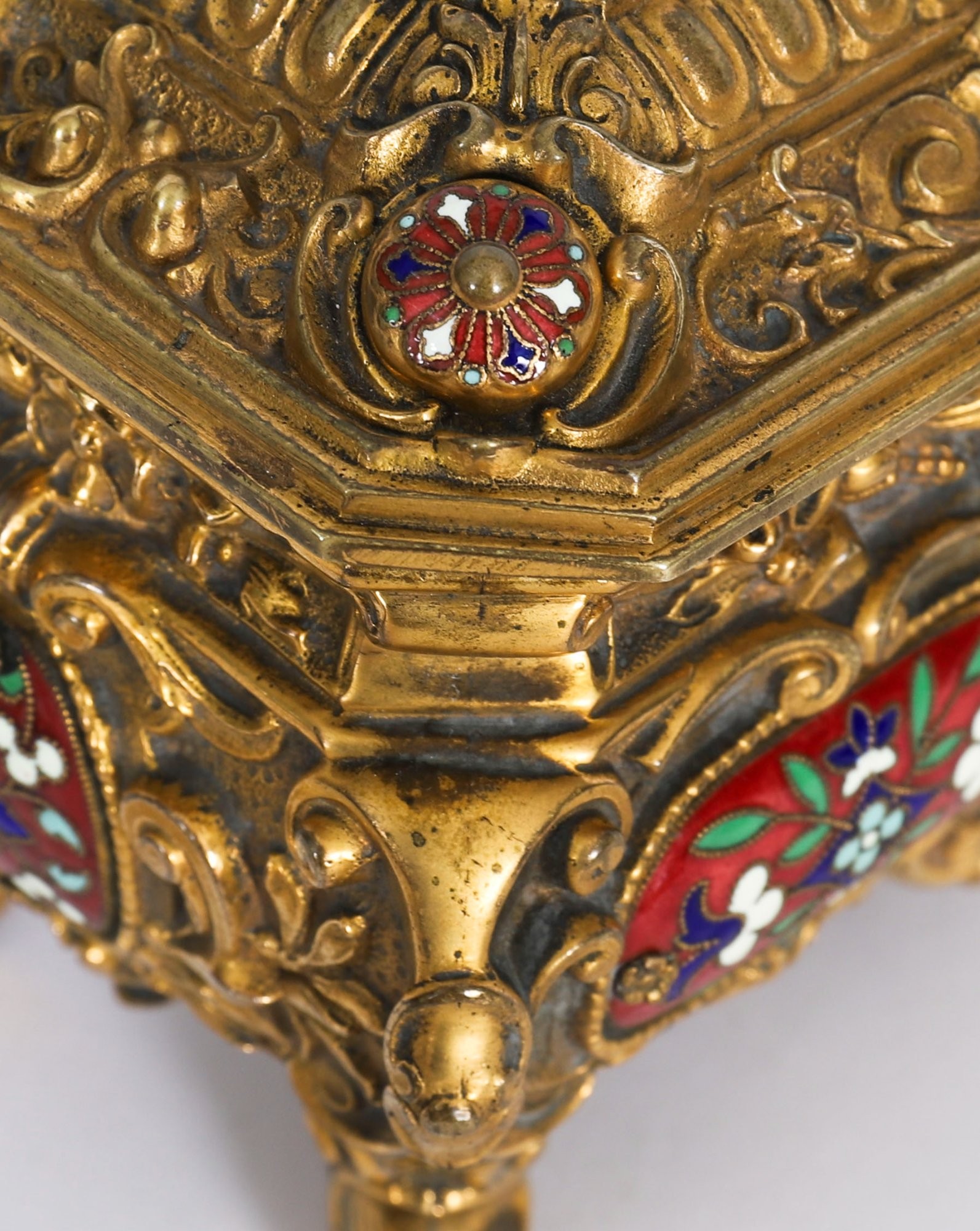
Gilt finish softened on high points: many years of handling.
Cast relief masks and scroll feet: French decorative bronze work.
Enamel floral panels set into bronze recesses: fine Parisian manufacture.
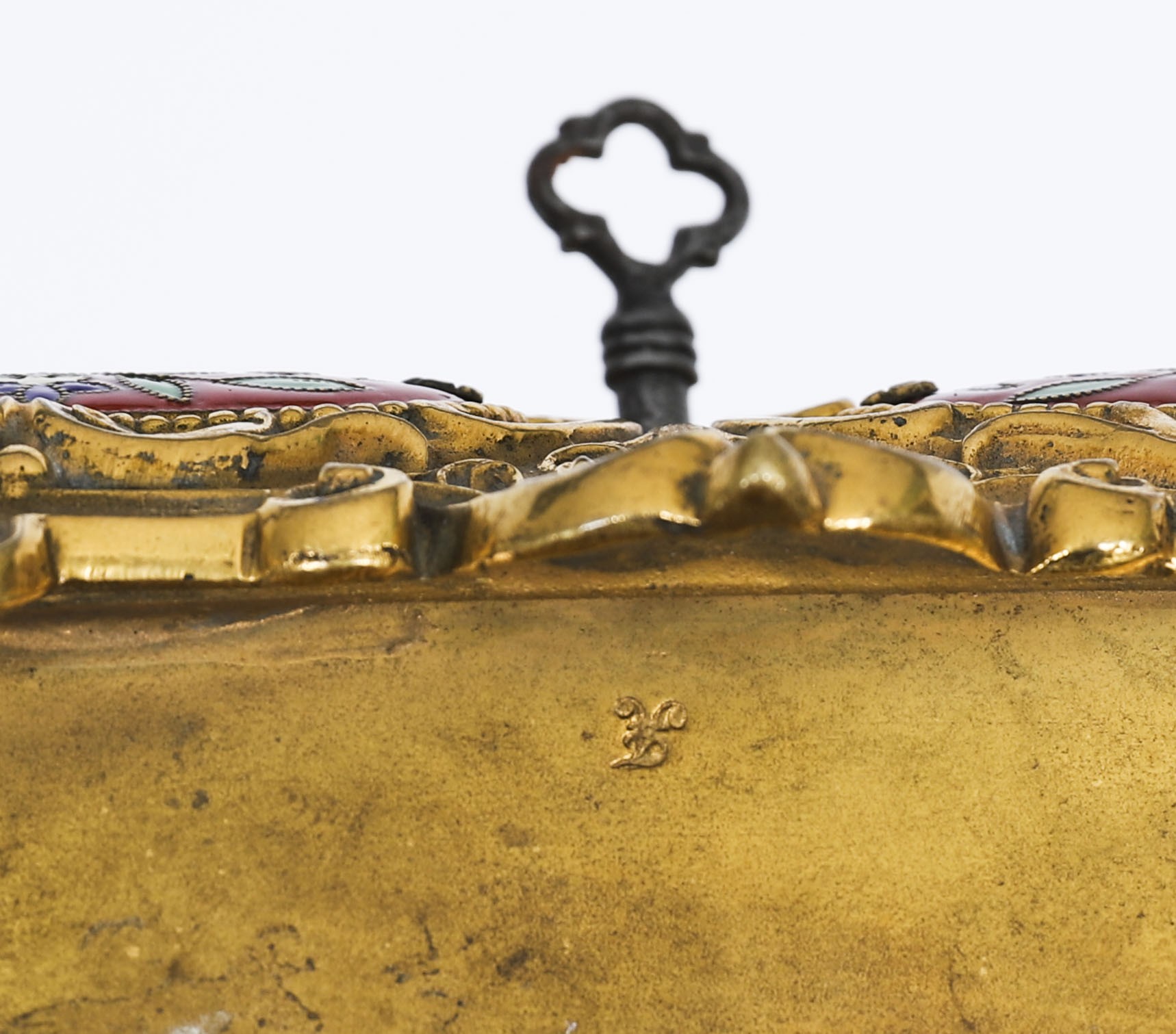
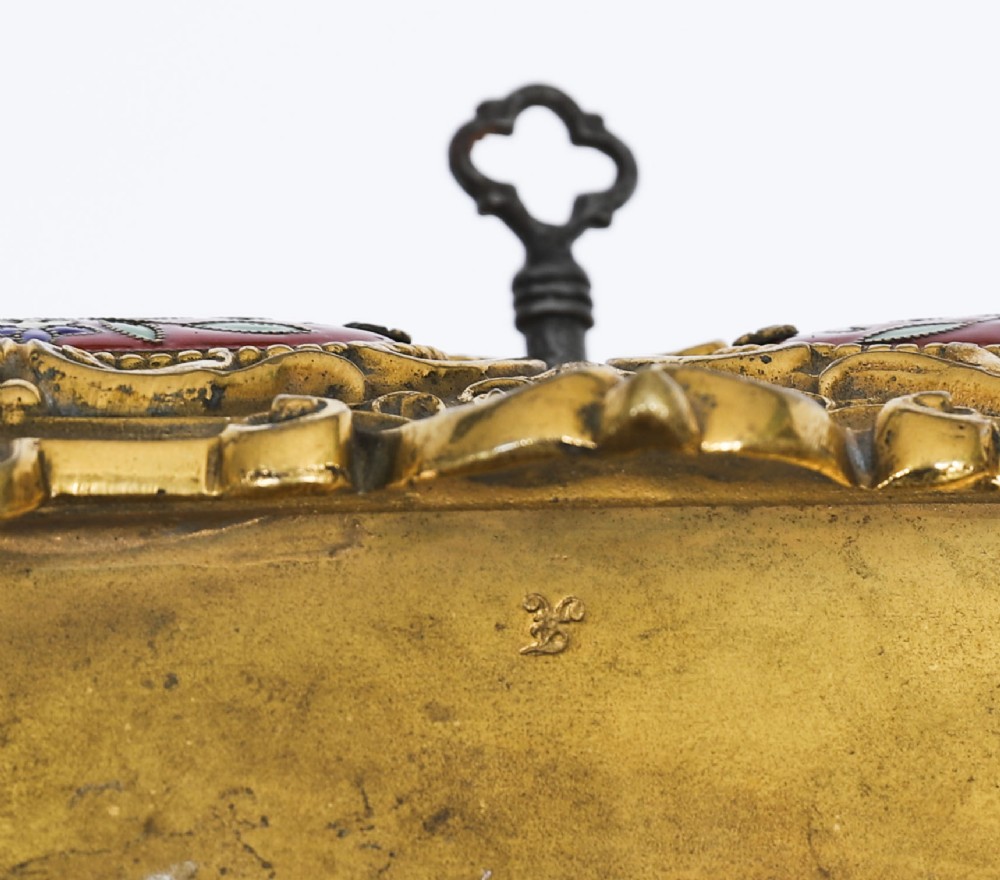
Stamped maker's mark on the rim: standard French workshop practice.

This is an independent date report produced by Sellingantiques using its own proprietary system. The process uses the photographs shown on this page. The system is never told the date the dealer has declared. This report shows that the two dates corroborate.

Physical Dimensions
Height
12cm (4.72")
Width
15cm (5.91")
Depth
9.5cm (3.74")
Reference Numbers
Sellingantiques Reference
SA1244311
Dealers Internal Reference
A5475
Description
A superb quality French Louis XIV Revival ormolu and cloisonné enamel jewellery casket, circa 1870 in date.


The stunning casket is of bombé rectangular form richly cast in relief with scrolls, masks and laurel branches and inset with oval cloisonné enamel panels of flowers in blue, white and green upon a red ground within beaded borders, the hinged cover with canted angles and a further panel, the interior lined in red velvet, upon four scroll feet, with a key.

fig 1. A 19th-century French gilt bronze jewellery casket decorated with Rococo scrollwork and inset polychrome enamel panels, complete with key.
fig 1. Antique French Ormolu and Cloisonne Enamel Jewellery Casket, 19th C


It is a lovely piece which is functional as well as being highly decorative.

Complete with lock and original key.


Condition:

In excellent condition; please see photos for confirmation.

Dimensions in cm:

fig 2. A 19th-century French gilt bronze jewellery casket decorated with Rococo scrollwork and inset polychrome enamel panels, complete with key.
fig 2. Antique French Ormolu and Cloisonne Enamel Jewellery Casket, 19th C

Height 12 cm x Width 15 cm x Depth 9.5 cm

Dimensions in inches:

Height 5 inches x Width 6 inches x Depth 4 inches

Cloisonné

is a decorative enamel technique where thin metal wires (called cloisons, French for “partitions” or “cells”) are attached to a metal base to create little compartments, which are then filled with powdered glass or enamel paste and fired.

“
The technique goes back to the Byzantine Empire and the Near East, where it was used on religious objects and jewelry.
Regent Antiques

It reached China around the 14th century, where it became famous (in Chinese, it’s called jingtailan, after the Jingtai era of the Ming dynasty, and the Chinese pieces are often blue). Japan developed its own refined tradition in the 19th century, with exquisite work by makers like Namikawa Yasuyuki. It’s still practiced today in China, Japan, Russia, and elsewhere.

fig 3. A 19th-century French gilt bronze jewellery casket decorated with Rococo scrollwork and inset polychrome enamel panels, complete with key.
fig 3. Antique French Ormolu and Cloisonne Enamel Jewellery Casket, 19th C

Ormolu - Gilt Bronze (from French 'or moulu', signifying ground or pounded gold) is an 18th-century English term for applying finely ground, high-carat gold in a mercury amalgam to an object of bronze. The mercury is driven off in a kiln, leaving behind a gold-coloured veneer known as 'gilt bronze'.

fig 4. A 19th-century French gilt bronze jewellery casket decorated with Rococo scrollwork and inset polychrome enamel panels, complete with key.
fig 4. Antique French Ormolu and Cloisonne Enamel Jewellery Casket, 19th C

The manufacture of true ormolu employs a process known as mercury-gilding or fire-gilding, in which a solution of nitrate of mercury is applied to a piece of copper, brass, or bronze, followed by the application of an amalgam of gold and mercury. The item was then exposed to extreme heat until the mercury burned off and the gold remained, adhered to the metal object.

fig 5. A 19th-century French gilt bronze jewellery casket decorated with Rococo scrollwork and inset polychrome enamel panels, complete with key.
fig 5. Antique French Ormolu and Cloisonne Enamel Jewellery Casket, 19th C

After around 1830, because legislation had outlawed the use of mercury, other techniques were used instead. Electroplating is the most common modern technique. Ormolu techniques are essentially the same as those used on silver to produce silver-gilt.

Our reference: A5475

Date of Manufacture

Regent Antiques has dated this French Ormolu Jewellery Casket to the 1870s.

Independent Date Report ID 09710177
Dealer's Item Date1870s
Sellingantiques dating1870s
Sellingantiques agingItem 140-165 years old
Test ResultsPassed dating check
Why Sellingantiques dated this piece to the 1870s:
Gilt finish softened on high points: many years of handling.
Cast relief masks and scroll feet: French decorative bronze work.
Enamel floral panels set into bronze recesses: fine Parisian manufacture.
Stamped maker's mark on the rim: standard French workshop practice.

This is an independent date report produced by Sellingantiques using its own proprietary system. The process uses the photographs shown on this page. The system is never told the date the dealer has declared. This report shows that the two dates corroborate.

Height
12cm (4.72")
Width
15cm (5.91")
Depth
9.5cm (3.74")
Reference Numbers
Sellingantiques Ref
SA1244311
Dealers Internal Ref
A5475
Regent Antiques
Regent Antiques
Sellingantiques verified Since Sep 2016

We specialise in english and continental furniture, silver, porcelain and decorative items.

Dealer Profile

You can view the stock and full dealer information on the Regent Antiques Profile Page

Trade Associations

Regent Antiques is a registered member of LAPADA  CINOA
PDF SHARE
SAVE
A 19th-century French gilt bronze jewellery casket decorated with Rococo scrollwork and inset polychrome enamel panels, complete with key.
1 / 15
Archive I A 19th-century French gilt bronze jewellery casket decorated with Rococo scrollwork and inset polychrome enamel panels, complete with key.

Antique French Ormolu and Cloisonne Enamel Jewellery Casket, 19th C
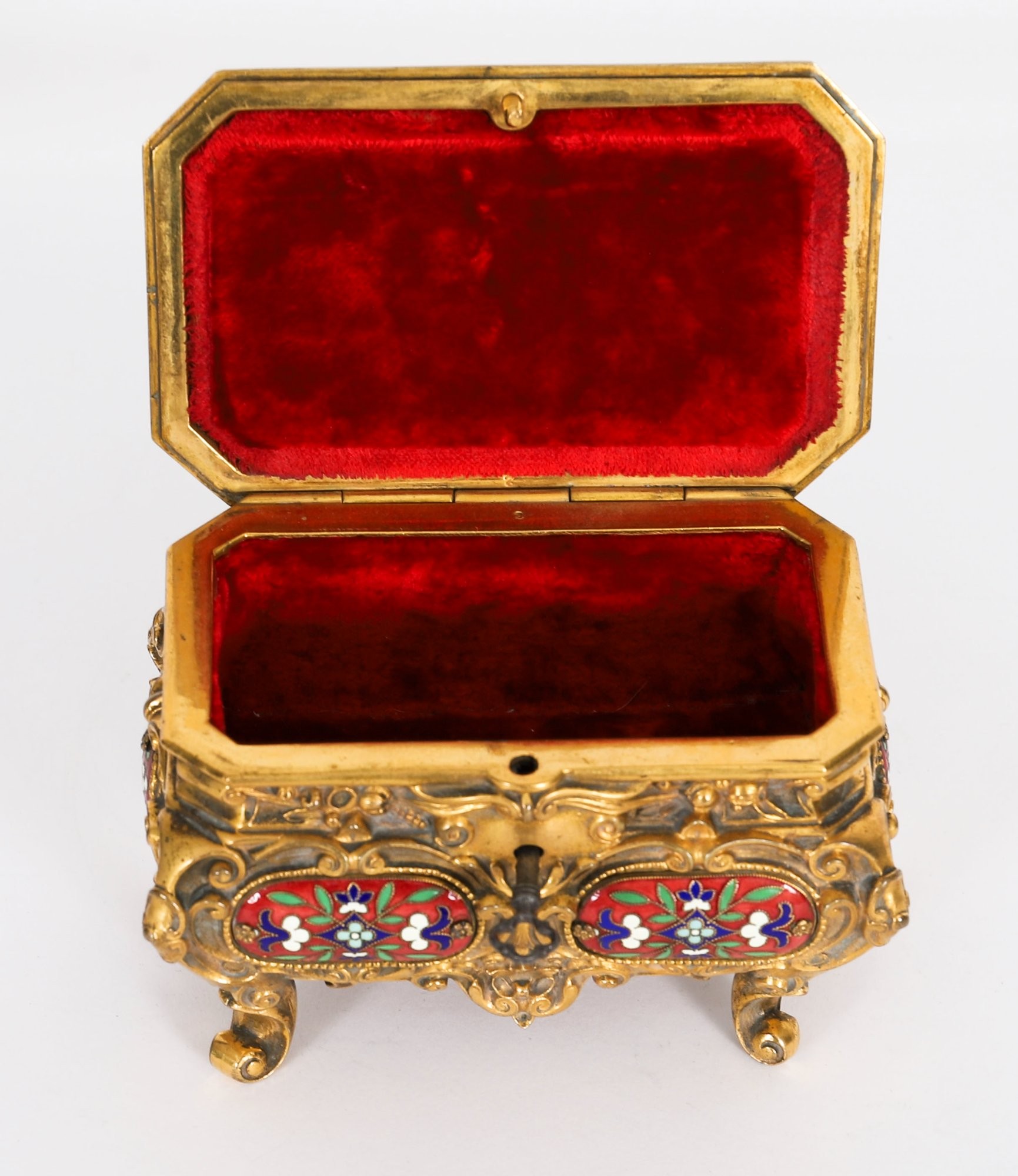
Archive II A 19th-century French gilt bronze jewellery casket decorated with Rococo scrollwork and inset polychrome enamel panels, complete with key. View II
Archive III A 19th-century French gilt bronze jewellery casket decorated with Rococo scrollwork and inset polychrome enamel panels, complete with key. View III
Archive IV A 19th-century French gilt bronze jewellery casket decorated with Rococo scrollwork and inset polychrome enamel panels, complete with key. View IV
Archive V A 19th-century French gilt bronze jewellery casket decorated with Rococo scrollwork and inset polychrome enamel panels, complete with key. View V
Archive VI A 19th-century French gilt bronze jewellery casket decorated with Rococo scrollwork and inset polychrome enamel panels, complete with key. View VI
Archive VII A 19th-century French gilt bronze jewellery casket decorated with Rococo scrollwork and inset polychrome enamel panels, complete with key. View VII
Archive VIII A 19th-century French gilt bronze jewellery casket decorated with Rococo scrollwork and inset polychrome enamel panels, complete with key. View VIII
Archive IX A 19th-century French gilt bronze jewellery casket decorated with Rococo scrollwork and inset polychrome enamel panels, complete with key. View IX
Archive X A 19th-century French gilt bronze jewellery casket decorated with Rococo scrollwork and inset polychrome enamel panels, complete with key. View X
Archive XI A 19th-century French gilt bronze jewellery casket decorated with Rococo scrollwork and inset polychrome enamel panels, complete with key. View XI
Archive XII A 19th-century French gilt bronze jewellery casket decorated with Rococo scrollwork and inset polychrome enamel panels, complete with key. View XII
Archive XIII A 19th-century French gilt bronze jewellery casket decorated with Rococo scrollwork and inset polychrome enamel panels, complete with key. View XIII
Archive XIV A 19th-century French gilt bronze jewellery casket decorated with Rococo scrollwork and inset polychrome enamel panels, complete with key. View XIV
Archive XV A 19th-century French gilt bronze jewellery casket decorated with Rococo scrollwork and inset polychrome enamel panels, complete with key. View XV
Enlarged Archival View
Location
Manor Warehouse
318 Green Lanes
London
N4 1BX
United Kingdom
Verified Since Sep 2016
Items For Sale 658
Items Sold 2,713
Regent Antiques
Regent Antiques
Verified Since Sep 2016
View Dealer Info
Location: Manor Warehouse, 318 Green Lanes, London, N4 1BX, United Kingdom
Verified
Sep 2016
For Sale
658
Sold
2,713
A 19th-century French gilt bronze jewellery casket decorated with Rococo scrollwork and inset polychrome enamel panels, complete with key.
Antique French Ormolu and Cloisonne Enamel Jewellery Casket, 19th C
Ref: SA1244311
A 19th-century French gilt bronze jewellery casket decorated with Rococo scrollwork and inset polychrome enamel panels, complete with key.
Detail View 1
Detail View 2
Detail View 3
Detail View 4
Detail View 5
Detail View 6
Detail View 7
Detail View 8
Detail View 9
Detail View 10
Detail View 11
Detail View 12
Detail View 13
Detail View 14
Archival Detail
Every single antique dealer on our platform is individually approved by our internal team. We verify their professional trade history, ethical standards, and photographic quality to ensure a secure, high-standard buying environment. Upon joining, every dealer agrees to a strict 9-point code of conduct. While issues can occasionally arise, our dealers typically resolve them swiftly and directly with the buyer. In fact, since our founding in 2002, Sellingantiques has only had to step in to help resolve an issue on roughly five occasions—a true testament to the quality of our dealers and their dedication to your happiness.
Our dealers are highly experienced in packing and shipping fragile, high-value antiques. Because you are in direct contact with the dealer, you will be able to easily go through all available shipping and insurance options together to ensure your item arrives safely.
Antiques are the ultimate green purchase. By choosing historical pieces over newly manufactured goods, you completely eliminate the carbon footprint of modern mass production while preserving exceptional, timeless craftsmanship.
Written by Sellingantiques from the dealer’s photographs and listing
  • ObjectJewellery Caskets
  • Period19th century
  • StyleFrench Rococo Revival
  • MaterialOrmolu, Gilt Bronze, Enamel
  • ColourGold
  • MotifsRococo scrollwork, Champleve enamel panels, Cabriole feet, Escutcheon keyhole
  • SizeH 12 cm (5 in) x W 15 cm (6 in) x D 9.5 cm (4 in)

This nineteenth-century French Rococo Revival jewellery casket takes the form of a rectangular ormolu container cast in relief with scrollwork, masks, and laurel branches. Gold in colour, the gilt bronze body features inset oval panels of polychrome enamel depicting flowers in blue, white, and green against a red ground within beaded borders. The hinged cover incorporates canted angles alongside an upper enamel panel, while the base rests upon four scroll feet. A key is inserted into the central escutcheon keyhole on the front. Measuring 12 cm high, 15 cm wide, and 9.5 cm deep, this item functions practically while providing ornamental value in a domestic setting. In a modern home, it suits placement on a sideboard top to hold small personal items.

During the nineteenth century, French decorative artists combined cast gilt bronze, known as ormolu, with vibrant champleve or cloisonne enamel work, producing elaborate table caskets inspired by Renaissance and Rococo motifs.

These caskets are typically constructed from heavy cast bronze or brass finished with gilding, featuring inset vitreous enamel panels in defined metal compartments and often fitted with silk or velvet interiors.

Authentic pieces feature heavy, detailed hand-chiselled metalwork, functional lock mechanisms with original steel keys, genuine vitreous enamel fused to the metal, and age-appropriate wear or minor oxidisation to the gilded surfaces.

Place the casket on a bedside table, hallway console, or vanity top to provide textural contrast and metallic accenting within contemporary room schemes.

Dust gently using a dry microfibre cloth or soft bristle brush, avoiding liquid cleaners, chemical polishes, or moisture that can strip gilt finishes or degrade vitreous enamel.
items
Add keywords to the filter
Price
£100
£250000
Era
Period
Style
Material
Origin
Stock Location
Recently Added
Online Payments
Categories