


A 2026 Guide by Sellingantiques
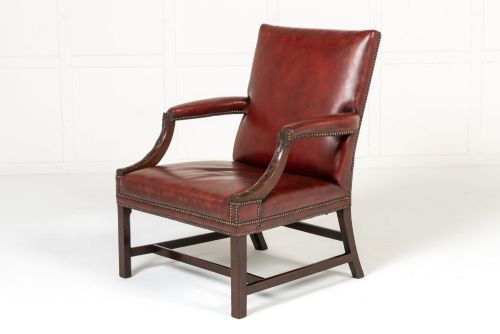
Georgian Style Leather Gainsborough Library Chairs, 1910
Priced at £1,595 from Shackladys Antiques
Thomas Chippendale called them French chairs in his trade catalogues. The current name only stuck in the late nineteenth century.
Look for wide seats. Gentlemen wore voluminous coats and carried swords when sitting down in these during the Georgian period.
Most antique Gainsborough chairs were meant for reading. Sitters pulled them close to the fire with a book.
Often found matching library steps or reading stands from the same era.
William Hallett supplied upholstered library chairs in this exact form to aristocratic clients during the 1740s.
Look for Paul Saunders in the Soho records. He made several documented sets for great houses.
Provincial makers copied London patterns for local gentry. Many fine antique Gainsborough chairs carry no stamp.

Mid C19th Irish Carved Mahogany ‘Gainsborough’ Library Armchair in the Mid C18th George II Period Style., 19th Century
Priced at £1,950 from M Lees and Sons
The 2026 retail price guide for Antique Gainsborough Chairs is drawn from a proprietary archive of over 1.1 million retail prices indexed by Sellingantiques since 2003. This guide relies exclusively on their own internal data; no external sources or auction records are used.
Analysing nearly 25 years of UK antique market history alongside current retail values, the data indicates that typical UK retail prices for Antique Gainsborough Chairs range between £1,200 and £5,200. Entry-level prices generally fall under £1,200 and premium examples upwards of £5,200.
Open sides always separate the armrests from the seat. This gives them a lighter profile than fully enclosed armchairs.
Padded armrests slope downwards. The wooden supports often sweep back slightly to meet the seat frame.
Straight square legs suggest a date after 1760. Cabriole legs point to earlier George II production.
Early makers relied on heavy timber frames to bear the weight. Later designs use thinner rails braced with corner blocks.
Carvers sometimes stopped their decoration just above the upholstery line. This saved time on hidden sections.
Inspect the stretcher arrangements. An H-stretcher provides extra rigidity for thinner square legs.
"The low back design kept heat circulating from a fireplace around the sitter's shoulders."
"Open arms provided space for spreading heavy silk skirts."
"Push two together. They were sometimes supplied with matching stools to create a long daybed."
Based on almost 25 years of Sellingantiques UK antique market data, Antique Gainsborough Chairs appeared 527 times (out of 1,100,000 antiques) which gives it a rarity score of 90/100.
This score measures scarcity within the Sellingantiques archive only and is not a survey of the entire antiques market, so these statistics may not be indicative of the general availability of Antique Gainsborough Chairs elsewhere.
Library chairs needed to move easily across floorboards. Readers pulled them closer to the hearth or a window for better light.
Original castors are brass with leather or wooden wheels. Many got changed in the nineteenth century when ceramic wheels became common.
Antique upholstery relies on webbing stretched across the bottom of the seat frame. Over decades, this canvas web stretches and loses tension.
Old webbing can snap under weight. The horsehair padding then drops into the void, causing that sagging feeling.
A good upholsterer can strip the seat back to the frame and rebuild it. They use fresh webbing to restore the original firm seating position.
Yes, updating the cover is standard practice. Few eighteenth-century seats keep their first fabric.
Just check the timber beneath. Hundreds of old tacks can splinter the rails if recovered too often.
The joints take sideways stress every time someone sits and shifts their weight. Hide glue becomes brittle after a century in central heating.
The wooden dowels or tenons eventually break their bond with the frame. This creates a slight rocking movement in the arm support.
Leave loose joints alone if they only move a fraction. If the arm feels like it might detach, a restorer needs to clean out the old glue and re-seat it.
Please note: This Antique Gainsborough Chairs guide and its associated pricing data are provided for general informational purposes only. It does not constitute formal financial, investment, or appraisal advice and should not be relied upon as the sole basis for any commercial activity, purchasing, or sales decisions. Sellingantiques.co.uk accepts no liability for any actions taken in reliance on this information. Always consult with a qualified professional or independent appraiser.
