7,315  PAGES BROWSED TODAY PAGES TODAY 0 ANTIQUES UPLOADED TODAYNEW ARRIVALS
Satsuma Vases
Satsuma Vases
LATEST STOCK
Sort Order
Items Per Page
Browse Categories
Sort order
Items per page
Home > Vases > Satsuma Vases > Page 1

Antique Satsuma Vases

78 items · page 1 of 5
Page 1 of 5

Japanese crackle-glazed earthenware vases, enamelled and gilded over a cream body, made for export from the later nineteenth century and sold as decoration for Western rooms.

£595
2 WEEKS AGO
vases
£495
2 WEEKS AGO
vases

Satsuma vases have been listed on Sellingantiques since 2008.

£5,200
3+ MONTHS AGO
vases
£225
3+ MONTHS AGO
vases
1 2 3 4 5
Sellingantiques  ·  Guide 5612026/2027 edition
Vases

Antique Satsuma Vases

Japanese crackle-glazed earthenware vases, enamelled and gilded over a cream body, made for export from the later nineteenth century and sold as decoration for Western rooms.

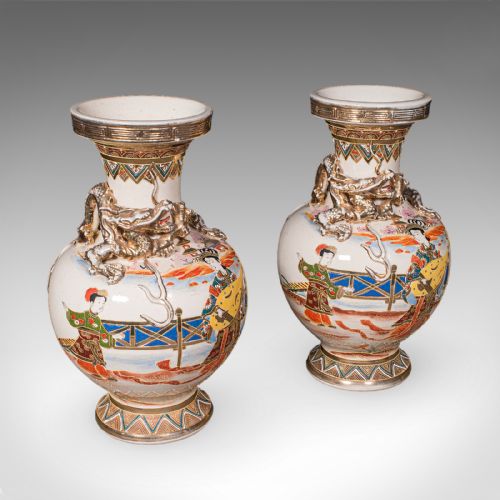
Quality large antique Japanese Satsuma vase
Plate I  ·  Quality Large Antique Japanese Satsuma Vase, 1900Unique Antiques by Emma Jade
The category

What Satsuma Vases Are

Satsuma takes its name from the old province in southern Kyushu, where a crackle-glazed cream earthenware was made from the seventeenth century. The finely enamelled, heavily gilded style sold as Satsuma in Britain is largely a nineteenth-century export product, much of it decorated in Kyoto and other centres after Japan opened to foreign trade.

The vase you'll meet on Sellingantiques is a baluster or ovoid form of the Meiji period, roughly 1880 to 1910. The word "japanese" appears in 154 of 257 titles and "meiji" in 77, and the dated field puts 79 listings in the 1900s and 32 in the 1890s. Where a listing says only "19th Century", the title text often narrows it to a Meiji date.

Pairs are close to being the default: 104 of 257 titles say "pair", and the archive also holds three pairs offered at once and two garnitures of four. Scale runs a long way in both directions, from miniature and bud vases up to floor vases stated at 38 inches and a lidded vase at 84cm.

Subjects repeat across unrelated dealers. Rakan and "thousand faces" crowd scenes, bijin and court processions, wisteria, peacocks, dragons and butterflies all turn up throughout. Alongside the plain baluster sit lidded vases and covers, reticulated bodies, moon flasks, triple gourd, garlic head, hexagonal and square forms, each surfacing once rather than as a type.

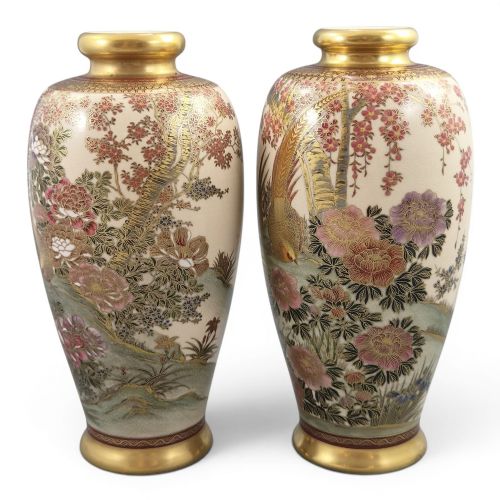
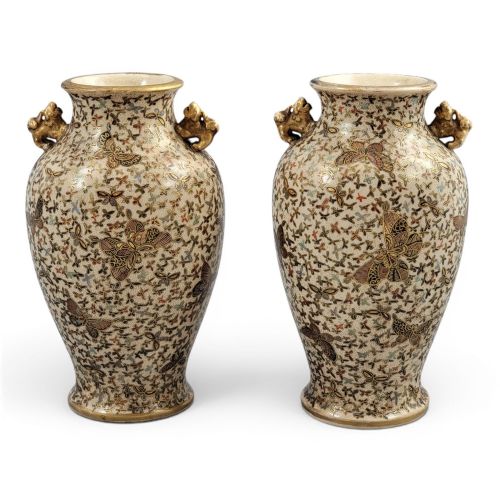
Quality pair of large antique Satsuma vases
Plate II  ·  Quality Pair of Large Antique Satsuma Vases, 1900Unique Antiques by Emma Jade
What sets them apart

What Separates Them

A name does most of the work. Kinkozan appears in 37 titles from seven dealers and sits at the top of the range; Yabu Meizan turns up in 11, and "signed" in 22, with Kizan, Ryozan, Hozan, Seikozan, Shozan and Hotoda surfacing among named pieces. Kyoto is the only decorating centre named with any frequency, in 16 titles.

Then decoration. Titles single out rich gilt, raised gold, heavy gilding and moriage, and the crowded programmes cluster in the dearer listings: 1000 Faces, 1000 Arhats, Thousand Butterflies, thousand flowerheads, samurai and courtly processions. A panel of a single figure on a plain ground sits lower than a body covered edge to edge.

Scale and completeness lift a piece without carrying it alone. "Large" appears in 52 titles, and the biggest recorded are floor vases and an 84cm covered vase. An intact pair beats a single, a garniture of four beats a pair, and an unusual silhouette does more than height on its own.

The market

Retail Price Guide 2026

Entry-levelUnder £400
Typical prices£400 – £3,900
Premium examplesOver £3,900

Typical UK retail prices for satsuma vases, calculated from the Sellingantiques database of over a million retail prices indexed since 2003. This retail price guide relies exclusively on Sellingantiques data; no external sources or auction records are used, so the figures do not describe the wider market.

From the Sellingantiques archive

The largest to pass through Sellingantiques are a pair of floor vases given as 38 inches and a lidded vase given as 84cm high.

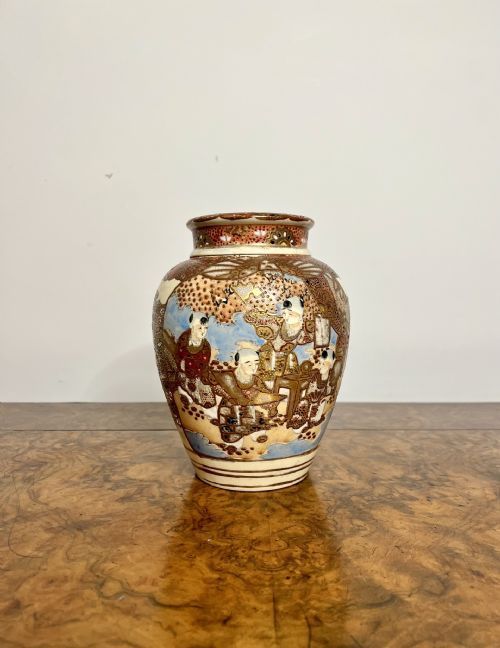
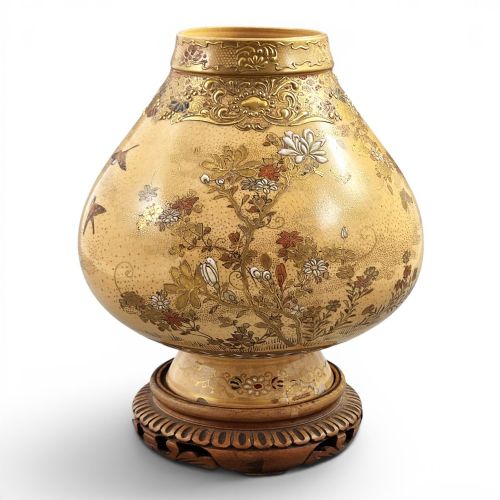
Satsuma Bottle vase circa 1890
Plate III  ·  Satsuma Bottle Vase Circa 1890, VictorianFrank Craig Antiques
Notable makers of satsuma vases

Kinkozan·Kizan

Terms antiques dealers use

The Antique Satsuma Vases Glossary

Satsuma
Cream-bodied Japanese earthenware with a crackled glaze, decorated in enamels and gilt. Titles call the body pottery, earthenware and sometimes porcelain.
Meiji period
1868 to 1912, and the commonest period label in this category, named in 77 titles.
Baluster
The swelling-bodied vase shape, and the silhouette named most often across these listings.
Moriage
Raised slip or enamel standing proud of the surface, named in several titles as a selling point alongside raised gold.
Rakan or arhat
Buddhist disciples, a stock figural subject, sometimes listed in the crowded form as 1000 Arhats.
Kyo-Satsuma
Satsuma-style wares decorated in Kyoto workshops rather than in the south; "kyoto" appears in 16 titles.
Questions people ask

Frequently Asked Questions

What does Meiji period mean on a Satsuma listing?

It refers to 1868 to 1912, the years when most export Satsuma reached the West. The word appears in 77 of 257 titles on Sellingantiques, making it the commonest period label in the category.

The dated field runs 1860 to 1930, with the 1900s the largest single bucket. A good number of listings dated simply "19th Century" carry a Meiji date or a c.1890 in their own wording.

Are Satsuma vases usually sold in pairs?

Often, yes. 104 of 257 titles say "pair", so a buyer meets pairs almost as readily as singles.

Larger groupings exist too. The archive holds one listing of three pairs together and two separate garnitures of four vases.

How big do Satsuma vases get?

The range is wide. At the top end are floor-standing vases stated at 38 inches and a lidded vase at 84cm, with "large" appearing in 52 titles.

At the other end sit miniature vases, bud vases and mini vases on stands, with "miniature" in 10 titles. Only a handful of listings give dimensions at all.

Which Satsuma names appear most often?

Kinkozan is the name that carries the top of the range, in 37 titles from seven dealers. Yabu Meizan appears in 11 titles and Kizan in four from three dealers.

Other names surface among signed pieces: Ryozan, Hozan, Seikozan, Shozan, Hotoda. Some titles record a signature, others say only "attributed to".

What subjects are painted on Satsuma vases?

Figural, floral and landscape panels dominate. Rakan or arhats, bijin, court and samurai processions, wisteria, peacocks, dragons and butterflies all recur.

Crowded patterns have their own trade shorthand, repeated by unrelated dealers: 1000 Faces, Thousand Faces, 1000 Arhats, Thousand Butterflies and a thousand-flowerhead vase.

Is Satsuma pottery or porcelain?

It is an earthenware with a crackled cream glaze, and titles describe it as pottery or earthenware.

The word porcelain does appear in a small number of titles, used loosely. The evidence on Sellingantiques doesn't settle which term a given dealer prefers.

65,789
Antiques For Sale
0
Antiques Approved Today
1,455
Antique Uploads This Month
438,840
Total Antiques Sold
items
Add keywords to the filter
Price
£100
£250000
Era
Movements
Material
Origin
Stock Location
Freshness
Online Payments
Categories