


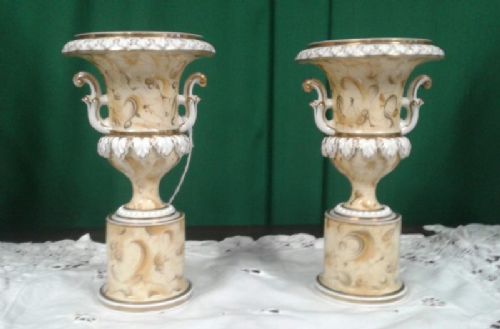


Antique Campana Vases
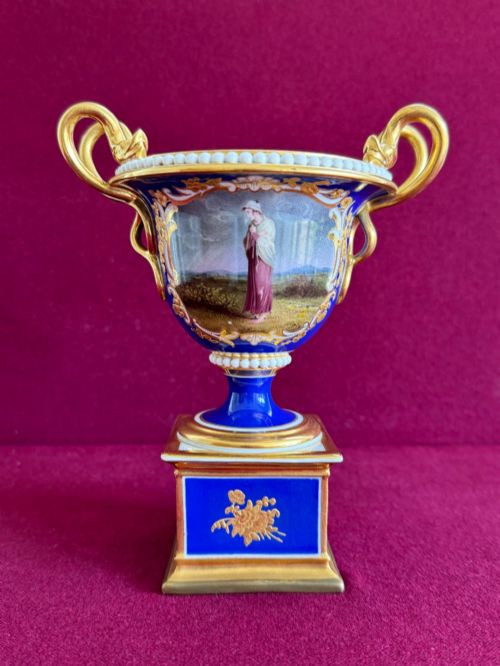
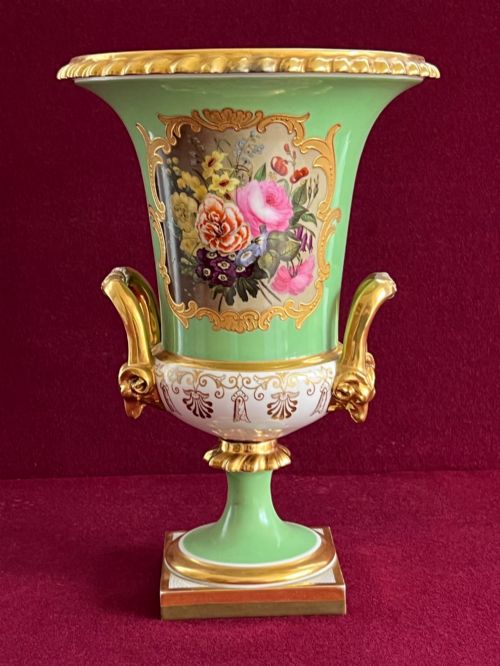
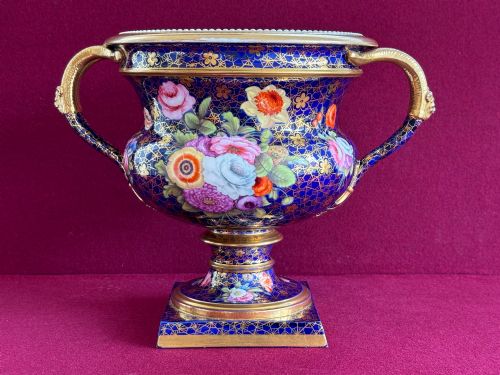
A campana vase is an urn on a short stem with a flaring, inverted-bell body, made from the late 18th century onwards as a mantel or console ornament rather than for any practical use.

Antique Campana Vases
The shape takes its name from the Italian for bell, and the form from the ancient Greek bell krater. Neoclassical taste brought it back into European workshops as excavation and pattern books spread the antique repertoire. It was an ornamental vessel from the start, usually made in pairs for a mantel or console.
Porcelain dominates. Half the listings on Sellingantiques name porcelain or a porcelain factory, and pairs appear in 8 of the 15 records, so a Regency to mid-Victorian English or French porcelain pair is the likeliest thing you will meet. English work forms the largest block, with French porcelain, including vases described as Medici form, close behind.
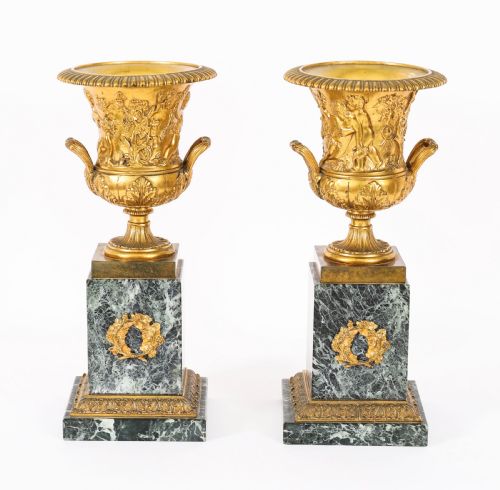
Outside porcelain the archive holds a cut-crystal body with ormolu mounts, a pair of Charles X bronzes on siena marble bases, gilt-bronze Grand Tour urns, and a pair of ivory-mounted burr fruitwood lidded urns. That last form turns up once and nowhere else, which is a fair guide to how thinly the non-porcelain branches are spread.
Names shift about. Three listings call the profile a Medici vase, one a Warwick vase, and several describe pieces as of classical campana design without using the word campana at all. Dating shifts too: the dated field leans on loose labels like 19th Century and Regency, while the titles carry the tighter circa, reaching back to c.1810.

Where Value Sits
A named factory does most of the work. Flight, Barr & Barr Worcester accounts for four listings, more than any other single description, and sits at the top of the range with the other named-factory porcelain. Unattributed porcelain sits at the bottom of it.
Painting is the next lever. Titles that describe topographical views or armorial bearings carry decoration worth describing, and plain-bodied examples do not. Two listings go further and name the painter as well as the factory, one signed Hawkins and one decorated by Thomas Lowe; both sit in the upper half.
Pairs cluster high and singles cluster low, which follows from a form made in twos for a chimneypiece. Mixed materials also lift a piece: ormolu-mounted crystal, ivory-mounted fruitwood and bronze on siena marble all sit above the plain porcelain.
Antique Campana Vases Retail Price Guide 2026
Typical UK retail prices for campana vases, calculated from the Sellingantiques database of over a million retail prices indexed since 2003. This retail price guide relies exclusively on Sellingantiques data; no external sources or auction records are used, so the figures do not describe the wider market.
Campana is just the Italian word for bell. The same profile also turns up named as a Medici vase and as a Warwick vase.
The Antique Campana Vases Glossary
- Campana
- Italian for bell, describing the inverted-bell body that defines the form.
- Medici vase
- A closely related flaring urn named after a famous antique marble, used in three titles in place of campana.
- Ormolu
- Gilded bronze mounts, fitted in this archive to a cut-crystal body.
- Topographical
- Painted with an identifiable view or landscape, a premium decoration in these listings.
- Warwick vase
- A specific antique model quoted in one title, a campana variant with handles and a gadrooned body.
- Grand Tour
- Souvenir bronzes and marbles in the antique taste; one pair of gilt-bronze urns is so described.
Antique Campana Vases: Frequently Asked Questions
Why are so many sold as pairs?
The form was made for symmetry, standing at either end of a mantel or on flanking consoles. That intent shows in the records: 8 of the 15 listings are pairs rather than single vases.
Pairs also cluster in the upper part of the range, while single vases cluster low.
What is a Medici vase?
It is a closely related flaring urn form, named after a famous antique marble. Three listings use it instead of the word campana for what is effectively the same profile.
One title quotes the Warwick vase as well, a campana variant with handles and a gadrooned body. So the same shape arrives under at least three names.
Are these vases English or French?
English porcelain forms the largest single block, with the named factories in the titles taking the top of the range.
French origin is claimed in five titles, making it the commonest origin after English. That includes French porcelain, a Charles X bronze pair and a cut-crystal example with ormolu mounts.
How often do campana vases come up for sale?
Roughly two a year are listed on Sellingantiques, spread across nine different dealers.
That means no single dealer holds a run of them, and the archive as a whole is small at fifteen records.
Which dates are you likely to see?
The dated field leans on broad labels, with 19th Century and Regency taking most of the entries and single records for Georgian, Victorian, the 1870s, 1890s and 1910s.
Only three listings carry a clean year, running 1870 to 1910. The closer dating lives in the titles, which give circas from c.1810 through to c.1830.
What are they made from besides porcelain?
Porcelain dominates, but the archive also holds bronze on siena marble bases, gilt-bronze Grand Tour urns and a cut-crystal body with ormolu mounts.
There is also a pair of ivory-mounted burr fruitwood lidded urns of classical campana design, a treatment that appears once and nowhere else.