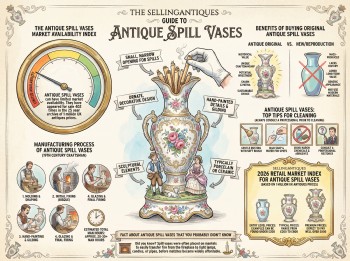
Antique Spill Vases
A spill vase is a small upright holder that stood on the mantelpiece with paper twists or wood slivers in it, ready to carry a flame from the fire to a candle or a pipe.

What Are Spill Vases?
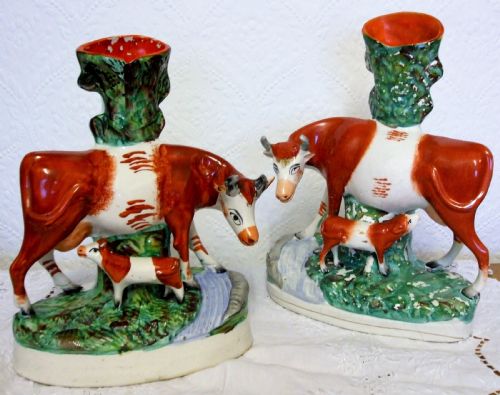
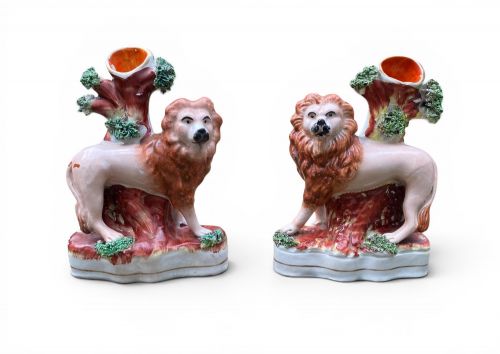
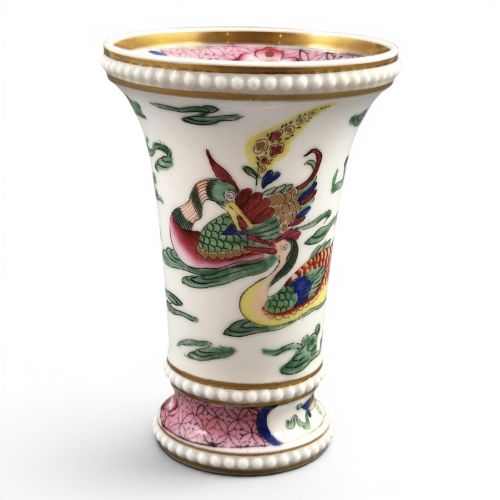
Two quite different things sit under the heading. One is the modelled Staffordshire earthenware group, an animal or rustic figure with a tube or tree stump worked in behind it. The other is a plain porcelain cylinder, painted or gilded, the sort a mantelpiece pair was made from.
The Staffordshire figural type is the single largest block on Sellingantiques, with staffordshire in 37 of 101 titles and victorian staffordshire in 13 of them. Sheep, spaniels, cow-and-calf, deer, swans, horses, greyhounds and foxes all recur, and the archive has also turned up a zebra, a mastiff, a poodle, lions and a group inscribed MILK SOLD HERE. This branch sits at the lower end of the range.
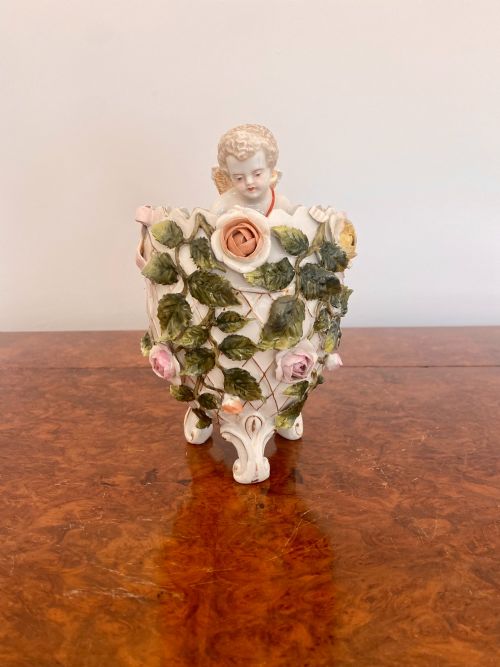
On the porcelain side, Royal Worcester dominates, painted with fruit, highland cattle, sheep, stags or storks. Earlier English porcelain cylinders dated around 1810 to 1830 form a smaller but persistent slice. Continental and Asian pieces appear one at a time rather than as a group, among them Meissen, Chinese porcelain, Japanese Satsuma and Japanese Imari.
Dating tends to be broad. "19th Century" is the commonest entry and "Victorian" the next, and between them they account for over four in ten listings. Where decades are given, the Staffordshire groups cluster in the 1860s and 1880s, the painted Royal Worcester in the 1900s through the 1930s. Almost a quarter of listings are pairs, and that cuts across every branch.

Where The Range Splits
On the Royal Worcester side, a painter's signature does most of the work. Titles carrying a name occupy nearly the whole upper reach of the range, while unsigned Royal Worcester sits well below. The painting subjects repeat: fruit, cattle, sheep, stags, storks.
Within the Staffordshire earthenware, subject decides position. The familiar sheep and spaniel groups sit at the bottom of the category, and the odd ones out climb above them, the zebra, the lions, the foxes, the MILK SOLD HERE group. In porcelain, the Georgian and Regency cylinders of around 1810 to 1830 run above the plainer nineteenth-century English ones.
Two things lift a piece regardless of branch. Pairs recur at every level, including several of the highest sampled entries, and the same subject turns up both singly and paired in the archive. Size matters too: "large" and "massive" are the usual title qualifiers, and the only title stating a measurement, a pair of Japanese Imari at 93cm high, sits at the very top.
Retail Price Guide 2026
Typical UK retail prices for spill vases, calculated from the Sellingantiques database of over a million retail prices indexed since 2003. This retail price guide relies exclusively on Sellingantiques data; no external sources or auction records are used, so the figures do not describe the wider market.
The top sale of the last year on Sellingantiques was a Royal Worcester spill vase decorated with sheep by Harry Davis, in January 2026.

The Antique Spill Vases Glossary
- Spill
- A thin paper twist or sliver of wood used to carry flame from the hearth to a candle or a pipe.
- Spill group
- A modelled animal or figure with the spill tube worked in behind it, the standard Staffordshire form in this category.
- Matchpot
- An alternative name for the same small cylinder, used in two titles on Sellingantiques.
- Flatback
- A figure modelled fully at the front and left plain behind, made to stand against a wall.
- Blush ivory
- A soft shaded cream-to-peach porcelain ground, named in two of the sampled titles.
- Moriage
- Raised slip decoration, applied rather than painted, named once on a Japanese Satsuma piece.
Frequently Asked Questions
What were spill vases used for?
They held spills, the paper twists and wood slivers used to take a flame from the fire to a candle or a pipe. They stood on the mantelpiece where the fire was.
They were made in quantity through the nineteenth century. Matches and then electricity turned them into ornaments rather than tools.
How often do they come up for sale?
Around eleven come to market on Sellingantiques in a year, spread across 38 dealers. No single dealer holds anything like the category.
The archive runs to 101 listings, so the pattern below is drawn from a fair spread rather than one shop's stock.
Are pairs common?
Yes. Twenty-five of 101 listings are pairs, and pairs turn up in every branch, Staffordshire and porcelain alike.
The archive also holds one set of three and one lot described simply as two. The same subject appears both singly and paired, and the paired listings sit higher in the range.
Which Staffordshire subjects turn up?
Sheep, spaniels, cow-and-calf, deer, swans and cygnets, horses and foals, greyhounds and foxes all recur in the titles.
Beyond those, the archive has thrown up a zebra, a mastiff, a poodle, lions, and figure groups including William Tell, Scots Harvesters and Babes in the Wood.
A group inscribed MILK SOLD HERE and one piece titled a Tulip Holder also appear.
Were spill vases only made in pottery?
Mostly ceramic, either earthenware or porcelain. Pearlware and ironstone are both named in titles, and one blue jasper piece appears.
One piece in the whole archive is not ceramic at all: a turned pearwood treen spill vase, dated c.1780 to c.1800, the earliest bracket recorded on Sellingantiques.
How old are the ones for sale?
The dated field runs from 1800 to 1960, though only 41 of the 101 listings carry a clean year.
Georgian and 18th Century are the earliest labels used, on a handful of listings. The latest are a block dated to the 1930s and a single 1960 entry, a signed Royal Worcester piece.