



Antique Cloisonne Vases
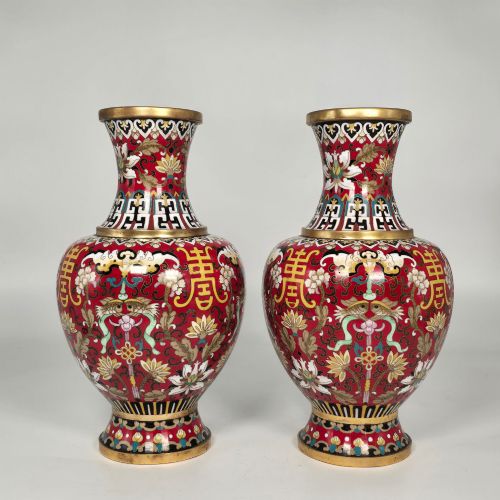
Vases in coloured glass enamel held in wire cells on a metal body, made in Japan and China for display at home and for export.

Antique Cloisonne Vases
The method is old and simple to describe: wires are fixed to a metal body to form cells, the cells are packed with powdered glass, and the piece is fired. Japanese and Chinese workshops turned out enamelled vases in quantity from the mid-19th century, for domestic use and for export west.
The listing you are most likely to meet is a matched pair of Japanese vases of modest size. "Pair" appears in just over half the titles on Sellingantiques, "Japanese" in around six of every ten, and "Meiji" in a quarter. One listing offers a set of three.
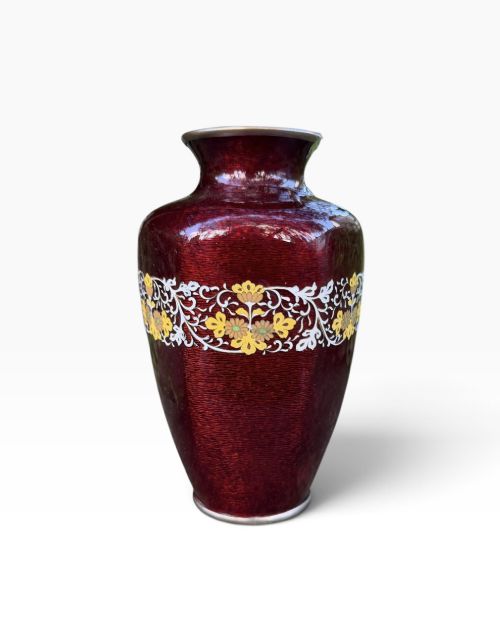
Behind that sit single Japanese vases, often named in the title by technique or subject: musen or wireless work, silver wire, moriage, jiki-shippo, Mount Fuji, an egret, the hoo-oo bird. Chinese cloisonné makes up a smaller group, clustered in the 1900 to 1930 span.
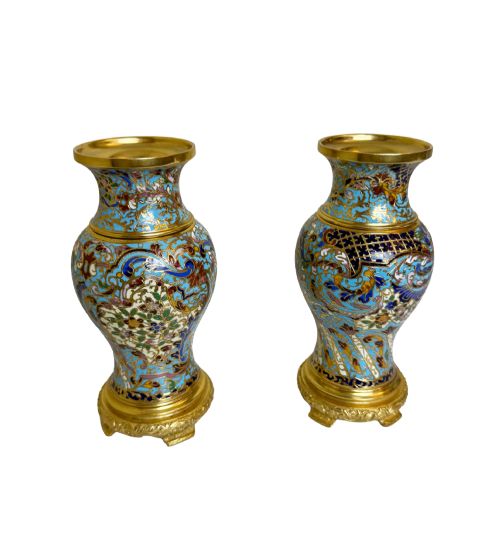
Dates run from 1800 to 1930, with the bulk between 1890 and 1930. Some listings give only "19th Century" as an era label, and a few dated fields sit oddly against the period named in the title, so read the year as dealer shorthand. A handful of vases carried under this heading are champlevé on gilt bronze or French enamelled faience, related by technique rather than by wire cells.
What Sets Them Apart
A workshop name is the clearest divider. Ando and Hayashi are the only names that surface at all, twice each, one of those as a firm attribution rather than a mark, and they sit at the very top of the range. Everything else in the archive is anonymous work.
After that it is the technique named in the title. Musen, silver wire, moriage, basse-taille and ginbari appear from the middle of the range upward, while a plain "cloisonné vase" with nothing further said carries the bottom. Named pictorial subjects behave the same way: Mount Fuji, chrysanthemums, an egret, the hoo-oo bird.
Size pulls in one direction, with "large" recurring through the upper half and "miniature" or "small" at the foot. Pairs spread across the whole range and supply the highest listing, though singles occupy upper slots too, so a pair alone is no guarantee of standing.
Antique Cloisonne Vases Retail Price Guide 2026
Typical UK retail prices for cloisonne vases, calculated from the Sellingantiques database of over a million retail prices indexed since 2003. This retail price guide relies exclusively on Sellingantiques data; no external sources or auction records are used, so the figures do not describe the wider market.
Cloisonne takes its name from the French cloison, a partition - the little wire walls that keep each colour of enamel apart.
The Antique Cloisonne Vases Glossary
- Cloisonné
- Enamel held in cells formed by wires fixed to a metal body, then fired and polished flush.
- Champlevé
- Enamel sunk into recesses cut or cast into the metal itself, with no wires fencing the colour. Named in several titles here.
- Musen, or wireless
- Cloisonné with the dividing wires pulled out before the final firing, leaving unbroken fields of colour.
- Ground
- The background colour of the enamel. Salmon, lemon, green and blue grounds are all specified in titles.
- Ginbari
- Translucent enamel laid over embossed silver or metal foil, so the ground shimmers through. Two listings in the sample.
- Hoo-oo bird
- The Japanese phoenix, one of the decorative subjects that turns up throughout.
Antique Cloisonne Vases: Frequently Asked Questions
How often do cloisonné vases come up for sale?
Only about two reach the market on Sellingantiques in a year, so the category moves slowly.
Twenty different dealers have listed one, which means almost nobody handles them twice. There is no single specialist supplier behind the archive.
Are they usually sold as pairs?
Just over half the titles say "pair", so matched pairs are the norm rather than the exception. One listing offers a set of three.
Single vases make up the rest, and they sit at both ends of the range, from small anonymous pieces up to technique-named work.
Japanese or Chinese, which is more common?
Japanese work dominates the naming, at around six in ten titles, with Meiji attached to a quarter.
Chinese cloisonné forms a smaller contingent, single and paired, and its dated fields cluster between 1900 and 1930.
What does musen mean on a cloisonné vase?
Musen, also written as wireless, means the dividing wires were removed before the final firing. The colour fields run together without visible metal lines.
It is one of several techniques named in titles, alongside moriage, ginbari, silver wire and basse-taille, and those names appear from the middle of the range upward.
Which workshop names appear in the archive?
Two: Ando and Hayashi. Each appears twice, and one of the Hayashi listings is an attribution rather than a mark.
They occupy the highest-priced end of the sample. Everything else is unattributed.
Do unusual shapes turn up in this category?
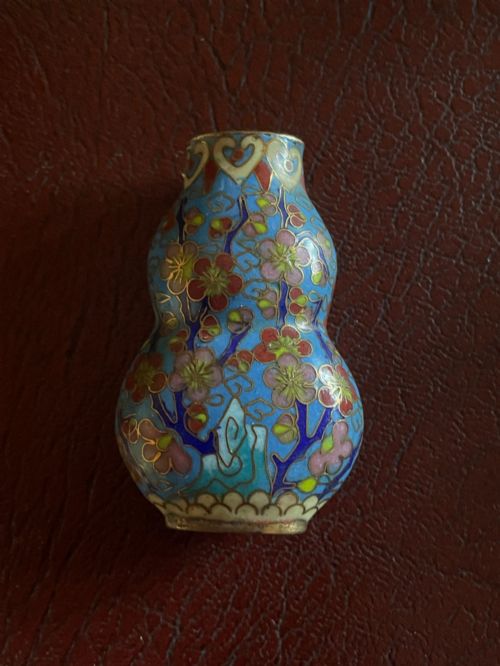
They do, singly rather than in runs. A pumpkin-shaped lidded vase, a double-gourd on a stand, a twin-handled vase with bronze mounts and a silver-mounted example have all been listed.
There is also a pair of French enamelled faience vases, sitting under the heading by technique rather than origin, and one piece worked on porcelain rather than metal.