Antique Vienna Vases
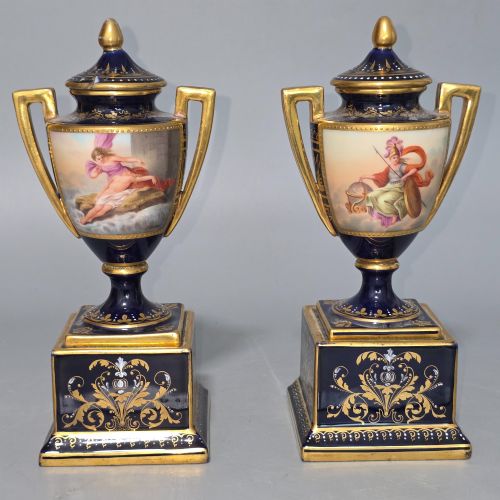
Painted, gilded display porcelain in the Vienna manner, made for a mantel or a cabinet shelf, and more often than not sold as a matched pair.

What Are Vienna Vases?
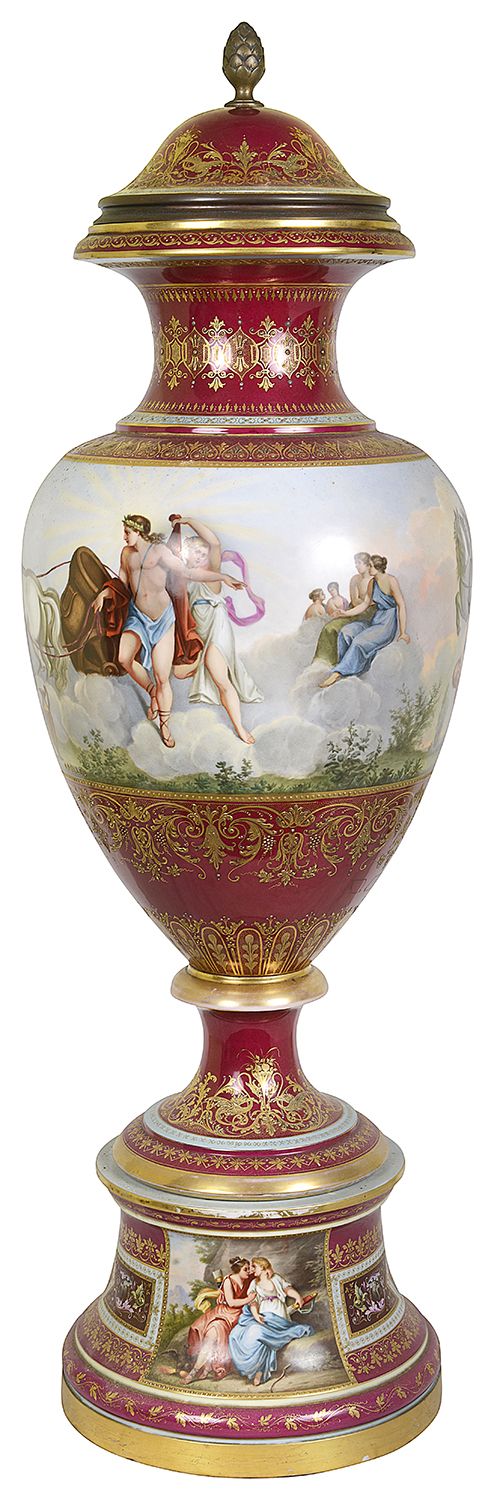
Porcelain vases painted and gilded in the Vienna manner, listed as "Vienna", "Royal Vienna" or "Vienna style". Porcelain appears in 15 of the 26 titles on Sellingantiques, and the decoration runs from portrait panels and classical figure subjects to cobalt grounds and Art Nouveau florals.
Pairs dominate. Eleven of the 26 titles say pair, and plural "vases" appears in twelve, so a single vase is the exception rather than the rule. Covers recur too, sold as "vase & cover" or "lidded vases", and one garniture of three large lidded vases sits at the very top of the range.
Porcelain has been made in Vienna since the early 18th century, and the city's painted cabinet wares became a byword for finely decorated display porcelain. After the original state factory closed in the mid-19th century, its shield mark and its style were taken up widely, so "Vienna" and "Royal Vienna" describe a manner as much as a source. The word "royal" is in a third of titles, and no factory of that name shows up anywhere in the record.
Dating is loose. Eleven listings are dated no more precisely than "19th Century", and the clean years that are given run from 1870 to 1920, with the 1900s the busiest decade. A smaller strand sits apart from the classic painted cabinet vase: Art Nouveau Turn Vienna earthenware and porcelain, about a fifth of the archive, one of them pinned by its model number.

What Sets Them Apart
Configuration does most of the work. Pairs and garnitures hold the top of the range, and the highest-placed listing in the archive is a set of three large lidded vases. Singles cluster low. Covers move a piece up as well, with "lidded" and "& covers" turning up on the dearer entries.
Size pushes in the same direction. Where dimensions are quoted at all, the largest is a pair on stands standing 2ft6" (76cm), and the word "Large" recurs on the more expensive listings. Painting counts where it is identified: a named sitter, a Rembrandt subject, a Rothschild bird pattern, and one painter's signature, which is the only signature in the whole archive.
Attribution separates the ends of the range. An outright Vienna description sits above the two listings that say "Vienna style", and the Art Nouveau Turn Vienna wares occupy the lower half consistently, whatever their form.
Retail Price Guide 2026
Typical UK retail prices for vienna vases, calculated from the Sellingantiques database of over a million retail prices indexed since 2003. This retail price guide relies exclusively on Sellingantiques data; no external sources or auction records are used, so the figures do not describe the wider market.
Named painted subjects turn up now and then: a Rembrandt portrait, a sitter called Lissette and a Rothschild bird pattern each appear once in the archive.

The Antique Vienna Vases Glossary
- Royal Vienna
- A trade description for painted, gilded porcelain in the Vienna manner. It appears in a third of titles and is not the name of a factory.
- Vienna style
- Wording a dealer uses to place a piece in the manner rather than the source. Two listings in the archive use it.
- Cover
- The separate fitting top. Several listings sell the vase with its cover, and "& Cover" or "lidded" is quoted as part of the title.
- Garniture
- A matched set for a mantel or cabinet. One set of three large lidded vases appears, plus a further piece described as a garniture.
- Beehive mark, or bindenschild
- The shield mark that reads upside-down as a beehive, cited in two titles as the identifying mark.
- On stands
- Supplied with separate plinths under the feet. One pair is offered this way, and it is the largest piece whose size is stated.
Frequently Asked Questions
Are Vienna vases usually sold in pairs?
Yes, more often than not. Eleven of the 26 titles on Sellingantiques say pair, and plural "vases" appears in twelve, so matched pairs are the norm rather than the exception.
Beyond pairs there are garnitures. One set of three large lidded vases appears in the archive, and it sits at the very top of the range.
What does Royal Vienna actually mean?
It is a trade description for painted and gilded porcelain in the Vienna manner. The word "royal" turns up in a third of titles, but no factory of that name is evidenced anywhere in the record.
After the original Vienna state factory closed in the mid-19th century, its shield mark and style were taken up by other decorators and factories. So the label describes a manner of painted porcelain as much as a single origin.
How old are Vienna vases on the market?
The dated fields dealers give run from 1870 to 1920, with the 1900s the commonest decade and single entries for the 1870s, 1890s, 1910s and 1920s.
Much of the category comes with a century rather than a year. Eleven listings are dated no more precisely than "19th Century". No 18th-century pieces appear in this evidence.
What subjects are painted on them?
Portrait panels and classical figure subjects turn up, along with cobalt grounds, a blush ground and Art Nouveau floral work.
Named subjects appear occasionally rather than routinely. A Rembrandt portrait, a sitter called Lissette and a Rothschild bird-and-foliage pattern each occur exactly once.
Is Turn Vienna the same thing?
It sits under the same heading but it is a different sort of piece. Five titles reference Turn Vienna wares, Art Nouveau in date rather than classic painted cabinet porcelain.
They form a distinct fifth of the archive and occupy the lower half of the range, one of them identified by model number 6146.
Do signed Vienna vases come up?
Rarely. One pair of Empire vases and covers carries a painter's signature, and it is the only signature recorded in the archive.
Marks are sparse too. Two titles mention the beehive or bindenschild shield, and nothing else in the way of numbers or painters' marks is set down.