




Antique Celadon Vases
A vase whose defining feature is a celadon glaze, the pale green to grey-green high-fired glaze coloured by iron, long prized in China as a stand-in for jade and made for display, export and, in a few cases, burial.
Antique Celadon Vases
The glaze came out of Chinese kilns and was exported widely, then revived and imitated in Japan, the Near East and Europe. "Celadon" itself is a European word, applied later to a whole family of green-glazed stonewares and porcelains. The bodies are mostly porcelain and stoneware.
The one you're most likely to meet on Sellingantiques is a single Chinese or broadly "Oriental" celadon-glazed porcelain vase carrying a 19th Century date. Baluster, bottle and urn are the named shapes. Around half the listings recorded name China or an export origin; pairs and sets are the minority.
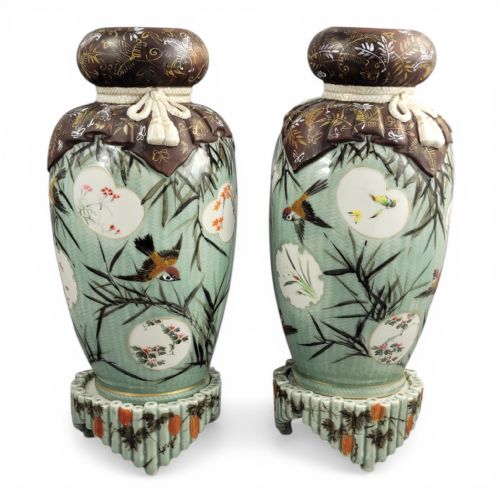
Beyond that core, three groups turn up. Japanese vases of the Meiji period and later, including a Seto pair on original stands. English art pottery, where celadon names the ground colour behind a tube-lined design rather than an East Asian glaze tradition. And furnishing pieces, such as an ormolu-mounted pair and a large Regency country-house vase. A single Safavid pottery vase from Persia is the only piece from outside East Asia and Britain.
Dating is loose across the category. The dealers' own period fields spread over ten buckets, from Before 1700 through to the 1930s, with no single one holding more than six of the twenty recorded listings. Only eight carry a clean year, and those run from 1890 to 1930, so material claimed as earlier sits in wide buckets like "19th Century" or "17th Century". Titles sometimes name a dynasty the period field doesn't support, which makes period an attribution rather than a settled fact.
Top And Bottom
Attribution does most of the work. Listings carrying a dynasty, kiln or period name, Qing, Ming Longquan, Safavid, Meiji, sit well above those that say only "Oriental" or "19th Century". A named workshop lifts a piece further: two listings attach Makuzu Kozan and one Kato Sanhei, the only named East Asian hands recorded, and the English art pottery patterns work the same way. At the other end are vases titled simply "Celadon Vase". One described as recovered shipwreck cargo sits at the bottom of the range.
Scale and multiples pull upward too. Descriptions using "monumental" or "large", and pairs and sets, cluster in the upper half. So do original accompanying elements, matching porcelain stands in one case, gilt-metal mounts in another.
Decoration separates a plain monochrome from a celadon ground put to use. Named subjects, a modelled cockerel, orchids, cornflower, blue and white painting, carry the better-placed listings, while undecorated glazed vases rely on form and colour alone.
Antique Celadon Vases Retail Price Guide 2026
Typical UK retail prices for celadon vases, calculated from the Sellingantiques database of over a million retail prices indexed since 2003. This retail price guide relies exclusively on Sellingantiques data; no external sources or auction records are used, so the figures do not describe the wider market.
The most expensive celadon vase ever sold on Sellingantiques was a rare Japanese cockerel vase by Makuzu Kozan, in April 2021.
The Antique Celadon Vases Glossary
- Celadon
- Pale green to grey-green high-fired glaze, coloured by iron in a reducing kiln. The word is also used loosely for the ground colour of a decorated piece.
- Celadon ground
- The celadon acts as background for painted, enamelled or tube-lined decoration rather than standing alone. This is the sense used in the English art pottery listings.
- Baluster
- A vase profile that swells at the lower body and narrows towards the neck. One of the shapes named in the archive.
- Bottle vase
- Globular or pear-shaped body with a long narrow neck. A fluted version, worked with vertical grooves, appears once.
- Longquan
- Southern Chinese kiln complex whose name is used in titles as a celadon type.
- Funeral vase
- Burial or tomb vessel. The term attaches to one Chinese pair described as Song dynasty.
Antique Celadon Vases: Frequently Asked Questions
How many celadon vases come up for sale?
Roughly two a year on Sellingantiques. Twenty listings are recorded in the archive.
Those twenty came from sixteen different dealers, so almost every one is a single piece from a different stockholder rather than a run of similar vases from one source.
Why do Moorcroft vases appear in this category?
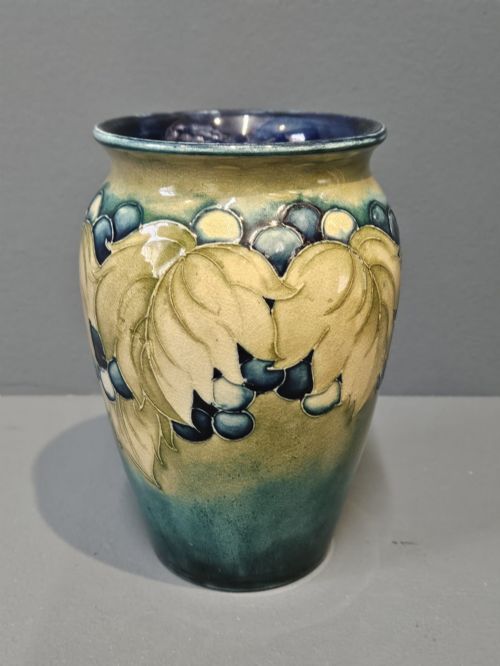
Because "celadon" also names a ground colour in English art pottery. Four listings use it that way, behind Leaf and Berries or Cornflower designs.
It's a different sense of the word from the Chinese glaze. There the celadon is the finish itself; on the art pottery it's the background the tube-lined design sits on.
Are pairs and sets common?
No, single vases dominate. Pairs and sets are the minority in the archive.
The multiples recorded include a pair of ormolu-mounted vases, a pair of funeral vases, a set of three, and a Meiji Seto pair on matching original stands. All of them sit in the upper half of the range.
What forms do these vases take?
Baluster, bottle and urn are the shapes named most often, with baluster the profile that swells low and narrows to the neck.
Single appearances include a fluted bottle vase, an urn, and a modelled cockerel vase, which is the oddest form in the archive.
Can the dating in a listing be relied on?
The dealers' period fields spread across ten buckets with no cluster, and only eight of the twenty listings carry a clean year. Those years run from 1890 to 1930.
Anything claimed as earlier sits in wide buckets such as "19th Century", "17th Century" or "Before 1700". Titles sometimes name Ming, Song or an 18th century Qing date that the period field doesn't confirm, so early dating on these pieces is an attribution.
Where do celadon vases in this category come from?
About half the recorded listings name China or an export origin, whether Chinese, Qing, Longquan, Ming, Song or generic "Oriental".
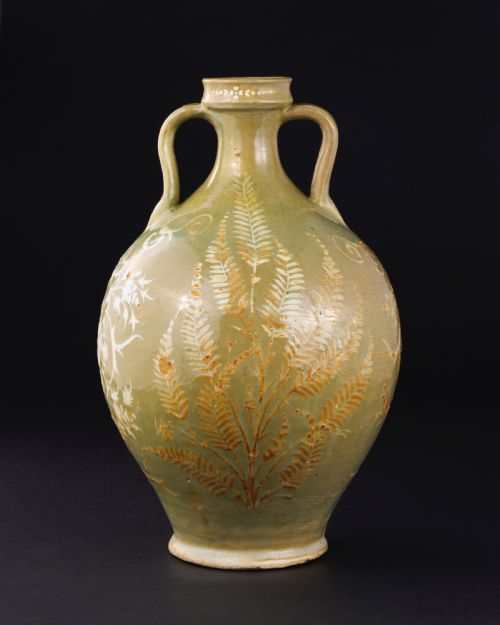
Japan accounts for roughly a fifth, English art pottery another fifth. One Safavid pottery vase from Persia is the only piece from outside East Asia and Britain, and it stands at the very top of the range.