976  PAGES BROWSED TODAY PAGES TODAY 0 ANTIQUES UPLOADED TODAYNEW ARRIVALS
Staffordshire Vases
Staffordshire Vases
LATEST STOCK
Sort Order
Items Per Page
Browse Categories
Sort order
Items per page

Antique Staffordshire Vases

18 items · page 1 of 2
Page 1 of 2

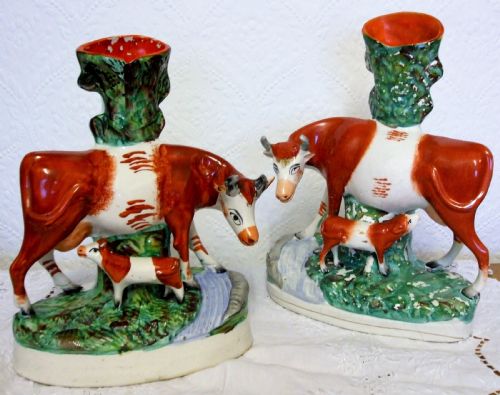
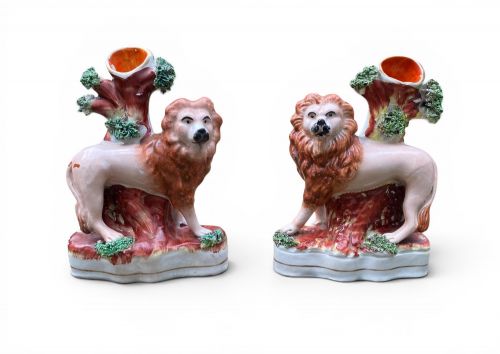
A small earthenware ornament from the Staffordshire potteries, usually a modelled animal or figure standing before a hollow stump that held spills for carrying a flame to a candle or pipe.

£225
1 MONTH AGO
vases
£135
3+ MONTHS AGO
vases
£950
3+ MONTHS AGO
vases

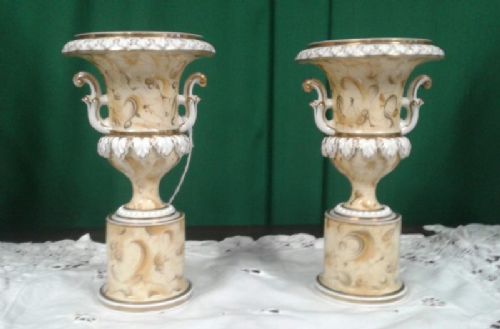
The most expensive Staffordshire vase ever sold on Sellingantiques was a large porcelaneous twin-handled vase, in March 2022.

£145
3+ MONTHS AGO
vases
£285
3+ MONTHS AGO
vases
£165
3+ MONTHS AGO
vases
1 2
Sellingantiques  ·  Guide 8612026/2027 edition
Vases

Antique Staffordshire Vases

A small earthenware ornament from the Staffordshire potteries, usually a modelled animal or figure standing before a hollow stump that held spills for carrying a flame to a candle or pipe.

Pair of Antique English Victorian Staffordshire Pottery "Scots Harvesters" Spill Vases
Plate I  ·  Pair of Antique English Victorian Staffordshire Pottery "Scots…, 19th CenturyApplecross Antiques
The category

What Are Staffordshire Vases?

Mostly spill vases. Of the 55 listings on Sellingantiques, 34 use the word "spill" in the title, and a buyer searching only for "vase" would miss most of the category. A spill was a thin slip of wood or twisted paper, lit from the fire and carried to a candle or a pipe, and the Staffordshire potteries turned out these holders in quantity as inexpensive chimneypiece ornaments.

The form you will meet most often is a figure group with a hollow tube or tree stump rising behind it, in earthenware described simply as pottery in 19 of the titles. Animals dominate the subjects: sheep, ram and ewe, spaniels, a poodle, a mastiff, greyhounds, cow and calf, horse and foal, fox, lion, deer, swans with cygnets, and a zebra that appears once.

Human subjects sit at the once-in-a-while end. A William Tell figure, "Scots Harvesters", "Babes in the Wood", a bird's-egg collector and a "MILK SOLD HERE" group each turn up a single time, and flatbacks, modelled at the front and left plain behind, appear alongside them.

A smaller group is not figural at all: twin-handled porcelaneous vases, chintz-decorated pairs, a pot pourri vase and cover, an urn, a baluster vase and ironstone china vases. Dating clusters hard on the mid-Victorian, with thirteen listings put in the 1860s and fourteen labelled Victorian; thirteen more say only "19th Century", which is a century-wide label rather than a date.

Exceptional Large Staffordshire Porcelaneous Twin Handled Vase
Plate II  ·  Exceptional Large Staffordshire Porcelaneous Twin Handled Vase, 1860London City Antiques
What sets them apart

Where The Range Splits

Pairs do the most work. Eighteen of the 55 listings are pairs, and paired spaniels, cows and calves, horses and foals, foxes and lions all sit in the upper half of the range, with one lot of three matching deer the only larger set in the archive. A single sheep group sits at the other end.

Subject and scale then separate the rest. Sheep and spaniel spill vases are the everyday stock and occupy the bottom; the zebra, the lion pair and the "MILK SOLD HERE" group sit far higher. Size is claimed openly, with "large" in twelve titles and one billed as "MASSIVE", and the biggest pieces sit toward the top.

Body and attribution account for the rest. Plain pottery spill vases are the cheapest end, while the porcelaneous twin-handled vases, a hand-painted china vase and an ironstone pair are the highest-priced listings. Titles that name a factory or decorator sit in the upper part of the range; unattributed animal groups sit at the bottom.

The market

Retail Price Guide 2026

Entry-levelUnder £200
Typical prices£200 – £900
Premium examplesOver £900

Typical UK retail prices for staffordshire vases, calculated from the Sellingantiques database of over a million retail prices indexed since 2003. This retail price guide relies exclusively on Sellingantiques data; no external sources or auction records are used, so the figures do not describe the wider market.

From the Sellingantiques archive

The archive's one-offs include a William Tell figure, a bird's-egg collector, a "MILK SOLD HERE" group, and a single zebra.

Terms antiques dealers use

The Antique Staffordshire Vases Glossary

Spill vase
A small vase for the wooden or paper spills used to light candles and pipes. It is the term used in 34 of the 55 titles in this category.
Flatback
A figure modelled in the round at the front and left plain behind, made to stand against a wall or chimneypiece.
Pearlware
A whitened earthenware body under a bluish glaze, named in two of the sampled titles.
Porcelaneous
A hard, white, part-vitrified body short of true porcelain, used of the twin-handled vases in this archive.
Ironstone china
A dense, durable earthenware body, named on one sampled pair.
Tulip holder
An alternative title-word for a spill-type vase with an open tube; "posy vase" is used the same way, each appearing once.
Questions people ask

Frequently Asked Questions

What were spill vases used for?

Spills were thin slips of wood or twisted paper. You lit one from the fire and carried the flame to a candle or a pipe, and the vase held a bundle of them ready on the chimneypiece.

The holder is the hollow tube or tree stump behind the modelled group. That is why so many of these pieces have an animal in front and an open stump rising at the back.

How old are Staffordshire vases usually?

Twenty-three listings carry a clean year, and those years run from 1850 to 1920. Thirteen of them are put in the 1860s, with single examples given to the 1870s and the 1920s.

Fourteen more are labelled Victorian and thirteen say only "19th Century". A couple of titles claim around 1820 while the dated field records them as 19th Century, so the field is often vaguer than the title.

Are they usually sold in pairs?

Pairs are a third of the archive: 18 of 55 listings. Paired spaniels, cows and calves, horses and foals, foxes and lions all appear.

One lot of three matching deer spill vases is the only set larger than two.

Which animals appear most often?

Sheep and spaniels are the everyday subjects, and they sit at the lower end of the range. Ram and ewe groups, cows with calves, horses with foals, and swans with cygnets recur as well.

The wider repertoire in the samples takes in a poodle, a mastiff, greyhounds, a fox, a lion, deer and a single zebra.

Do all Staffordshire vases have figures on them?

No. Roughly a fifth of the listings are conventional vases rather than figure groups: twin-handled porcelaneous vases, chintz pairs, a pot pourri vase and cover, an urn, a baluster vase and ironstone china vases.

Those non-figural pieces include the highest-priced listings in the archive, while plain pottery spill vases sit at the cheaper end.

Is there a maker's name on these vases?

A scan of the descriptions turned up no factory that can be presented as typical of the category, so no single name stands behind Staffordshire vases as a group.

Where a factory or decorator is named in a title, that listing tends to sit in the upper part of the range. Unattributed sheep and spaniel groups sit at the bottom.

65,829
Antiques For Sale
0
Antiques Approved Today
1,666
Antique Uploads This Month
438,940
Total Antiques Sold
items
Add keywords to the filter
Price
£100
£250000
Era
Movements
Material
Origin
Stock Location
Freshness
Online Payments
Categories