




Antique Garniture Vases
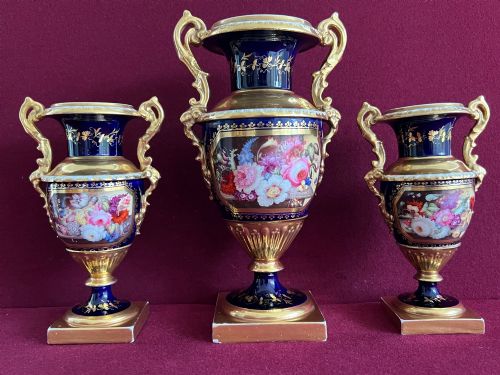
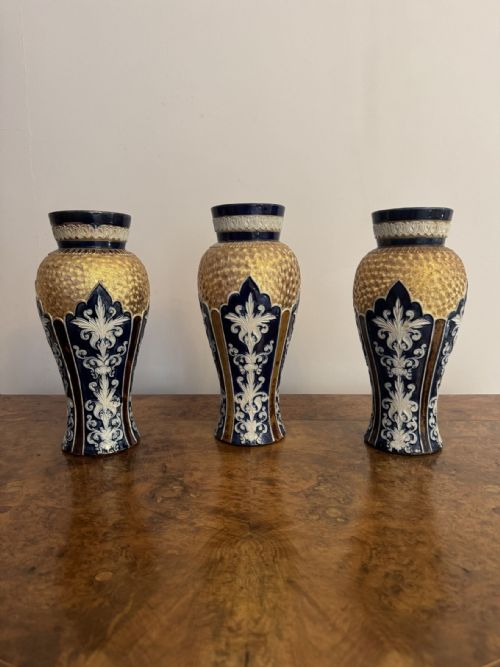
A garniture is a matched set of vases, most often three or five, made to stand together along a mantelpiece.
Antique Garniture Vases
The garniture de cheminée is a set of vessels made to be displayed as a group on a chimneypiece, a fashion that took hold in Europe in the later 17th century alongside imported East Asian porcelain and carried on through the 18th and 19th centuries. The standard arrangement is a taller covered centre vase with smaller ones flanking it.
Ceramic dominates. The word "vases" is in the great majority of titles on Sellingantiques, and porcelain in a good number of them. The largest identifiable strand is East Asian and Imari-pattern porcelain, with Japan the commonest named origin. Dutch and English Delft turns up steadily too, several sets of five still carrying their lids and dated between 1750 and 1800.
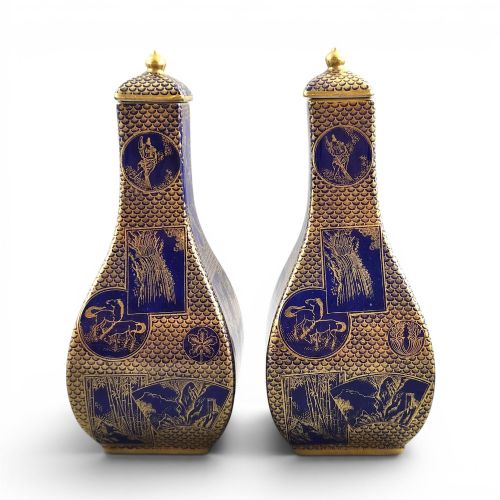
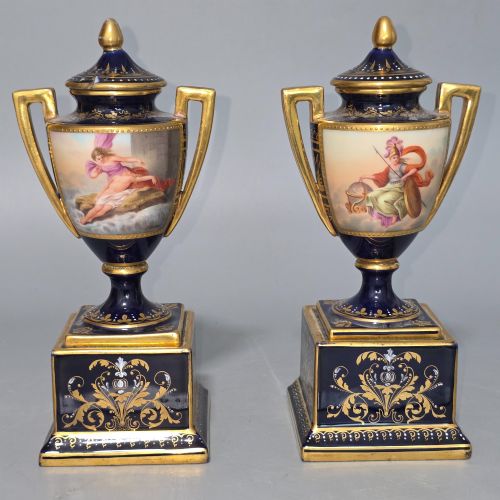
The heading takes in pairs as well as full sets. About a quarter of titles say "pair" rather than garniture, covering lidded French porcelain, Vienna-style pieces, bronze and marble. Alongside those sit English ironstone, an Art Deco pottery set, and a garniture in Bohemian glass.
Dating is mostly broad. "19th Century" is the commonest entry in the dated field, followed by "1900s", with a smaller run of 18th-century pieces; the field as a whole spans 1700 to 1930. Titles are often more precise than the date given, reaching down to a decade or a single year.

Where The Money Sits
Completeness does most of the work. Five-piece sets with their covers sit at the top of the sampled range, and three-piece sets and pairs below them. Covers matter on their own account: "lidded", "and cover" and "with original lids" recur through the upper part of the range, since the removable tops are the first thing a set loses.
Age pushes hard in the same direction. The 18th-century Chinese, Japanese Edo and Delft sets group in the upper reaches, while a 1930s English pottery garniture sits at the very bottom. Size follows: titles reaching for "Large", "3 Large" and "of Considerable Size" cluster higher than those that stay silent on scale.
A named factory or a signed decorator in the title lifts a set above the generic "Pair of Blue and White Vases" or "Pair of French Porcelain Vases". Every factory named in this category comes from a single listing rather than a run, so the names attach to individual pieces rather than to the category. One title admits to a composite garniture, a set of five assembled rather than made together.
Antique Garniture Vases Retail Price Guide 2026
Typical UK retail prices for garniture vases, calculated from the Sellingantiques database of over a million retail prices indexed since 2003. This retail price guide relies exclusively on Sellingantiques data; no external sources or auction records are used, so the figures do not describe the wider market.
Sets of five come up more often than you'd think on Sellingantiques: six titles specify five vases, several of them Delft with their lids.

The Antique Garniture Vases Glossary
- Garniture
- A matched set of vases meant to stand together, most often three or five pieces, with the tallest in the centre.
- Pair
- Two matching vases rather than a full set, and the wording used in roughly a quarter of titles in this category.
- Covers
- Removable tops, usually on the centre or taller vases; several Delft sets are described as keeping their original lids.
- Imari
- A blue, iron-red and gilt palette associated with Japanese export porcelain and later copied in Europe. It is the commonest named palette here.
- Composite garniture
- A set assembled from pieces that were not originally made together; one title in this category uses the word.
- Amphora
- A shape term for the vase body, used alongside baluster; it appears in one Vienna porcelain pair.
Antique Garniture Vases: Frequently Asked Questions
How many vases make a garniture?
Three or five is the usual count, with a taller covered vase in the centre and smaller ones either side. Sets of four turn up as well.
Six titles on Sellingantiques specify five vases, several of them Delft with original lids, and one a five-piece Imari-pattern set of early 18th-century design.
Why are pairs listed under garnitures?
The heading covers matched pairs as well as three- and five-piece sets. Around a quarter of titles say "pair".
Those pairs run to lidded French porcelain, Vienna-style amphora forms, bronze on siena marble bases and marble vases converted to lamps.
What are garniture vases usually made from?
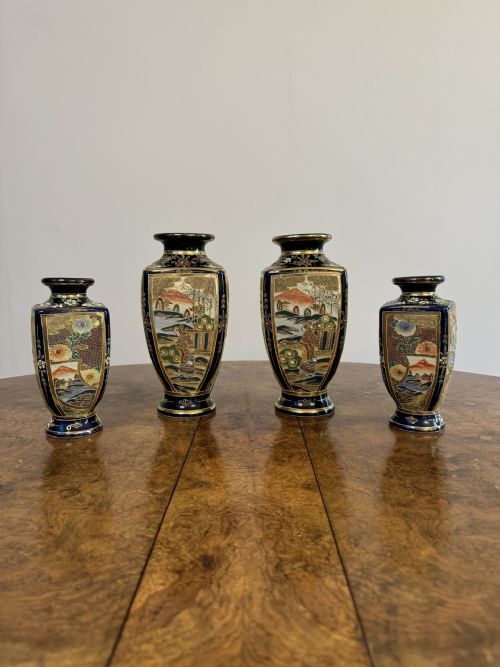
Ceramic, in the bulk of cases. Porcelain is named in a good many titles, and Japanese Imari, Satsuma, Delft and English ironstone all appear.
The exceptions are few. Out of forty-two listings, three are not ceramic: a Bohemian glass garniture, a bronze pair and a marble pair.
Which countries do these sets come from?
Japan is the commonest named origin, and Imari the commonest named palette. Dutch and English Delft accounts for six titles.
China appears only twice, both sets in the upper half of the range. France, Austria and England fill out the rest.
Are garniture vases common on the market?
Not especially. Around five come to market on Sellingantiques in a year.
Nineteen different dealers have listed them, close to one dealer per listing, so the category isn't held by a single seller.
What does a composite garniture mean?
It means the set was put together from vases that were not made as a group, matched later for shape, palette or size.
One title in this category uses the word, describing a five-vase Imari garniture.