



Antique Shodana Cabinets
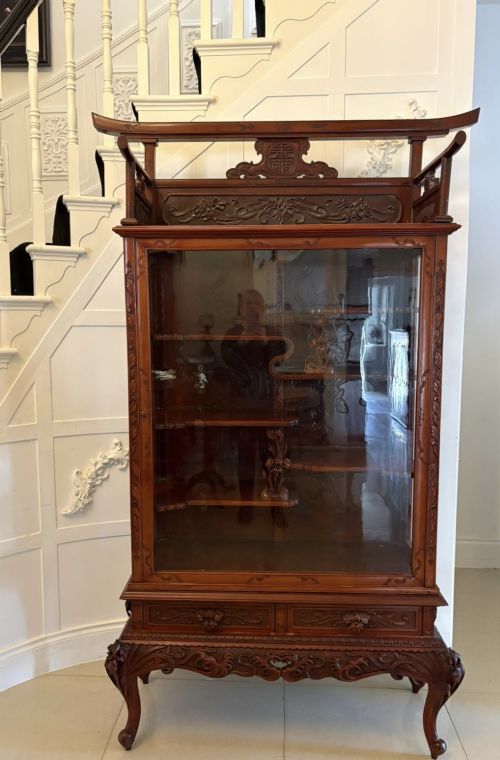
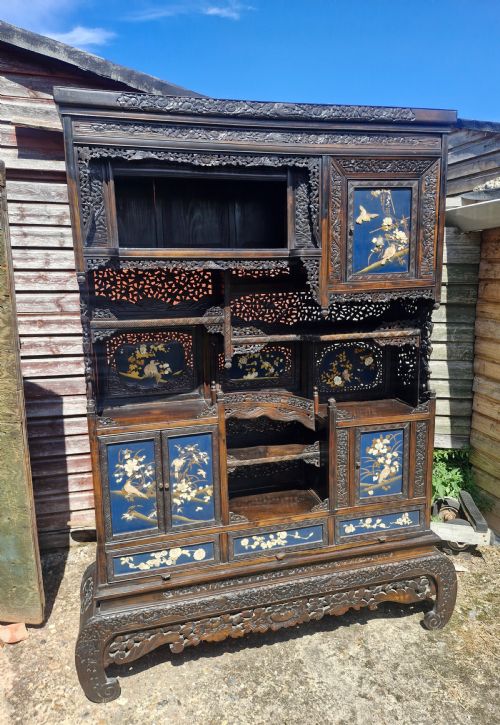
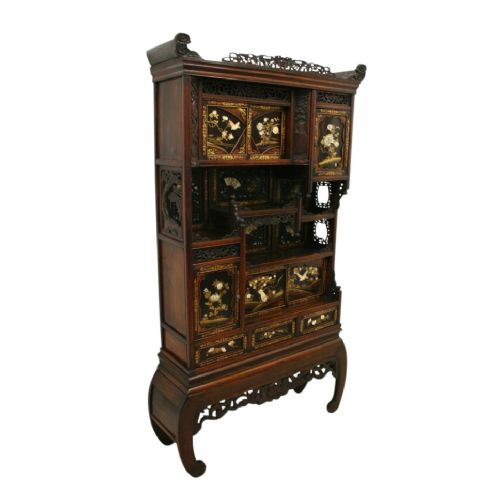
A shodana is a Japanese display cabinet of staggered open shelves worked in with small cupboards, sliding doors and drawers, built to show off prized objects.
Antique Shodana Cabinets
The form grew out of chigaidana, the staggered shelving used in Japanese interiors for displaying treasured things. From the later nineteenth century it was made in quantity for export to the West, where the asymmetric shelves and decorated panels suited the taste for Japonisme.
The category on Sellingantiques is overwhelmingly Japanese work of the Meiji period. The word japanese appears in 28 of 45 titles and meiji in 25, and a typical listing reads simply as a Meiji period shodana cabinet, freestanding and of moderate size. Dating clusters hard at the turn of the century: sixteen of the dated listings fall in the 1900s, with the 1910s and 1890s next.
Surfaces carry the interest. Lacquer runs through the archive in gold, black, red and cinnabar; Shibayama inlay turns up on roughly one in six sampled cabinets; carved hardwood and rosewood examples make up another handful, some of them ebonised. Metal and hardstone appear more sparingly, including two cabinets linked in their titles to Komai-style inlaid ironwork.
Size and mounting vary more than the decoration does. The archive runs from table cabinets and a wall-hung example up to large freestanding pieces, with a small consistent group raised on a separate open stand. Only about three shodana are listed in a year, spread across fifteen different dealers, so no one dealer holds the form.
Where The Range Widens
Decoration does most of the sorting. Shibayama inlay, set into lacquer or wood, accounts for both extremes at the very top of the archive, and the descriptive language in those titles is the warmest in the category. Gold, red and cinnabar lacquer sit in the upper half; the plainest cabinets, named as nothing more than a Japanese shodana, sit mid-range.
Metalwork pushes a cabinet up in the same way. Silver inlay and the two iron cabinets associated with Komai-style work all sit in the upper third. Depth of carving does similar work on the hardwood side, where profusely carved rosewood stands well above the median and a plain carved carcase sits closer to it.
Scale then reinforces whatever the surface has already decided. Large appears on several of the highest-priced sampled cabinets, while small, table cabinet and wall cabinet cluster at the cheaper end. The exception is the miniature iron shodana, the oddest single piece in the archive, which does not follow that rule.
Antique Shodana Cabinets Retail Price Guide 2026
Typical UK retail prices for shodana cabinets, calculated from the Sellingantiques database of over a million retail prices indexed since 2003. This retail price guide relies exclusively on Sellingantiques data; no external sources or auction records are used, so the figures do not describe the wider market.
Shodana cabinets have been listed on Sellingantiques since 2013.
The Antique Shodana Cabinets Glossary
- Shodana
- Japanese asymmetric display cabinet of staggered shelves, small cupboards and drawers. It is the word that defines this category and it appears in almost every title.
- Meiji period
- 1868 to 1912, and the era named in more titles than any other. A Meiji attribution and a 1900s or 1910s date often sit side by side on the same listing.
- Shibayama
- Inlay of shell, horn, stone and ivory-substitutes set into lacquer or wood. It appears in seven sampled titles and at the top of the range.
- Cabinet-on-stand
- The cabinet raised on a separate open base rather than standing on the floor. Three sampled titles specify it.
- Cinnabar lacquer
- Deep red lacquer, named on one sampled cabinet alongside black. Gold, black and plain red lacquer are the commoner descriptions.
- Komai
- A style of inlaid iron metalwork from Kyoto, named in two sampled titles, one of them as Komai style rather than as an attribution.
Antique Shodana Cabinets: Frequently Asked Questions
What does shodana mean?
It is the Japanese name for a display cabinet built on staggered, asymmetric shelves, with small cupboards, sliding doors and drawers worked in around them. The form developed from earlier chigaidana shelving used to display prized objects.
The word carries the whole category on Sellingantiques. Almost every title names the cabinet type outright, even where the country and period are left off.
When were most of these made?
The dated listings run from 1860 to 1920, and thirty-nine of forty-five carry a clean year. Sixteen fall in the 1900s alone, making the turn of the century the centre of gravity.
Six further listings are dated only to the 19th century, several of them described in their titles as late 19th century. That is a dealer's approximation rather than a precise year.
Are shodana always Japanese?
On Sellingantiques the category is overwhelmingly Japanese, with japanese in 28 of 45 titles and meiji in 25.
One sampled cabinet is Chinese Qing-dynasty hardwood, only likened to a shodana in its description. So the term does travel beyond Japan occasionally, though it is the exception.
How big do these cabinets get?
The archive spans a wide range. At one end are table cabinets meant to stand on other furniture, a wall-hung example and a small freestanding cabinet.
At the other are large freestanding cabinets, some of them raised on a separate open stand. Large appears on several of the highest-priced sampled pieces.
What is Shibayama decoration?
Shibayama is inlay of shell, horn, stone and ivory-substitutes set into a lacquer or wood ground, often building up figures and floral motifs across panels.
It turns up on roughly one in six sampled cabinets and accounts for both of the highest-priced entries in the archive.
Do shodana carry maker's names?
Nothing in the evidence records a signature, seal or inscribed mark on any of the forty-five listings, and no workshop name is established across them.
Two titles reference Komai-style inlaid ironwork from Kyoto, one of them worded as a style rather than an attribution.