



A 2026 Guide by Sellingantiques
Classical Rome provides the original shape for these bell-like urns.
Wealthy Grand Tour travellers brought copies back to Britain from Italy during the eighteenth century.
Expect to see antique Campana vases popping up in both Georgian landscape gardens and Regency dining rooms.
Look for their peak popularity hitting hard during the late eighteenth-century Neoclassical revival.
Coalbrookdale cast some of the heaviest iron versions for Victorian estates.
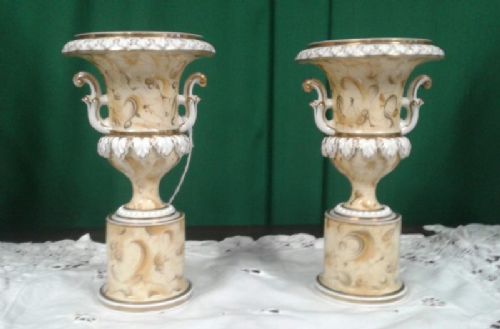
Worcester factories turned out fine porcelain examples with painted panels in the early nineteenth century.
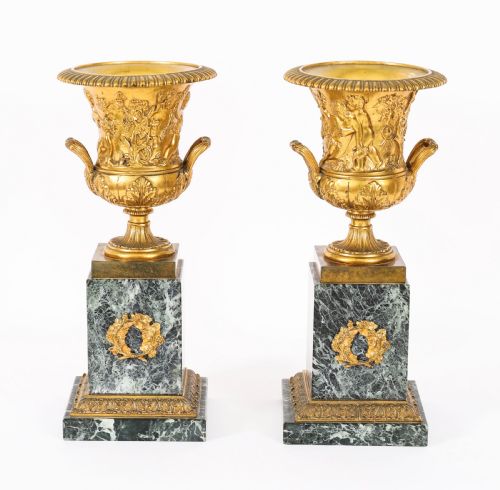
Matthew Boulton produced large ormolu and Blue John variations in his Soho Manufactory.
The 2026 retail price guide for Antique Campana Vases is drawn from a proprietary archive of over 1.1 million retail prices indexed by Sellingantiques since 2003. This guide relies exclusively on their own internal data; no external sources or auction records are used.
Analysing nearly 25 years of UK antique market history alongside current retail values, the data indicates that typical UK retail prices for Antique Campana Vases range between £500 and £2,800. Entry-level prices generally fall under £500 and premium examples upwards of £2,800.
Flared rims give them a distinct inverted bell profile.
Notice the twin handles springing up from the lower body.
A fluted bowl resting on a narrow knopped stem and square base defines the classic silhouette.
Iron foundries used sand moulds to cast the large outdoor urns in separate sections.
Bronze makers bolted the base to the bowl using a central threaded rod.
Turners shaped stone versions on a lathe before hand-carving the surface relief.
"Some smaller porcelain models contain separate perforated lids used for holding potpourri."
"The shape proved so successful it became a standard design for silver presentation cups."
"Many cast iron garden variants have hidden drainage holes engineered straight through the central stem."
Based on almost 25 years of Sellingantiques UK antique market data, Antique Campana Vases appeared 116 times (out of 1,100,000 antiques) which gives it a rarity score of 98/100.
This score measures scarcity within the Sellingantiques archive only and is not a survey of the entire antiques market, so these statistics may not be indicative of the general availability of Antique Campana Vases elsewhere.
Many indoor examples held nothing at all. They were strictly decorative objects designed to sit on a side table to show off the classical taste of the owner.
Others held dry potpourri. Sometimes you find them with a metal liner meant to hold water for fresh flowers, but that liner often gets lost over time.
Dealers usually don't touch old paint. That crusty, weathered surface takes decades to form and gives a garden urn its character.
Stripping them back to bare iron removes that history. It also leaves the metal exposed to the rain, meaning they will start rusting unless you repaint them straight away.
If the paint is falling off in sheets, you might brush away the loose flakes. Otherwise, leave well alone.
Cast iron and carved stone versions survive the cold very well. They were designed for the British climate.
Just make sure any soil or water inside can drain away freely. If ice forms and expands inside the bowl, it can crack the cast metal or split a stone base.
A spinning base usually means the internal rod has worked loose over the years. Most bronze and brass examples are held together by a single threaded rod running from the bowl down to the plinth.
Turn it upside down and look inside the square block. You usually find a nut. Tightening that nut slightly will pull the sections back together and stop the wobble.
Please note: This Antique Campana Vases guide and its associated pricing data are provided for general informational purposes only. It does not constitute formal financial, investment, or appraisal advice and should not be relied upon as the sole basis for any commercial activity, purchasing, or sales decisions. Sellingantiques.co.uk accepts no liability for any actions taken in reliance on this information. Always consult with a qualified professional or independent appraiser.
