

A 2026 Guide by Sellingantiques
Large Antique Indian Hoshiarpur Shisham & Ivory Inlaid Wall Mirror, 1880
Priced at £2,650 from Mark Jones Antiques
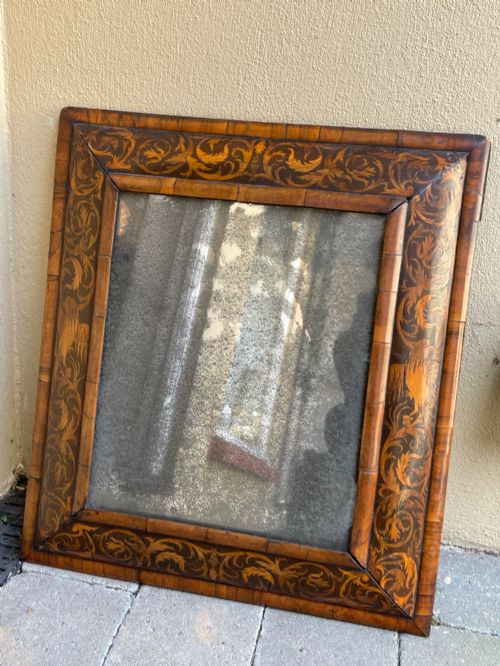
Craftsmen in the late seventeenth century used imported exotic woods to lay floral patterns into walnut frames.
Syrian workshops produced complex geometric designs using bone and mother-of-pearl during the nineteenth century.
Look at the Anglo-Dutch seaweed marquetry examples. These feature dense, flowing arabesques cut from two contrasting veneers.
Victorian makers sometimes revived older styles to furnish grand townhouse interiors.
Antique inlaid mirrors often reflected the main trade routes, mixing local carcase woods with materials shipped from overseas.
Gerrit Jensen supplied seaweed marquetry mirrors to the Royal Household between 1680 and 1715.
Look for the trade labels of Sorrentine makers like Luigi Gargiulo, working in Italy during the mid-nineteenth century.
Many fine pieces lack a maker's mark, produced instead by anonymous regional workshops adapting to local tastes.
The 2026 retail price guide for Antique Inlaid Mirrors is drawn from a proprietary archive of over 1.1 million retail prices indexed by Sellingantiques since 2003. This guide relies exclusively on their own internal data; no external sources or auction records are used.
Analysing nearly 25 years of UK antique market history alongside current retail values, the data indicates that typical UK retail prices for Antique Inlaid Mirrors range between £500 and £3,300. Entry-level prices generally fall under £500 and premium examples upwards of £3,300.
Flat or cushion-moulded frame profiles provide a wide surface for the decorative work.
Check the cresting. Many early examples feature a shaped, removable top section decorated to match the main frame.
The glass plate often has a shallow, hand-ground bevel following the inner edge of the sight ring.
Marquetry cutters pinned layers of light and dark veneer together before sawing the pattern out in one go.
The traditional method involves assembling the cut pieces face-down on paper before gluing them to the rough frame carcase.
Bone and shell inlays require tiny recesses carved directly into the solid wood rather than using a veneer ground.
"Craftsmen could cut multiple identical patterns simultaneously by stacking up to six sheets of veneer in a single block."
"The complex geometric patterns found in Syrian designs rely on advanced mathematics to ensure seamless repetition around corners."
"Early makers used hide glue precisely because it allows modern restorers to safely lift and re-lay the original decoration."
Based on almost 25 years of Sellingantiques UK antique market data, Antique Inlaid Mirrors appeared 40058 times (out of 1,100,000 antiques) which gives it a rarity score of 1/100.
This score measures scarcity within the Sellingantiques archive only and is not a survey of the entire antiques market, so these statistics may not be indicative of the general availability of Antique Inlaid Mirrors elsewhere.
Heat is the main enemy of traditional cabinet work. Fluctuating temperatures from a fire dry out the carcase wood.
This causes the hide glue to fail and the decorative veneers to blister or pop off. Constant soot can also darken the light woods over time.
Find a wall with a stable temperature away from direct heat sources.
Syrian or North African antique inlaid mirrors frequently use solid walnut or mahogany as the base timber. The star motifs typically combine bone, mother-of-pearl, and lemon wood.
Keep the loose pieces safe in an envelope. A professional restorer will clean the old adhesive from the recess and re-lay the original stars using traditional animal glue.
They weigh a considerable amount. The combination of thick nineteenth-century plate glass and solid pine backboards adds up quickly.
You need heavy-duty wall fixings drilled directly into masonry to support them safely.
Early mirror plates were ground by hand using abrasives. The craftsman worked the edge over a wheel, resulting in a shallow, slightly irregular bevel that modern machines cannot replicate.
These hand-worked edges often follow the slight distortions of the frame. They reflect light softly and add character to the piece.
Replacing them with modern glass removes much of the historic appeal.
Please note: This Antique Inlaid Mirrors guide and its associated pricing data are provided for general informational purposes only. It does not constitute formal financial, investment, or appraisal advice and should not be relied upon as the sole basis for any commercial activity, purchasing, or sales decisions. Sellingantiques.co.uk accepts no liability for any actions taken in reliance on this information. Always consult with a qualified professional or independent appraiser.
