
A 2026 Guide by Sellingantiques
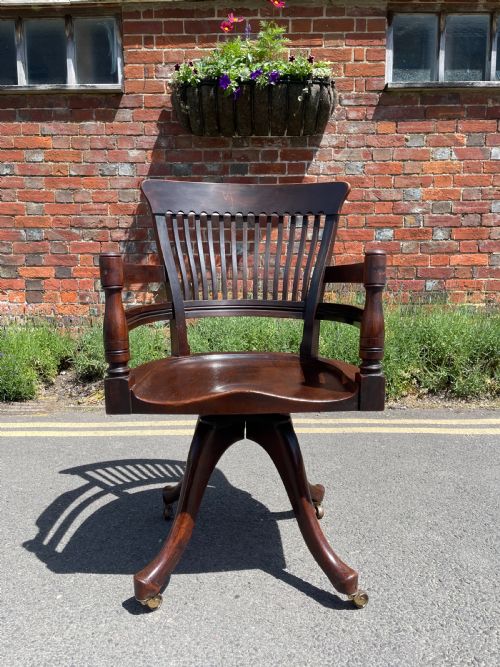
Revolving Desk Chair, 1900
Priced at £595 from Athey Antiques
Thomas Jefferson famously adapted a Windsor chair with an iron spindle in the late eighteenth century.
Commercial production took off during the nineteenth century to supply expanding railway and banking offices.
Antique revolving chairs quickly became standard daily equipment for early typists.
Look at early Victorian examples to see how makers hid the new mechanisms under heavy upholstery.
The firm of W.H. Gunlocke Chair Co. produced thousands of these for offices from 1902 onwards.
Centripetal Spring Chair Company operated in the mid-nineteenth century, combining cast iron frames with velvet upholstery.
Regional furniture factories across the Midlands turned out basic wooden versions for local clerks.
Oak Revolving Office Desk Chair with Wooden Seat, 1920
Priced at £545 from Andros Antiques
The 2026 retail price guide for Antique Revolving Chairs is drawn from a proprietary archive of over 1.1 million retail prices indexed by Sellingantiques since 2003. This guide relies exclusively on their own internal data; no external sources or auction records are used.
Analysing nearly 25 years of UK antique market history alongside current retail values, the data indicates that typical UK retail prices for Antique Revolving Chairs range between £500 and £1,400. Entry-level prices generally fall under £500 and premium examples upwards of £1,400.
A central threaded iron rod allows the user to adjust the seat height by spinning.
Four curving legs sweep out from a central hub to provide a stable footprint.
Slat backs bend around the sitter, offering support during long hours of desk work.

Early 20th Century Mahogany Desk Chair, 1920
Priced at £1,650 from Martlesham Antiques
Steam bending allowed makers to form single continuous pieces of ash or elm for the curved backrests.
Machined iron threads replaced early hand-filed screws, making height adjustment much smoother over time.
Seat panels were often carved out into a saddle shape to spread the user's weight evenly.
"Many Victorian designs include hidden coil springs allowing the seat to tilt backwards."
"The slatted back structure actively improves air circulation for the sitter during hot weather."
"Some early domestic examples hide their metal mechanics within a carved mahogany pedestal."
Based on almost 25 years of Sellingantiques UK antique market data, Antique Revolving Chairs appeared 694 times (out of 1,100,000 antiques) which gives it a rarity score of 87/100.
This score measures scarcity within the Sellingantiques archive only and is not a survey of the entire antiques market, so these statistics may not be indicative of the general availability of Antique Revolving Chairs elsewhere.
The noise usually comes from dry friction between the iron spindle and the socket plate. Lift the seat up to expose the metal threads.
Apply a small amount of heavy grease or beeswax to the contact points. Avoid thin oils, as they tend to run down the spindle and stain the wooden base.
Yes, replacing damaged castors is a straightforward job. Turn the chair over and check how the old wheels attach to the leg ends.
Most early wooden castors sit on a metal pin tapped directly into the timber. You can source period-appropriate replacements from restoration suppliers.
Antique revolving chairs were built for Victorian desks, which sometimes sit lower than modern office furniture. The threaded spindle gives you a few inches of adjustment.
Measure the height of your desk before buying. A raised seat might bring your knees too close to the desk apron, especially if the piece has shallow drawers.
It usually means the iron thread is damaged near the end or packed with a century of dust and old oil.
Wind the seat all the way out and clean the threads with a wire brush.
Please note: This Antique Revolving Chairs guide and its associated pricing data are provided for general informational purposes only. It does not constitute formal financial, investment, or appraisal advice and should not be relied upon as the sole basis for any commercial activity, purchasing, or sales decisions. Sellingantiques.co.uk accepts no liability for any actions taken in reliance on this information. Always consult with a qualified professional or independent appraiser.
