

A 2026 Guide by Sellingantiques
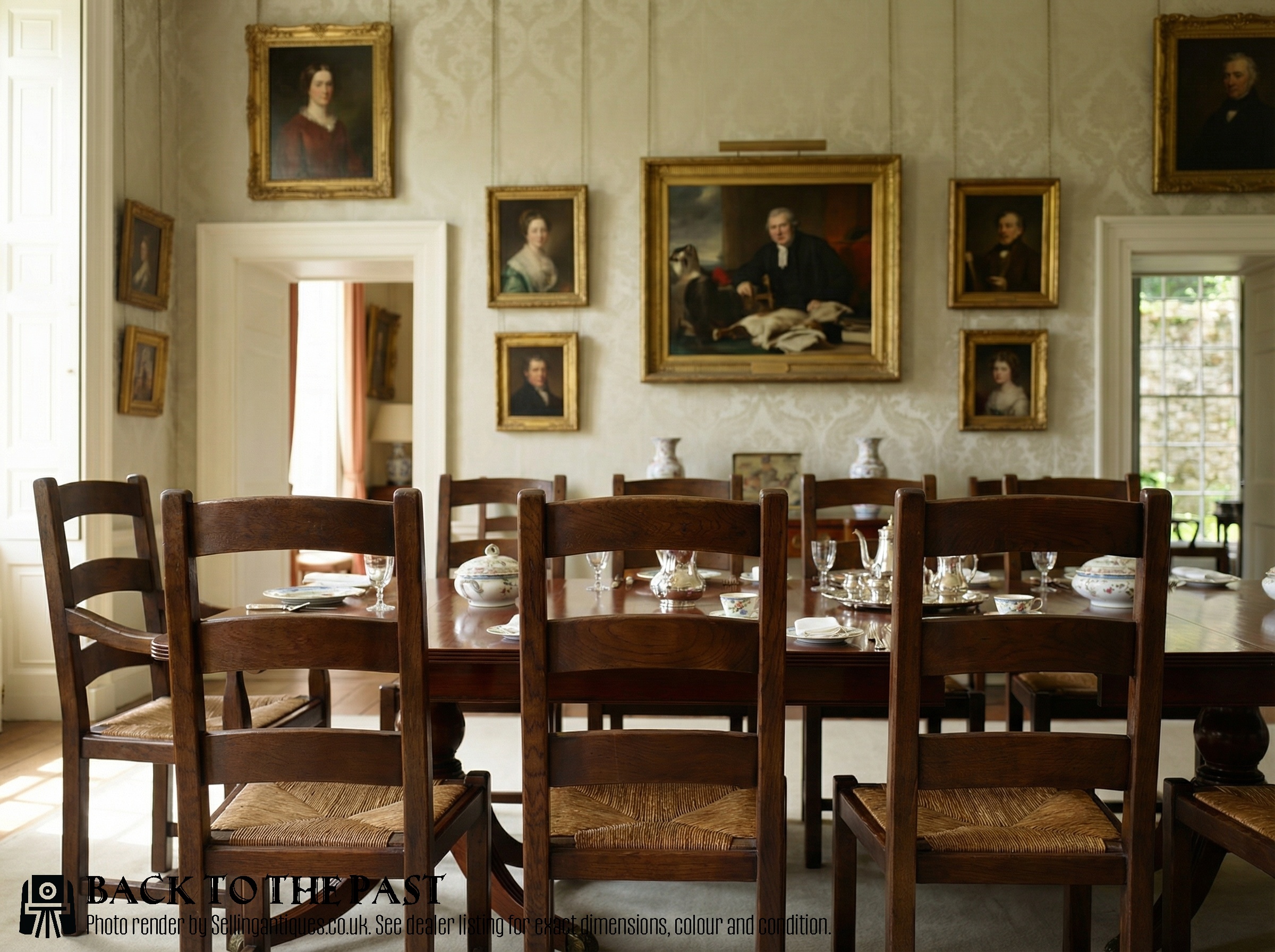
Antique Vintage Set of 8 Oak Dining Chairs C.1930 – 6 Side Chairs + 2 Armchairs, Heavy Solid Kitchen Seating, 1930
Priced at £2,096 from Prior and Willis
Early turners began replacing solid back panels with horizontal slats around the mid-seventeenth century.
A regional trade for antique ladderback chairs developed across Britain. Distinct patterns soon emerged in specific counties, shaping local seating traditions for generations.
Look at the rural workshops. Whole families worked together turning posts and weaving seats for local provincial markets.
American Shaker communities adopted the form, discarding heavy ornamentation for pure utility.
By the late nineteenth century, factory production largely replaced these traditional hand-turned local cottage industries.
Documented individual makers are rare for early provincial seating. Production was usually a collaborative workshop effort rather than a signed pursuit.
Philip Clissett worked in Herefordshire during the late nineteenth century. He famously produced traditional ash ladders that influenced the Arts and Crafts movement.
Ernest Gimson learned directly from Clissett. He designed refined versions with tall backs and shaped slats.
The 2026 retail price guide for Antique Ladderback Chairs is drawn from a proprietary archive of over 1.1 million retail prices indexed by Sellingantiques since 2003. This guide relies exclusively on their own internal data; no external sources or auction records are used.
Analysing nearly 25 years of UK antique market history alongside current retail values, the data indicates that typical UK retail prices for Antique Ladderback Chairs range between £400 and £2,500. Entry-level prices generally fall under £400 and premium examples upwards of £2,500.
Horizontal slats span the back. They number anywhere from three to six depending on the height of the frame.
Check the front stretchers. Bulbous turnings feature on North Country chairs, while southern variants often use plain tapering rods.
The back posts usually end in decorative finials. Acorns, points, and simple domes appear frequently across different regions.
Turners used unseasoned wood for the horizontal stretchers and dry wood for the legs. The dry wood shrinks around the wet joint to lock it tight.
Notice the subtle curve on the back slats. Craftsmen shaped these by boiling the timber and clamping it into a wooden mould to dry.
Cleaving logs with a froe instead of sawing them preserved the long grain. This ensured the slender posts remained strong under daily load.
"Spindle backs belong to the same family tree. The horizontal ladders were just swapped out for vertical spindles in the same turned frame."
"Many early nineteenth-century examples feature peg holes at the bottom of the legs. Rockers were often added here as a later upgrade."
"The weaving patterns in rush seats hold regional signatures. Specific corner knots vary from village to village across the countryside."
Based on almost 25 years of Sellingantiques UK antique market data, Antique Ladderback Chairs appeared 451 times (out of 1,100,000 antiques) which gives it a rarity score of 91/100.
This score measures scarcity within the Sellingantiques archive only and is not a survey of the entire antiques market, so these statistics may not be indicative of the general availability of Antique Ladderback Chairs elsewhere.
Yes, rush seating is a wear component meant to be replaced. Specialist chair weavers can re-rush a frame using traditional methods.
The old material is cut away. Fresh rush is then woven directly onto the exposed seat rails in the original pattern.
Hide glue usually holds early turned joints together. Over time, central heating dries out the timber and causes that old adhesive to fail.
A restorer can inject warm hide glue into the loose sockets. This swells the wood fibres and secures the joint without requiring modern screws or synthetic epoxies that damage the timber.
Never hammer nails into the stretchers. That splits the dry wood and makes proper repair much harder later on.
They handle everyday use well. Traditional post-and-rung construction distributes weight across the whole frame.
As long as the horizontal stretchers remain sound, an antique ladderback chair performs as well as a modern equivalent.
Turners shaped those slats to match the natural curve of a person sitting back. A flat board digs into the spine, whereas a gentle curve provides support.
They achieved this by steaming or boiling the thin ash boards until pliable. The wet wood was clamped into a wooden former and left to dry into that sweeping shape.
Please note: This Antique Ladderback Chairs guide and its associated pricing data are provided for general informational purposes only. It does not constitute formal financial, investment, or appraisal advice and should not be relied upon as the sole basis for any commercial activity, purchasing, or sales decisions. Sellingantiques.co.uk accepts no liability for any actions taken in reliance on this information. Always consult with a qualified professional or independent appraiser.
