


A 2026 Guide by Sellingantiques
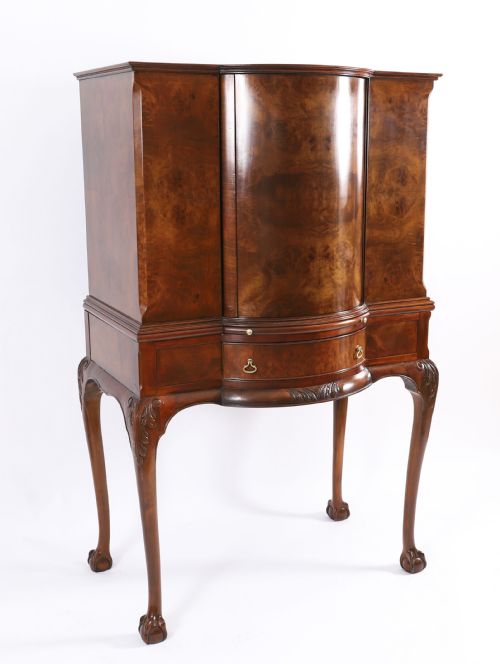
Victorian Walnut 2 Door Drinks Cabinet., Victorian
Priced at £380 from Rupert Hitchcox Antiques
Dedicated antique drinks cabinets emerged as distinct furniture pieces during the Edwardian period. Before that, households relied on cellarettes or sideboard cupboards.
The cocktail craze of the 1920s drove mass demand. Art Deco designers quickly adapted, creating striking geometric forms to house modern mixing accessories.
Prohibition in America influenced European production. Exporters designed disguised cabinets that looked like radios or bookcases to hide alcohol in plain sight.
Check early examples for locking mechanisms. Spirits were expensive commodities, requiring secure storage away from household staff.
Harry Epstein produced large numbers of Art Deco drinks cabinets in London. His workshop specialised in figured walnut veneers and cloud-shaped designs.
Turn over mid-century models to check for the Turnidge of London stamp. They focused heavily on compact, glazed display units with built-in cocktail sections.
Waring and Gillow occasionally manufactured elaborate examples during the 1920s. Their stamped pieces often feature superior hinges and thicker glass shelving.

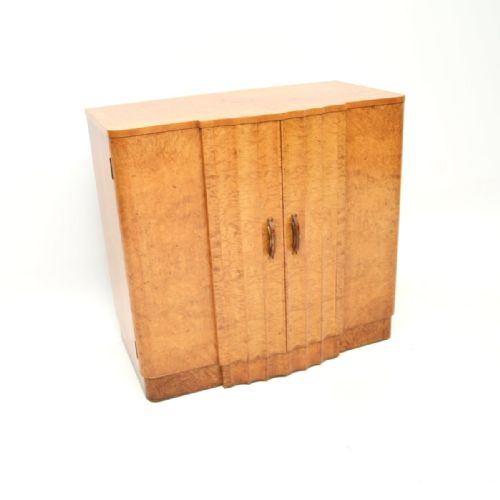
Art Deco Figured Walnut Drinks Cabinet, C1930, 1930
Priced at £1,550 from Art Deco World
The 2026 retail price guide for Antique Drinks Cabinets is drawn from a proprietary archive of over 1.1 million retail prices indexed by Sellingantiques since 2003. This guide relies exclusively on their own internal data; no external sources or auction records are used.
Analysing nearly 25 years of UK antique market history alongside current retail values, the data indicates that typical UK retail prices for Antique Drinks Cabinets range between £800 and £3,500. Entry-level prices generally fall under £800 and premium examples upwards of £3,500.
Mirrored mixing slides pull out from the waist. These provide a dedicated, wipe-clean surface for preparing drinks.
Automatic lighting is common on later Art Deco pieces. Opening the top doors triggers a mechanical switch wired to a bulb at the back.
Custom racks hold specific glassware shapes. You often find slotted shelves for stems and circular recesses designed for tumblers or decanters.
Machine-cut dovetails became standard practice for drawer joints in early twentieth-century antique drinks cabinets. They offer precise, uniform spacing compared to hand-cut equivalents.
Bookmatching requires significant skill. Craftsmen slice a single piece of burr walnut and open it like a book to create a symmetrical pattern across the doors.
Examine the glass retaining clips. Better quality cabinets use screwed metal brackets rather than simple wooden beads to hold the interior mirror plates in place.
"Antique drinks cabinets sometimes contain secret compartments. Small hidden drawers sit behind the main bottle racks to store cocktail recipes."
"Many Art Deco examples feature integral lemon zesters. These sit neatly in dedicated metal slots alongside the standard cocktail pins."
"Original cocktail sticks remain in some models. You can find them with Bakelite cherry or cockerel finials slotted into the inner door racks."
Based on almost 25 years of Sellingantiques UK antique market data, Antique Drinks Cabinets appeared 896 times (out of 1,100,000 antiques) which gives it a rarity score of 84/100.
This score measures scarcity within the Sellingantiques archive only and is not a survey of the entire antiques market, so these statistics may not be indicative of the general availability of Antique Drinks Cabinets elsewhere.
Use a very mild glass cleaner on a soft cloth. Never spray directly onto the glass. The liquid can run down behind the retaining clips and damage the silvering on the back.
Keep the cloth barely damp. Wipe gently and dry immediately with a second clean cloth.
Finding exact replacements for fitted glassware is difficult. Makers often commissioned custom sizes for their specific rack designs, so standard modern bottles rarely fit the original circular cut-outs.
Your best option is to measure the recess diameter carefully. You can sometimes find loose period glass at fairs that happens to match the dimensions.
Old rubber wiring degrades and poses a severe fire risk. Do not plug it in.
Ask an electrician to fit modern cables. They can usually keep the original door switches while making the circuit safe.
Tambour doors stick when the canvas backing shrinks or the wooden runners become dry. Forcing the door will snap the canvas or split the wooden slats.
Try rubbing a plain candle along the visible runner grooves. The wax acts as a dry lubricant and often solves minor sticking. If the canvas itself has warped, the door needs removing and re-backing by a restorer.
Never use wet silicone sprays. They swell the timber and make the problem worse.
Please note: This Antique Drinks Cabinets guide and its associated pricing data are provided for general informational purposes only. It does not constitute formal financial, investment, or appraisal advice and should not be relied upon as the sole basis for any commercial activity, purchasing, or sales decisions. Sellingantiques.co.uk accepts no liability for any actions taken in reliance on this information. Always consult with a qualified professional or independent appraiser.
