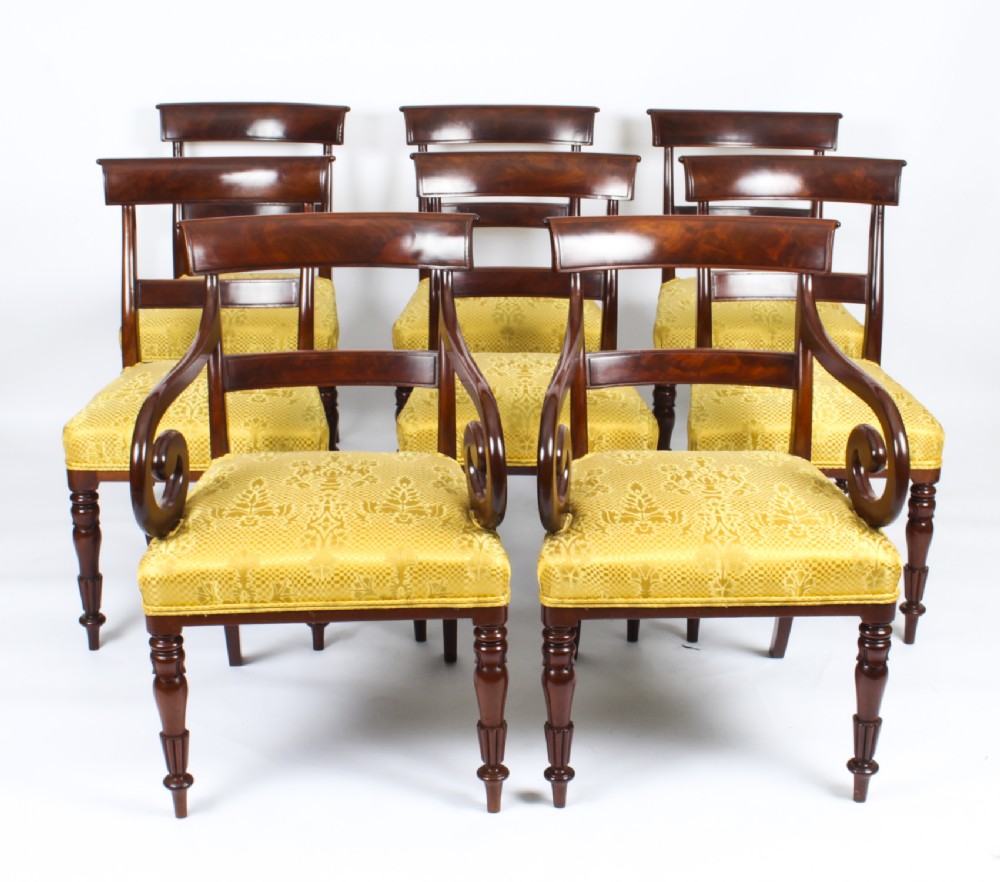
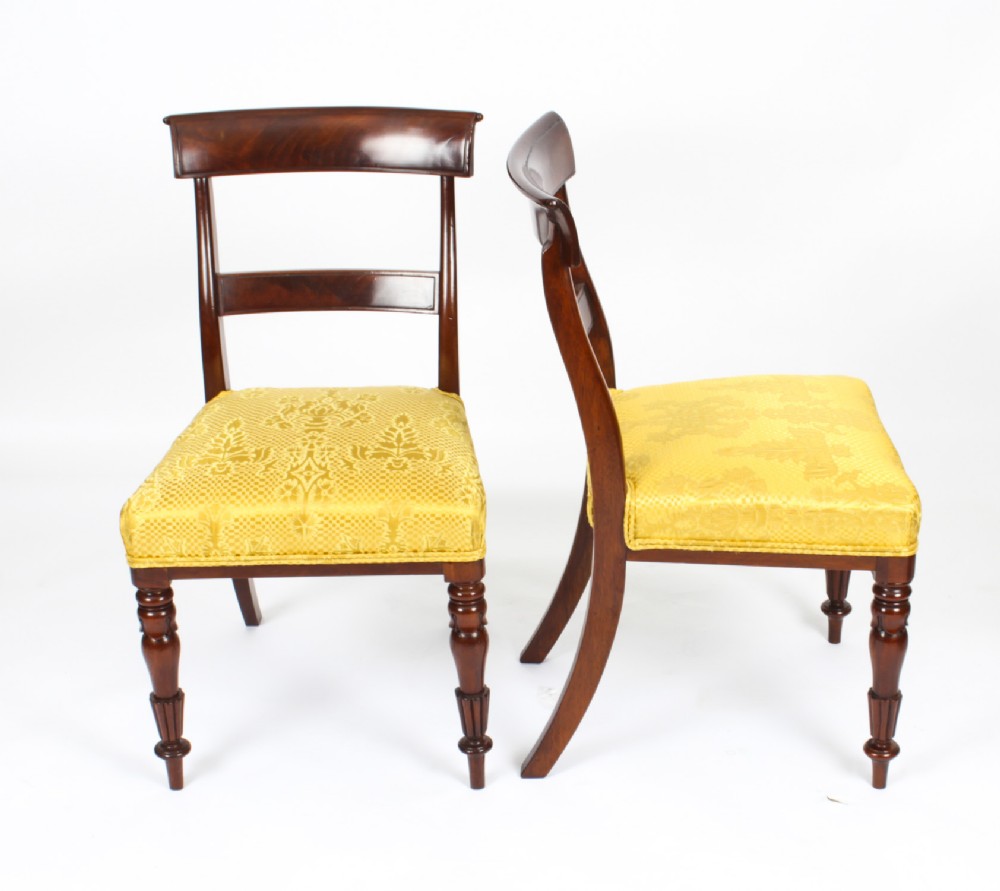
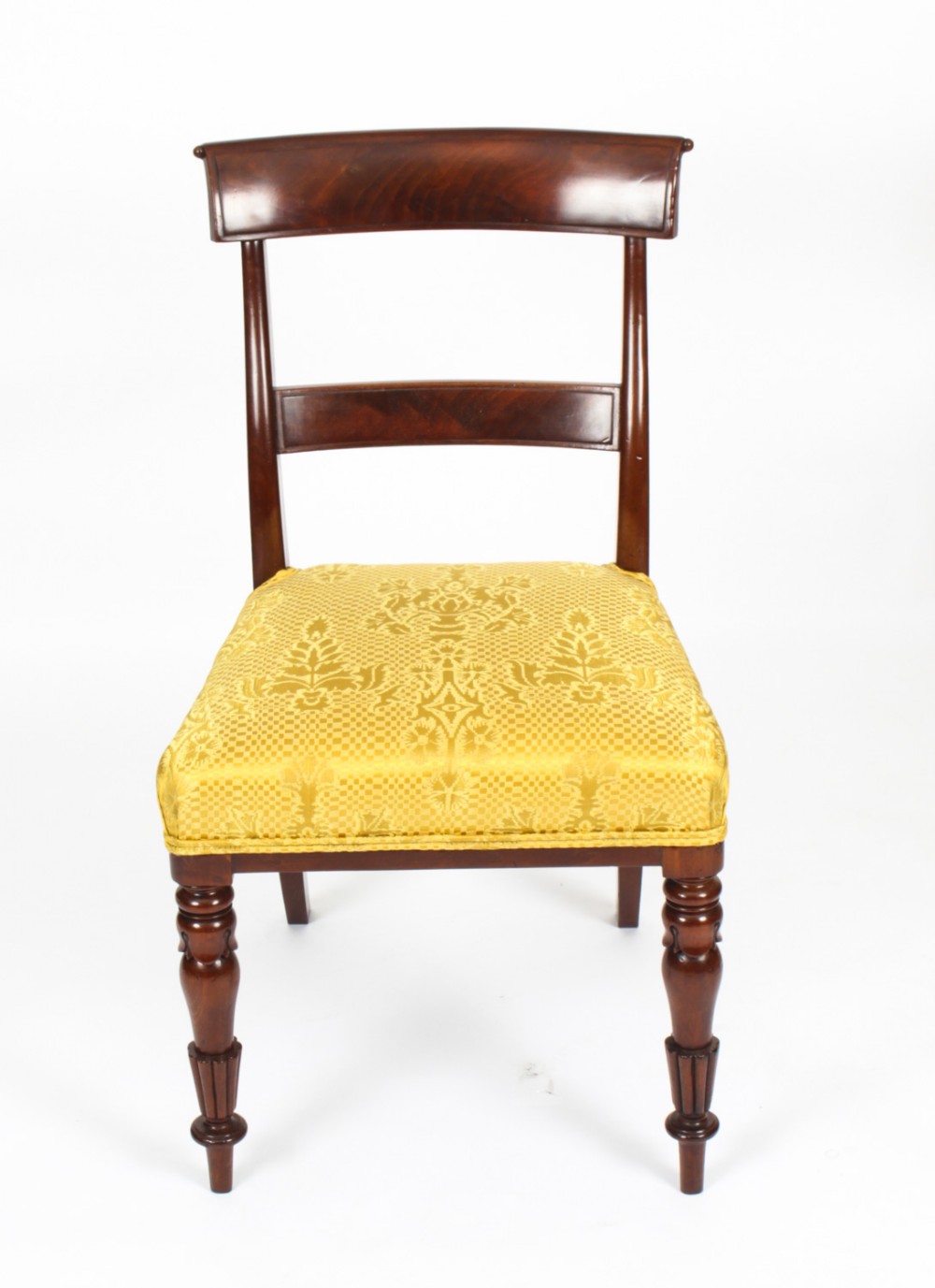
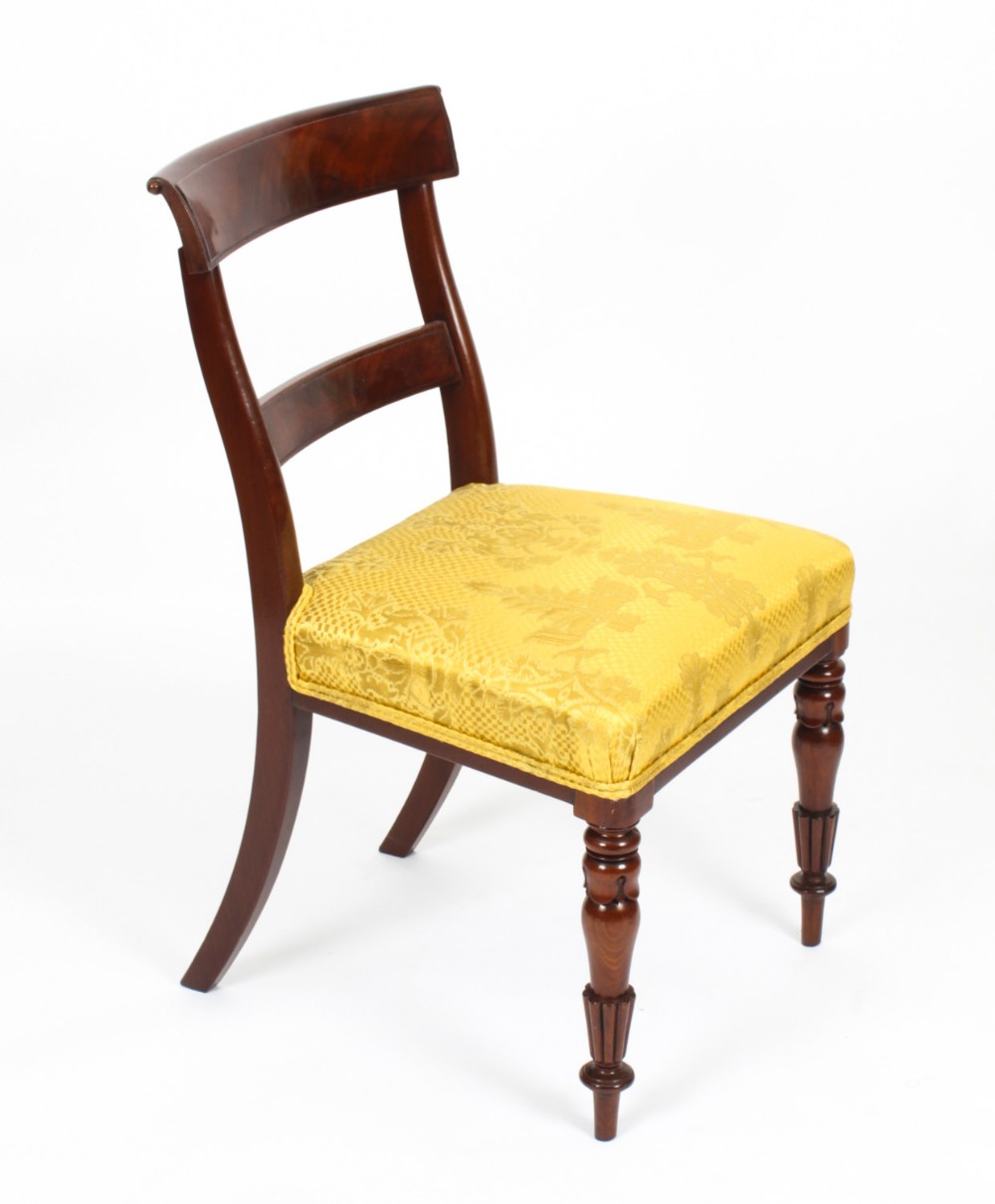
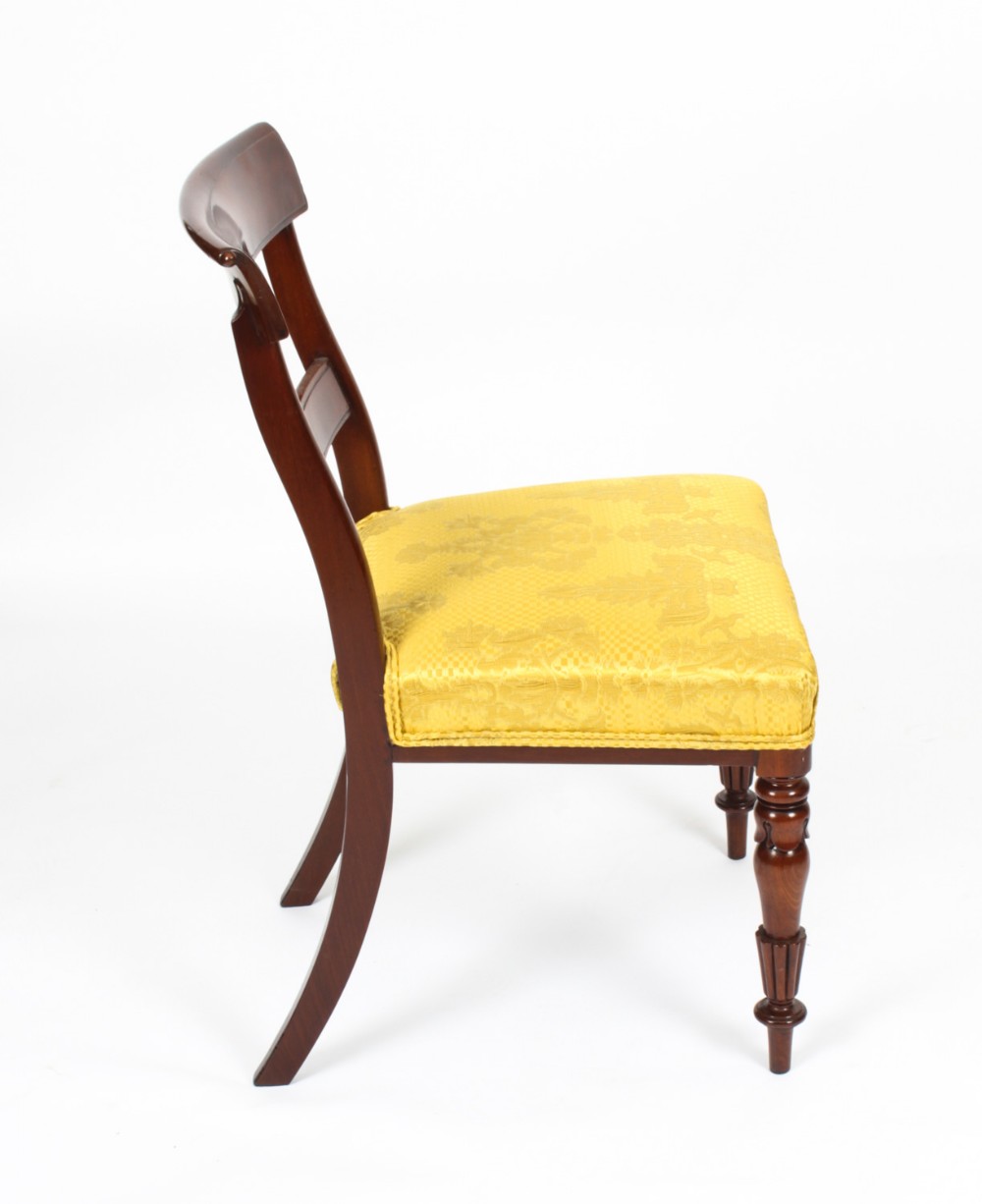
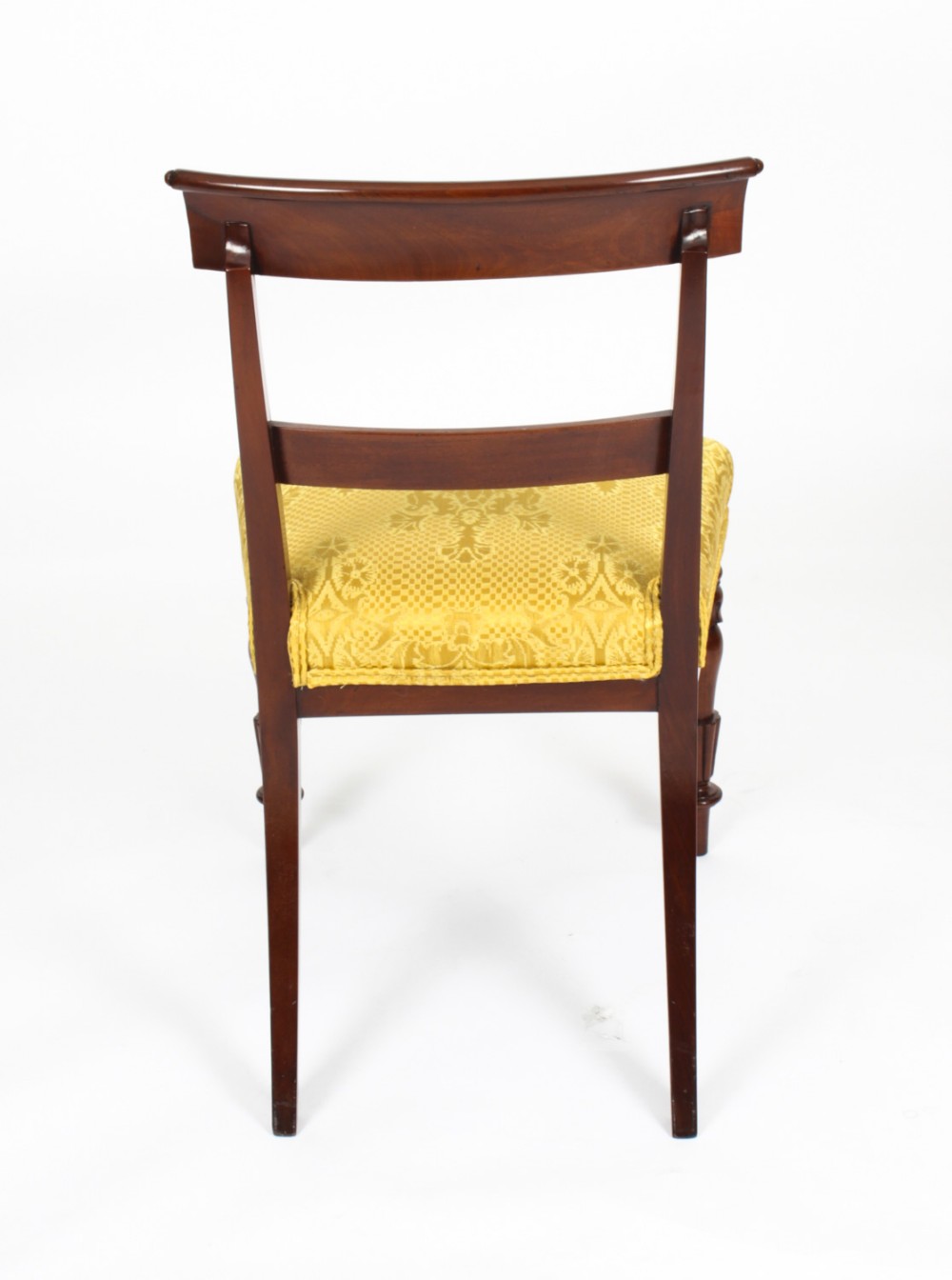
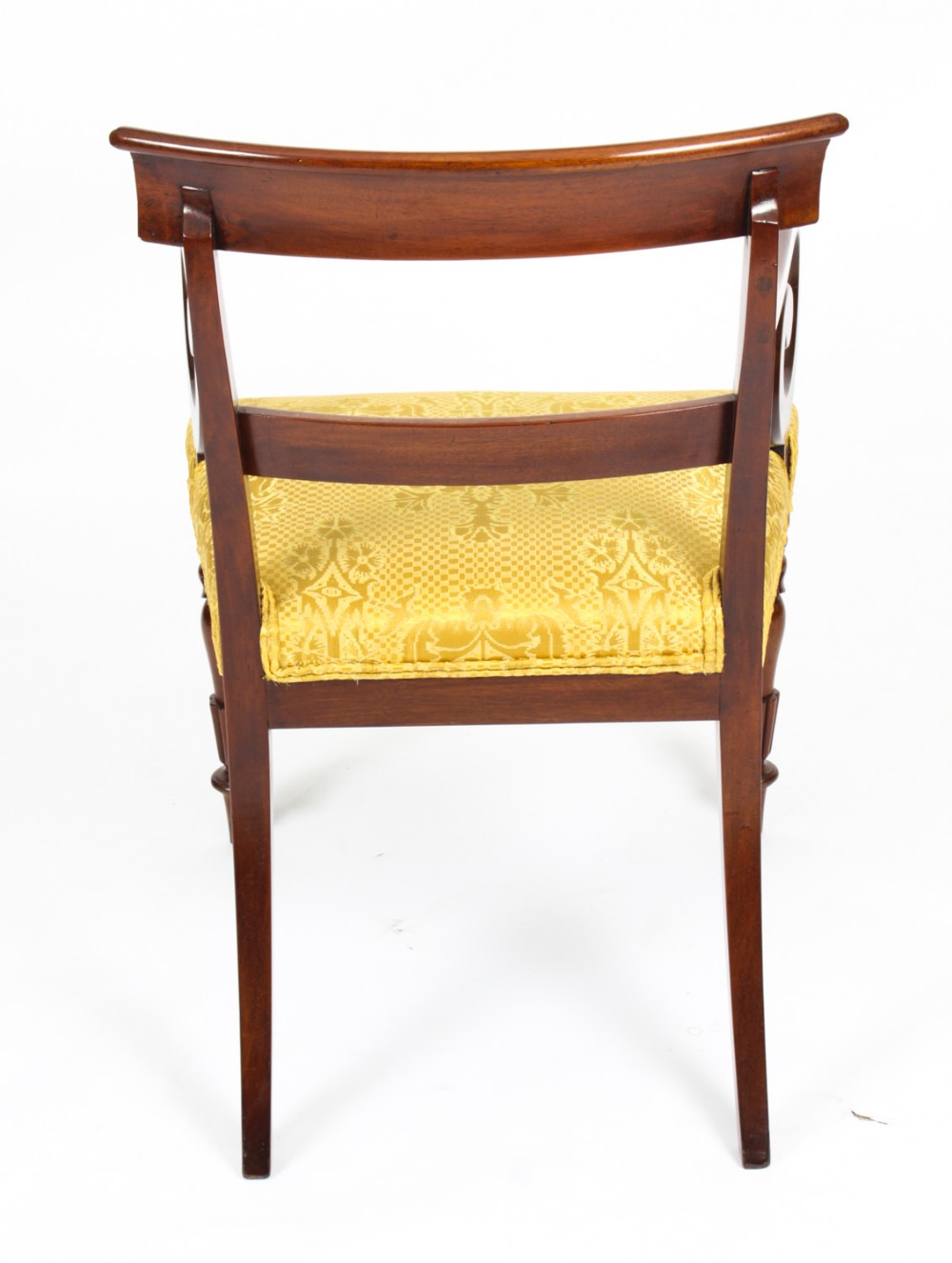
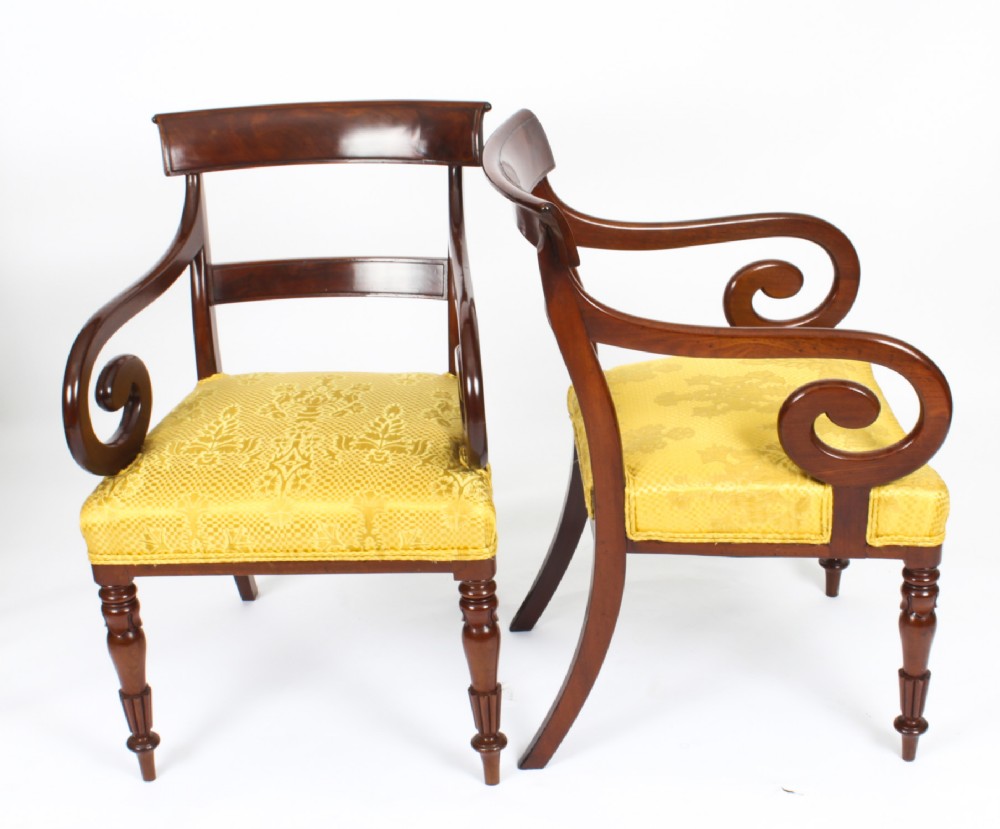
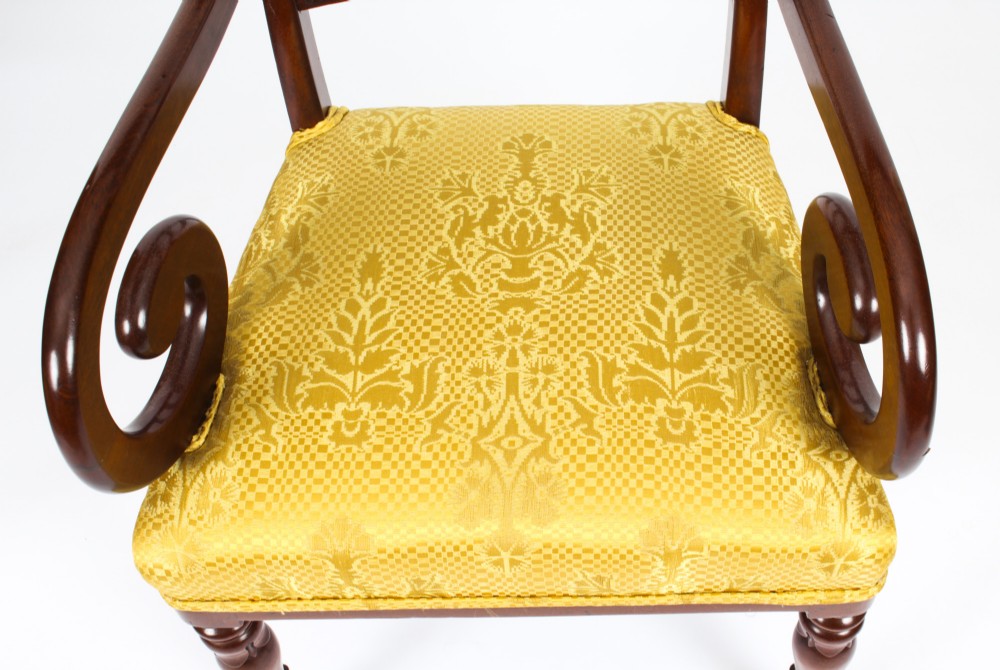
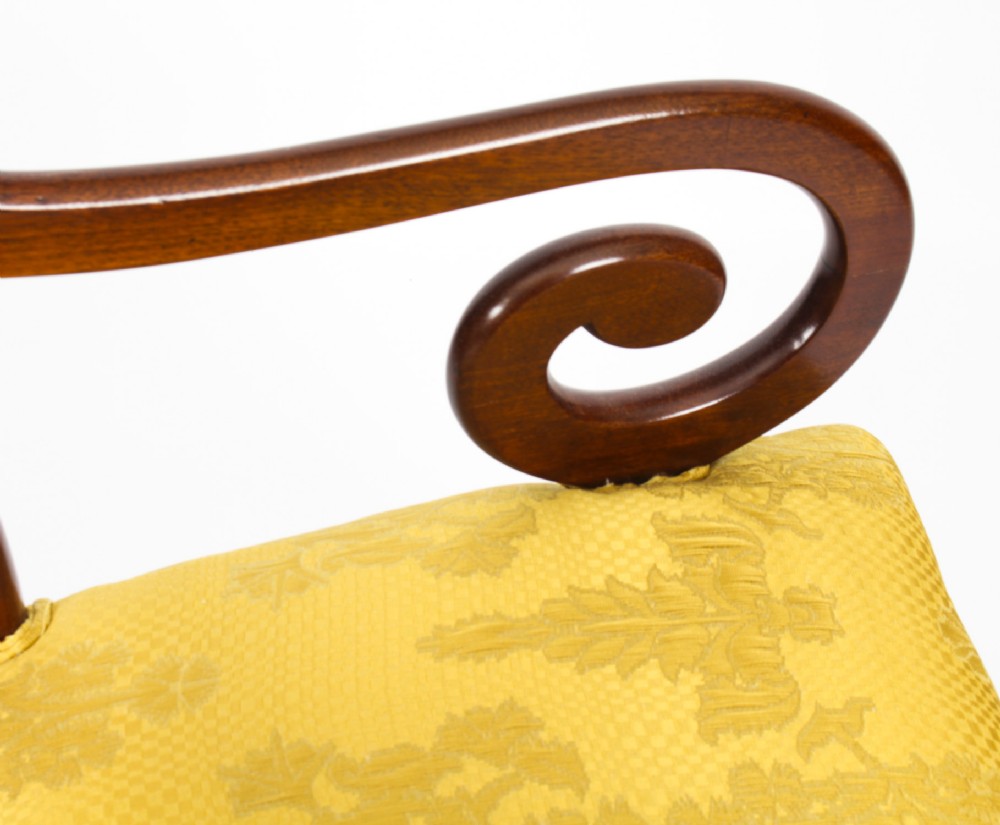
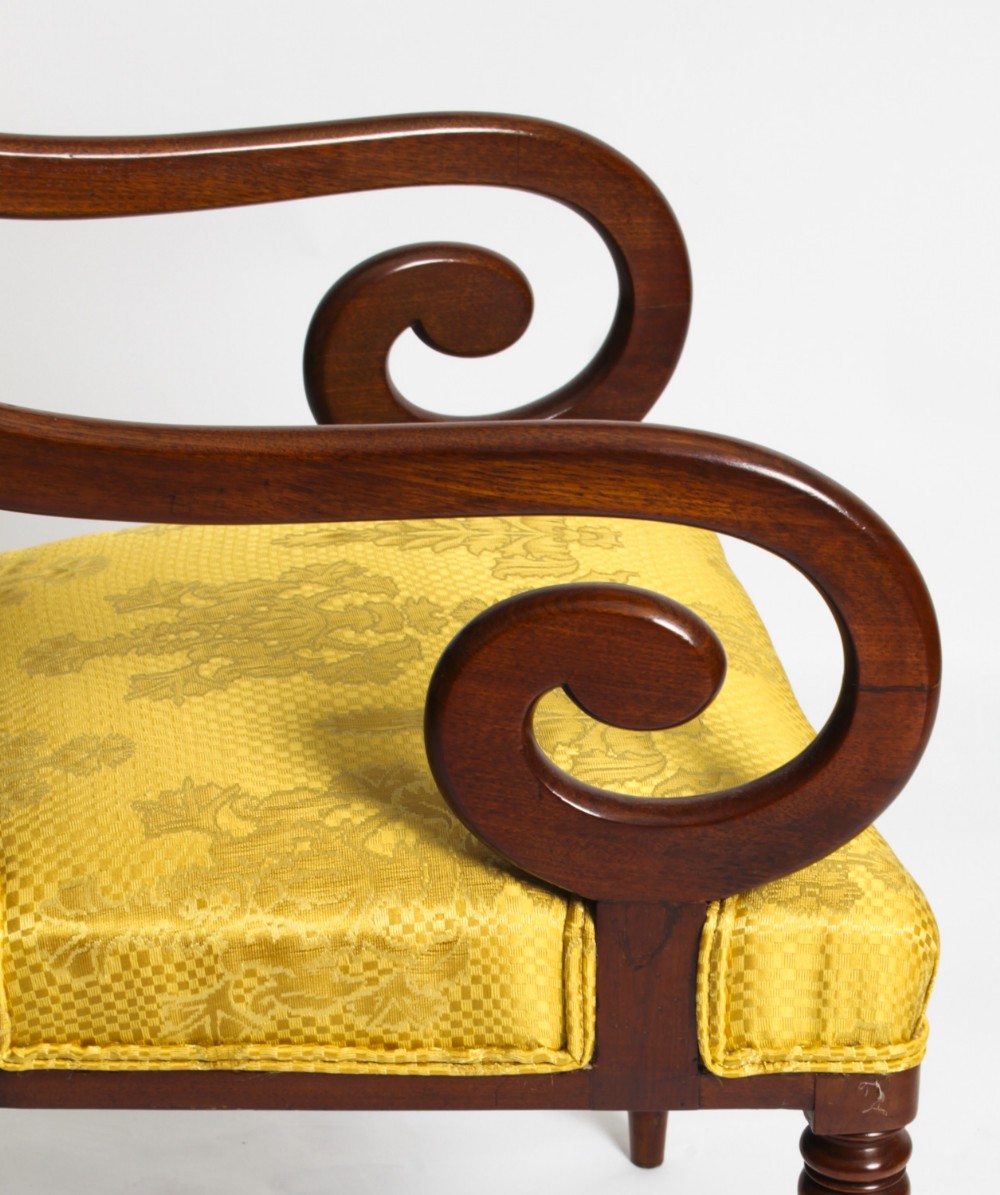
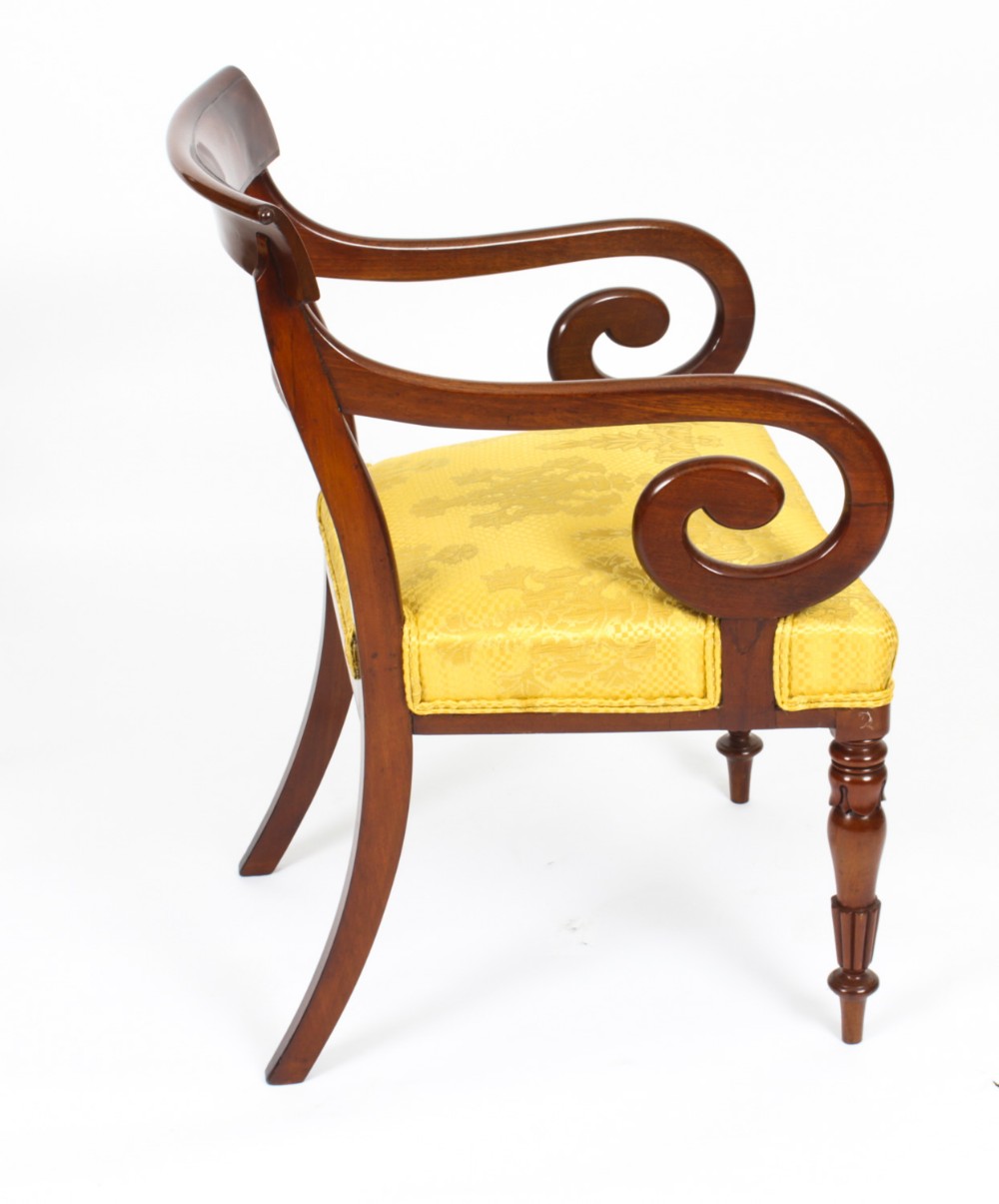
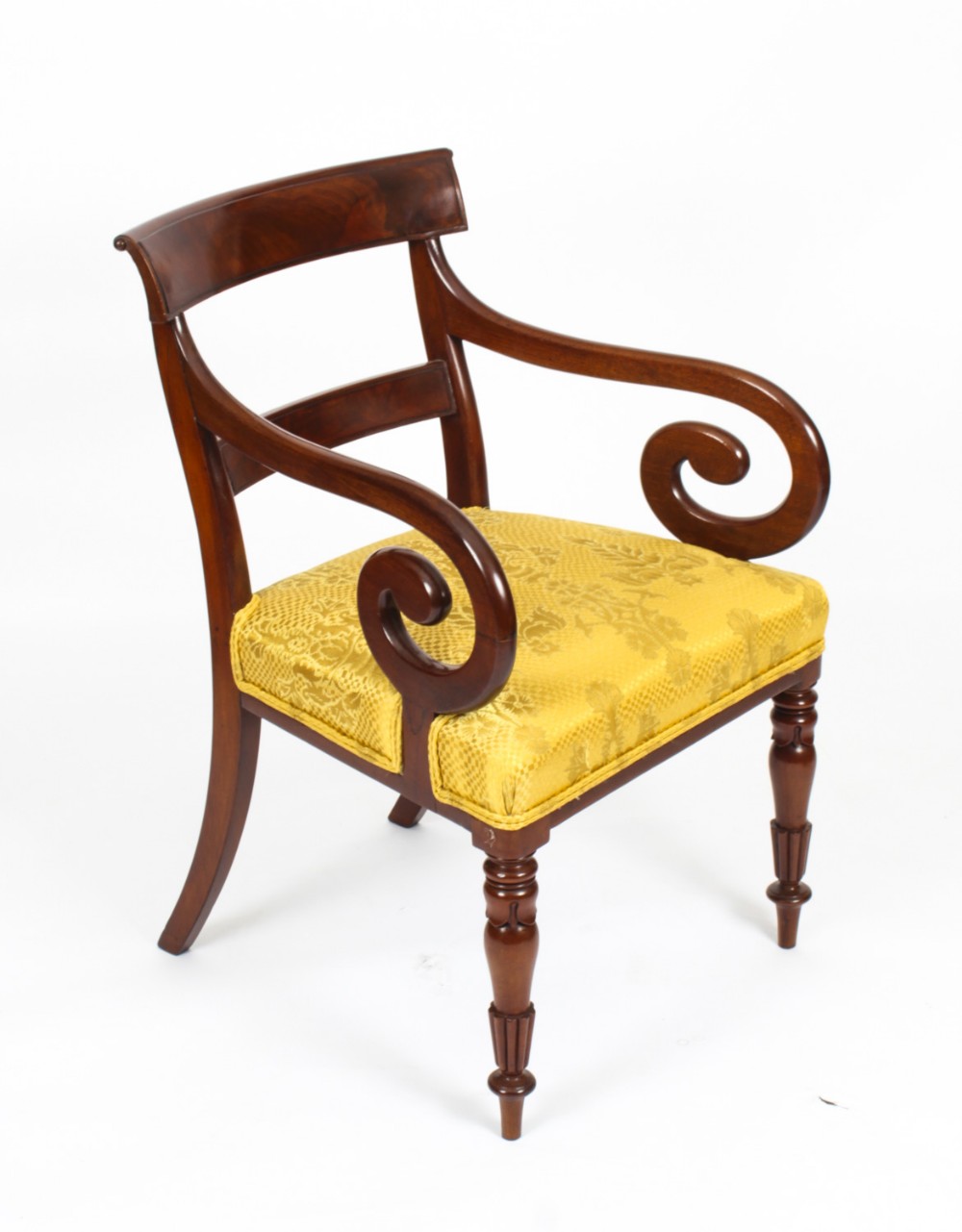
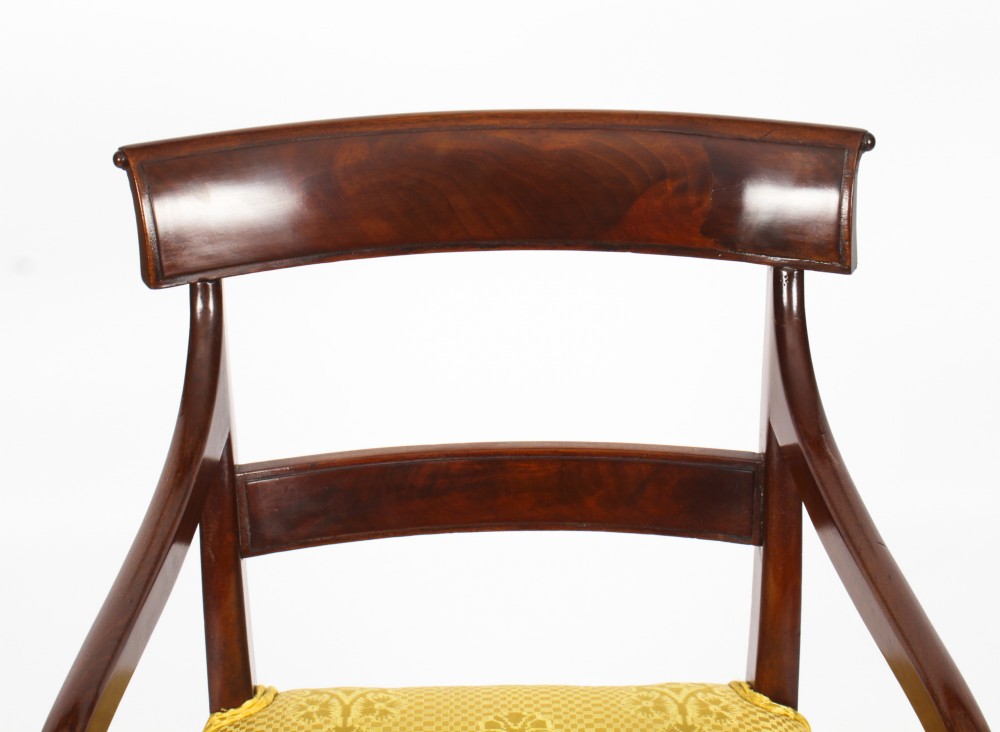
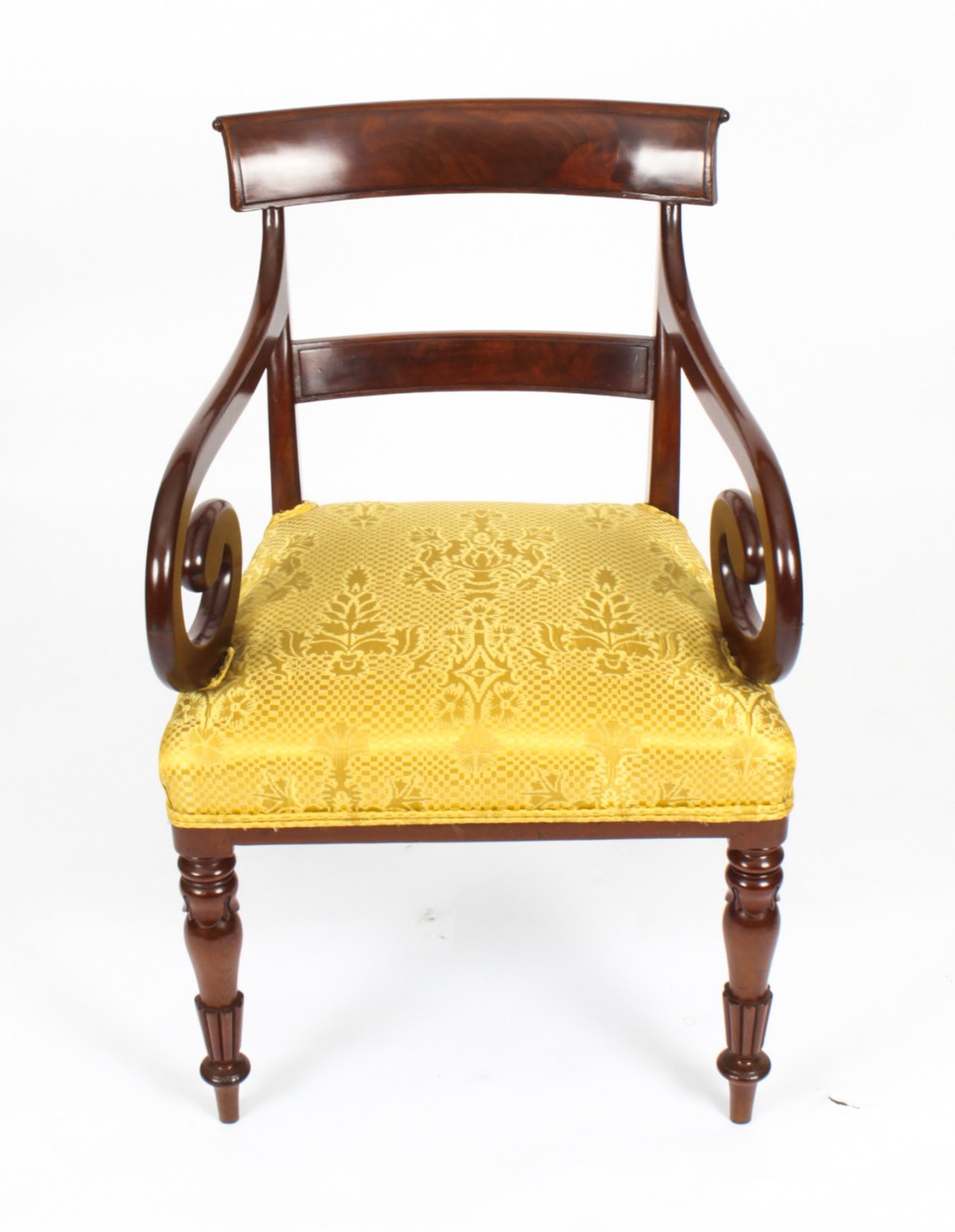
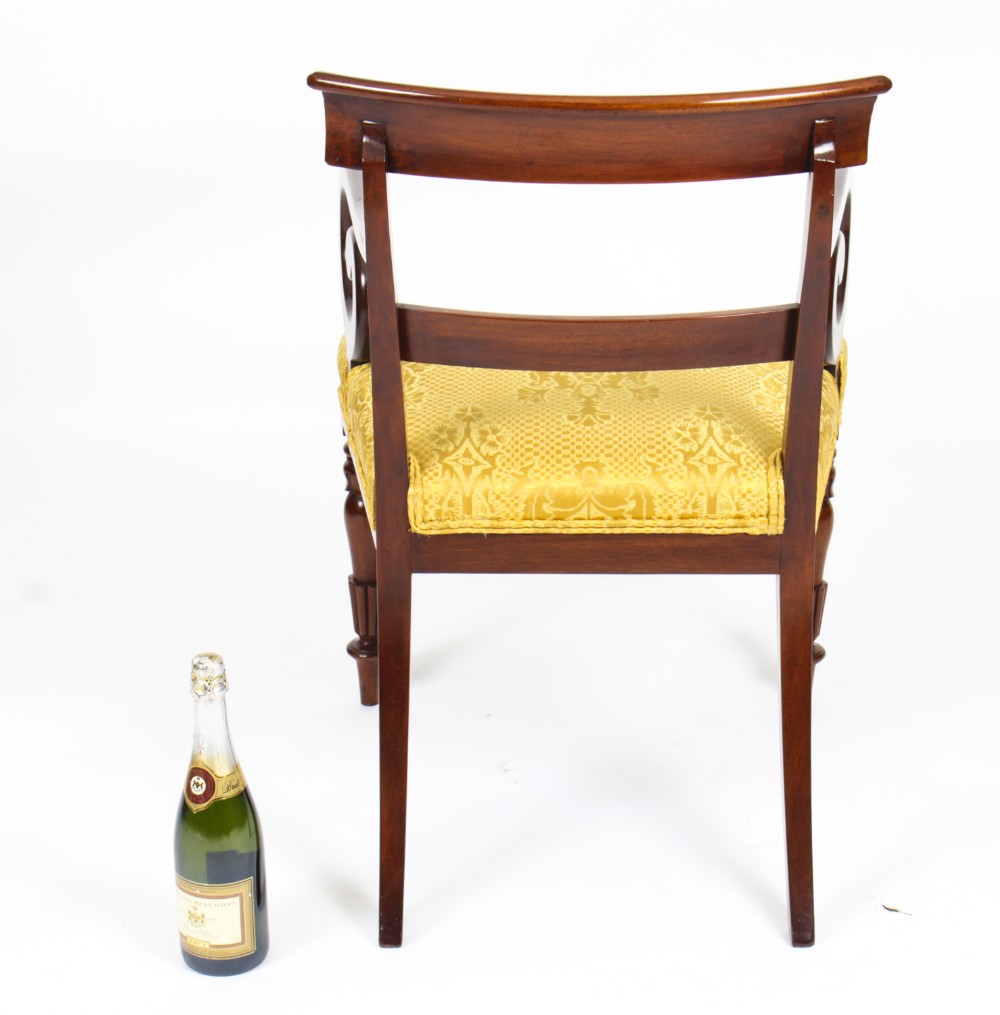
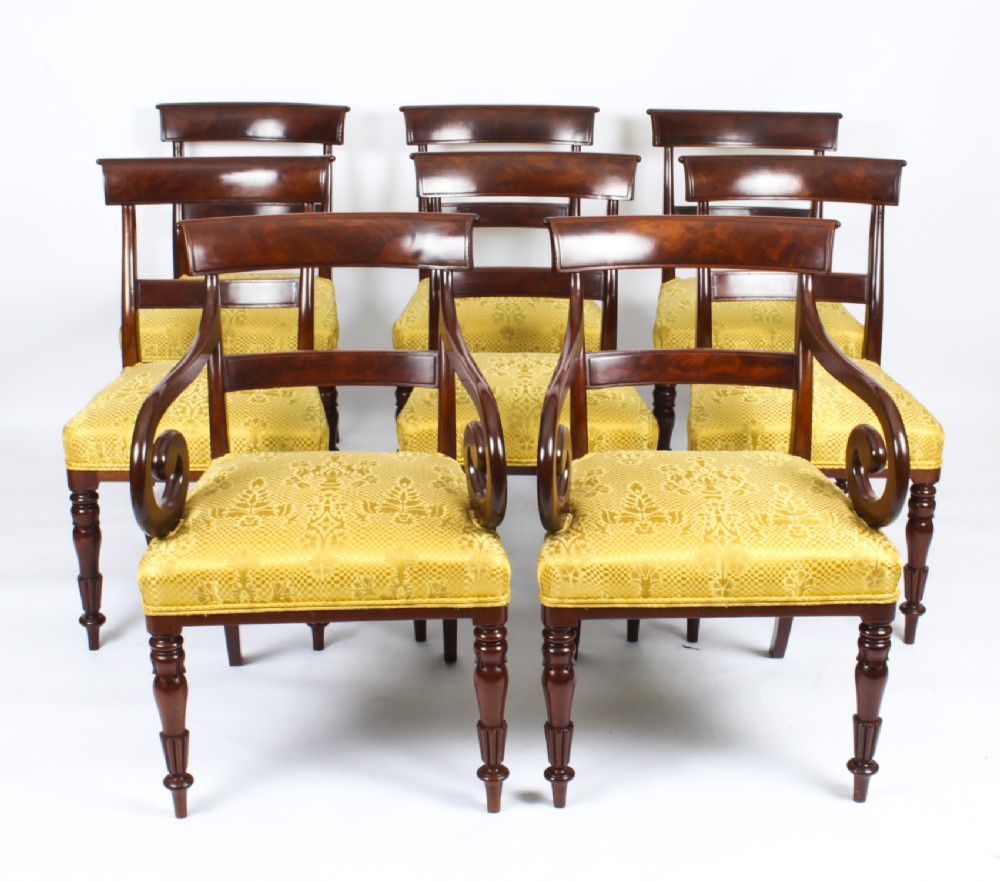
This is a fantastic antique English set of eight mahogany William IV barback dining chairs, circa 1830 in date.
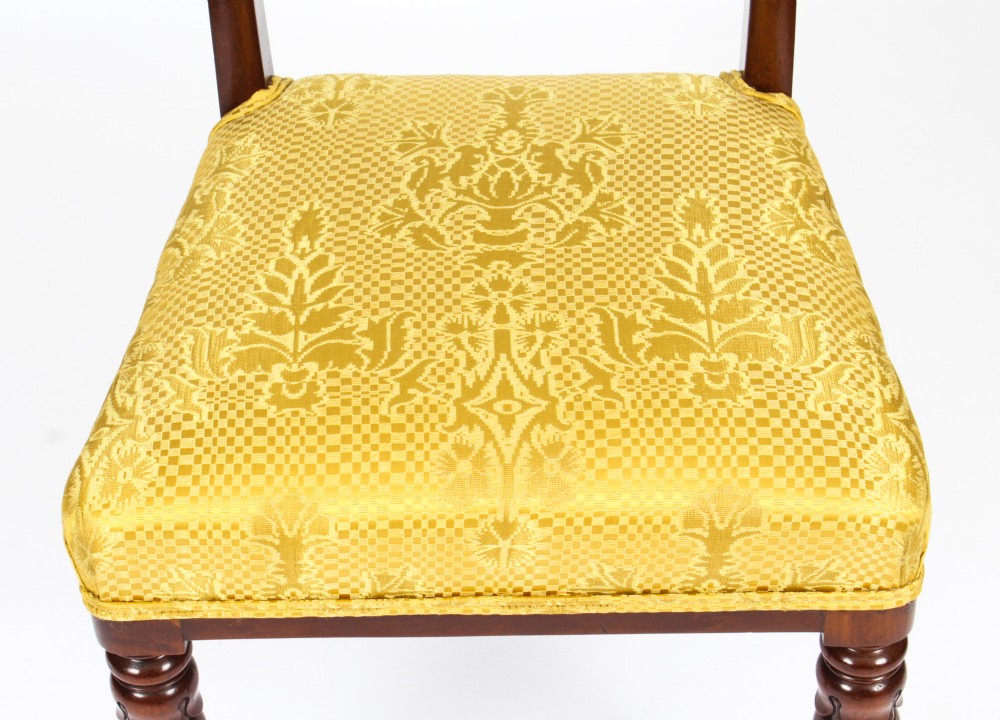
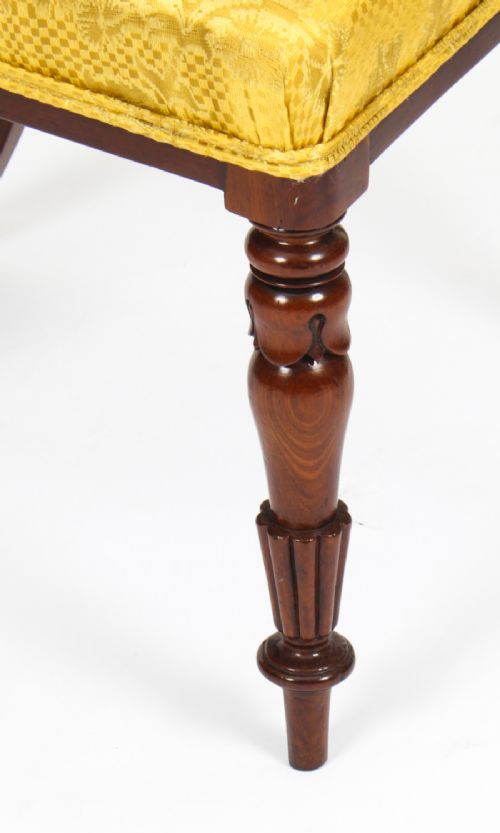
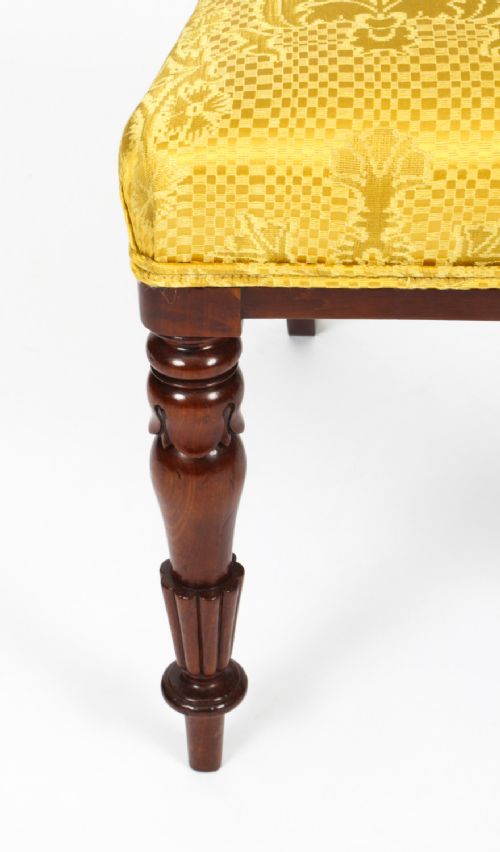
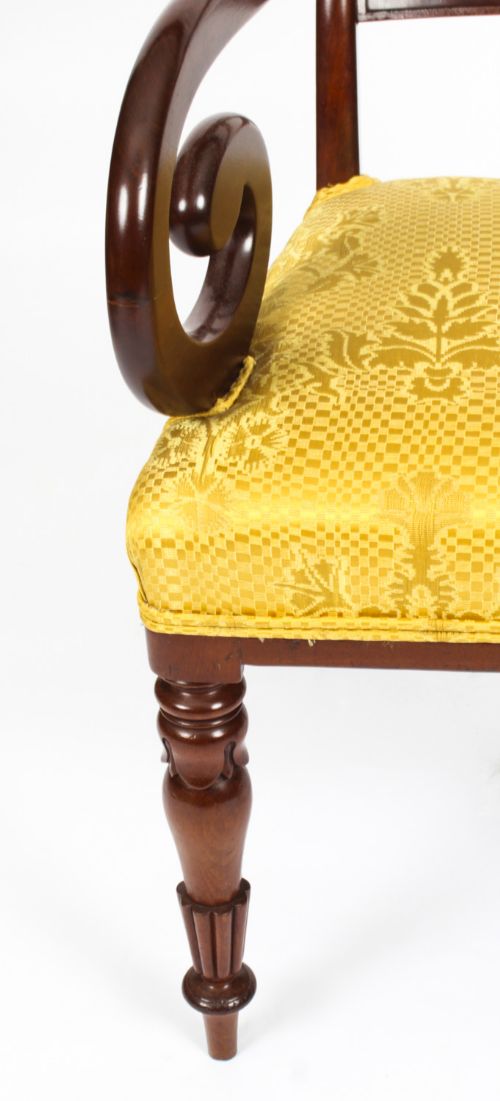
The set comprising six singles and two armchairs, with barbacks seats that have been reupholstered in a striking golden fabric with new double cone handspringing, and they are raised on semi reeded baluster front legs.
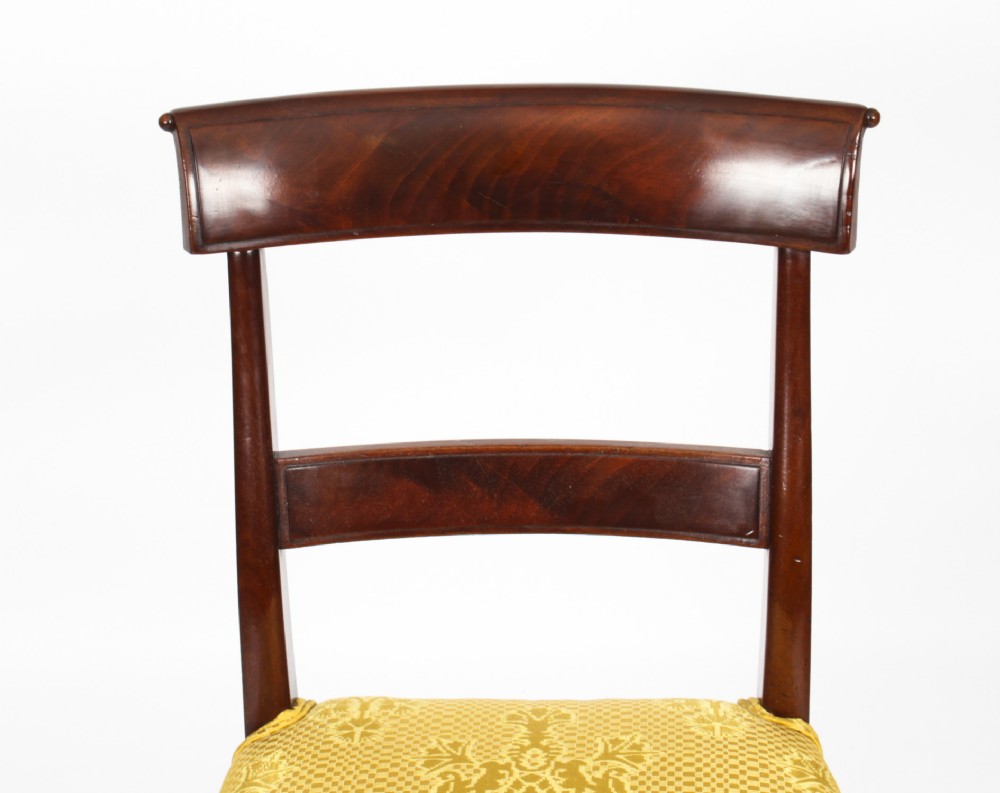
These chairs have been masterfully crafted in beautiful solid mahogany throughout and the finish and attention to detail on display are truly breathtaking.
Transform the fine dining experience in your home with this set of dining chairs fit for a king.
Condition:
In excellent condition having been beautifully cleaned, polished, waxed and reupholstered in our workshops, please see photos for confirmation.
Dimensions in cm:
Height 85 x Width 48 x Depth 53 - Side Chair
Height 85 x Width 54 x Depth 57 - Armchair
Height 47 - Seat Height
Dimensions in inches:
Height 2 foot, 9 inches x Width 1 foot, 7 inches x Depth 1 foot, 9 inches - Side Chair
Height 2 foot, 9 inches x Width 1 foot, 9 inches x Depth 1 foot, 10 inches - Armchair
Height 1 foot, 6 inches - Seat Height
Mahogany
is probably one of the largest ‘families’ of hardwood, having many different varieties within its own species.
Mahogany has been used for centuries in ship building, house building, furniture making etc and is the core structure of just about every 19th century vanity box, dressing case or jewellery box. It became more of a Victorian trend to dress Mahogany with these decorative veneers, such as Rosewood, Kingwood, Burr Walnut and Coromandel, so that the actual Mahogany was almost hidden from view.
Mahogany itself is a rich reddish brown wood that can range from being plain in appearance to something that is so vibrant, figured and almost three dimensional in effect.
Although Mahogany was most often used in its solid form, it also provided some beautifully figured varieties of veneer like ‘Flame’ Mahogany and ‘Fiddleback’ Mahogany (named after its preferred use in the manufacture of fine musical instruments).
Cuban Mahogany was so sought after, that by the late 1850's, this particular variety became all but extinct.
George Hepplewhite
(1727 - 1786) was a cabinetmaker. He is regarded as having been one of the "big three" English furniture makers of the 18th century, along with Thomas Sheraton and Thomas Chippendale.
There are no pieces of furniture made by Hepplewhite or his firm known to exist but he gave his name to a distinctive style of light, elegant furniture that was fashionable between about 1775 and 1800 and reproductions of his designs continued through the following centuries. After he died in 1786, the business was continued by his widow, Alice. In 1788 she published a book with about 300 of his designs, The Cabinet Maker and Upholsterers Guide, with two further editions published in 1789 and 1790.
Hepplewhite produced designs that were slender, more curvilinear in shape and well balanced. There are some characteristics that hint at a Hepplewhite design, such as shorter more curved chair arms, straight legs, shield-shape chair backs, all without carving. The design would receive ornamentation from paint and inlays used on the piece.
Our reference: A1898