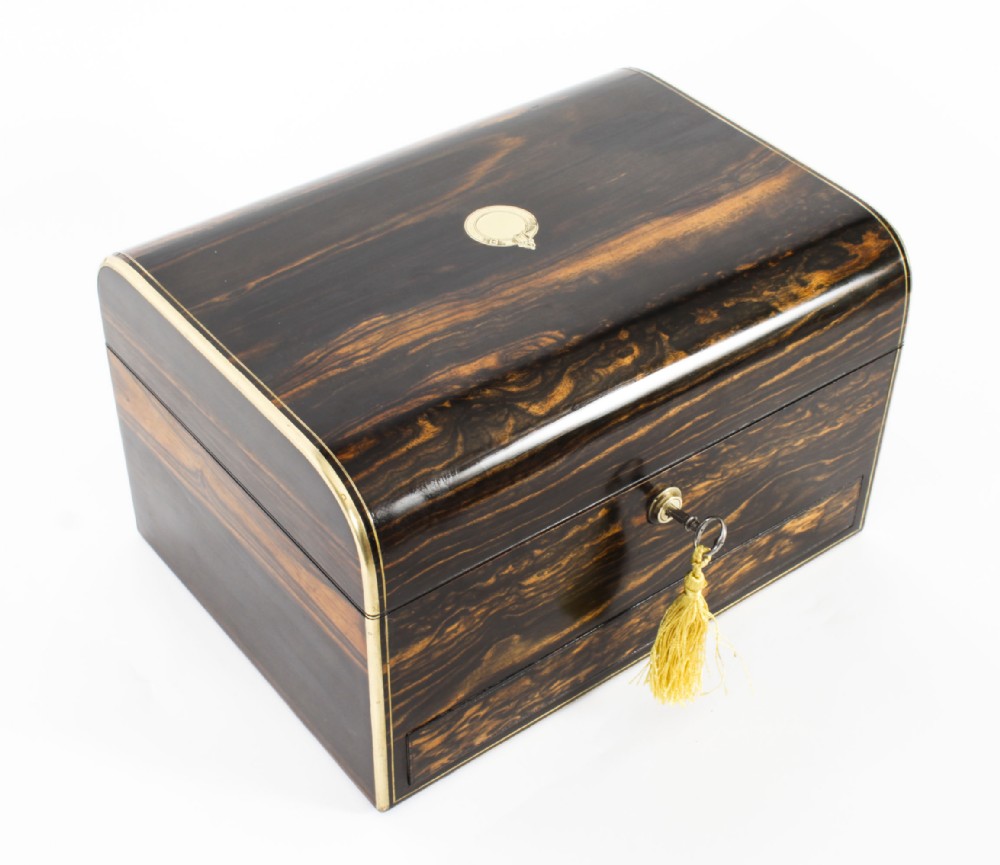
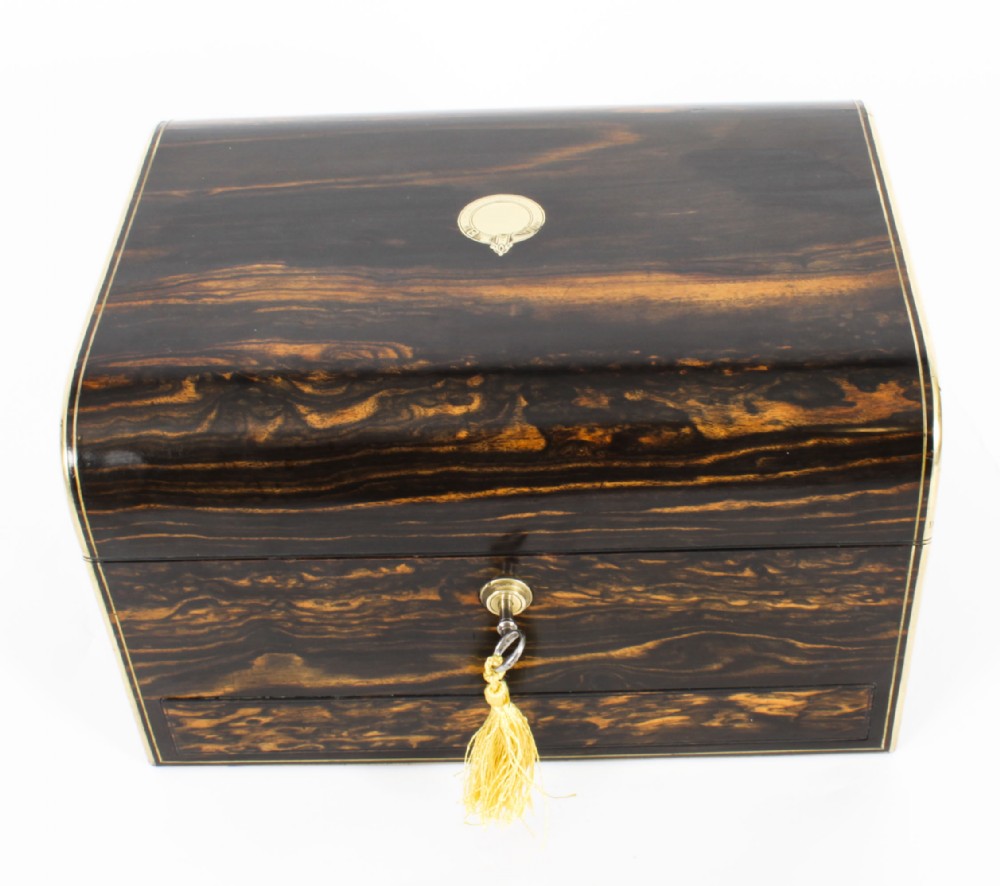
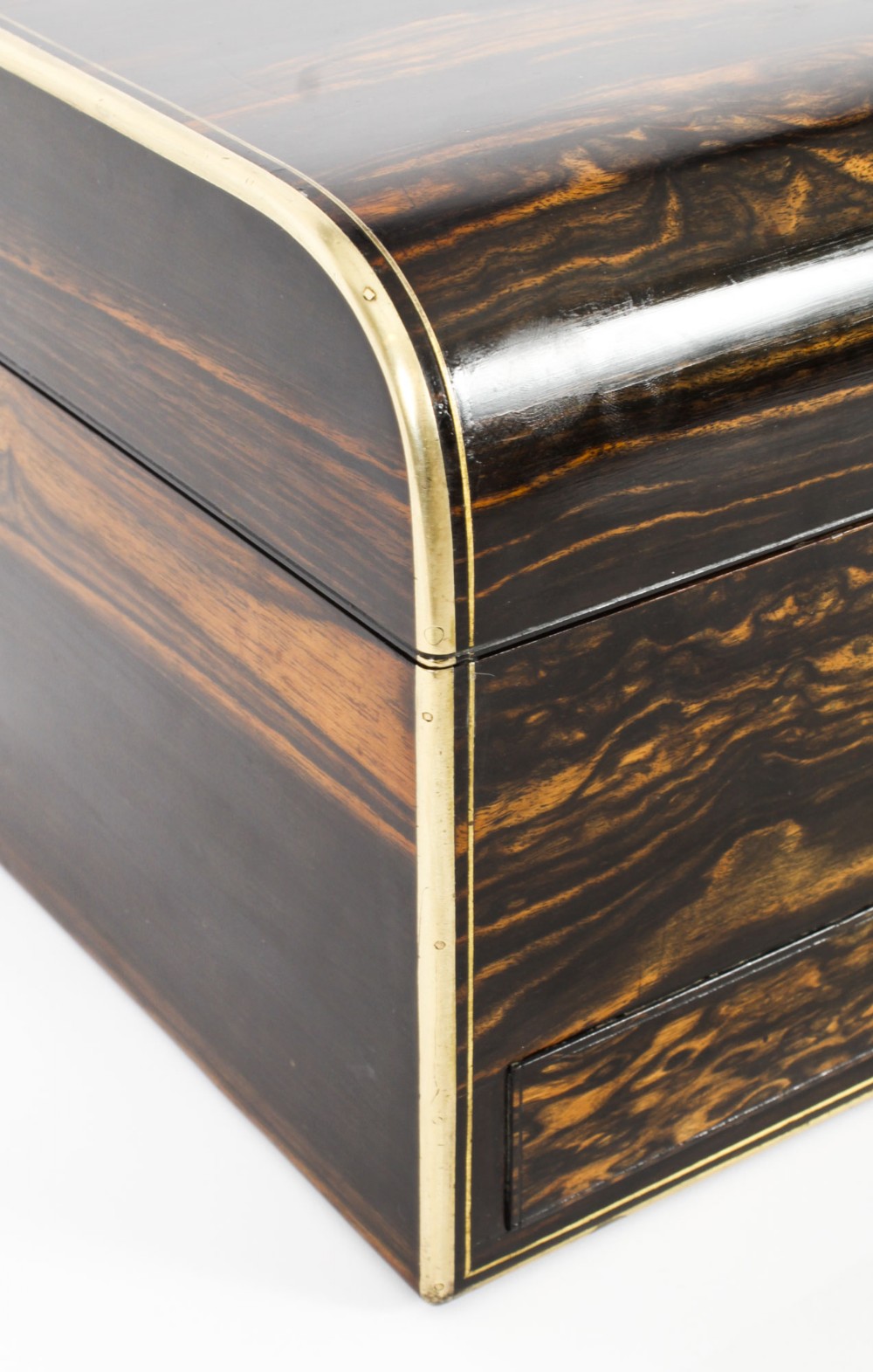
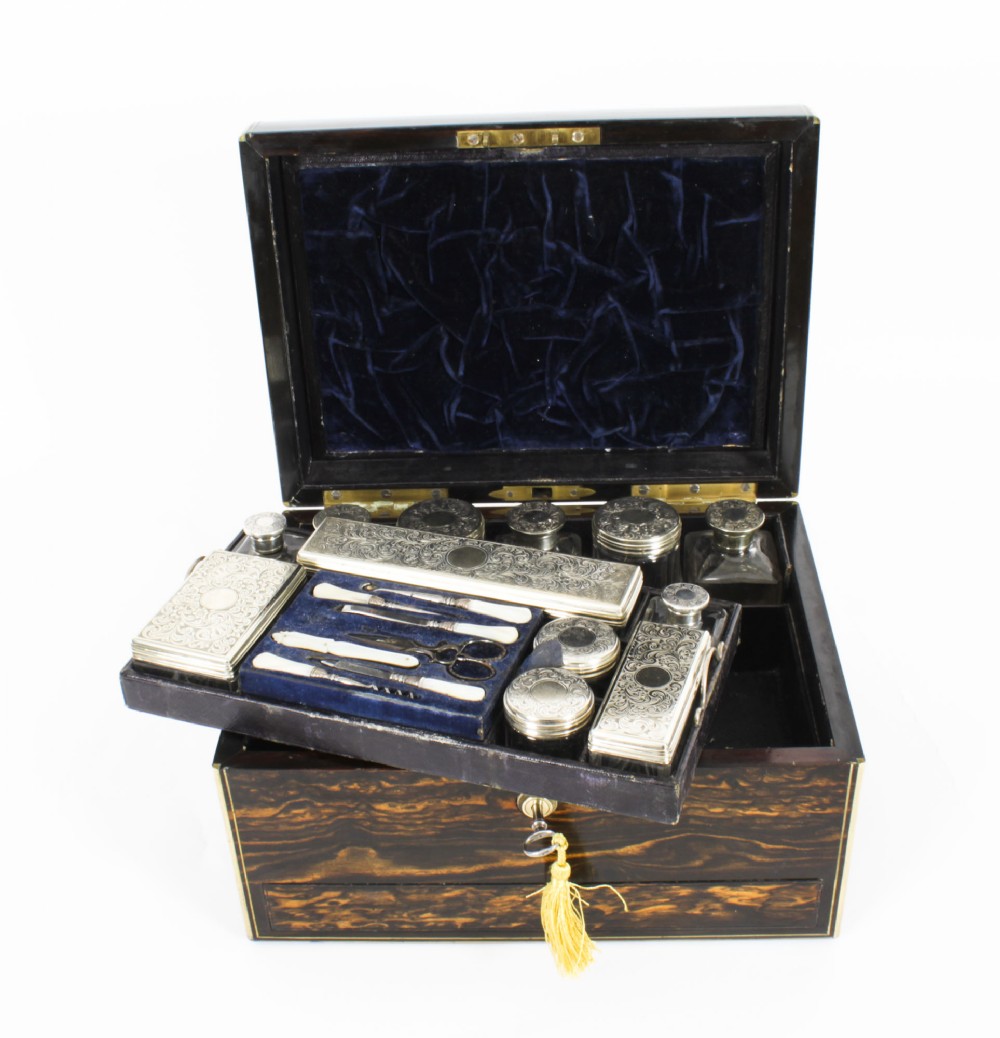
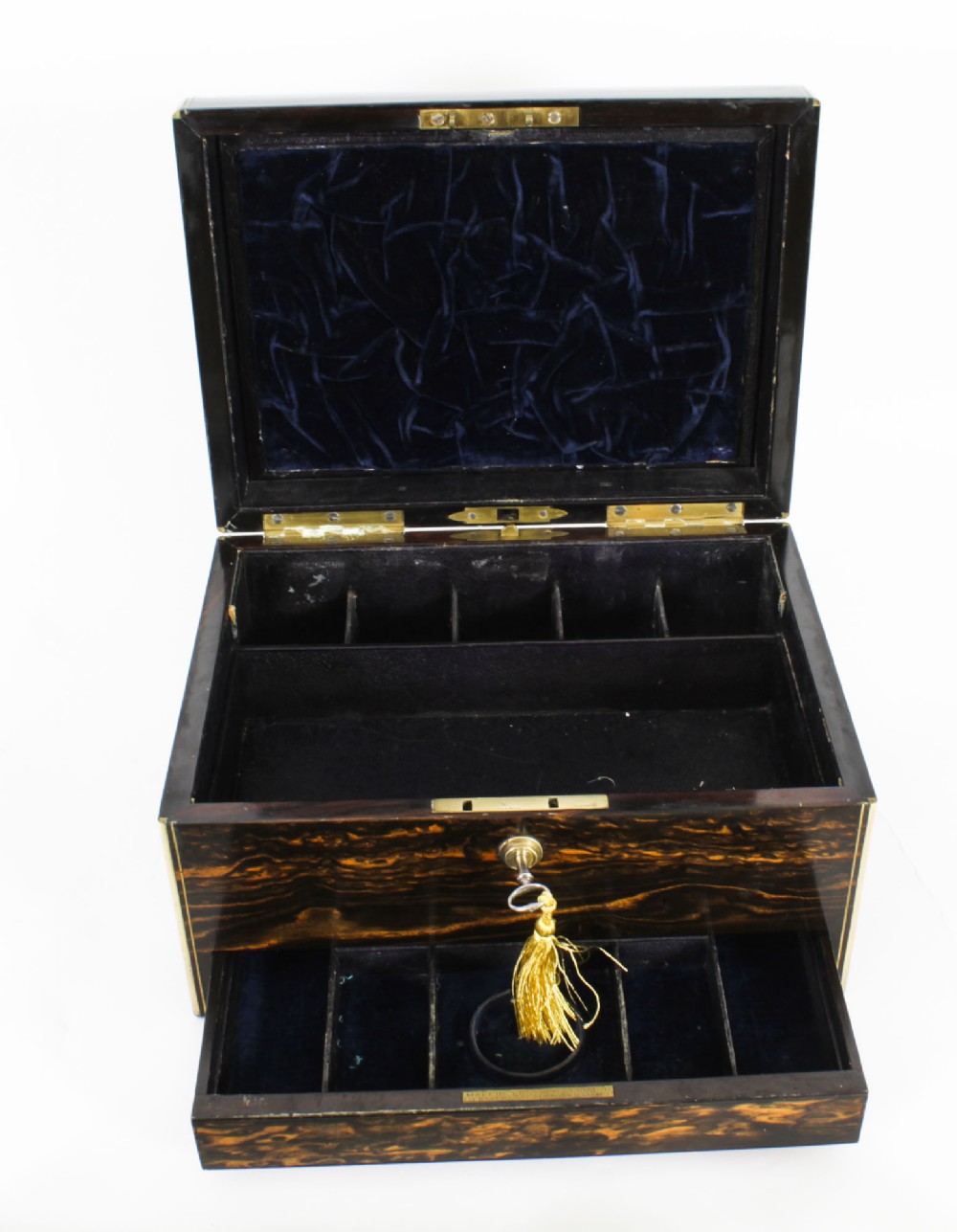
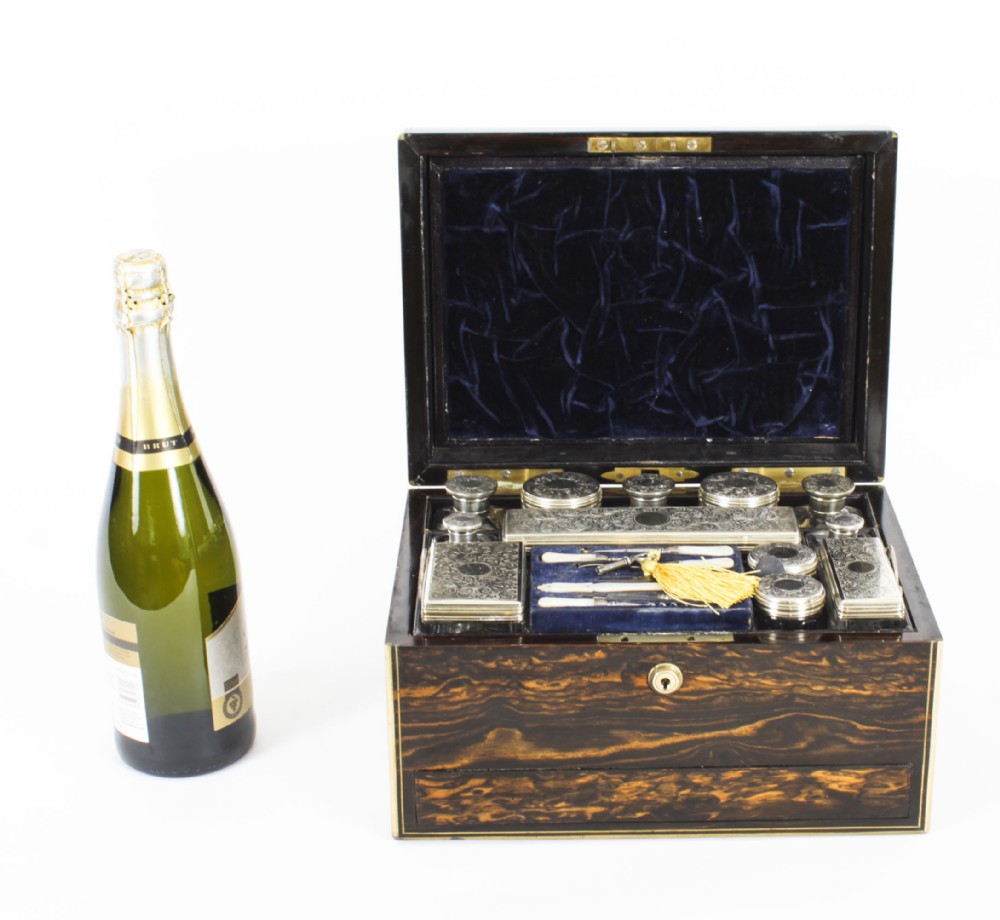
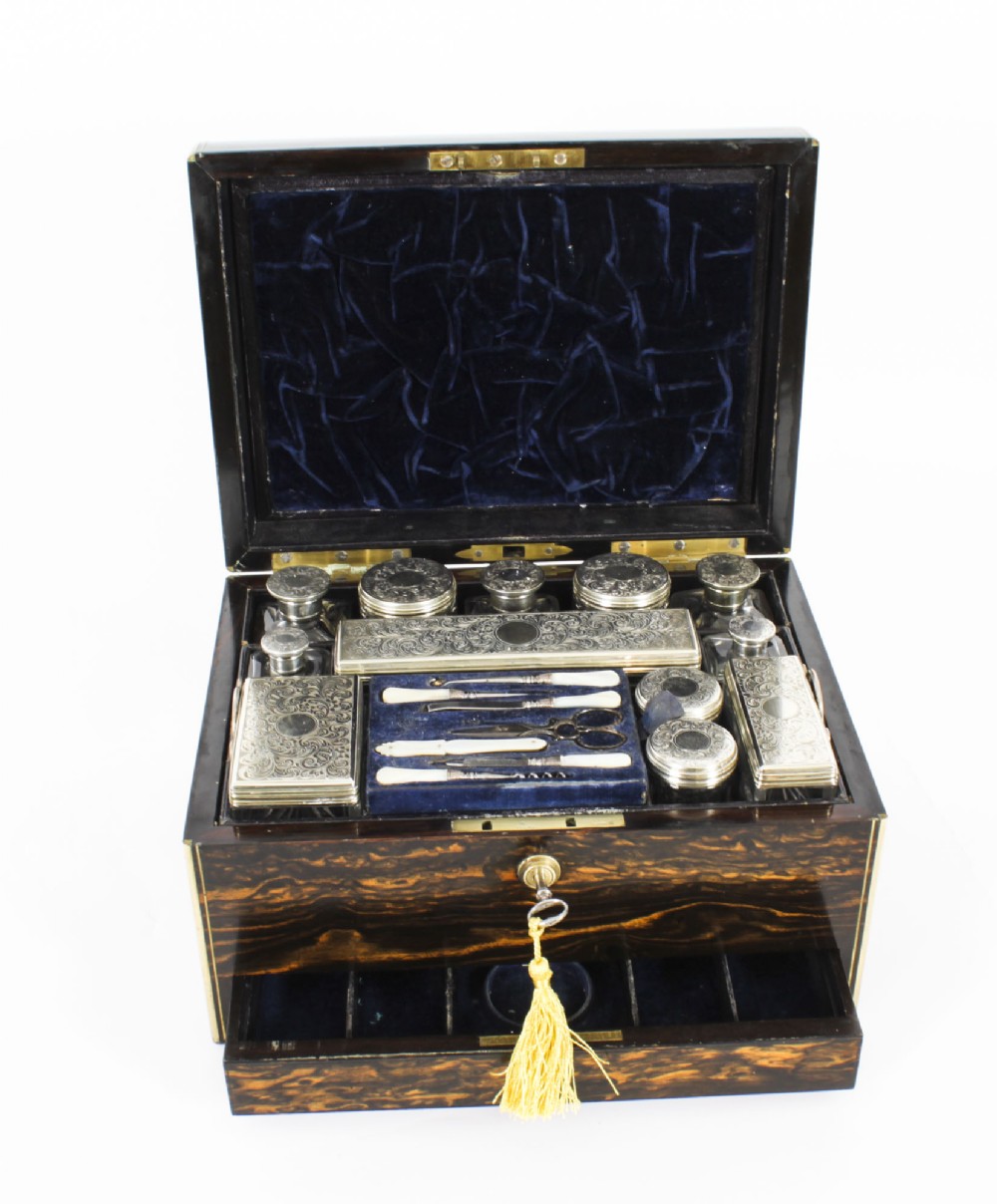
This is a stunning antique Victorian Coromandel travelling vanity case with fitted interior, by the world renowned retalier Mappin Brothers, circa 1865.
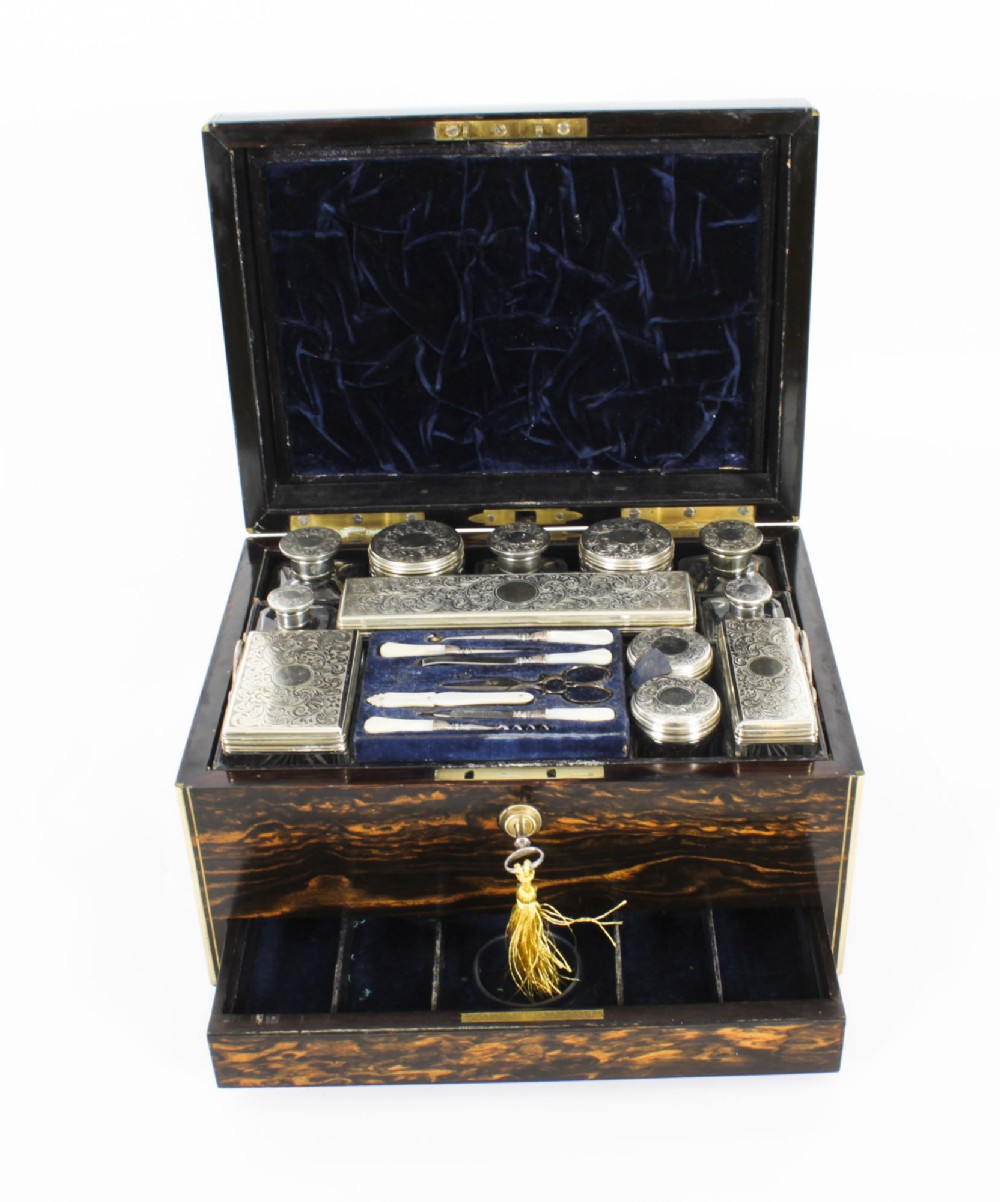
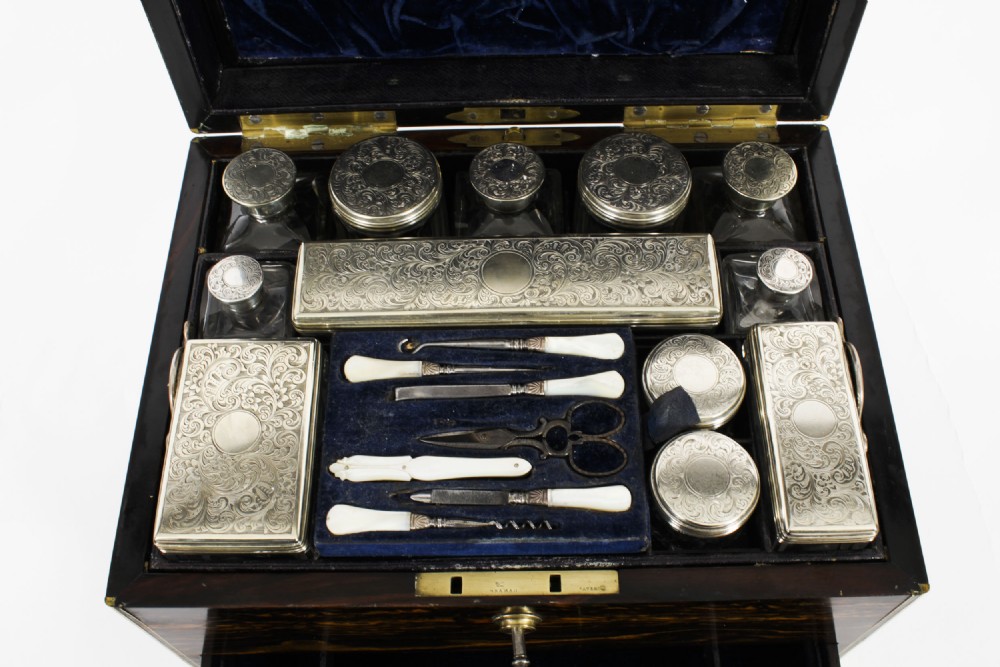
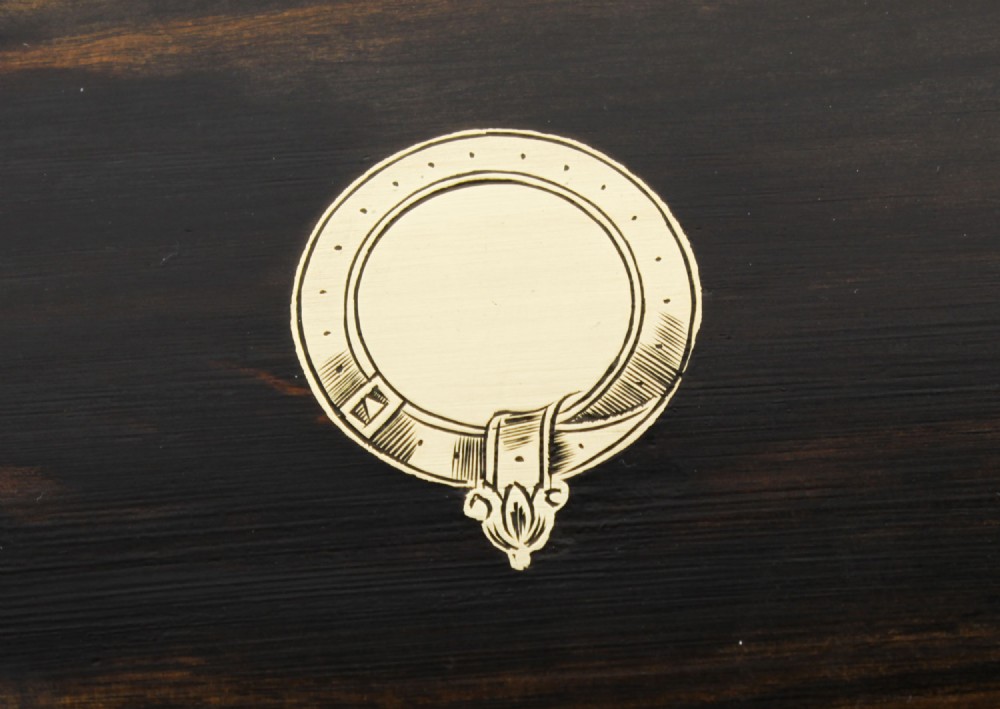
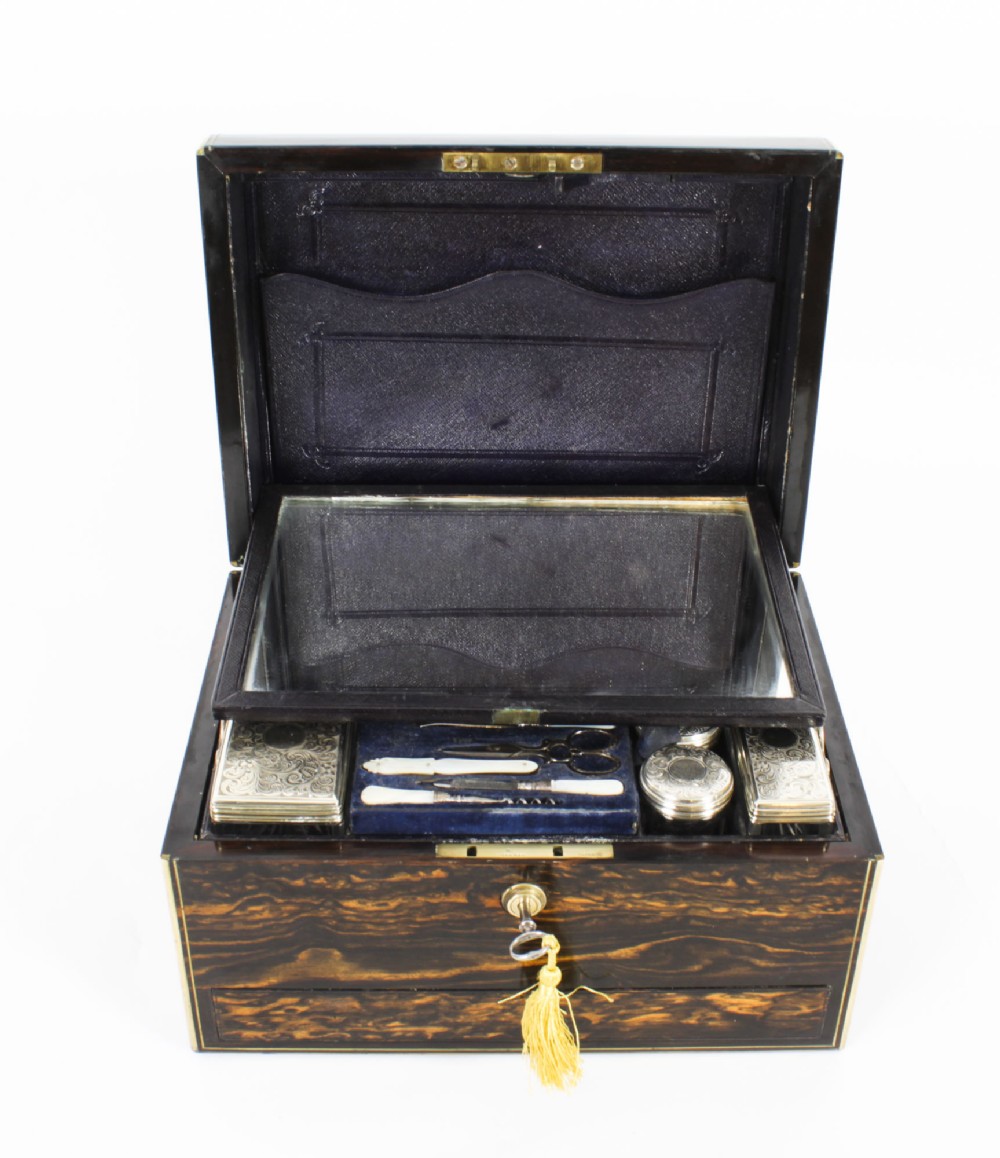
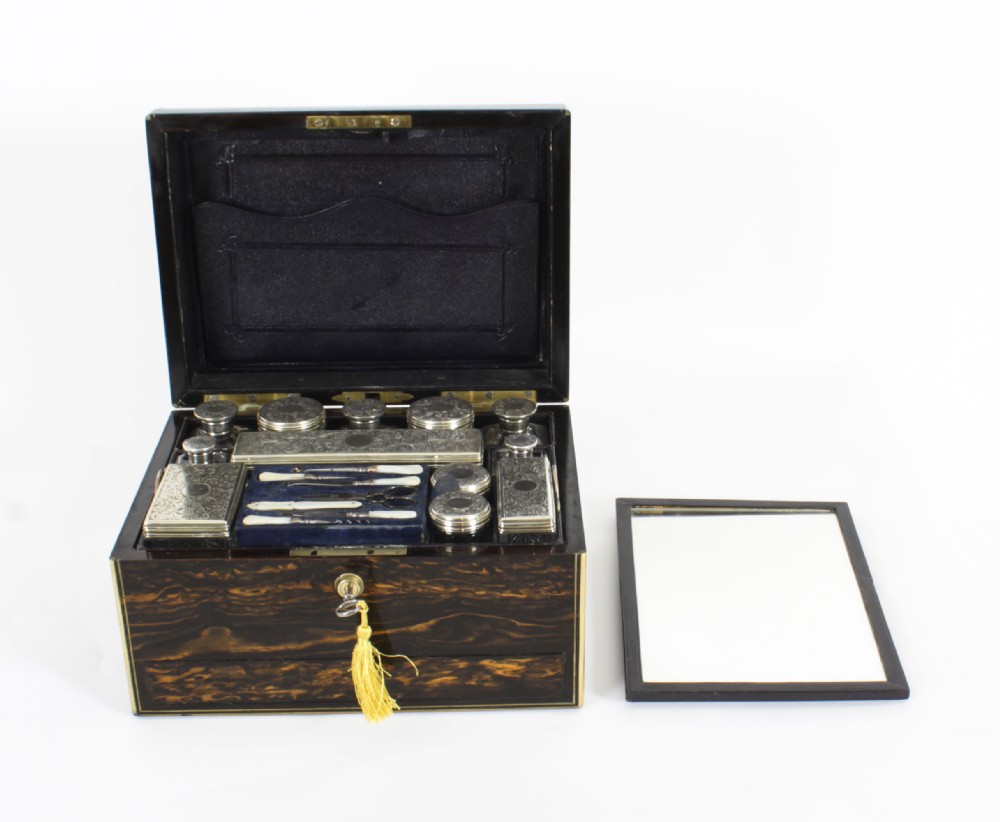
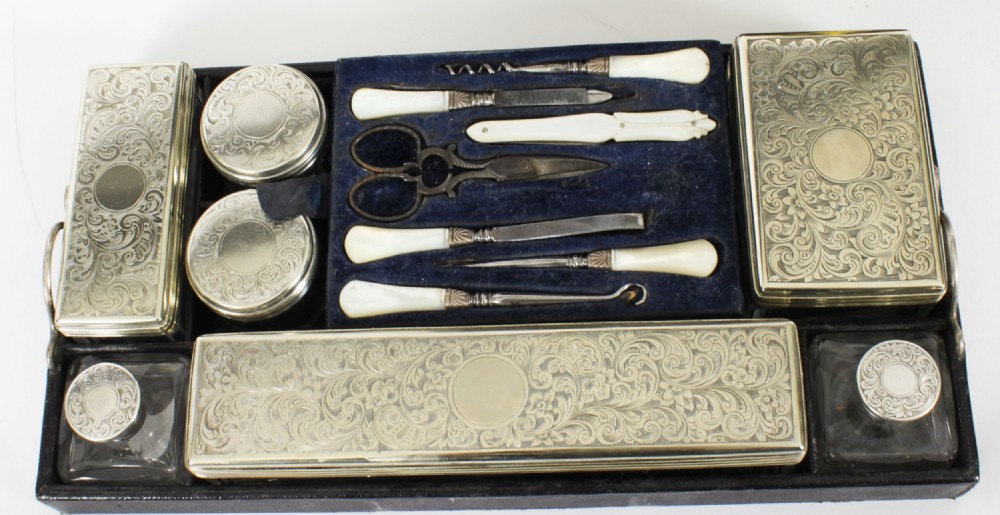
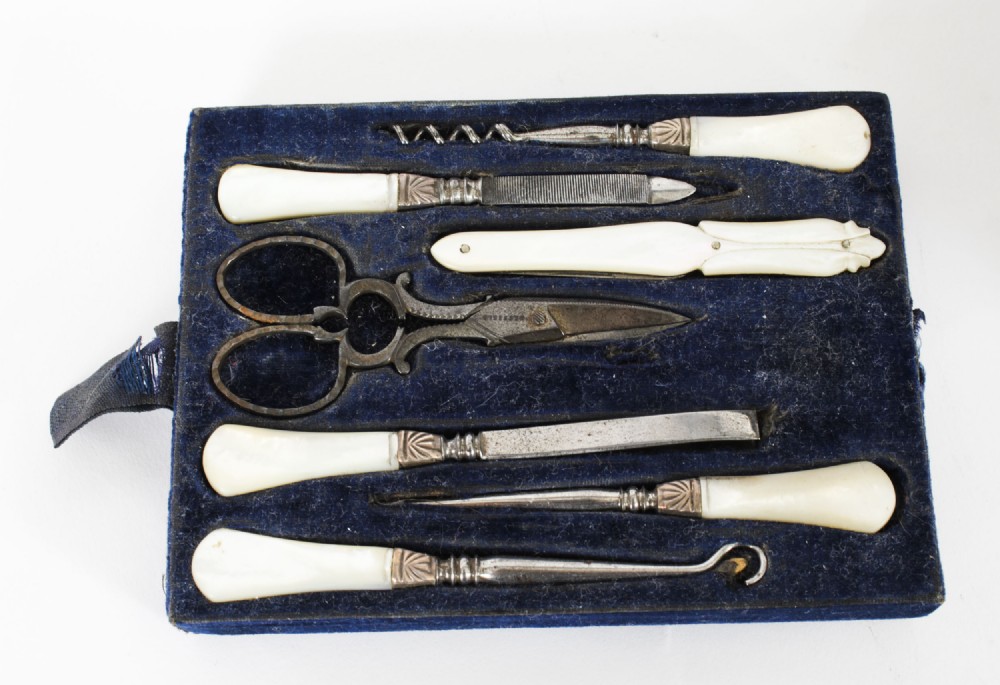
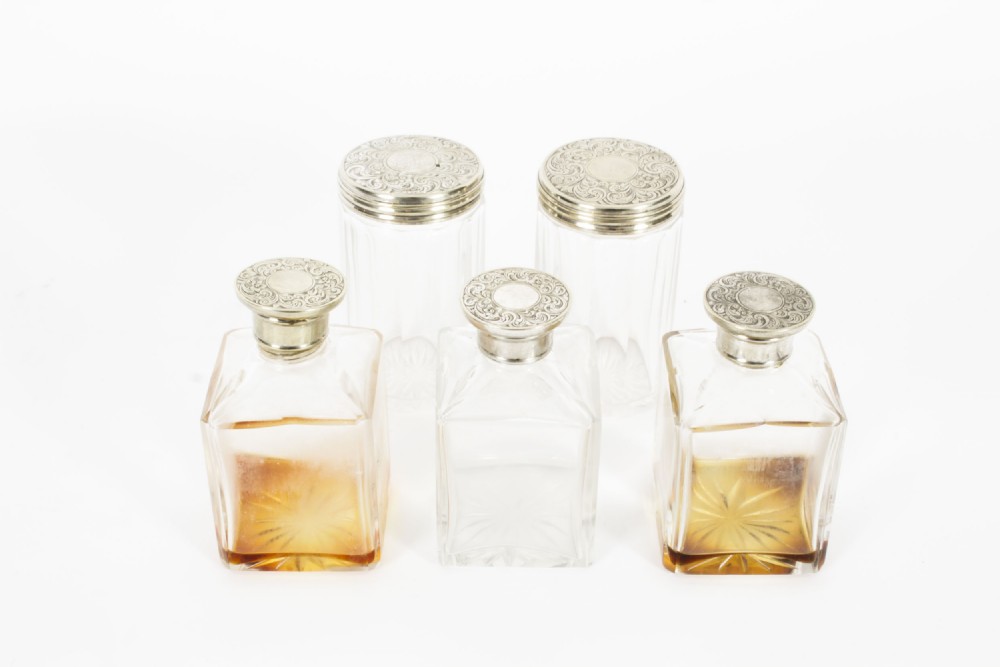
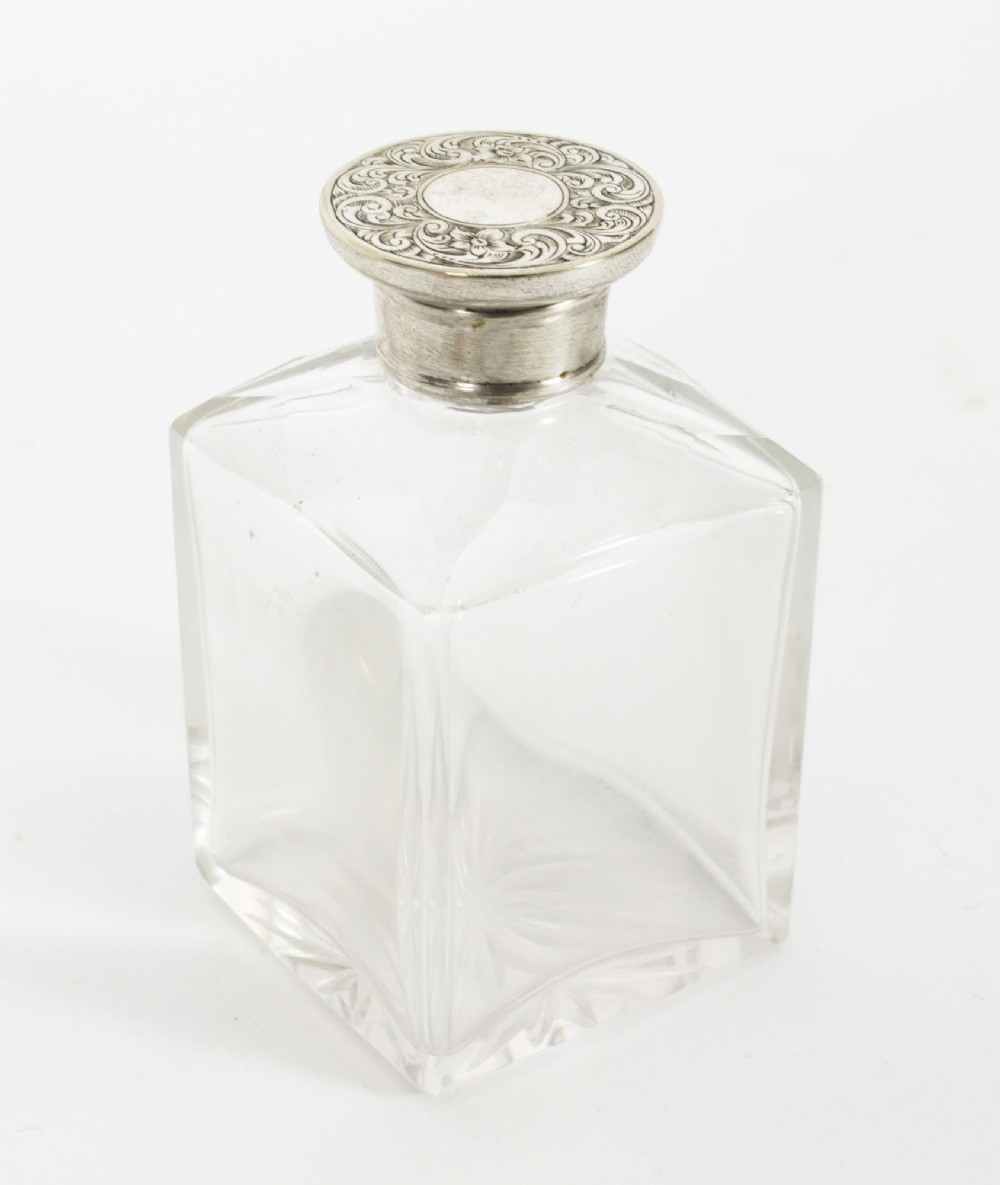
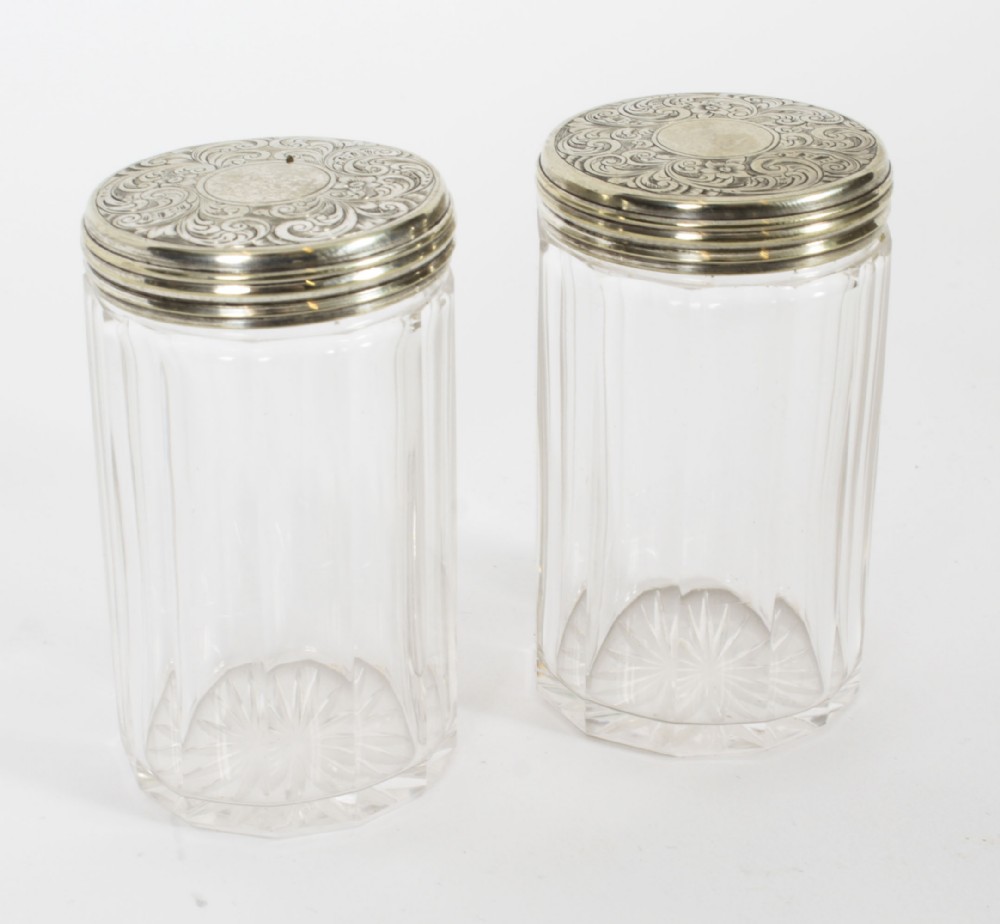
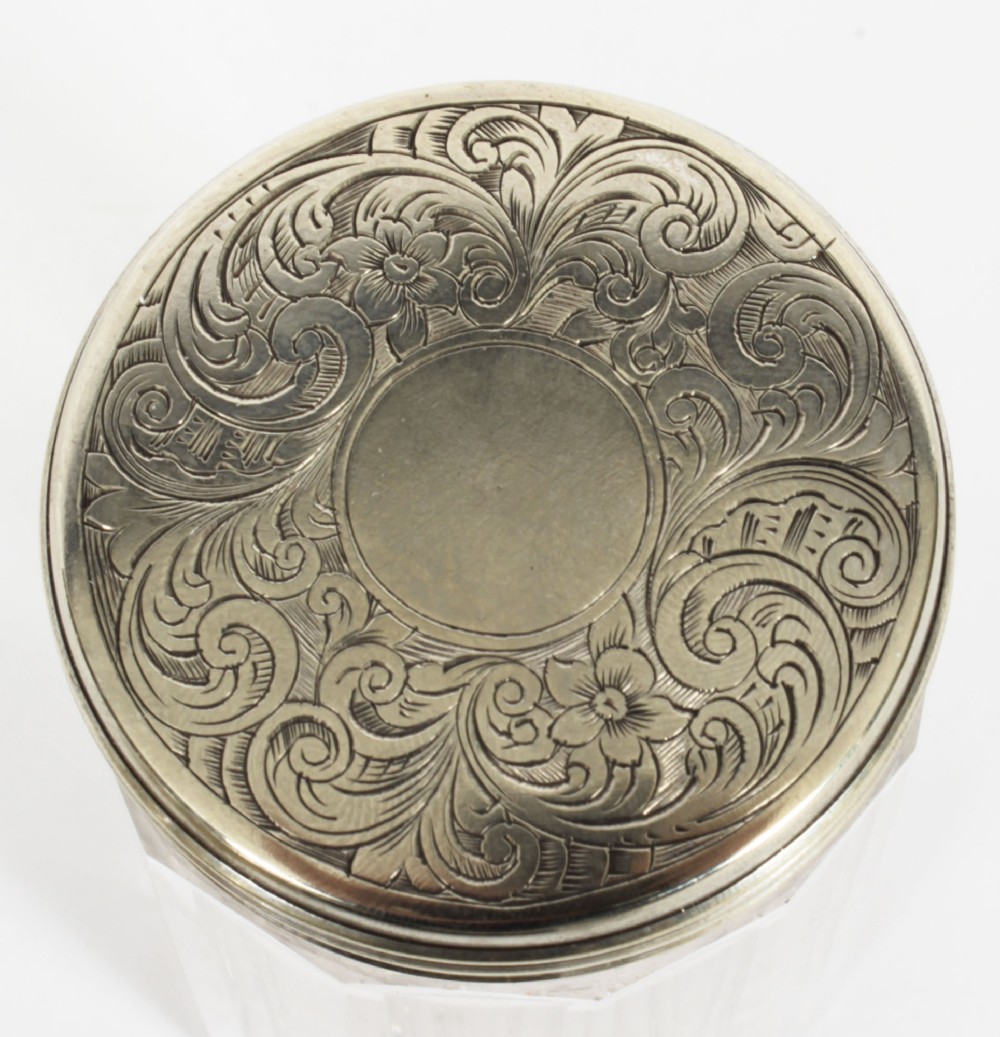
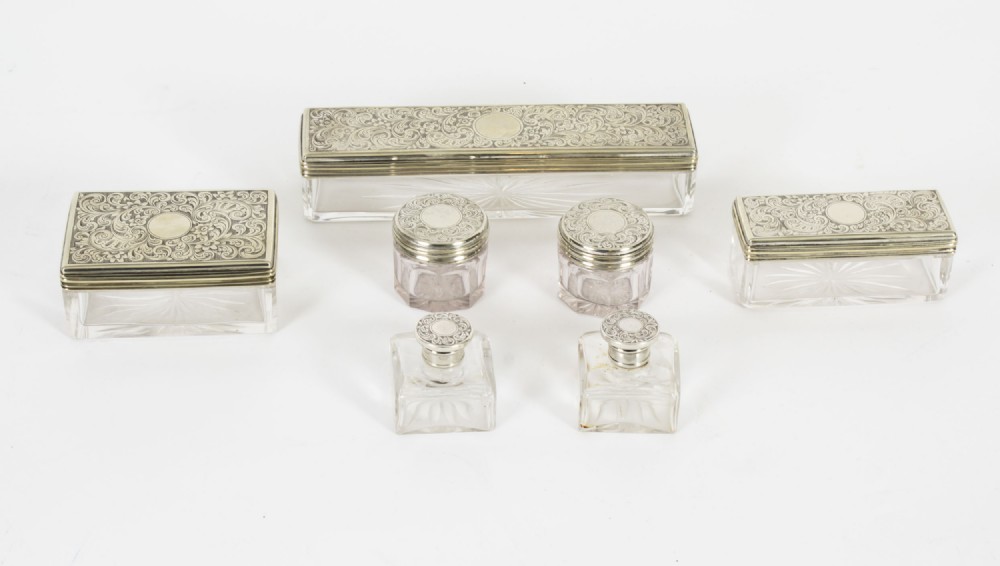
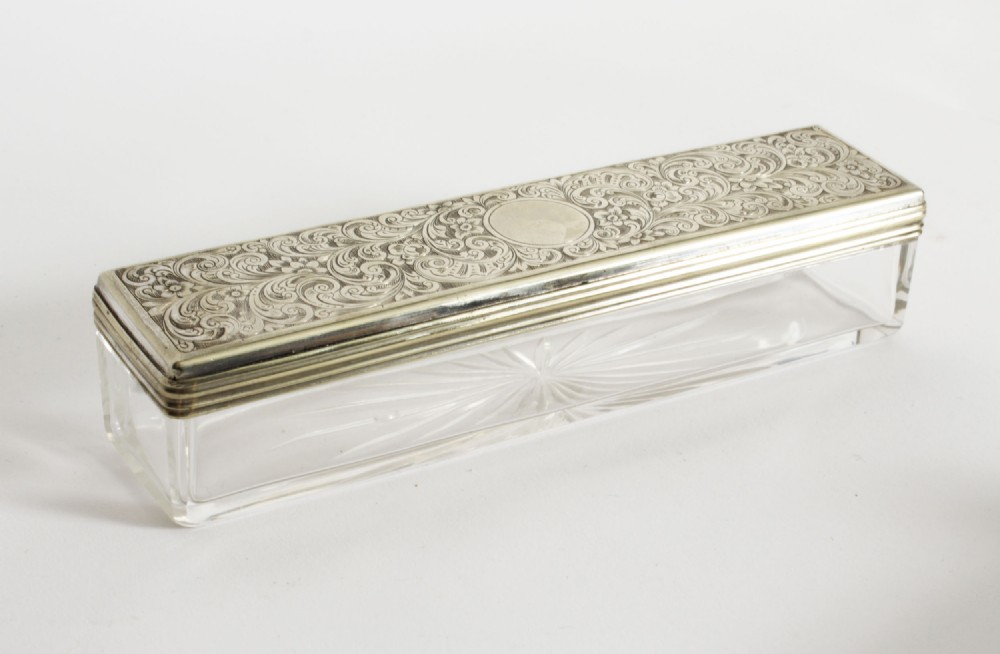
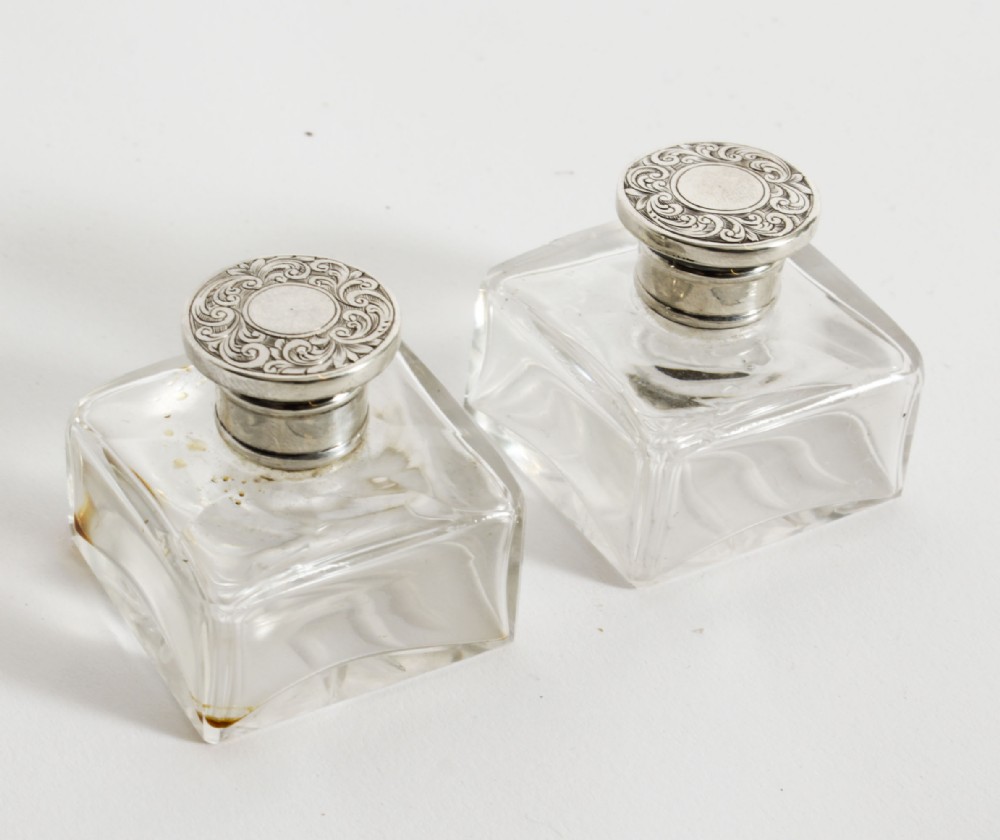
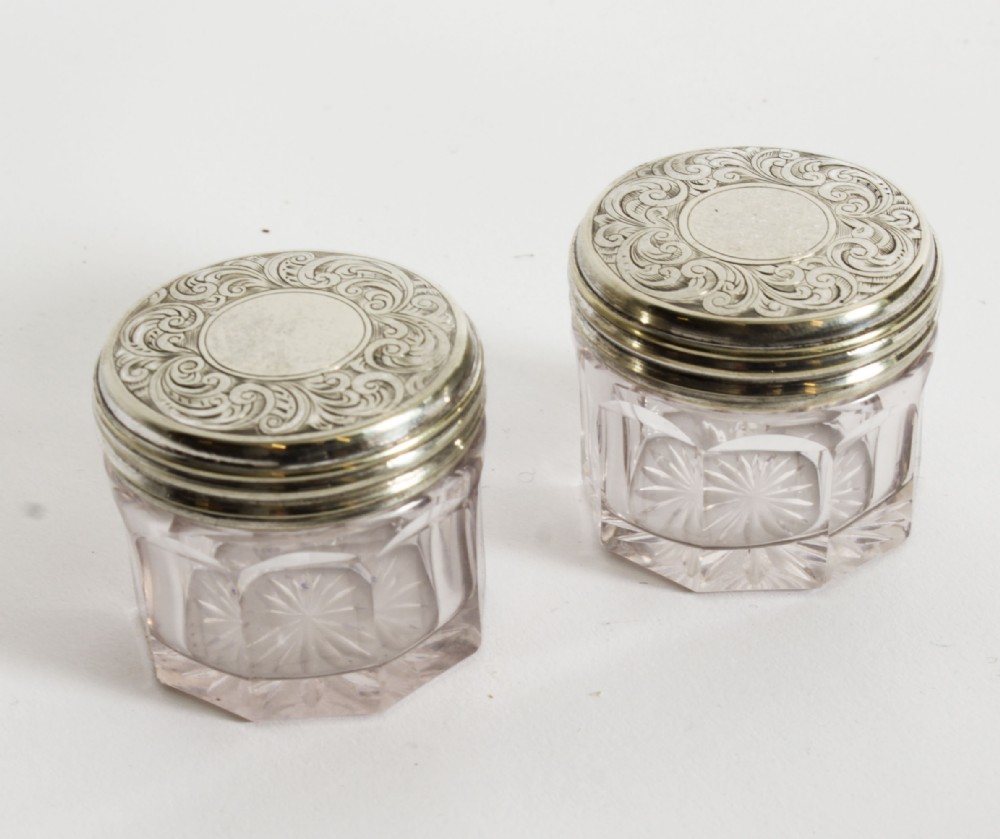
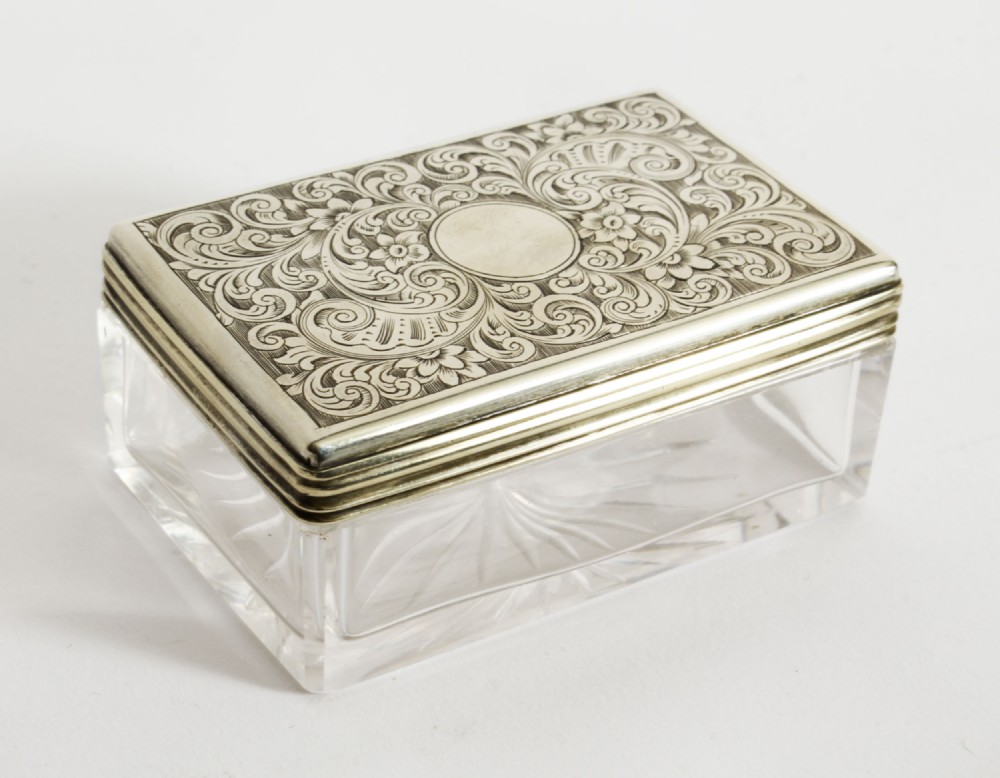
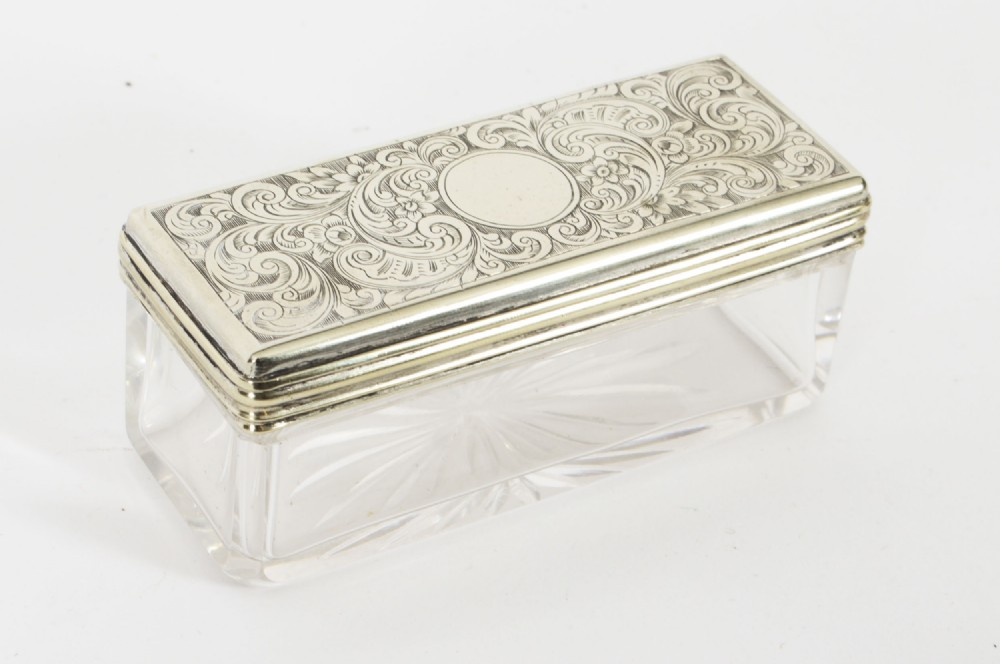
This dome shaped traveling case is made of rare coromandel wood and features blank brass plaque. The interior is well fitted with Sheffield silver plated jar and bottle tops, and a set of seven manicure tools, displayed on fitted blue velvet.
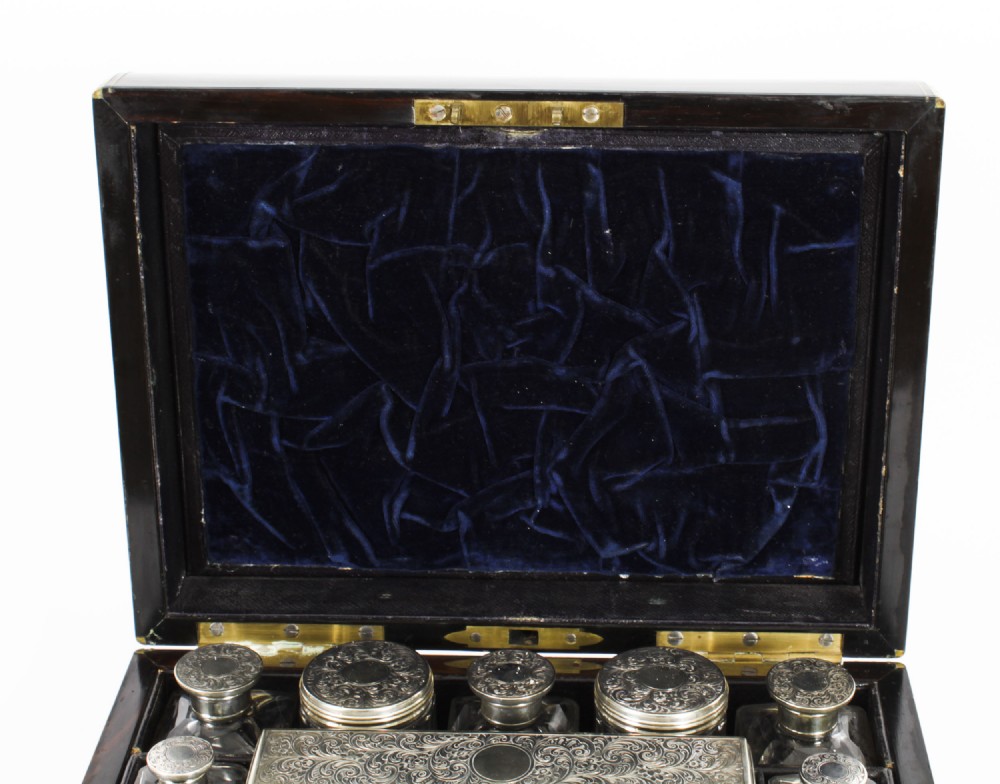
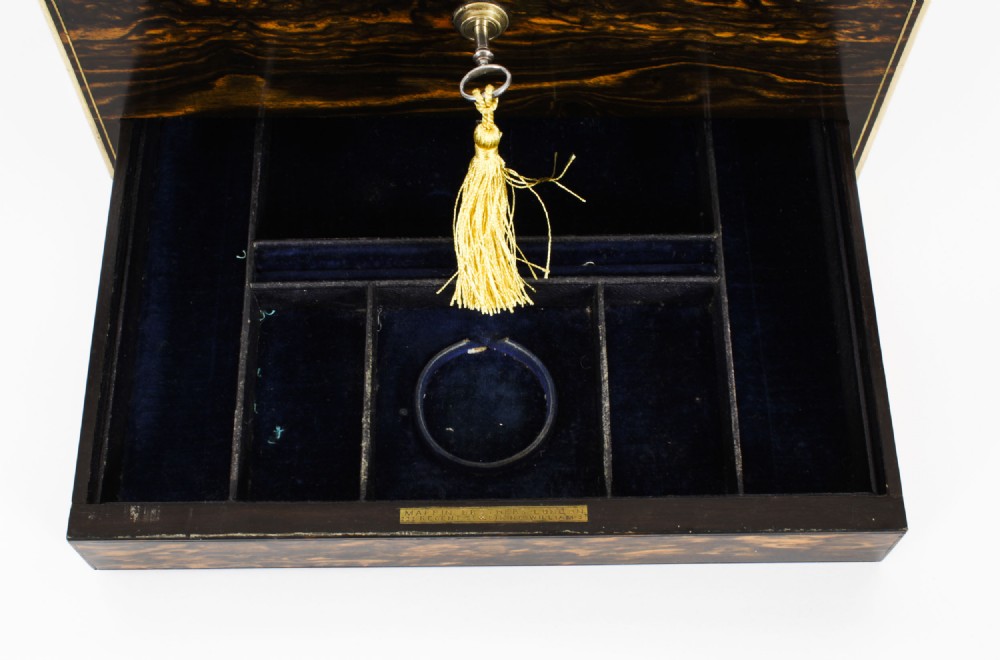
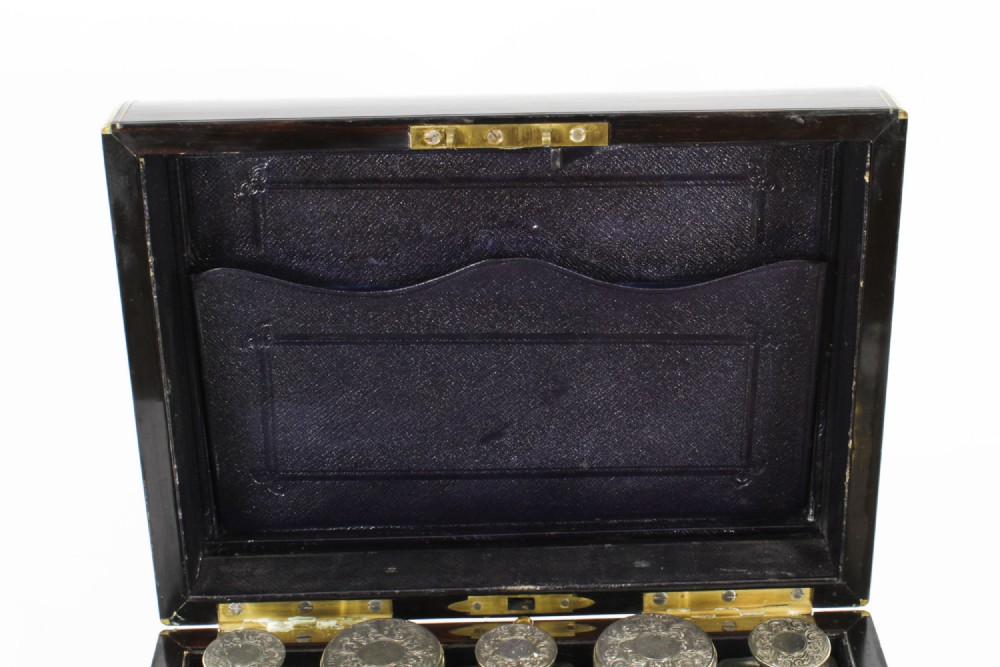
The secret button at the back of the case opens a sprung secret drawer below, for your jewellery. Another sprung secret button at the top of the underside of the lid allows you to remove the velvet backed underside of the lid to reveal a useful mirror and a leather lined compartment for hiding your letters.
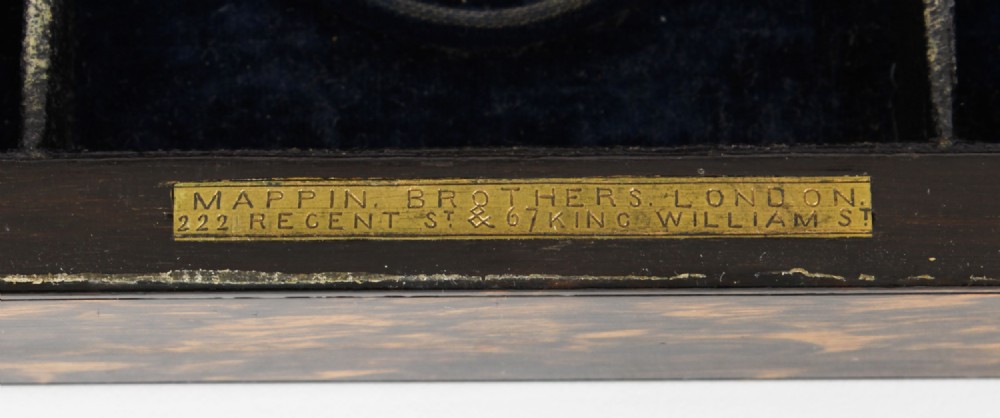
It bears a brass plaque inscribed with the maker's details
"Mappin Brothers London
222 Regent Street & 67 King William Street"
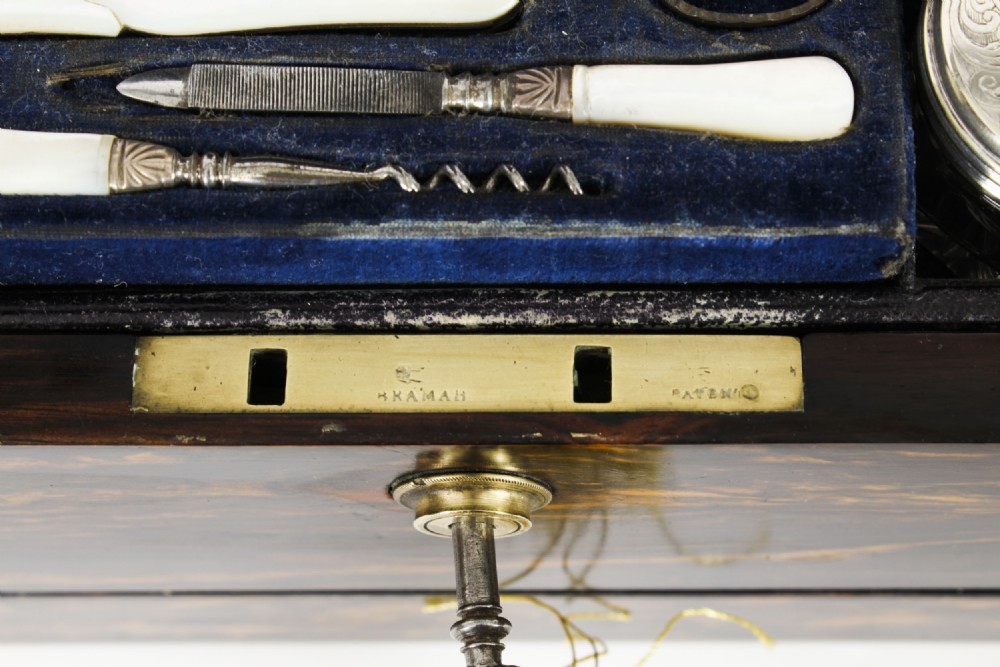
Complete with working Bramah lock and original key.
It is a beautiful piece which will look stunning on your dressing table.
Condition:
In really excellent condition. Please see photos for confirmation.
Dimensions in cm:
Height 19 x Width 31 x Depth 23
Dimensions in inches:
Height 7 inches x Width 1 foot x Depth 9 inches
Mappin Bros.
The family firm was reportedly founded in 1810 by Joseph Mappin, and their sun trademark was granted in 1835 by the Cutlers’ Company. They were not known as Mappin Brothers until after 1852 when all four of Joseph Mappin’s sons had joined the company, after his death. It was a year earlier in 1851 that they opened the Queen’s Plate and Cutlery Works on Baker’s Hill, bound by Little Pond Street and Flat Street. In 1859 there was an argument between the brothers and both the eldest son, Frederick, and the youngest, John, left the company. Frederick Mappin became a politician and was a director of many Sheffield companies. Mappin Brothers continued under Edward and Joseph Charles Mappin and acquired central London showrooms in 1856 and 1861, on King William Street at London Bridge, and Regent Street. By doing this they claimed they were the only Sheffield cutlery manufacturer to sell directly to the customer in London. The company was bought by Mappin & Webb and incorporated into their sales and manufacturing structure.
Calamander wood or Coromandel wood is a valuable wood from India, Sri Lanka and South East Asia. It is of a hazel-brown color, with black stripes (or the other way about), very heavy and hard. It is also known as Macassar Ebony or variegated ebony and is closely related to genuine ebony, but is obtained from different species in the same genus; one of these is Diospyros quaesita Thwaites, from Sri Lanka. The name Calamander comes from the local sinhalese name, 'kalu-medhiriya', which means dark chamber; referring to the characteristic ebony black wood.
Coromandel wood has been logged to extinction over the last 2 to 3 hundred years and is no longer available for new work in any quantity. Furniture in coromandel is so expensive and so well looked after that even recycling it is an unlikely source. A substitute, Macassar Ebony, has similar characteristics and to the untrained eye is nearly the same but it lacks the depth of colour seen in genuine Coromandel.
Travelling cases
became very popular towards the end of the 18th century. They were manufactured specifically to accompany upper class gentleman during travel. Dressing cases were originally rather utilitarian but they spoke volumes about their owners’s wealth and place in society, as at that time, traveling was only done by the elite.
Gentleman’s dressing cases would contain bottles and jars for colognes, aftershaves and creams as well as essential shaving and manicure tools. As these boxes became more popular, many further traveling item options were offered for inclusion.
By the early Victorian era, ladies also began to travel and suddenly t