45,459  PAGES BROWSED TODAY PAGES TODAY 103  ANTIQUES UPLOADED TODAY NEW ARRIVALS
ID #SA1120780
FOR SALE
£8,500
Email
Save
Charles Frodsham & Holingue Frères: A Giant Carriage Clock
Leigh Extence Antique Clocks
for sale €9,945     $10,795
£8,500
Leigh Extence Antique Clocks

Leigh Extence Antique Clocks

Sellingantiques Verified Since Sep 2024
View Dealers Stock Page
  • About Us
    Specialists in fine antique clocks
  • Trade Associations
    Leigh Extence Antique Clocks is a registered member of BADA  CINOA
Id #SA1120780
PDF SHARE
SAVE

Charles Frodsham & Holingue Frères: A Giant Carriage Clock

19th century
Description

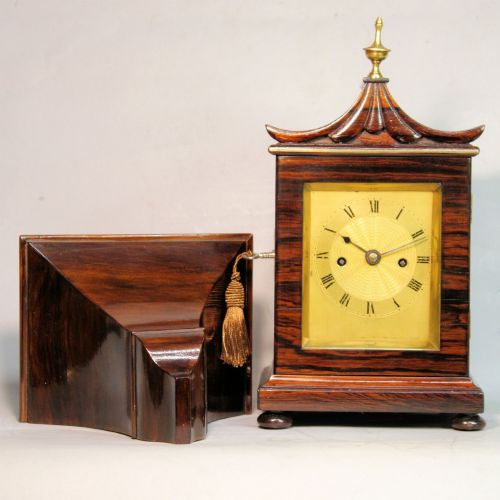
A rare giant wooden carriage clock by Charles Frodsham with an over-sized movement supplied by Holingue Frères, one of the most important of the French carriage clock makers, and fitted with an English platform escapement.

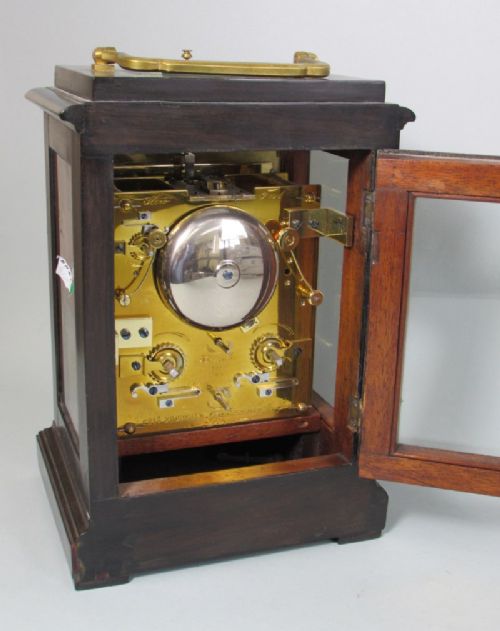
The eight-duration movement is twice normal size and strikes the hours and half-hours on a bell with a push button to the top allowing for a repeat of the last hour at will.

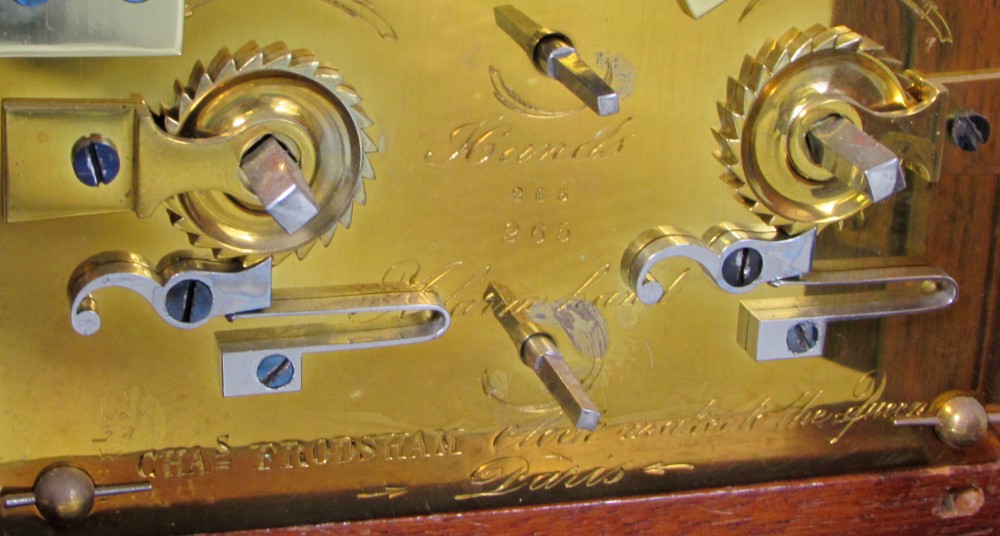
The backplate of the movement is numbered 265 and engraved along the bottom in script Chas. Frodsham, Clock maker to the Queen, Paris with engraved Slow/Fast regulation to the top.

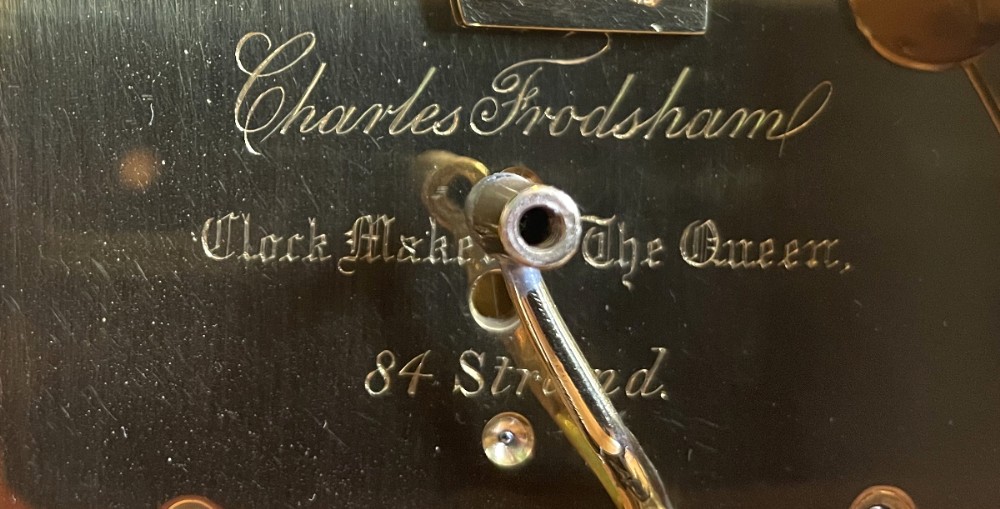
It is also beautfully engraved on the backplate, but hidden by the bell, Charles Frodsham, Clock Maker to the Queen, 84 Strand, being Frodsham's well-known London address.?

The front of the frontplate is stamped H.L. being the initials of the blanc roulant maker Holingue Frères of Saint-Nicolas-d'Aliermont in northern France, and stamped within with their blanc serial number 7327. This number dates the clock to circa 1860.

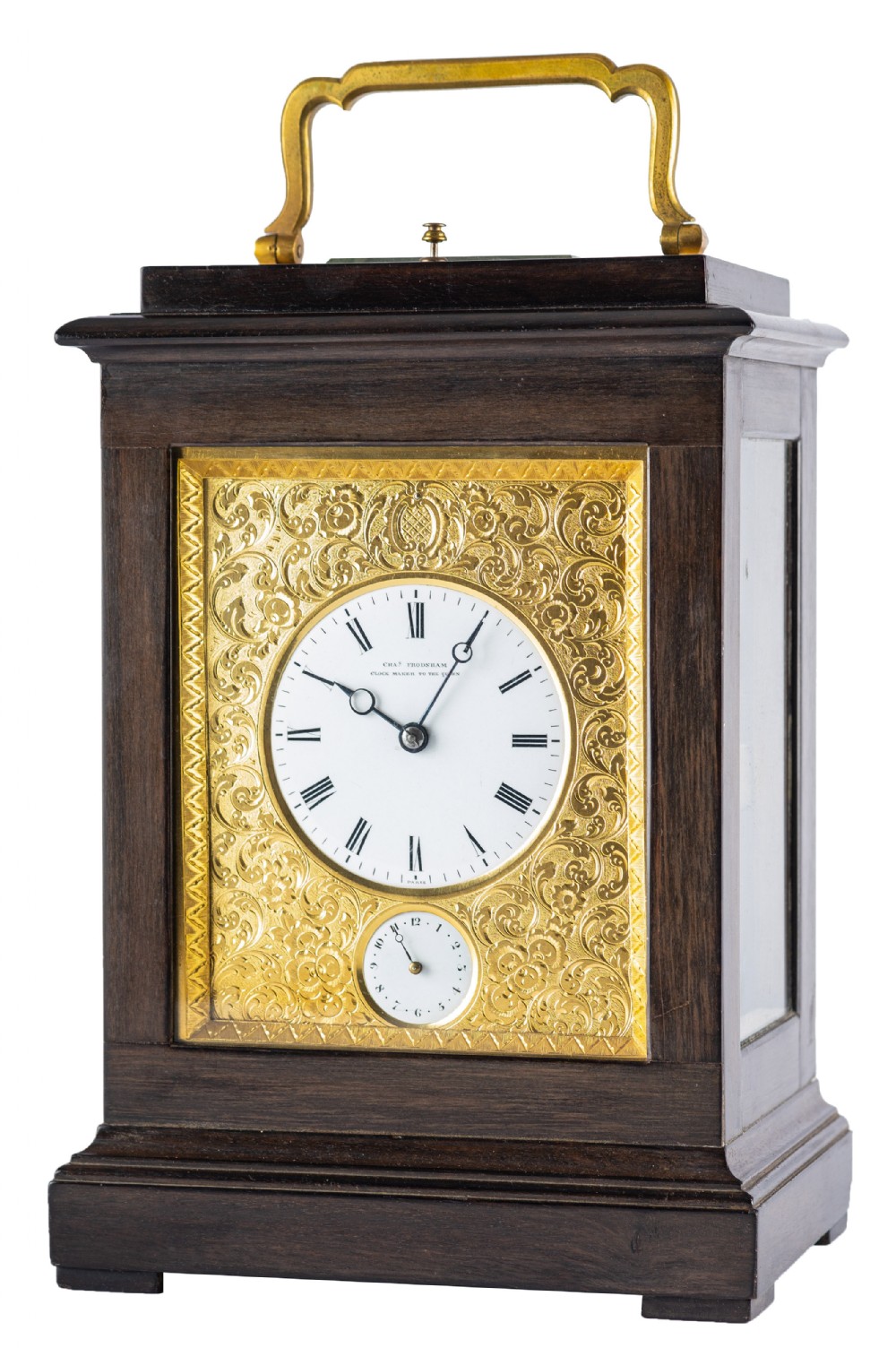
The round enamel dial has black Roman numerals and is signed Chas. Frodsham, Clock Maker to the Queen, Paris, and has a finely engraved gilded mask of c-scroll and floral decoration. Below the main dial is a subsidiary alarm setting dial.

The case is of English library clock form and has a gilt-brass handle to the top, and glazed sides and top.

?Interestingly another similar clock with a Holingue movement is numbered 765 and signed Parkinson & Baker, London. That example is also fitted with an English platform escapement. The Holingue movement number on the Parkinson & Baker is 5652.??

?Very little was known of the Holingue family of carriage clock makers until I undertook my research into their relationship with the famed Parisian makers Pierre Drocourt and his son Alfred. Holingue had supplied both Drocourt father and son with movements, and indeed complete clocks, until Alfred Drocourt took over the Holingue workshops in 1875.

It was only when I delved into the family that it became apparent that the father Jean-Baptiste Holingue had supplied movements to some of the most important early makers from the outset of carriage clock production. These were the pioneering pendule de voyages makers such as Paul Garnier, Athanase Bourdin and Moise Bolviller. Jean-Baptiste's two sons, Jean-François and Louis Holingue then continued to supply the important makers following the founding of their partnership in circa 1842.

More on the Holingue family can be accessed in various articles following the link on my website: Exhibition Catalogues & Articles

Charles Frodsham was a member of the well-known Frodsham family of clock, watch and chronometer makers. Born on the 15th April 1810, the son of William James Fodsham, he atended Christ's Hospital school leaving aged 14 in June 1824 before being apprenticed to his father on the 14th July 1824 for seven years.

Whilst still an apprentice he submitted two chronometers to the Greenwich Trials commencing October 1830 and in 1833 had the rare distinction for one of such a young age of being made a Fellow of the Royal Astronomical Society.

Charles founded the business of Charles Frodsham in 1834 and having become one of the leading chronometer makers so it was in 1843 that he approached the excutors of the renowned chronometer maker John Roger Arnold with a view to buying the Arnold business at 84, Strand along with all the stock-in-trade, which he succeeded in doing, becoming J.R. Arnold-Chas. Frodsham.

In 1858 he changed the name to Charles Frodsham, 84 Strand.

Charles Frodsham died on the 11th January 1871, aged 60, at his home 26 Upper Bedford Place, London.

Ref: Vaudrey Mercer The Frodshams The Story of a Family of Chronometer Makers Pub: The Antiquarian Horological Society 1981.

Physical Dimensions
Height
31cm (12.20")
Declaration

Leigh Extence Antique Clocks has dated this Giant Antique Carriage Clock to the 1860s.
Reference Numbers
Sellingantiques Reference
SA1120780
Dealers Internal Reference
1493
Dealers Notes

Leigh Extence offers for sale antique clocks that are fully researched and validated.

Leigh is acknowledged as the world's leading expert on French carriage clocks of the 19th century and has lectured both home and abroad on the subject for over ten years.

He has had many papers published on the subject and his research is used by many of the leading auction houses in their descriptions.

Research Articles and Exhibition Catalogues are available to view on our website:

www.extence.co.uk

Unless otherwise stated, all clocks have been fully overhauled and are guaranteed as such.

Description
A rare giant wooden carriage clock by Charles Frodsham with an over-sized movement supplied by Holingue Frères, one of the most important of the French carriage clock makers, and fitted with an English platform escapement.
The eight-duration movement is twice normal size and strikes the hours and half-hours on a bell with a push button to the top allowing for a repeat of the last hour at will.
Leigh Extence Antique Clocks
fig 1. A nineteenth-century giant carriage clock featuring a dark wooden case, a brass carrying handle, glazed sides, and an engraved gilt face with Roman numerals.
fig 1. Charles Frodsham & Holingue Frères: A Giant Carriage Clock

The backplate of the movement is numbered 265 and engraved along the bottom in script Chas. Frodsham, Clock maker to the Queen, Paris with engraved Slow/Fast regulation to the top.

It is also beautfully engraved on the backplate, but hidden by the bell, Charles Frodsham, Clock Maker to the Queen, 84 Strand, being Frodsham's well-known London address.?
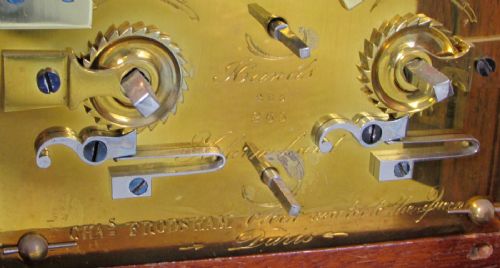
fig 2. A nineteenth-century giant carriage clock featuring a dark wooden case, a brass carrying handle, glazed sides, and an engraved gilt face with Roman numerals.
fig 2. Charles Frodsham & Holingue Frères: A Giant Carriage Clock

The front of the frontplate is stamped H.L. being the initials of the blanc roulant maker Holingue Frères of Saint-Nicolas-d'Aliermont in northern France, and stamped within with their blanc serial number 7327. This number dates the clock to circa 1860.
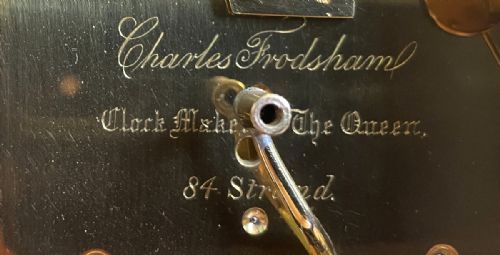
fig 3. A nineteenth-century giant carriage clock featuring a dark wooden case, a brass carrying handle, glazed sides, and an engraved gilt face with Roman numerals.
fig 3. Charles Frodsham & Holingue Frères: A Giant Carriage Clock

The round enamel dial has black Roman numerals and is signed Chas. Frodsham, Clock Maker to the Queen, Paris, and has a finely engraved gilded mask of c-scroll and floral decoration. Below the main dial is a subsidiary alarm setting dial.
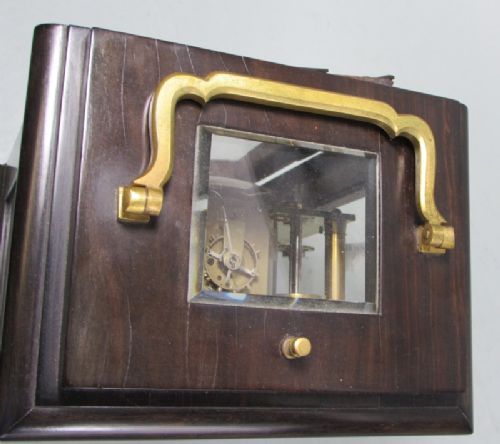
fig 4. A nineteenth-century giant carriage clock featuring a dark wooden case, a brass carrying handle, glazed sides, and an engraved gilt face with Roman numerals.
fig 4. Charles Frodsham & Holingue Frères: A Giant Carriage Clock

The case is of English library clock form and has a gilt-brass handle to the top, and glazed sides and top.

?Interestingly another similar clock with a Holingue movement is numbered 765 and signed Parkinson & Baker, London. That example is also fitted with an English platform escapement. The Holingue movement number on the Parkinson & Baker is 5652.??
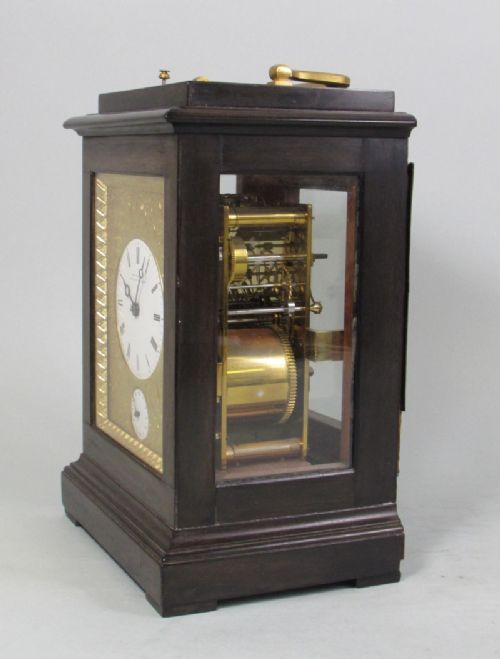
fig 5. A nineteenth-century giant carriage clock featuring a dark wooden case, a brass carrying handle, glazed sides, and an engraved gilt face with Roman numerals.
fig 5. Charles Frodsham & Holingue Frères: A Giant Carriage Clock

?Very little was known of the Holingue family of carriage clock makers until I undertook my research into their relationship with the famed Parisian makers Pierre Drocourt and his son Alfred. Holingue had supplied both Drocourt father and son with movements, and indeed complete clocks, until Alfred Drocourt took over the Holingue workshops in 1875.

It was only when I delved into the family that it became apparent that the father Jean-Baptiste Holingue had supplied movements to some of the most important early makers from the outset of carriage clock production. These were the pioneering pendule de voyages makers such as Paul Garnier, Athanase Bourdin and Moise Bolviller. Jean-Baptiste's two sons, Jean-François and Louis Holingue then continued to supply the important makers following the founding of their partnership in circa 1842.

More on the Holingue family can be accessed in various articles following the link on my website: Exhibition Catalogues & Articles

Charles Frodsham was a member of the well-known Frodsham family of clock, watch and chronometer makers. Born on the 15th April 1810, the son of William James Fodsham, he atended Christ's Hospital school leaving aged 14 in June 1824 before being apprenticed to his father on the 14th July 1824 for seven years.

Whilst still an apprentice he submitted two chronometers to the Greenwich Trials commencing October 1830 and in 1833 had the rare distinction for one of such a young age of being made a Fellow of the Royal Astronomical Society.

Charles founded the business of Charles Frodsham in 1834 and having become one of the leading chronometer makers so it was in 1843 that he approached the excutors of the renowned chronometer maker John Roger Arnold with a view to buying the Arnold business at 84, Strand along with all the stock-in-trade, which he succeeded in doing, becoming J.R. Arnold-Chas. Frodsham.

In 1858 he changed the name to Charles Frodsham, 84 Strand.

Charles Frodsham died on the 11th January 1871, aged 60, at his home 26 Upper Bedford Place, London.

Ref: Vaudrey Mercer The Frodshams The Story of a Family of Chronometer Makers Pub: The Antiquarian Horological Society 1981.

Height
31cm (12.20")
Date of Manufacture

Leigh Extence Antique Clocks has dated this Giant Antique Carriage Clock to the 1860s.

Reference Numbers
Sellingantiques Ref
SA1120780
Dealers Internal Ref
1493
Leigh Extence Antique Clocks
Sellingantiques verified Since Sep 2024

Specialists in fine antique clocks

Dealer Profile

You can view the stock and full dealer information on the Leigh Extence Antique Clocks Profile Page

Trade Associations

Leigh Extence Antique Clocks is a registered member of BADA  CINOA
PDF SHARE
SAVE
A nineteenth-century giant carriage clock featuring a dark wooden case, a brass carrying handle, glazed sides, and an engraved gilt face with Roman numerals.
1 / 6
Archive I A nineteenth-century giant carriage clock featuring a dark wooden case, a brass carrying handle, glazed sides, and an engraved gilt face with Roman numerals.

Charles Frodsham & Holingue Frères: A Giant Carriage Clock
Archive II A nineteenth-century giant carriage clock featuring a dark wooden case, a brass carrying handle, glazed sides, and an engraved gilt face with Roman numerals. View II
Archive III A nineteenth-century giant carriage clock featuring a dark wooden case, a brass carrying handle, glazed sides, and an engraved gilt face with Roman numerals. View III
Archive IV A nineteenth-century giant carriage clock featuring a dark wooden case, a brass carrying handle, glazed sides, and an engraved gilt face with Roman numerals. View IV
Archive V A nineteenth-century giant carriage clock featuring a dark wooden case, a brass carrying handle, glazed sides, and an engraved gilt face with Roman numerals. View V
Archive VI A nineteenth-century giant carriage clock featuring a dark wooden case, a brass carrying handle, glazed sides, and an engraved gilt face with Roman numerals. View VI
FURTHER BROWSING

Visitors also looked at these ⇣

Enlarged Archival View
Telephone 07967 802160
Location
Pavilion Place
Exeter
Devon
United Kingdom

By appointment only.
Verified Since Sep 2024
Items For Sale 23
Items Sold 6
Leigh Extence Antique Clocks
Verified Since Sep 2024
View Dealer Info
Location: Pavilion Place, Exeter, Devon, United Kingdom, , By appointment only.
Verified
Sep 2024
For Sale
23
Sold
6
A nineteenth-century giant carriage clock featuring a dark wooden case, a brass carrying handle, glazed sides, and an engraved gilt face with Roman numerals.
Charles Frodsham & Holingue Frères: A Giant Carriage Clock
Ref: SA1120780
A nineteenth-century giant carriage clock featuring a dark wooden case, a brass carrying handle, glazed sides, and an engraved gilt face with Roman numerals.
Detail View 1
Detail View 2
Detail View 3
Detail View 4
Detail View 5
Archival Detail
Every single antique dealer on our platform is individually approved by our internal team. We verify their professional trade history, ethical standards, and photographic quality to ensure a secure, high-standard buying environment. Upon joining, every dealer agrees to a strict 9-point code of conduct. While issues can occasionally arise, our dealers typically resolve them swiftly and directly with the buyer. In fact, since our founding in 2002, Sellingantiques has only had to step in to help resolve an issue on roughly five occasions—a true testament to the quality of our dealers and their dedication to your happiness.
Our dealers are highly experienced in packing and shipping fragile, high-value antiques. Because you are in direct contact with the dealer, you will be able to easily go through all available shipping and insurance options together to ensure your item arrives safely.
Antiques are the ultimate green purchase. By choosing historical pieces over newly manufactured goods, you completely eliminate the carbon footprint of modern mass production while preserving exceptional, timeless craftsmanship.

Developed in France in the early nineteenth century by Abraham-Louis Breguet, carriage clocks were designed for travel, featuring robust spring-driven balance wheel movements instead of pendulums and folding top handles for portability.

Carriage clocks were predominantly constructed from cast or drawn brass, frequently finished with fire-gilding or dark ebonisation, alongside bevelled glass panels and white enamel dials featuring Roman numerals.

Authentic period examples feature heavy cast brass construction, hand-engraved dial masks, original platform escapements visible through the glass top or back, and maker signatures on the dial movement plates.

A classic carriage clock serves as a focal point on a fireplace mantelpiece, within a traditional bookcase, or set atop a dark wood desk alongside leather-bound volumes and brass accessories.

Keep the clock free from moisture and sudden temperature changes, wind the mechanism regularly using the correct size key without forcing it, and clean the glass and brass with a soft, lint-free dry cloth.
items
Add keywords to the filter
Price
£100
£250000
Era
Movements
Material
Origin
Stock Location
Freshness
Online Payments
Categories