



A 2026 Guide by Sellingantiques
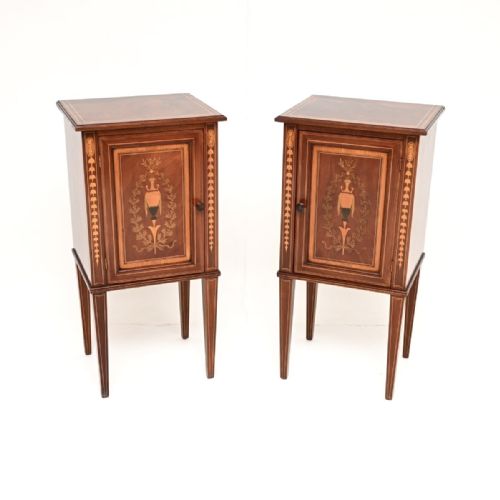
Magnificent Pair of Rosewood Cabinets by 'Sigmund Jaray, Wien', 1880
Priced at £18,000 from Fernyhough Antiques Ltd
Symmetrical room arrangements drove the demand for an antique pair of cabinets in the eighteenth century. Builders designed grand houses with classical balance in mind.
Palladian architecture dictated matching alcoves. Cabinet-makers answered by producing matching casework to fill these mirrored spaces.
Finding a true pair intact today takes some looking. They're often split up during inheritance divisions over the centuries.
Look for subtle differences in construction. Apprentices sometimes built one while the master built the other, or they were assembled on different benches.
Thomas Chippendale supplied matching pairs to major houses. His firm's accounts from the 1760s and 1770s list several sets of painted or japanned cabinets.
Mayhew and Ince produced substantial matched casework. They worked between 1759 and 1803, supplying grand classical pairs with marquetry decoration to wealthy clients.
Regional tradesmen made most surviving examples. Without a maker's stamp or a surviving country house bill, attributing an antique pair of cabinets remains guesswork.
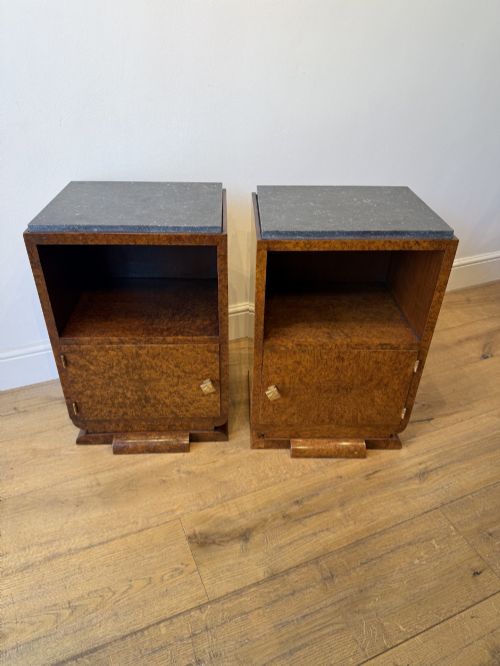
Pair of Satinwood Bedside Cabinets, 1910
Priced at £950 from Athey Antiques
The 2026 retail price guide for Antique Pair of Cabinets is drawn from a proprietary archive of over 1.1 million retail prices indexed by Sellingantiques since 2003. This guide relies exclusively on their own internal data; no external sources or auction records are used.
Analysing nearly 25 years of UK antique market history alongside current retail values, the data indicates that typical UK retail prices for Antique Pair of Cabinets range between £700 and £3,400. Entry-level prices generally fall under £700 and premium examples upwards of £3,400.
Handed doors are a strong indicator of a true pair. The left cabinet hinges on the left, while the right cabinet hinges on the right.
Check the veneer matching across both pieces. Cabinet-makers often used successive cuts from the same flitch to mirror the grain patterns exactly.
Proportions tend to be shallow. They're meant to stand against walls in walkways or alcoves without blocking the room.
Early pairs rely on heavy mortise and tenon joints for the main frame. Solid timber panels were set into grooves to allow for seasonal movement.
The introduction of wide commercial veneers changed things. Craftsmen moved to flat panel carcase construction, hiding the joinery beneath continuous decorative sheets.
Look at the dovetails. Hand-cut pins became narrower and finer as the eighteenth century progressed, showing off the bench worker's skill.
"Sometimes the decorative panelling is false. The doors might look like drawers, but they're built to match a partner piece across the room."
"A true antique pair of cabinets often shares a single set of locks. One key was cut to operate the mechanisms on both pieces."
"Craftsmen marked the backs to keep them together. You can sometimes find matching Roman numerals chalked or struck into the rear boards."
Based on almost 25 years of Sellingantiques UK antique market data, Antique Pair of Cabinets appeared 8031 times (out of 1,100,000 antiques) which gives it a rarity score of 20/100.
This score measures scarcity within the Sellingantiques archive only and is not a survey of the entire antiques market, so these statistics may not be indicative of the general availability of Antique Pair of Cabinets elsewhere.
You'd expect them to be identical, but slight variations are common. Hand-built furniture rarely matches down to the millimetre.
Often, different bench workers tackled each piece simultaneously. One might cut their dovetails just a fraction deeper or plane a top board slightly thinner. These minor dimensional quirks are a standard part of eighteenth-century workshop practice.
Internal differences do not disqualify them from being a true pair. Cabinets flanking a fireplace usually served different household functions.
One side often held a specific collection, like folio books, requiring deep, fixed shelves. The opposite cabinet might have featured shallow, adjustable shelving for displaying porcelain or storing smaller boxed items.
Makers designed the exteriors to provide symmetrical architecture for the room. The hidden interiors were customised to whatever the client actually needed to store.
That black finish is usually japanning, a European imitation of Asian lacquer.
It was highly fashionable for grand rooms in the Georgian era. Over time, the layers of varnish crackle and dull.
There's no strict rule dictating where they must sit. While originally intended to flank a central architectural feature, modern spaces often demand more flexible layouts.
You can place them on opposite sides of a room to anchor the space. Some people even use them in different rooms, letting the shared design elements tie the house together visually.
The structural proportions remain the same regardless of placement. Their shallow depth makes them practical for tight corridors or alcoves where modern casework feels too bulky.
Please note: This Antique Pair of Cabinets guide and its associated pricing data are provided for general informational purposes only. It does not constitute formal financial, investment, or appraisal advice and should not be relied upon as the sole basis for any commercial activity, purchasing, or sales decisions. Sellingantiques.co.uk accepts no liability for any actions taken in reliance on this information. Always consult with a qualified professional or independent appraiser.
