




A 2026 Guide by Sellingantiques
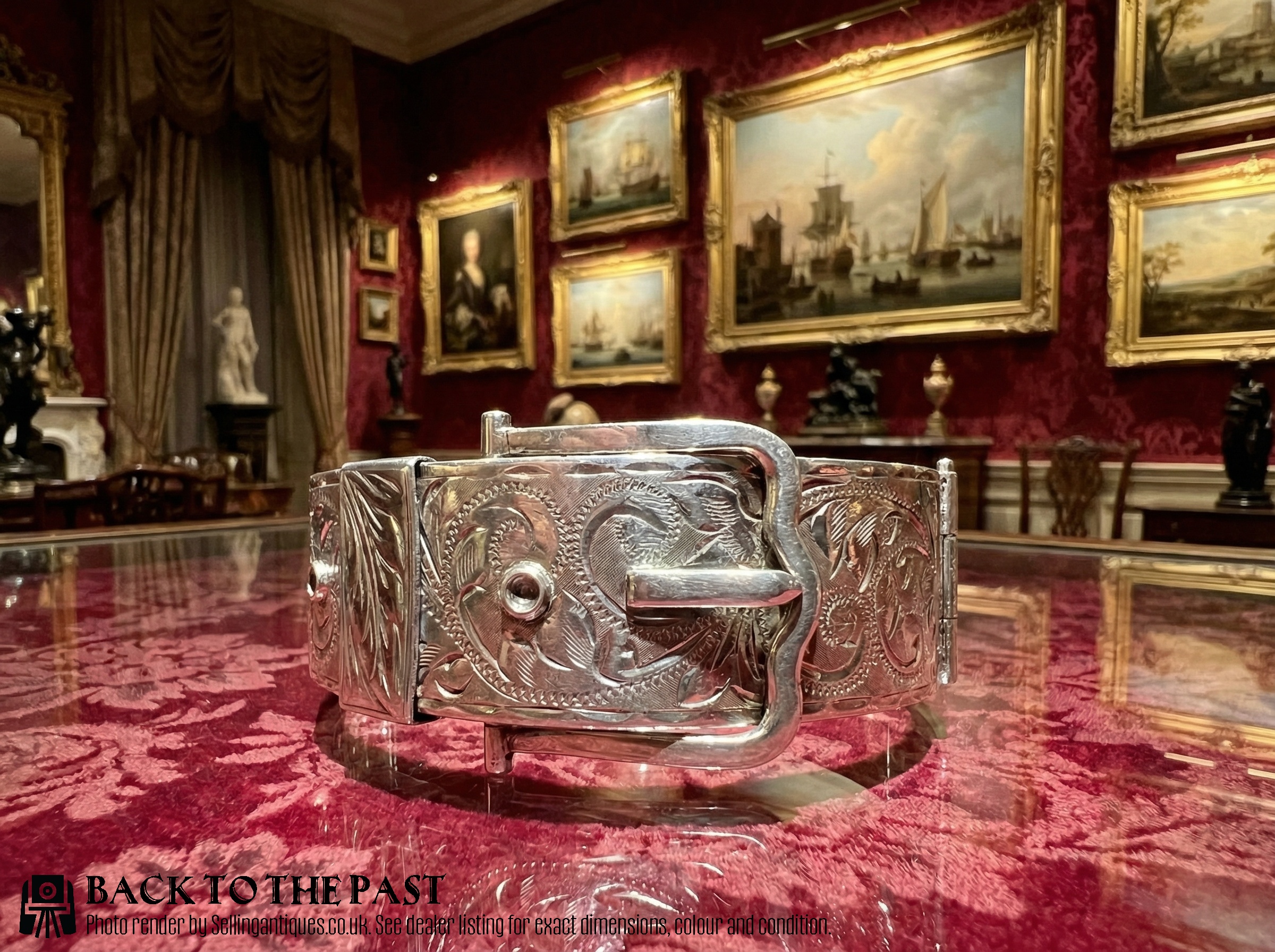
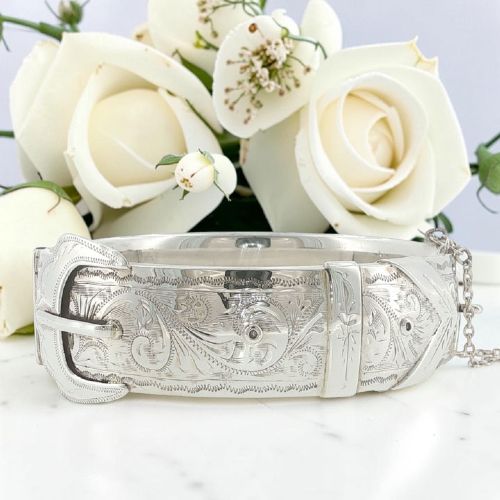
Vintage Sterling Silver Gilt Belt Buckle Cuff Bangle, 1960
Priced at £245 from Corvidae Antique
Before zips took over, antique belt buckles secured heavy wool breeches and silk waistcoats.
Look at seventeenth-century portraits. You'll see them anchoring sword baldrics straight across the chest.
Late Victorian dress codes drove massive demand for ornate nurses' buckles, which families still pass down today.
Turn-of-the-century sporting fashion required robust solid brass fittings. They held thick leather motoring belts in place.
Birmingham silversmiths Levi & Salaman dominated the late Victorian trade. They stamped thousands of pierced silver waist clasps.
Matthew Boulton produced high-quality cut steel buckles. You'll find his late eighteenth-century work mounted on fine leather sword belts.
Regional foundries supplied the bulk of the military contract work, so most cast brass pieces remain anonymous.
The 2026 retail price guide for Antique Belt Buckles is drawn from a proprietary archive of over 1.1 million retail prices indexed by Sellingantiques since 2003. This guide relies exclusively on their own internal data; no external sources or auction records are used.
Analysing nearly 25 years of UK antique market history alongside current retail values, the data indicates that typical UK retail prices for Antique Belt Buckles range between £100 and £700. Entry-level prices generally fall under £100 and premium examples upwards of £700.
Stamped hallmarks often sit on the reverse of silver examples. You'll usually find them grouped near the central bar.
Check the curvature of the frame. It usually arcs inward to sit flat against a rounded stomach.
Heavy military variants frequently feature a separate central motif pinned onto a plain outer wreath.
Early Georgian jewellers cast silver in sand moulds. They chased the surface details by hand afterwards.
Press-stamping machinery allowed Victorian workshops to punch out thin sheet silver in complex openwork patterns quickly.
Turn it over. You'll see how enamel got baked into recessed metal cells to create durable coloured borders.
"Many heavy silver nurses' buckles were designed to unpin easily. Staff washed them separately from the uniform."
"Art Nouveau jewellers sometimes incorporated large carved horn panels into their designs. This reduced the overall weight."
"Cut steel variants reflect candlelight well. They functioned as evening jewellery rather than mere practical fasteners."
Based on almost 25 years of Sellingantiques UK antique market data, Antique Belt Buckles appeared 465 times (out of 1,100,000 antiques) which gives it a rarity score of 91/100.
This score measures scarcity within the Sellingantiques archive only and is not a survey of the entire antiques market, so these statistics may not be indicative of the general availability of Antique Belt Buckles elsewhere.
Use a soft silver cloth rather than liquid dips. Dips strip away the dark tarnish in the deep recesses that gives the casting its depth.
Brush gently around any hinge pins with a dry toothbrush to dislodge lint. You want to preserve the aged surface, so avoid harsh polishes.
Many Victorian and Edwardian military buckles were constructed in several parts. The central motif was often pinned through the main backplate with small copper or brass lugs.
These lugs bend slightly over time, causing the front badge to rattle. A jeweller can sometimes press them flat again. Leaving it loose rarely causes harm, provided the lugs remain intact.
Yes, provided the leather thickness matches the original clearance of the buckle frame. Antique belt buckles often held much thinner leathers or fabric sashes than are used today.
A saddler can stitch an antique frame onto a new leather strap. They thin down the leather end to loop it smoothly over the central bar without binding the prongs.
Not necessarily. Silversmiths often struck the full set of hallmarks on the heavier half of a two-piece clasp. The opposing half might only carry a partial mark, like a lion passant, or no mark at all.
Check how the two halves physically lock together. If the decorative pattern aligns and the hook slides smoothly into the eye, they probably started life together in the same workshop.
Sometimes small discrepancies in the piercing indicate a replacement half. Mismatched marks alone do not prove they were married later.
Please note: This Antique Belt Buckles guide and its associated pricing data are provided for general informational purposes only. It does not constitute formal financial, investment, or appraisal advice and should not be relied upon as the sole basis for any commercial activity, purchasing, or sales decisions. Sellingantiques.co.uk accepts no liability for any actions taken in reliance on this information. Always consult with a qualified professional or independent appraiser.
