


A 2026 Guide by Sellingantiques
The form appeared in the mid-seventeenth century. The invention of the anchor escapement allowed a short pendulum swing, making a narrow wooden case practical.
Early antique longcase clocks often ran for thirty hours. Owners had to pull the weights up every day to keep them going.
Eight-day movements became the standard for wealthier households. They required heavier weights and longer drops, which dictated taller cases as the century progressed.
Provincial makers bought cast brass parts from urban centres. They assembled and adjusted the mechanisms locally before housing them in cases made by town joiners.
Check the dial for the maker's name. Usually engraved on the chapter ring or the brass dial plate itself, though sometimes this points to the retailer.
Thomas Tompion worked in London during the late seventeenth century. His antique longcase clocks set the standard for complex mechanisms and refined casework.
Members of the Knibb family dominated clockmaking in Oxford and London. Their pieces often feature slender walnut cases and Roman numeral strikes.
George Graham succeeded Tompion and refined the deadbeat escapement. This innovation improved timekeeping accuracy for domestic clocks.
The 2026 retail price guide for Antique Longcase Clocks is drawn from a proprietary archive of over 1.1 million retail prices indexed by Sellingantiques since 2003. This guide relies exclusively on their own internal data; no external sources or auction records are used.
Analysing nearly 25 years of UK antique market history alongside current retail values, the data indicates that typical UK retail prices for Antique Longcase Clocks range between £1,300 and £7,000. Entry-level prices generally fall under £1,300 and premium examples upwards of £7,000.
Lift the hood off or slide it forward to access the movement. Look for glass panels at the sides to let light in for maintenance.
A long trunk door protects the pendulum and weights. Keyholes here often lack a true lock, relying instead on a simple brass catch.
Most examples sit on a plinth base. Skirting boards often meant makers had to cut the back of the base flat so the clock stood flush.
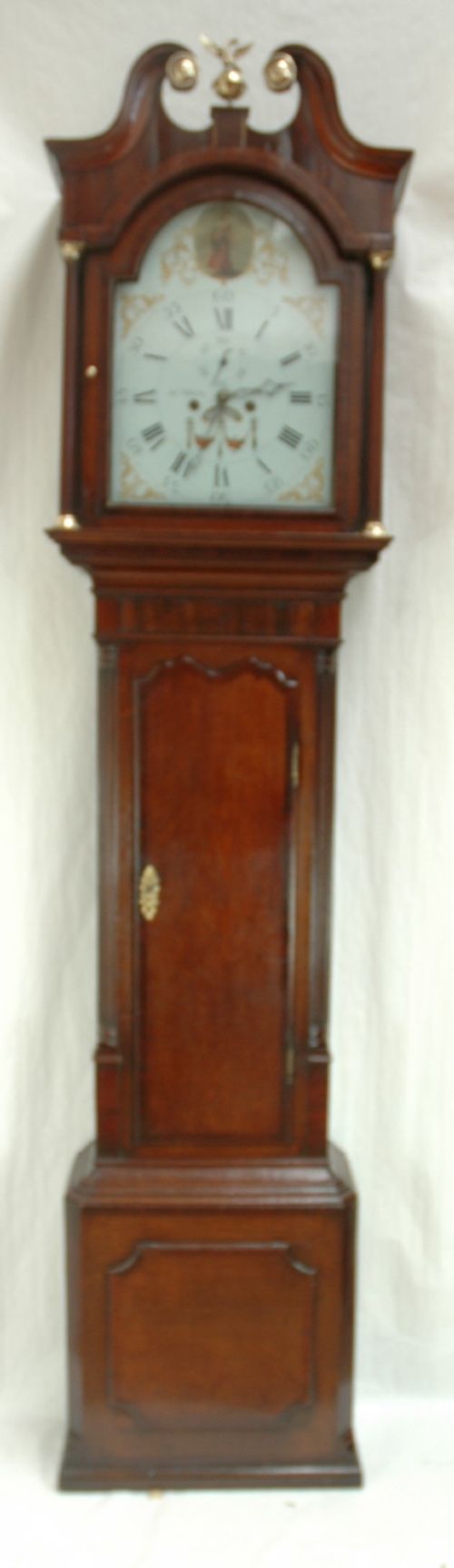
Early cases rely on architectural styling. Joiners used heavy mouldings and classical columns framing the hood to mimic stone buildings.
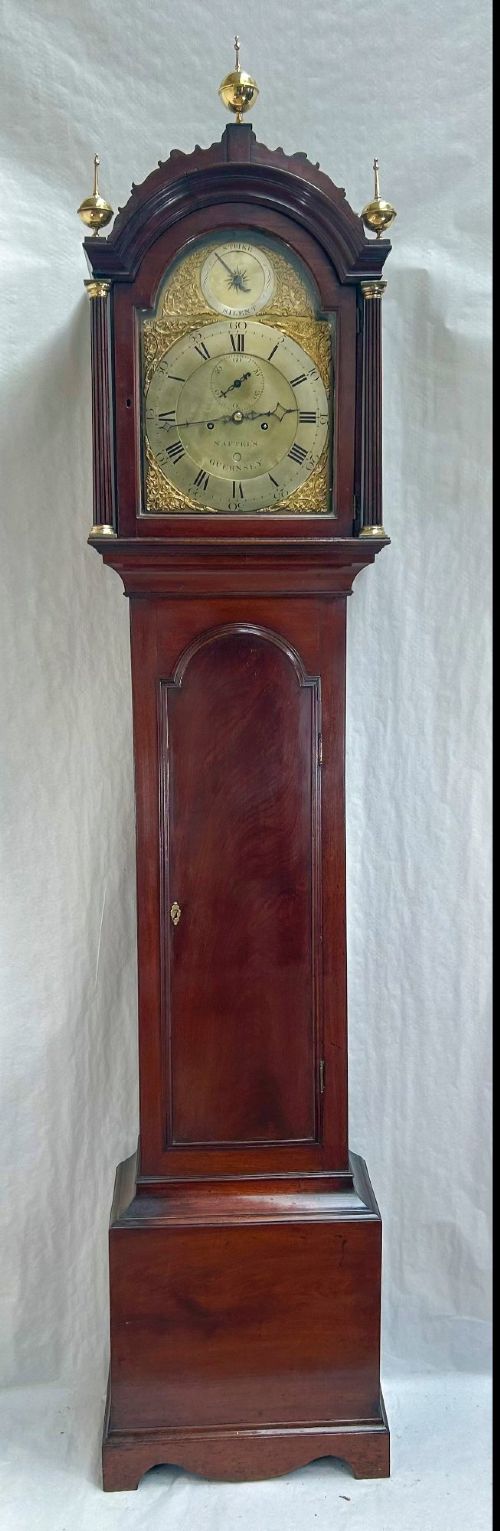
Arch dials replaced square formats in the early eighteenth century. This gave makers space to add moon phase discs or strike-silent indicators above the main face.
Mahogany altered case proportions. The wood allowed cabinetmakers to use crisp, narrow mouldings and swan-neck pediments without sacrificing structural strength.
"Provincial makers frequently packed the trunk base with brick dust. This gave the tall wooden case extra stability against the heavy swinging pendulum."
"False plates sit between the dial and the movement. Birmingham dial foundries used these to adapt their standard painted dials to fit any clockmaker's mechanism."
"Some dials show the date using a spinning wheel behind an aperture. The mechanism jumps forward once every twenty-four hours at midnight."
Based on almost 25 years of Sellingantiques UK antique market data, Antique Longcase Clocks appeared 903 times (out of 1,100,000 antiques) which gives it a rarity score of 83/100.
This score measures scarcity within the Sellingantiques archive only and is not a survey of the entire antiques market, so these statistics may not be indicative of the general availability of Antique Longcase Clocks elsewhere.
Best to dismantle it. Take the hood off first and slide the glass door out if it is loose.
Unhook the heavy lead weights and lift the pendulum off its suspension spring. Only then should you lift the movement and its seatboard out of the case. Move the wooden carcase separately.
The strike train only moves when the clock actually chimes. If you have the strike turned off, or if the mechanism is jammed, that weight stays at the top while the time side drops normally.
Open the hood and check the gut line. Sometimes it overlaps itself on the brass barrel during winding and binds. If the line is clear but the clock won't chime, the rack mechanism behind the dial needs looking at.
The hands have slipped out of sync with the internal striking snail. This happens if someone moves the hour hand independently of the minute hand.
Move the hour hand to point to the number the clock just struck.
You have to use wedges. The carcase must stand straight or the pendulum will rub against the backboard and stop the clock.
Most dealers pack folded card or thin wooden shims under the front feet. You want to tilt it back just enough so the case rests flat against the wall behind it. Secure it to the wall with a hidden screw through the backboard if you have children or dogs running around.
Please note: This Antique Longcase Clocks guide and its associated pricing data are provided for general informational purposes only. It does not constitute formal financial, investment, or appraisal advice and should not be relied upon as the sole basis for any commercial activity, purchasing, or sales decisions. Sellingantiques.co.uk accepts no liability for any actions taken in reliance on this information. Always consult with a qualified professional or independent appraiser.
