Antique Bachs
A coffer bach is a small lidded oak chest of Welsh type, made for valuables, documents and linen rather than bulk storage.

What Is A Coffer Bach?
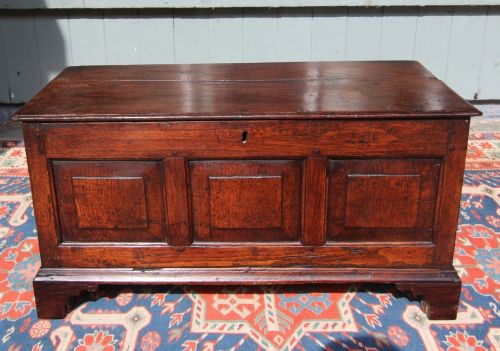
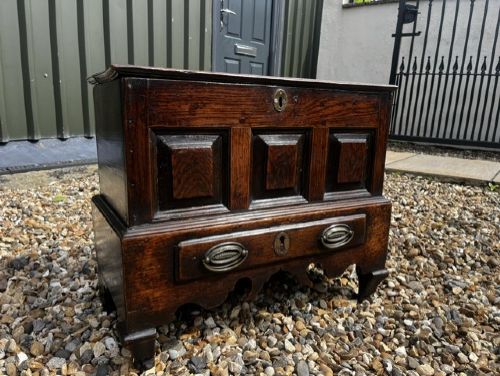
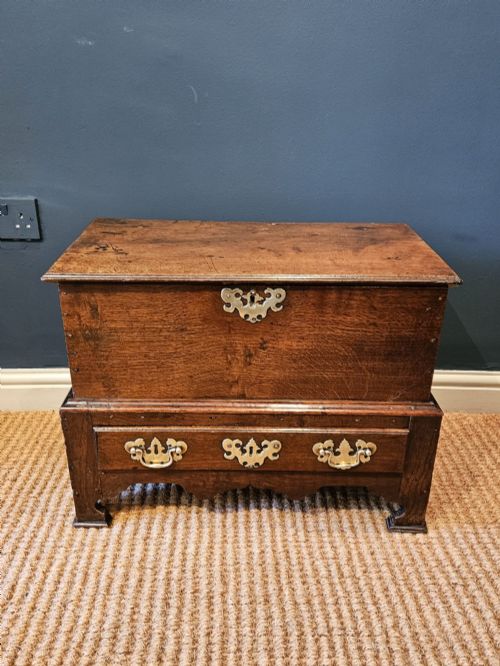
The name is Welsh for "little chest", and that is what you're looking at: a miniature coffer, usually panelled at the front, standing on stile or turned feet. Oak dominates, in 88 of a hundred titles, with one elm chest the single exception. Dealers reinforce the scale with words like small, tiny and miniature.
The version you'll meet most often is a Welsh oak coffer bach of the Georgian period. "Oak coffer" appears in 60 titles and "welsh oak" in 52; the dated field records 40 as 18th Century and 21 as Georgian, and those two labels overlap heavily enough to read as one loose bracket rather than two separate groups.
Eighteen listings use the Welsh spelling coffor, one shortened to coffr, and those tend to sit in the upper half of the range. Another sixteen name a reign outright, George I, II or III, with two William & Mary pieces. Nineteenth-century examples are a small group, eight titles.
Alongside the early pieces runs a set of chests whose own titles say "18th Century Style", dated by their sellers to between 1900 and 1930. The date given there is the date of making, not the date of the idiom. Reading the title and the dated field together is how the category makes sense, since only 27 of a hundred listings carry a clean year.

What Sets Them Apart
Date of making is the main divide. Titles dated between 1690 and 1780 occupy the upper half of the range, while the cluster of "18th Century Style" chests dated 1920 and 1930 all sit at almost the same modest figure near the bottom. Earliness carries weight within the old pieces too: circa 1690, 1710, 1720s and 1740 examples all sit high.
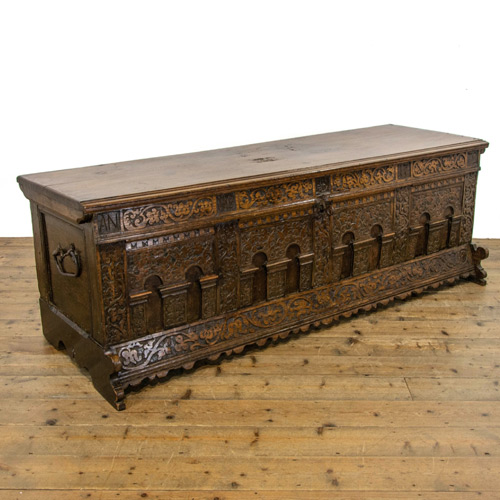
Work on the front lifts a chest. Carving, inlay, a fielded panel and two-panel fronts all appear on pieces above the middle of the range, against the plainer panelled fronts that make up the bulk of the category. Turned feet are named in only one title out of a hundred, and a fielded panel in only one.
Scale and attribution do the rest. The smallest chests, the ones dealers call tiny or miniature, sit higher, and the top of the range is held by small mid-18th-century Welsh examples described as miniature chests. A stated reign or an S. Wales origin also concentrates above the middle.
Retail Price Guide 2026
Typical UK retail prices for bachs, calculated from the Sellingantiques database of over a million retail prices indexed since 2003. This retail price guide relies exclusively on Sellingantiques data; no external sources or auction records are used, so the figures do not describe the wider market.
Eighteen listings on Sellingantiques use the Welsh spelling coffor, and one shortens it further to coffr.

The Antique Bachs Glossary
- Coffer bach
- Welsh for "little chest", and the standard name for the category: a small lidded oak chest, panelled at the front.
- Coffor bach
- The Welsh spelling, used in eighteen of the titles and often on the older pieces. One dealer shortens it further to coffr.
- Panelled front
- A front built from framed panels rather than a single board. "Two panel" turns up in titles as a description of the arrangement.
- Fielded panel
- A panel with a raised, bevelled central field, named in a single title across the hundred.
- Mule chest
- A chest with drawers beneath the lidded compartment. Two listings cross the coffer bach form with it.
- Marriage coffer
- A chest associated with a wedding, sometimes initialled or dated. One title uses the term, spelled coffor.
Frequently Asked Questions
What does coffer bach mean?
It's Welsh for "little chest". The form is a small lidded chest made in Wales, used domestically for valuables, documents and linen rather than for bulk storage.
Dealers often gloss the phrase in the title itself, calling the piece a miniature chest so the scale is clear at a glance.
Which wood are they made from?
Oak, in 88 of a hundred titles. It's the timber of the category and the one most listings name outright.
The only exception in the archive is a single elm chest, one of the two earliest pieces, dated to around 1690.
How old is a typical one?
The dated fields run from 1700 to 1930. Forty listings are labelled 18th Century and 21 Georgian, and since those overlap heavily they're best read as one Georgian bracket covering most of the category.
A handful sit in the 1750s and 1700s. Two titles carry a date read off the chest itself, one 1754 and one 1720s.
Only 27 of a hundred listings give a clean year; the rest use broad period labels.
Why do some titles say 18th Century Style?
Because the chest was made later in the earlier idiom. Those listings are dated by their sellers to between 1900 and 1930, so the year given is when it was made, not when the style began.
That cluster sits at almost exactly the same modest figure near the bottom of the range.
Are Welsh regions ever named?
South Wales is the only sub-regional origin anyone states, and it appears in just three titles out of a hundred.
Where it is stated, it sits above the middle of the range, as do the titles naming a reign such as George II or William & Mary.
How many come up for sale?
Around twelve coffer bachs come to market on Sellingantiques in a year.
They're spread across 26 dealers, so no single dealer defines the category or its supply.