


Antique Marriage Chests
A lidded chest made or decorated for a bride's dowry, holding the linen, cloth and household goods she brought with her.
What Are Marriage Chests?
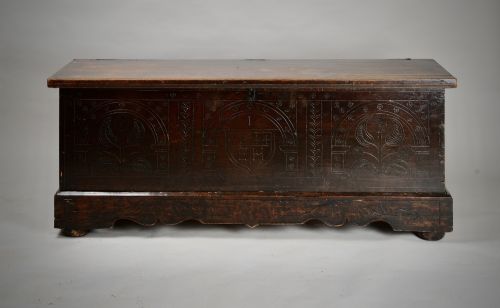
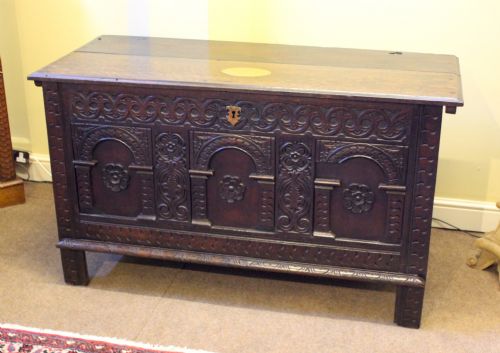
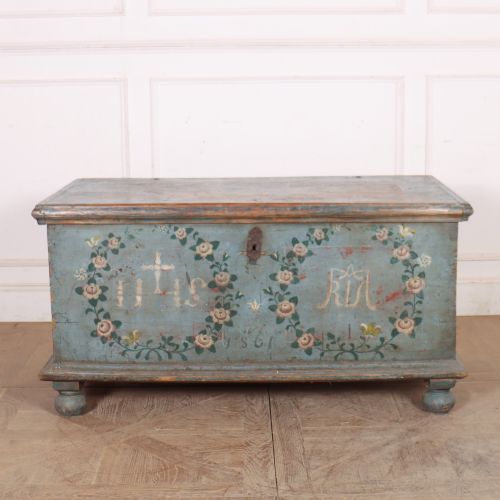
The heading covers two quite different objects. One is the painted softwood chest of northern and central Europe. The other is the carved oak coffer or mule chest of British and continental type. "Painted" and "coffer" are the two commonest words in the category's titles, and they rarely describe the same piece.
The painted chests dominate. Swedish examples run to twenty-two titles on their own, in pine, often with a dome top, and several are described as keeping their original paint. Alongside them sit Austrian marriage coffers, Hungarian painted pine coffer boxes, a Tyrolean coffer, a Romanian chest and a Norwegian folk art miniature. Together these make up over half of current stock on Sellingantiques.
The carved oak group is the next largest: 17th-century coffers, a Queen Anne oak mule kist, a Welsh coffor bach. Italian cassoni in walnut, some gilded, make a smaller group that sits at the top of the range. A scatter of Asian and colonial chests fills out the rest, in teak, elm and brass-inlaid work, from Korea, China, India and Zanzibar.
Dating is loose. Of 115 listings, only 26 carry a clean year; 19th Century alone is entered forty-five times, with 18th and 17th Century behind it. Reign and decade labels are used alongside, so a "Georgian" chest here may be a Hungarian painted box rather than an English one. Several chests quote a painted or carved date in the title, 1671 and 1891 among them, which makes this one of the few chest forms where the object dates itself.
What Sets Them Apart
Decoration does most of the work. Gilded and Gothic-decorated walnut cassoni, a Romayne carved chest, a Green Man mule chest and an inlaid dome coffer all sit in the upper reaches. A chest listed simply as an oak coffer, with no carving or paint named, sits at the bottom of the range.
On the painted side the distinction is between surface and scheme. Titles that specify original paint, or hand painted rather than painted, cluster well above the plainer entries. The paint is the object's decoration and its evidence of date at once, so a first surface counts for more than a later one.
Timber and scale follow the same line. Walnut and oak carry the dearer chests, pine and softwood most of the cheaper half. Large appears in sixteen titles, including massive early coffers and repeated large carved oak entries, while small coffers, boxes and one miniature sit low. Early stated dates, and inscribed ones, lift a chest above the generically 19th-century.
Retail Price Guide 2026
Typical UK retail prices for marriage chests, calculated from the Sellingantiques database of over a million retail prices indexed since 2003. This retail price guide relies exclusively on Sellingantiques data; no external sources or auction records are used, so the figures do not describe the wider market.
About eleven marriage chests are listed on Sellingantiques each year, and 59 different dealers have listed one.

The Antique Marriage Chests Glossary
- Coffer
- A plain lidded chest, usually panelled. After "chest" it's the commonest noun in these titles, used of British and continental examples alike.
- Mule chest
- A chest with one or more drawers built into the base, below the lidded well above them.
- Dome top
- A curved or humped lid rather than a flat one. Eleven titles carry it, mostly Swedish, with one Spanish example covered in leather and brass studs.
- Cassone
- The Italian marriage chest, typically walnut and carved, sometimes gilded. Eleven appear in the category.
- Coffor bach
- Welsh for a small chest, used once here on an 18th-century oak example.
- Romayne
- Carved profile heads set in medallions, an early Renaissance motif. Named on one chest in the archive.
Frequently Asked Questions
What is a marriage chest used for?
It held the linen, cloth and goods a bride brought into a household. The form is long-standing across Europe, made from the late medieval period into the 19th century.
The same purpose produced very different objects: painted softwood chests in the north and the Alps, carved hardwood coffers and cassoni further south and west.
Which type turns up most often?
The painted softwood chest, and most often the Swedish one. Painted appears in thirty-eight of 115 titles, Swedish in twenty-two, pine in seventeen.
Carved oak is the nearest rival group, with oak in twenty-six titles and mule chests in eight.
Are marriage chests and dowry chests the same thing?
In these listings, yes. Both terms describe a chest sold as made or decorated for a bride's goods, and titles use one or the other.
Neither word names a design. It's the purpose that's being described, and the physical chest under it might be Swedish pine, English oak or Italian walnut.
How old are the chests that come up?
The dated field spans 1680 to 1930. Two samples reach back further, a 16th-century Romayne chest and a late 16th-century Italian carved walnut cassone entered as "Before 1700".
Most listings give a century rather than a year, with 19th Century used forty-five times.
Do any carry their own date?
Several do, painted or carved into the chest and quoted in the title: 1671, 1811, 1818, 1835, 1837, 1839, 1851 and 1891.
That's unusual among chest forms. It's also why the Swedish painted group is often described more precisely than the oak coffers.
Where do the more unusual ones come from?
Single appearances in the archive include Zanzibar, Jaisalmer, Brittany, Romania and Korea. Against that, Sweden accounts for twenty-two titles on its own.
The oddest entries are a Norwegian folk art miniature, a teak Gerobog on wheels, a canvas dome-top chest on stand and a Korean fall-front chest.
Around eleven marriage chests are listed on Sellingantiques in a year, spread across many dealers rather than a few specialists.