



Antique Cedar Chests
A lidded storage box in which cedar is either the timber of the box or its lining, chosen because the aromatic oils in the wood deter moth and insect.
Antique Cedar Chests
The heading covers travelling trunks, blanket boxes and coffers. Trunk is the defining word: it turns up in 10 of the 18 listings on Sellingantiques, taking in campaign trunks, steamer and shipping trunks, brass-bound trunks and Canadian storage trunks. Coffer, cassone, dowry chest, mule chest and blanket box each appear only once or twice.
Cedar was picked for storage furniture because it keeps moth away from linen and clothes, which is why it recurs in blanket boxes, dowry chests and clothes trunks. It also travelled well in trade, so it shows up in European coffers as readily as in boxes built for shipping and campaign use.
Two ends of the category are genuinely datable. At one end sit 17th and 18th century Continental and colonial pieces: two mid-17th-century Italian pieces, a cedarwood coffer and a carved cedar and walnut cassone, plus an 18th century Dutch East Indies teak and cedar chest with gilt-brass and bronze fittings. At the other, the 1910 to 1930 travelling and storage trunks, including Canadian and Art Deco examples.
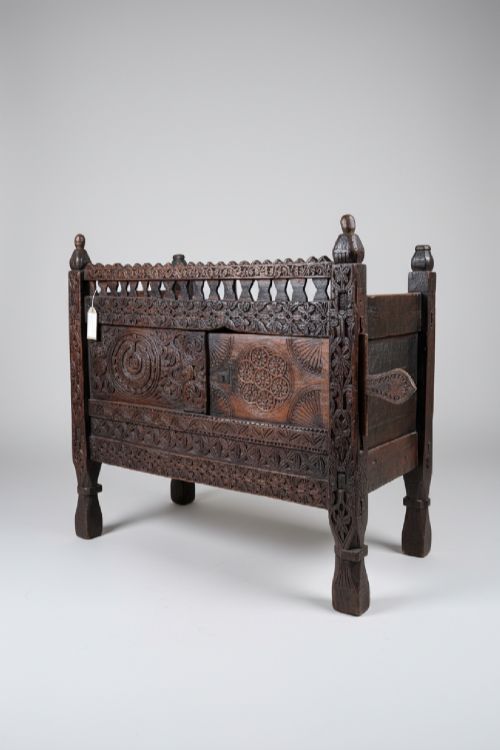
Origins named in the titles span four continents: Japan, China, the Swat Valley of the Hindu-Kush, Italy, the Dutch East Indies, England and Western Canada. Two Swat Valley dowry chests have passed through, the only origin outside Britain and Italy to appear more than once. Fourteen dealers have listed in the category, and roughly two pieces come to market a year.
Where The Range Splits
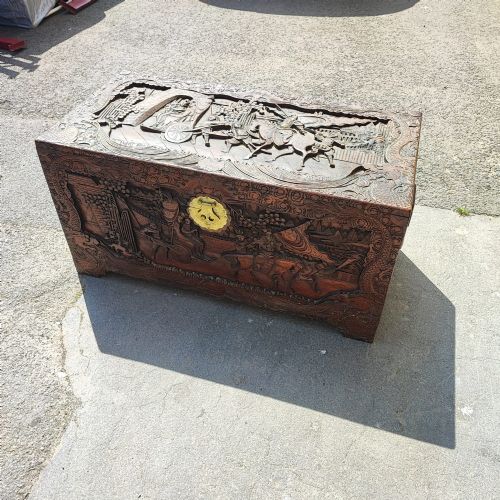
Carving and metalwork carry the top of the range. The highest-priced piece in the archive is an elaborate mid-17th-century Italian carved cedar and walnut cassone, and carved decoration also appears on the Chinese camphor trunk and a Swat Valley dowry chest. Brass binding, and the gilt-brass and bronze fittings on the Dutch East Indies chest, work the same way.
Age pushes upward. The two 17th century Italian pieces and the 18th century brass-bound and Dutch East Indies chests sit in the upper half, while 19th and 20th century travelling and storage trunks, including the 1920s Canadian trunk and a Japanese campaign trunk, occupy the bottom.
A named origin counts for something. Titles that pin the piece to Italy, the Dutch East Indies or the Swat Valley carry more than a generically titled 19th century cedar chest or Art Deco cedar box. Size is rarely declared: only one title in eighteen states scale at all, a large English steamer trunk.
Antique Cedar Chests Retail Price Guide 2026
Typical UK retail prices for cedar chests, calculated from the Sellingantiques database of over a million retail prices indexed since 2003. This retail price guide relies exclusively on Sellingantiques data; no external sources or auction records are used, so the figures do not describe the wider market.
The oldest cedar chests to pass through Sellingantiques are two mid-17th-century Italian pieces: a cedarwood coffer and a carved cedar and walnut cassone.
The Antique Cedar Chests Glossary
- Trunk
- A lidded travelling box, and the word used in 10 of the 18 titles in this category, from campaign trunks to Canadian storage trunks.
- Blanket box
- A domestic storage chest for linen and bedding; three listings use the term, including a Georgian red cedar example dated 1800.
- Steamer trunk
- A flat-topped trunk made for ship travel. Two English examples have appeared, dated around 1900 to 1910.
- Brass bound
- Strapped or edged with brass for strength, used of two trunks in these titles, one of them a red cedar example.
- Cassone
- An Italian marriage or storage chest. One carved cedar and walnut example has come through, and the word appears exactly once in the archive.
- Mule chest
- A chest with drawers below the lidded well; one Georgian piece is titled as trunk or mule chest, described as c.1770.
Antique Cedar Chests: Frequently Asked Questions
Why was cedar used for chests?
The aromatic oils in cedar deter moth and insect, which is why the timber recurs in furniture meant to hold linen, bedding and clothes.
That explains the shapes it takes in this category: blanket boxes, dowry chests and clothes trunks. Cedar also travelled well in trade, so it appears in European coffers and in boxes built for shipping.
What form is most common?
The trunk. Ten of the eighteen titles use the word, covering campaign trunks, steamer and shipping chests, brass-bound trunks and Canadian storage trunks.
Everything else appears once or twice: coffer, cassone, dowry chest, mule chest and blanket box.
How old are these chests?
Seventeen of the eighteen carry some period label, but only seven give a clean year, and those run from 1800 to 1930.
Much of the labelling is era words rather than dates: 19th century, 18th century, 17th century, Victorian, Georgian. One piece described in its title as c.1770 is simply dated Georgian in its field.
The two clusters that are firmly datable are the 17th and 18th century Continental and colonial pieces, and the 1910 to 1930 travelling and storage trunks.
Are cedar chests made outside Europe?
Yes, widely. Titles in this category name Japan, China, the Swat Valley of the Hindu-Kush, the Dutch East Indies and Western Canada alongside Italy and England.
Two Swat Valley dowry chests have passed through, which makes that the only origin outside Britain and Italy to appear more than once.
Do these chests carry maker's names?
Not in this category. Across the eighteen listings, no trunkmaker, retailer or workshop is named at all.
What the titles pin instead is origin and form: Italian cassone, Japanese campaign trunk, Dutch East Indies chest, Western Canadian trunk.
What is an Art Deco cedar trunk?
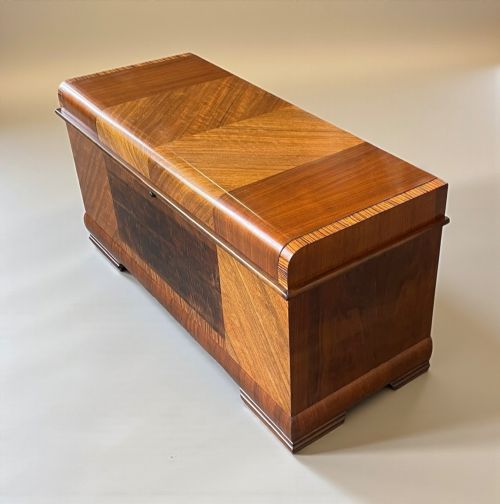
It is the 1920s and 1930s end of the category, and it turns up throughout: a 1920s Western Canadian cedar trunk, a 1930s Canadian cedar storage trunk described as a blanket chest, an Art Deco coffer chest trunk of about 1930 and an Art Deco blanket chest.
These sit at the lower end of the range, along with the 19th and early 20th century travelling trunks. The period field shows one 1920s piece and three from the 1930s.