
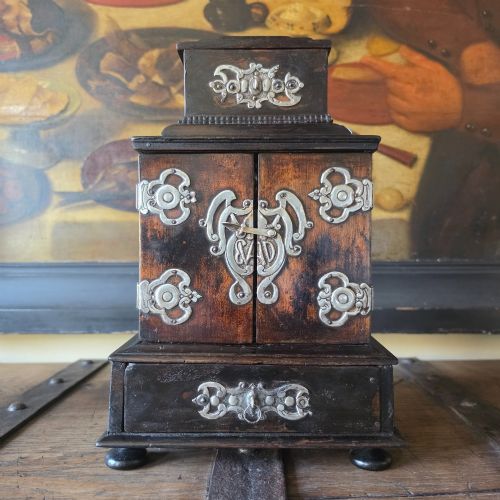


A 2026 Guide by Sellingantiques
Many early examples were built as scaled-down versions of larger furniture forms, mimicking the proportions of full-sized chests.
Most surviving antique jewellery cabinets date from the late eighteenth century onwards.
Look at the evolution of securing valuables. Earlier boxes just had open trays, while Victorian cabinets introduced complex locked drawers.
Travel heavily influenced the overall design. Frequent carriage journeys prompted the addition of recessed brass handles and robust outer carcases to withstand constant movement.
Edwards and Roberts made substantial numbers of these cabinets during the late nineteenth century.
You might spot a stamped lock plate from Bramah. They supplied high-quality locks rather than the woodwork itself.
Most examples lack a cabinetmaker's mark. The trade relied heavily on regional manufacturing patterns and unsigned workshop output across the country.
The 2026 retail price guide for Antique Jewellery Cabinets is drawn from a proprietary archive of over 1.1 million retail prices indexed by Sellingantiques since 2003. This guide relies exclusively on their own internal data; no external sources or auction records are used.
Analysing nearly 25 years of UK antique market history alongside current retail values, the data indicates that typical UK retail prices for Antique Jewellery Cabinets range between £500 and £2,800. Entry-level prices generally fall under £500 and premium examples upwards of £2,800.
Multiple shallow drawers are a standard feature for separating different gem cuts.
Open the main doors to find padded ring slots. These were often stuffed with wool and wrapped tightly in fabric.
Secret compartments exist in some antique jewellery cabinets. They are typically hidden behind a false back or concealed beneath a removable wooden tray in the lower section.
Hand-cut dovetails hold the small internal drawer boxes together securely.
Turn a drawer over to examine the base. Thin wood panels were typically chamfered and slid into grooves cut along the sides.
Veneering required laying expensive thin timber sheets onto the rough carcase. Craftsmen used hot animal glue and heavy presses to ensure the decorative wood stayed flat.
"Many were designed to sit on top of a larger dressing table rather than standing alone."
"The padded ring slots often double as a tight cushion. This pressure stops delicate items from shifting and scratching against each other when the cabinet moves."
"Pull the bottom drawer out fully to locate hidden release catches."
Based on almost 25 years of Sellingantiques UK antique market data, Antique Jewellery Cabinets appeared 569 times (out of 1,100,000 antiques) which gives it a rarity score of 89/100.
This score measures scarcity within the Sellingantiques archive only and is not a survey of the entire antiques market, so these statistics may not be indicative of the general availability of Antique Jewellery Cabinets elsewhere.
Do not scrub it. Old fabrics are fragile and water will leave a stain while loosening the historic glue.
Use a soft bristle brush to sweep dust out of the corners. A low-suction vacuum with a mesh screen over the nozzle helps lift loose dirt without tearing the silk.
A locksmith can usually pick a simple ward lock and cut a new key. Take the cabinet to them rather than trying to force the doors open with a screwdriver.
If the drawers are just stiff, check the runners. Sometimes wood swells in damp conditions, and moving it to a drier room for a few weeks solves the issue.
Most antique jewellery cabinets are veneered in mahogany or rosewood. Walnut is another common option.
Look at the drawer linings to identify the secondary wood. Pine and oak were used for the structural parts.
Finding an exact match for antique hardware takes patience. Specialist dealers keep boxes of spare handles salvaged from broken furniture over the years.
Measure the distance between the post holes carefully. If you cannot find a match, replacing the entire set with period-appropriate handles is an accepted practice. Keep the surviving original handles in a drawer just in case.
Please note: This Antique Jewellery Cabinets guide and its associated pricing data are provided for general informational purposes only. It does not constitute formal financial, investment, or appraisal advice and should not be relied upon as the sole basis for any commercial activity, purchasing, or sales decisions. Sellingantiques.co.uk accepts no liability for any actions taken in reliance on this information. Always consult with a qualified professional or independent appraiser.
