


A 2026 Guide by Sellingantiques
Flemish Walnut Collectors Cabinet on Stand, 18th Century
Priced at £850 from I M Chaney Antique Furniture
These forms emerged prominently in the late seventeenth century when wealthy households needed secure places for exotic imported goods.
Raising the main section on legs kept expensive veneers away from damp stone floors.
Look at how the antique cabinet on stand evolved from a simple chest on a frame into complex architectural furniture with deep cornices.
Dutch and English craftsmen drove much of the early development as global trade routes expanded.
Gerrit Jensen supplied elaborate marquetry examples to the royal households during the late seventeenth century.
Few early pieces carry marks. You usually have to attribute them based on construction methods and regional carving styles.
Cabinet makers often collaborated with specialist japanners or marquetry cutters to finish the complex decorative surfaces.
The 2026 retail price guide for Antique Cabinet On Stand is drawn from a proprietary archive of over 1.1 million retail prices indexed by Sellingantiques since 2003. This guide relies exclusively on their own internal data; no external sources or auction records are used.
Analysing nearly 25 years of UK antique market history alongside current retail values, the data indicates that typical UK retail prices for Antique Cabinet On Stand range between £600 and £4,700. Entry-level prices generally fall under £600 and premium examples upwards of £4,700.
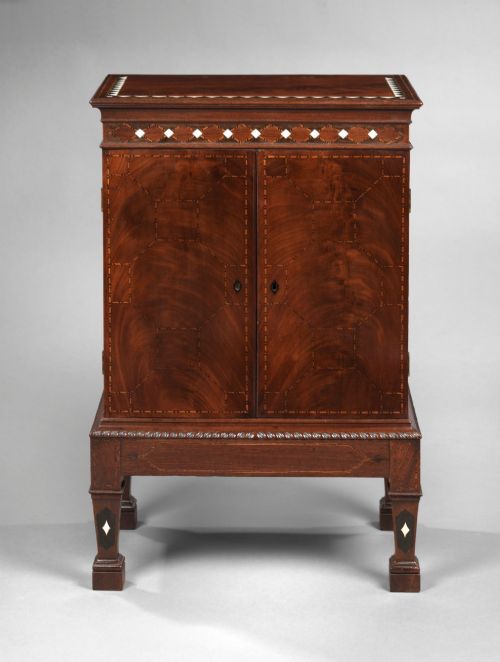
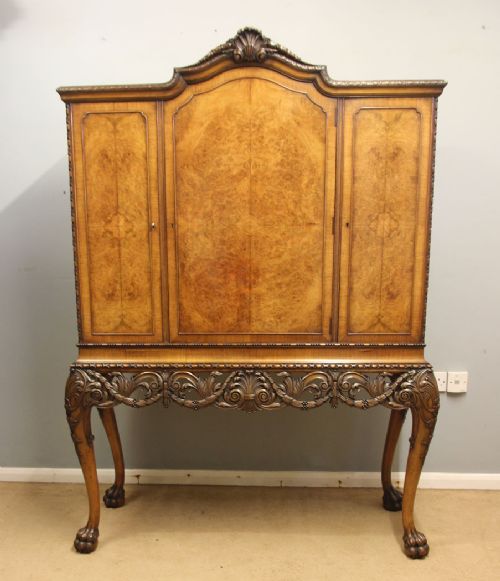
Two distinct sections make up the form. The upper box lifts off the lower supporting frame.
Open the doors to find banks of small drawers surrounding a central cupboard, sometimes hiding secret compartments behind the main tier.
Stretcher bases often tie the lower legs together, providing essential stability for the heavy top section.
Craftsmen laid thin sheets of expensive burr walnut over stable oak boards using hot animal hide glue.
Hand-cut dovetails secure the drawer corners. Early examples show fewer, thicker pins compared to refined eighteenth-century work.
Turn it over. Look under the stand to see wooden pegs locking the mortise and tenon joints firmly together.
"Many were originally flat-topped to display large pieces of blue and white Chinese porcelain."
"The elaborate interior often served as a conversation piece, opened specifically to entertain guests after dinner."
"Some bases detach into multiple sections, a clever design allowing them to be carried up narrow seventeenth-century staircases."
Based on almost 25 years of Sellingantiques UK antique market data, Antique Cabinet On Stand appeared 2830 times (out of 1,100,000 antiques) which gives it a rarity score of 57/100.
This score measures scarcity within the Sellingantiques archive only and is not a survey of the entire antiques market, so these statistics may not be indicative of the general availability of Antique Cabinet On Stand elsewhere.
Use a soft dry cloth for regular dusting. Japanning is fragile and you shouldn't use water as it degrades the varnish.
If the surface looks dull, a light application of microcrystalline wax works well. Apply it sparingly and buff gently to avoid lifting any loose decoration.
Mirrored plates are often original to early eighteenth-century pieces. Glass was expensive then, so fitting it inside a cabinet kept it safe while reflecting light onto the displayed objects.
Over time, the silvering on the back of old glass degrades and turns cloudy. Some owners had these replaced in the nineteenth century, but original plates usually show grey spots and an uneven surface.
You need a professional restorer for structural work. The upper cabinet is heavy, and a failing leg risks the entire piece collapsing.
The restorer won't usually replace the whole leg. They splice in matched timber, which preserves the finish while restoring the necessary load-bearing strength.
They belong against a wall. The back boards are strictly functional and weren't meant to be seen.
Placing them flush against a solid wall also provides a much safer centre of gravity.
Please note: This Antique Cabinet On Stand guide and its associated pricing data are provided for general informational purposes only. It does not constitute formal financial, investment, or appraisal advice and should not be relied upon as the sole basis for any commercial activity, purchasing, or sales decisions. Sellingantiques.co.uk accepts no liability for any actions taken in reliance on this information. Always consult with a qualified professional or independent appraiser.
