32,875  PAGES BROWSED TODAY PAGES TODAY • 71 ANTIQUES UPLOADED TODAYNEW ARRIVALS
GIFTS
71 ITEMS ADDED TODAY
Sort Order
Items Per Page
Browse Categories
Sort order
Relevant Links
Items per page
ID #SA1090487
SOLD
Email Phone
Save
André Romain Guilmet: An Automata Windmill Clock
Sold by Leigh Extence Antique Clocks
sold SA1090487
Sorry, but this item has been sold.
Leigh Extence Antique Clocks

Leigh Extence Antique Clocks

Sellingantiques Verified Since Sep 2024
Browse dealers 23 items
  • About Us
    Specialists in fine antique clocks
  • Trade Associations
    Leigh Extence Antique Clocks is a registered member of BADA  CINOA
Id #SA1090487
PDF SHARE
SAVE

André Romain Guilmet: An Automata Windmill Clock

19th century
Sold 27 January 2025 · Leigh Extence Antique Clocks
This “André Romain Guilmet: An Automata Windmill Clock” found a buyer.

It was listed by Leigh Extence Antique Clocks. Sold pieces stay on Sellingantiques as a record of what has passed through, and the next one is rarely far away.

Description

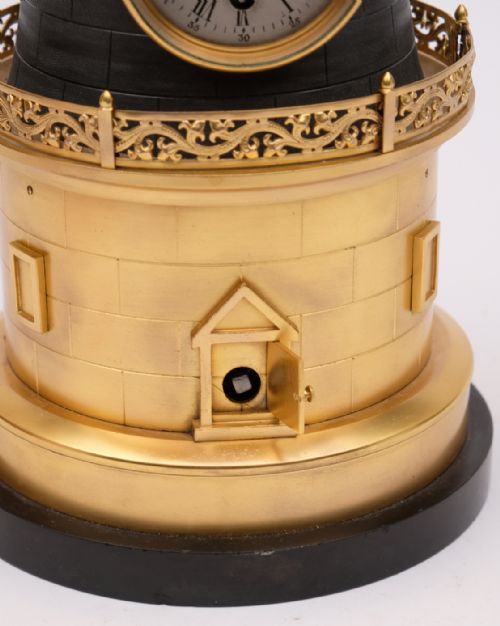
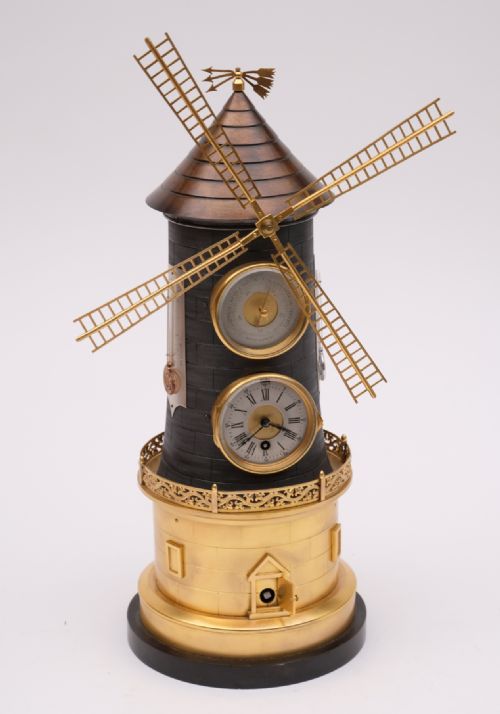
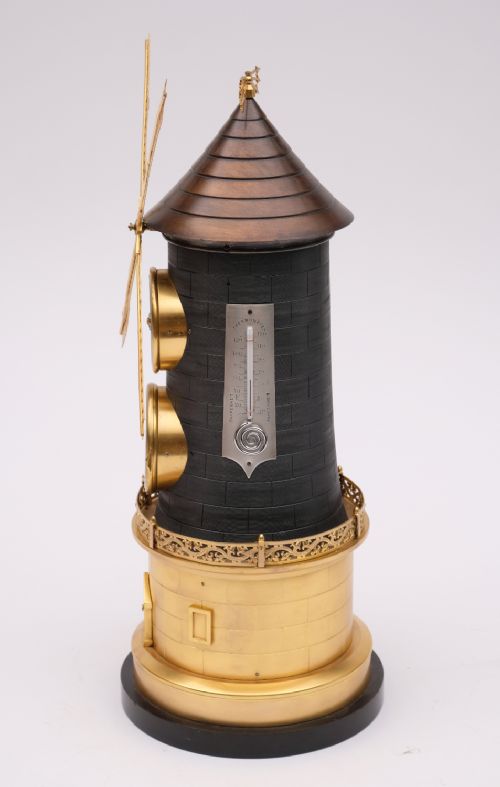
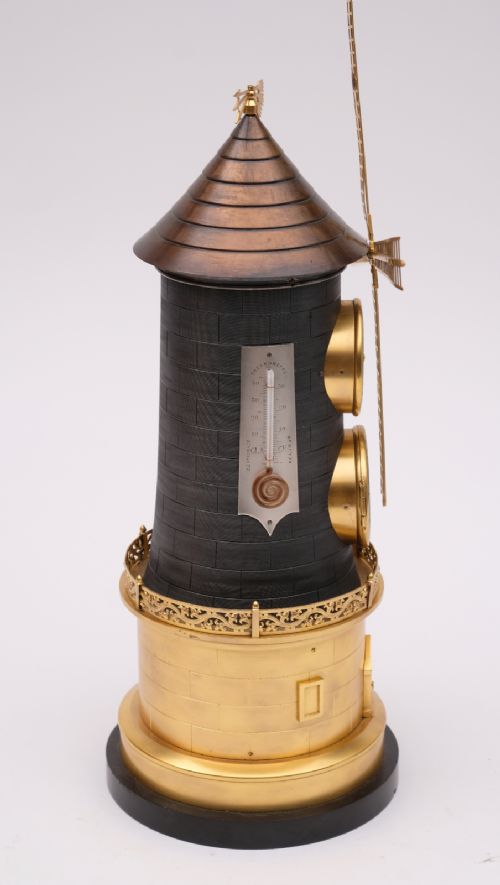
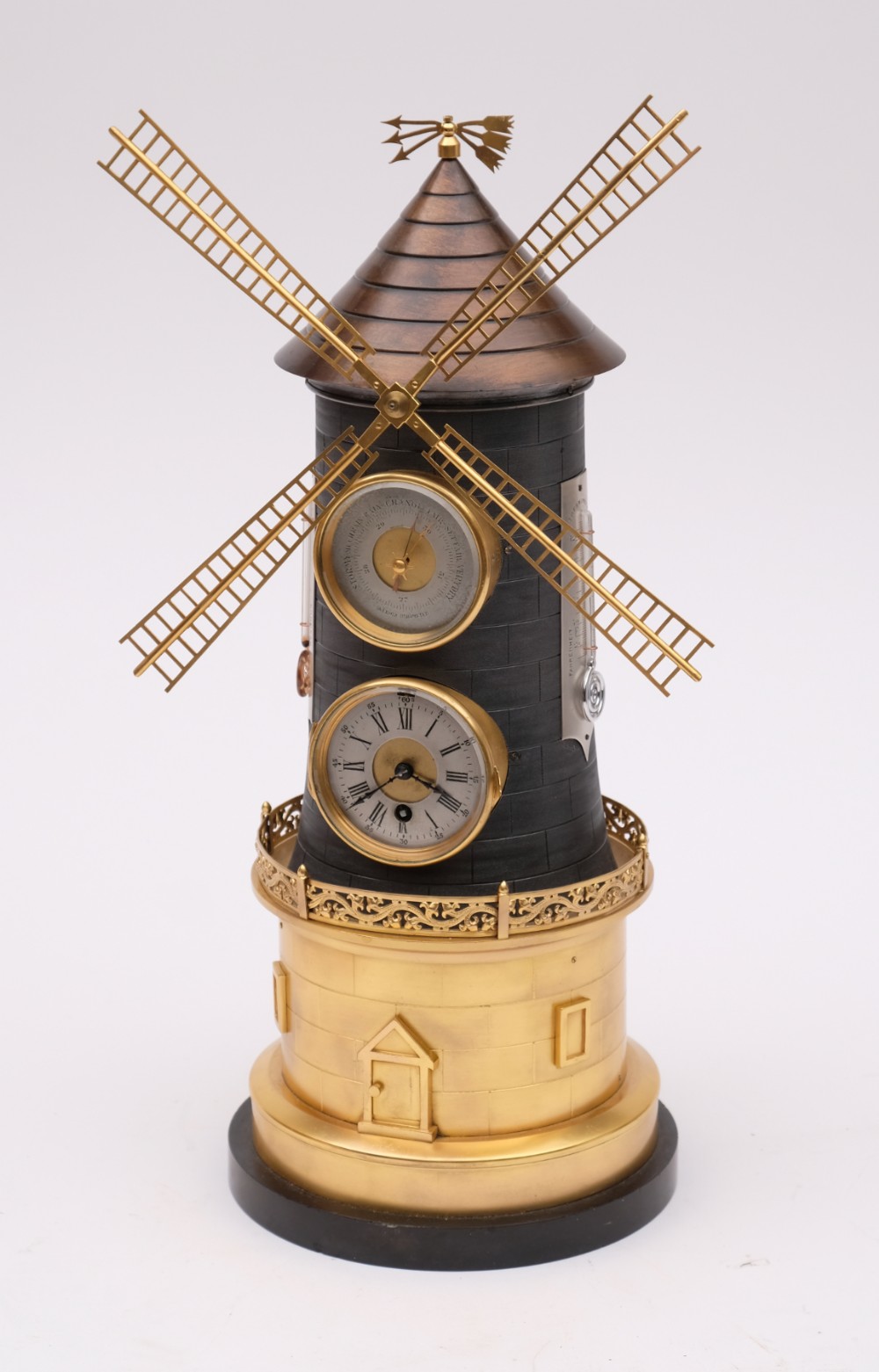
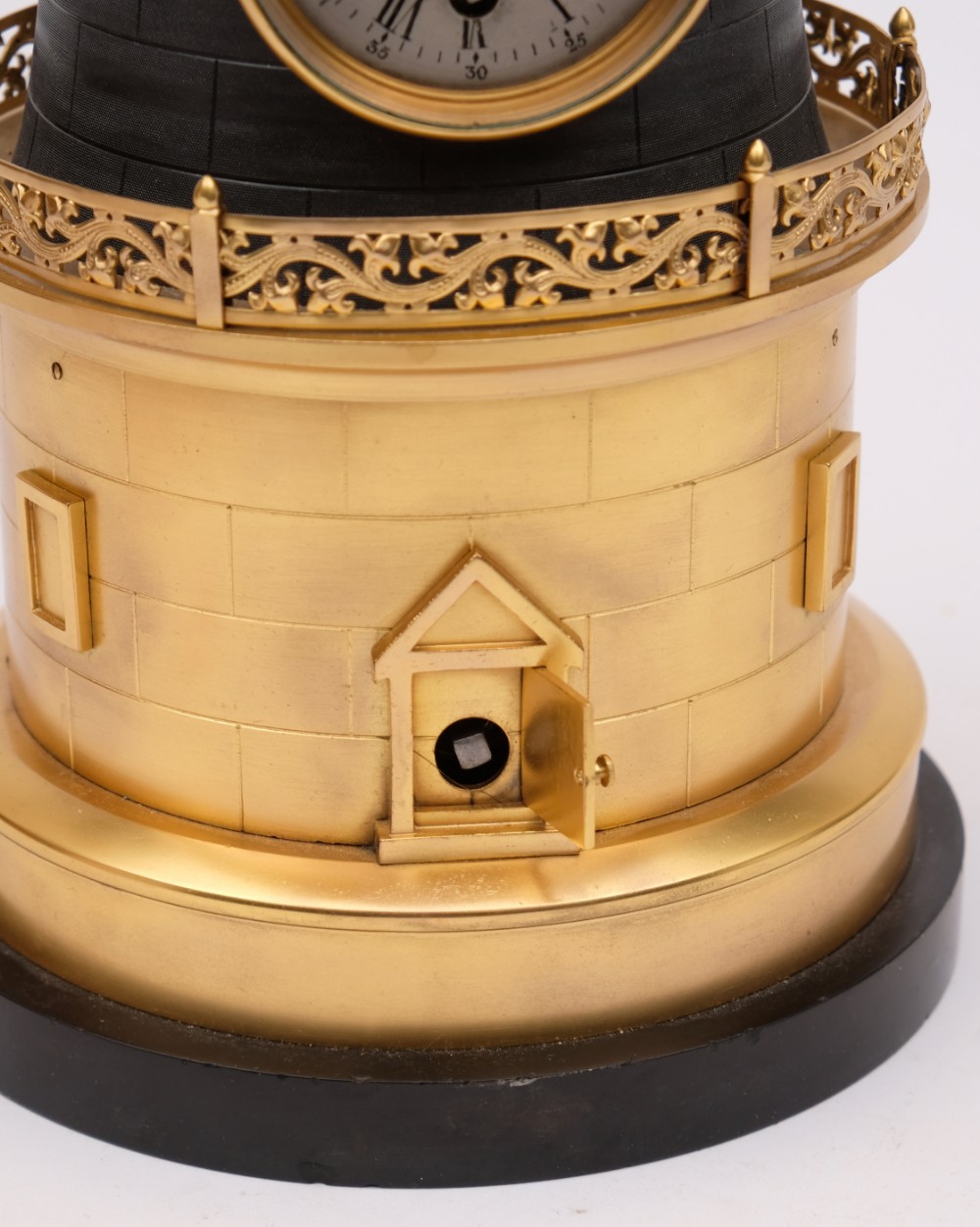
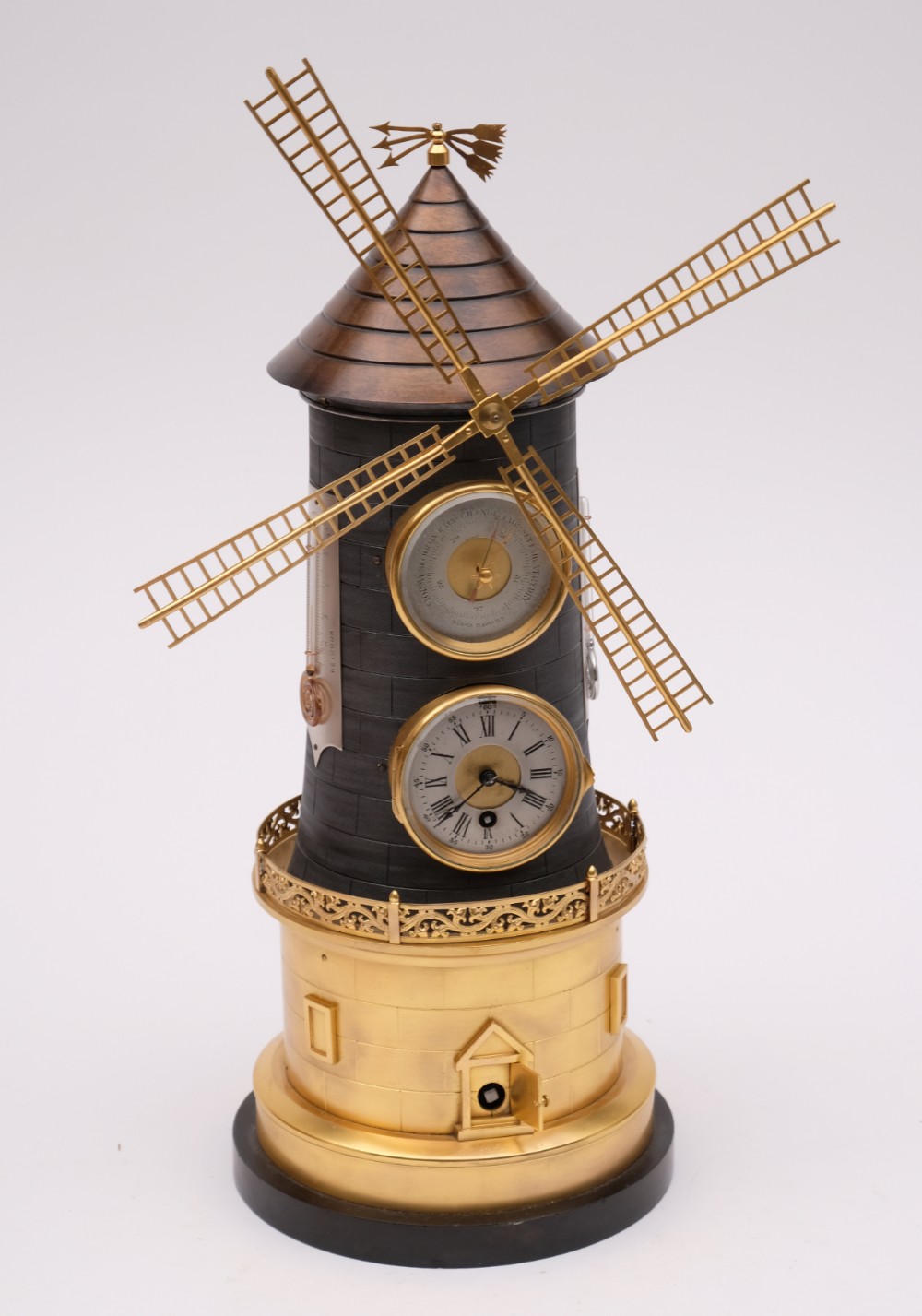
An excellent example of a rare windmill clock by the famous Parisian horologist André Romain Guilmet. The circular base is of black stone, above which is the gilded lower portion of the windmill with attached windows and a door which opens to reveal the winding arbor to operate the sails. The bronze higher portion of the windmill is decorated with simulated blocks and surmounted by a gilded weather vane.
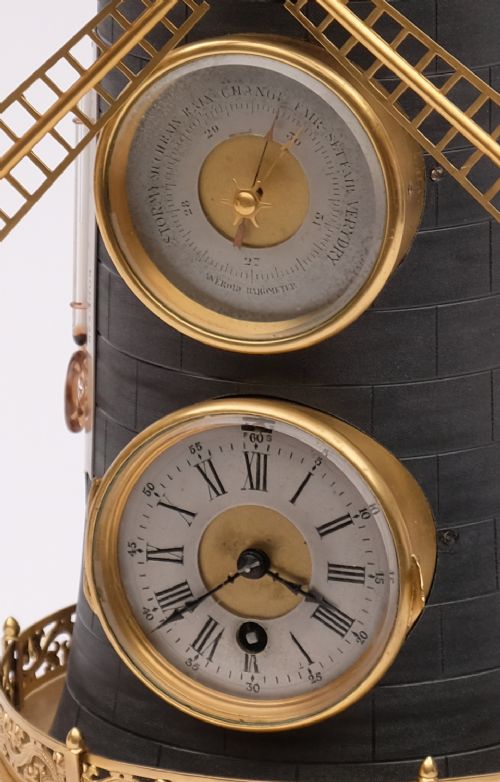
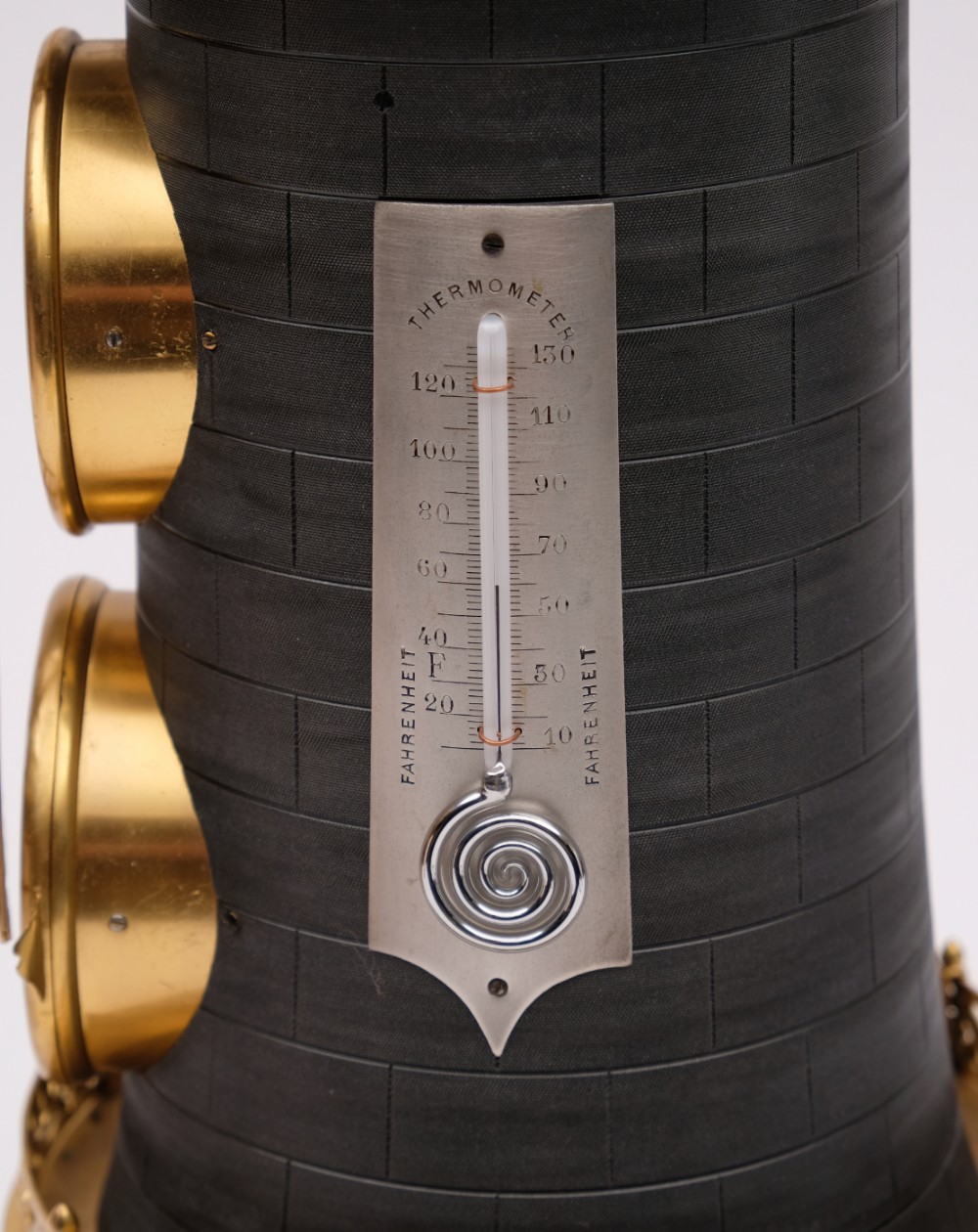
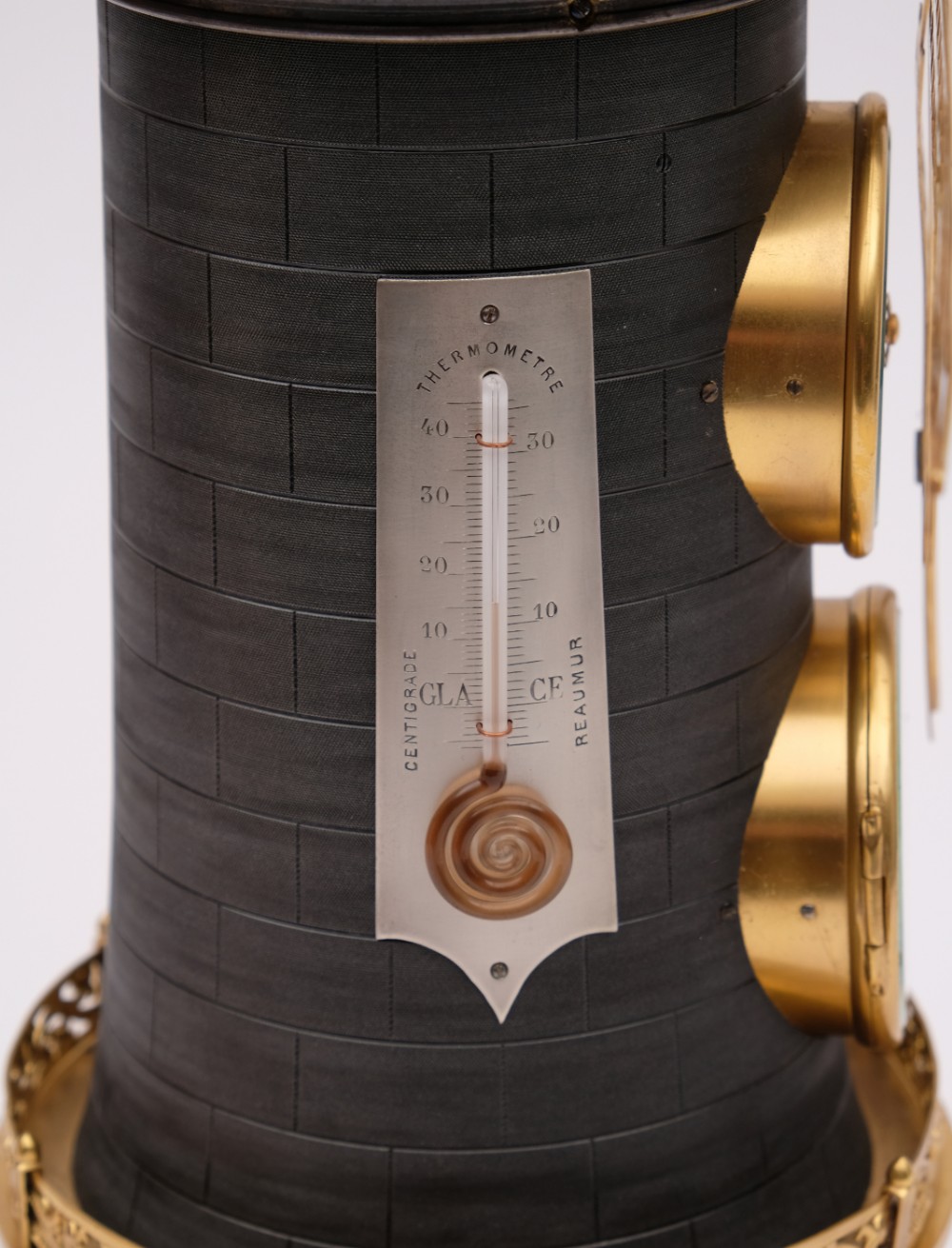
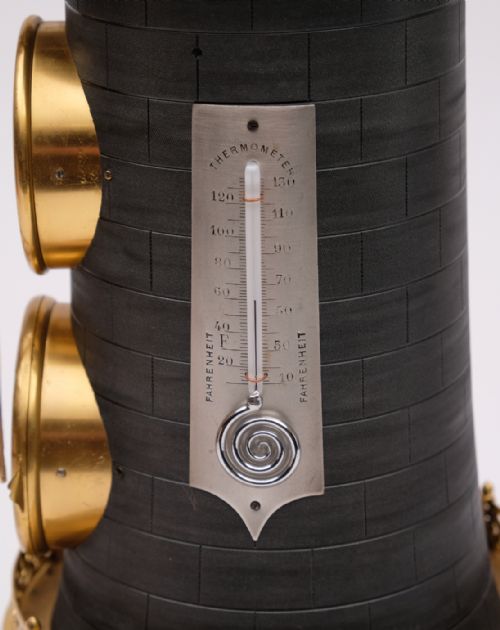
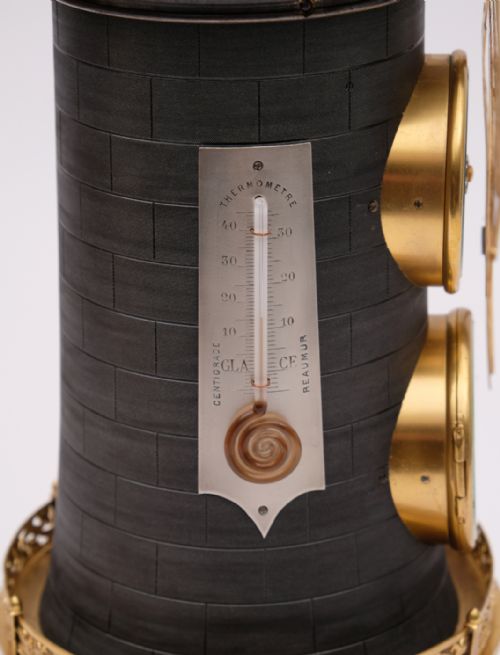
To the front of the windmill are two dials, one for the eight-day duration timepiece clock and, above it, another showing the barometric pressure. Either side are two thermometers, one showing Centigrade and the other Fahrenheit. Immediately beneath the roof of the tower is the arm from which the rotating blades of the windmill sails rotate.
Provenance: The Derek Roberts Collection

Derek Roberts notes: This clock, with all the detail on the base and the delicate arms of the windmill, was expensive to restore and therefore must have been very time consuming to make.
Literature: Derek Roberts: Mystery, Novelty, Fantasy Clocks; fig. 22-28, for a virtually identical clock.

Leigh Extence notes: Further research into the clockmaker Guilmet.

André Romain Philéas Guilmet was an obsessive inventor who took out many patents for designs, both horological and others.
It was he who in 1868, in collaboration with Edouard Meyer, first placed a driving chain on a bicycle, set below the seat to drive the rear wheels, and so produced the first bicycle powered in the method that is standard on all machines.
Quite possibly the clocks that Guilmet is most known for are the form of mystery clock where the pendulum hangs from the arm of a female statue, sitting atop the clock movement which is set within a marble base, and with no apparent means of power swings almost imperceptibly to keep the clock ticking. He took out a patent for this movement, number 78311, on the 30th of October 1867 and featured an example on his stand at the Paris Exposition of that year, where it was remarked in the Revue Chronométrique that: ‘No other exhibitor excites the curiosity of visitors to the Exhibition to the same degree as M. Guilmet. In front of a female statue, sitting on top of a marble clock, the hand holds a pendulum oscillating without apparent reason. There is no revelation within the pendulum as to the skills of the author of this new form of perpetual motion and there is a never-ending selection of comical remarks, the funniest finding themselves entangled in endless explanations.’
Guilmet also produced a number of clocks of an ‘industrial’ nature, including a beam engine, a steam hammer, the stern of a ship and a boiler amongst others.

There is a large amount of detail in previous research into Guilmet, and which doesn’t require repeating here, including that he was born on the 10th of December 1827 in La Ferte-Gaucher, a town some miles from Paris, to parents Philéas Germain Guilmet and Claire Bourrrienne.
I have since managed to unearth some new material, a summary of which is as follows:

The first recorded date I have found for Guilmet is in Paris in 1854 where he is described as the successor to the horloger Marchal jeune (junior) at Fauberg-Saint-Martin, 103; an address that is associated with the younger Marchal in earlier records. Marchal aîné (elder) is also known to have worked as an horloger, at Faubourg-Saint-Antoine, 111, and was still there at the time that Guilmet took over his son’s business. It is interesting to note that his name is spelled incorrectly in the 1854 Bottin Almanach, ‘Guillement aîné’, although that it is him is proven with the wording that follows his name; ancienne maison Marchal jeune. In this write-up he is described as ‘habillage de montres, de bijoux, remontage de pendules à l’anneé'; dress watches, jewellery, and clocks that run for a year.

In 1855 he married Marie Augustine Leblond, whos

Physical Dimensions
Height
43cm (16.93")
Declaration

Leigh Extence Antique Clocks has dated this Automaton Windmill Clock to the 1870s.

Reference Numbers
Sellingantiques Reference
SA1090487
Dealers Internal Reference
D407
Dealers Notes

Leigh Extence offers for sale antique clocks that are fully researched and validated.

Leigh is acknowledged as the world's leading expert on French carriage clocks of the 19th century and has lectured both home and abroad on the subject for over ten years.

He has had many papers published on the subject and his research is used by many of the leading auction houses in their descriptions.

Research Articles and Exhibition Catalogues are available to view on our website:

www.extence.co.uk

Unless otherwise stated, all clocks have been fully overhauled and are guaranteed as such.

Description
An excellent example of a rare windmill clock by the famous Parisian horologist André Romain Guilmet.
“
The circular base is of black stone, above which is the gilded lower portion of the windmill with attached windows and a door which opens to reveal the winding arbor to operate the sails.
Leigh Extence Antique Clocks

The bronze higher portion of the windmill is decorated with simulated blocks and surmounted by a gilded weather vane.

fig 1. An antique mechanical windmill automaton desk clock crafted from brass and patinated metal featuring integrated dials and rotating sails.
fig 1. André Romain Guilmet: An Automata Windmill Clock

To the front of the windmill are two dials, one for the eight-day duration timepiece clock and, above it, another showing the barometric pressure. Either side are two thermometers, one showing Centigrade and the other Fahrenheit. Immediately beneath the roof of the tower is the arm from which the rotating blades of the windmill sails rotate.

fig 2. An antique mechanical windmill automaton desk clock crafted from brass and patinated metal featuring integrated dials and rotating sails.
fig 2. André Romain Guilmet: An Automata Windmill Clock

Provenance: The Derek Roberts Collection

Derek Roberts notes: This clock, with all the detail on the base and the delicate arms of the windmill, was expensive to restore and therefore must have been very time consuming to make.

fig 3. An antique mechanical windmill automaton desk clock crafted from brass and patinated metal featuring integrated dials and rotating sails.
fig 3. André Romain Guilmet: An Automata Windmill Clock

Literature: Derek Roberts: Mystery, Novelty, Fantasy Clocks; fig. 22-28, for a virtually identical clock.

Leigh Extence notes: Further research into the clockmaker Guilmet.

André Romain Philéas Guilmet was an obsessive inventor who took out many patents for designs, both horological and others.

fig 4. An antique mechanical windmill automaton desk clock crafted from brass and patinated metal featuring integrated dials and rotating sails.
fig 4. André Romain Guilmet: An Automata Windmill Clock

It was he who in 1868, in collaboration with Edouard Meyer, first placed a driving chain on a bicycle, set below the seat to drive the rear wheels, and so produced the first bicycle powered in the method that is standard on all machines.

fig 5. An antique mechanical windmill automaton desk clock crafted from brass and patinated metal featuring integrated dials and rotating sails.
fig 5. André Romain Guilmet: An Automata Windmill Clock

Quite possibly the clocks that Guilmet is most known for are the form of mystery clock where the pendulum hangs from the arm of a female statue, sitting atop the clock movement which is set within a marble base, and with no apparent means of power swings almost imperceptibly to keep the clock ticking. He took out a patent for this movement, number 78311, on the 30th of October 1867 and featured an example on his stand at the Paris Exposition of that year, where it was remarked in the Revue Chronométrique that: ‘No other exhibitor excites the curiosity of visitors to the Exhibition to the same degree as M. Guilmet. In front of a female statue, sitting on top of a marble clock, the hand holds a pendulum oscillating without apparent reason. There is no revelation within the pendulum as to the skills of the author of this new form of perpetual motion and there is a never-ending selection of comical remarks, the funniest finding themselves entangled in endless explanations.’

fig 6. An antique mechanical windmill automaton desk clock crafted from brass and patinated metal featuring integrated dials and rotating sails.
fig 6. André Romain Guilmet: An Automata Windmill Clock

Guilmet also produced a number of clocks of an ‘industrial’ nature, including a beam engine, a steam hammer, the stern of a ship and a boiler amongst others.

There is a large amount of detail in previous research into Guilmet, and which doesn’t require repeating here, including that he was born on the 10th of December 1827 in La Ferte-Gaucher, a town some miles from Paris, to parents Philéas Germain Guilmet and Claire Bourrrienne.

fig 7. An antique mechanical windmill automaton desk clock crafted from brass and patinated metal featuring integrated dials and rotating sails.
fig 7. André Romain Guilmet: An Automata Windmill Clock

I have since managed to unearth some new material, a summary of which is as follows:

The first recorded date I have found for Guilmet is in Paris in 1854 where he is described as the successor to the horloger Marchal jeune (junior) at Fauberg-Saint-Martin, 103; an address that is associated with the younger Marchal in earlier records. Marchal aîné (elder) is also known to have worked as an horloger, at Faubourg-Saint-Antoine, 111, and was still there at the time that Guilmet took over his son’s business. It is interesting to note that his name is spelled incorrectly in the 1854 Bottin Almanach, ‘Guillement aîné’, although that it is him is proven with the wording that follows his name; ancienne maison Marchal jeune. In this write-up he is described as ‘habillage de montres, de bijoux, remontage de pendules à l’anneé'; dress watches, jewellery, and clocks that run for a year.

In 1855 he married Marie Augustine Leblond, whos

Height
43cm (16.93")
Date of Manufacture

Leigh Extence Antique Clocks has dated this Automaton Windmill Clock to the 1870s.

Reference Numbers
Sellingantiques Ref
SA1090487
Dealers Internal Ref
D407
Leigh Extence Antique Clocks
Sellingantiques verified Since Sep 2024

Specialists in fine antique clocks

Dealer Profile

You can view the stock and full dealer information on the Leigh Extence Antique Clocks Profile Page

Trade Associations

Leigh Extence Antique Clocks is a registered member of BADA  CINOA
PDF SHARE
SAVE
An antique mechanical windmill automaton desk clock crafted from brass and patinated metal featuring integrated dials and rotating sails. SOLD6+ MONTHS AGO
1 / 8
Archive I An antique mechanical windmill automaton desk clock crafted from brass and patinated metal featuring integrated dials and rotating sails. SOLD6+ MONTHS AGO

André Romain Guilmet: An Automata Windmill Clock
Archive II An antique mechanical windmill automaton desk clock crafted from brass and patinated metal featuring integrated dials and rotating sails. View II
Archive III An antique mechanical windmill automaton desk clock crafted from brass and patinated metal featuring integrated dials and rotating sails. View III
Archive IV An antique mechanical windmill automaton desk clock crafted from brass and patinated metal featuring integrated dials and rotating sails. View IV
Archive V An antique mechanical windmill automaton desk clock crafted from brass and patinated metal featuring integrated dials and rotating sails. View V
Archive VI An antique mechanical windmill automaton desk clock crafted from brass and patinated metal featuring integrated dials and rotating sails. View VI
Archive VII An antique mechanical windmill automaton desk clock crafted from brass and patinated metal featuring integrated dials and rotating sails. View VII
Archive VIII An antique mechanical windmill automaton desk clock crafted from brass and patinated metal featuring integrated dials and rotating sails. View VIII
Enlarged Archival View
Telephone 07967 802160
Location
Pavilion Place
Exeter
Devon
United Kingdom

By appointment only.
Verified Since Sep 2024
Items For Sale 23
Items Sold 6
Leigh Extence Antique Clocks
Verified Since Sep 2024
View Dealer Info
Location: Pavilion Place, Exeter, Devon, United Kingdom, , By appointment only.
Verified
Sep 2024
For Sale
23
Sold
6
An antique mechanical windmill automaton desk clock crafted from brass and patinated metal featuring integrated dials and rotating sails.
André Romain Guilmet: An Automata Windmill Clock
Ref: SA1090487
An antique mechanical windmill automaton desk clock crafted from brass and patinated metal featuring integrated dials and rotating sails.
Detail View 1
Detail View 2
Detail View 3
Detail View 4
Detail View 5
Detail View 6
Detail View 7
Archival Detail
Every single antique dealer on our platform is individually approved by our internal team. We verify their professional trade history, ethical standards, and photographic quality to ensure a secure, high-standard buying environment. Upon joining, every dealer agrees to a strict 9-point code of conduct. While issues can occasionally arise, our dealers typically resolve them swiftly and directly with the buyer. In fact, since our founding in 2002, Sellingantiques has only had to step in to help resolve an issue on roughly five occasions—a true testament to the quality of our dealers and their dedication to your happiness.
Our dealers are highly experienced in packing and shipping fragile, high-value antiques. Because you are in direct contact with the dealer, you will be able to easily go through all available shipping and insurance options together to ensure your item arrives safely.
Antiques are the ultimate green purchase. By choosing historical pieces over newly manufactured goods, you completely eliminate the carbon footprint of modern mass production while preserving exceptional, timeless craftsmanship.
Written by Sellingantiques from the dealer’s photographs and listing
  • ObjectDesk Clocks
  • Period19th century
  • StyleVictorian & Gothic
  • MaterialBrass, Gilt Metal, Patinated Metal
  • ColourWarm Brown
  • MotifsRotating windmill sails, Integrated barometer dial, Roman numeral clock face, Architectural tower form
  • SizeH 43 cm (17 in)

Automaton clocks are mechanical timepieces featuring moving figures or mechanisms, highly popular during the late 19th century in France, particularly through makers like Andre Romain Guilmet who combined horology with industrial innovation.

These pieces typically utilise cast brass, gilt bronze, patinated metals, and sometimes enamel or silvered dials, paired with intricate mechanical brass gear movements.

Authentic pieces feature high-quality french cylinder or spring-driven movements, maker marks or patent stamps on the brass backplate, precise metalwork, and functional mechanical animations.

Position the timepiece as a focal point on a sturdy surface such as a mantelpiece, heavy desk, or bookshelf, allowing its metallic textures and mechanical novelty to contrast with clean, contemporary lines.

Keep the clock away from direct sunlight and humidity, dust gently with a soft microfibre cloth, and have the internal mechanical movement professionally serviced every few years by a qualified horologist.
items
Add keywords to the filter
Price
£100
£250000
Era
Period
Style
Material
Origin
Stock Location
Recently Added
Online Payments
Categories