



Antique Gothic Chests
A lidded storage chest carved with Gothic ornament, made to hold linen, clothes, documents or valuables in the household.
Antique Gothic Chests
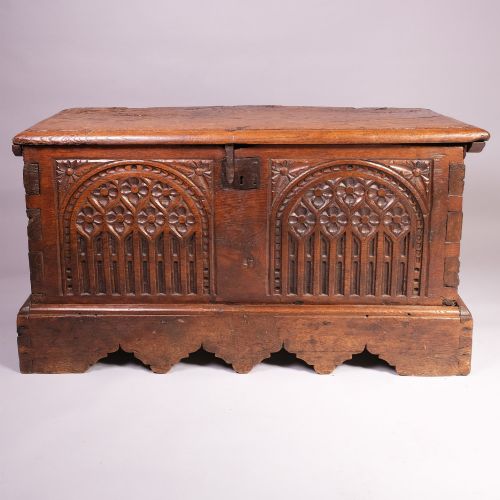
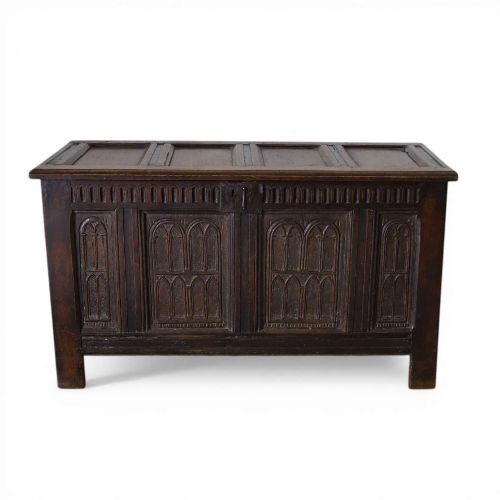
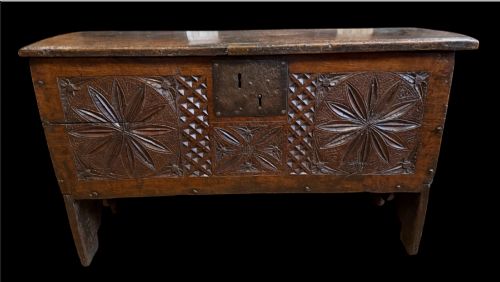
The coffer is the governing form. "Coffer" appears in 19 of 33 titles on Sellingantiques, "oak" in 18, and the pairing "oak coffer" in 10. So the likeliest single encounter is an oak coffer with a hinged lid and a carved front, either plank-built or panelled.
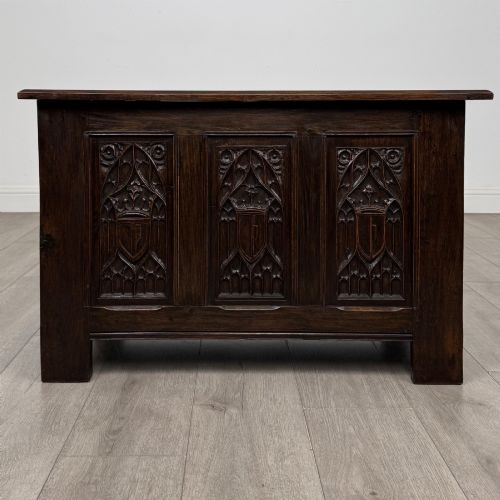
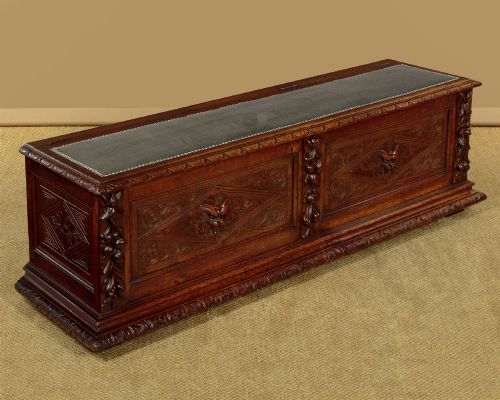
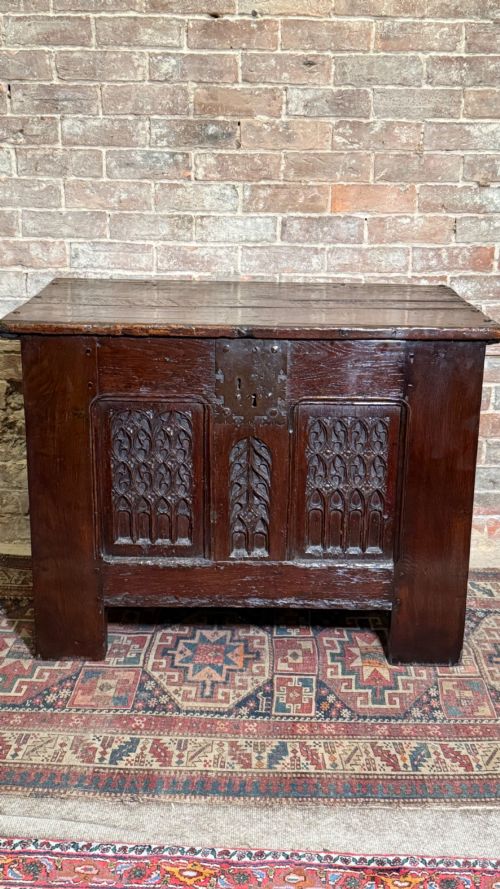
Two clusters sit behind the heading. One is genuine early oak, from the 16th and 17th centuries and earlier, with linenfold, tracery and chip carving. The other is a later revival wave: 19th-century Gothic Revival chests, and Arts and Crafts coffers with Gothic carving from around 1880 to 1940.
The coffer was the principal storage furniture of the late medieval and early modern household, carved with the architectural motifs of its day. Gothic ornament came back in the 19th and early 20th centuries, applied both to new furniture and to reworkings of older forms.
Around the coffers sit related boxes: iron-bound strong boxes, a French chestnut deed box, blanket and dower chests, and continental pieces outside the English oak tradition, including a Spanish painted blanket chest, an Italian gilt-decorated walnut cassone, a Westphalian coffer and a Swedish hand-painted strong box. Timbers named are chiefly oak, with walnut, chestnut, elm, mahogany and rosewood appearing singly.

Where The Range Splits
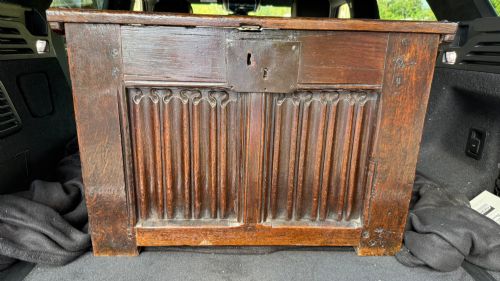
Age of the carcase does most of the work. The upper half of the range is dominated by 16th and 17th century oak, including plank coffers, a linenfold Henry VIII coffer of about 1540 and an iron bound 16th-century coffer. Arts and Crafts and 19th-century revival coffers sit lower, and a small carved elm lidded box sits at the very bottom.
Carving separates pieces that otherwise look alike. Titles naming a programme - saints and tracery, linenfold, a cathedral chest, gilt Gothic decoration - sit above those that say only "Gothic carved". Figured or decorated timber pulls the same way: pollard oak, walnut and rosewood higher, plain elm and mahogany lower.
Iron and steel binding is a recurring theme rather than a rarity, named on six sampled pieces, and the single highest-placed chest in these titles is an iron bound coffer. Size reads the same direction: "massive", "large" and "long" cluster at the top, while the two pieces described as small sit near the bottom.
Antique Gothic Chests Retail Price Guide 2026
Typical UK retail prices for gothic chests, calculated from the Sellingantiques database of over a million retail prices indexed since 2003. This retail price guide relies exclusively on Sellingantiques data; no external sources or auction records are used, so the figures do not describe the wider market.
Spanish, Italian, French, Swedish, German and American chests have each turned up once, among them a gilt-decorated walnut cassone.
The Antique Gothic Chests Glossary
- Coffer
- A chest with a hinged lid, and the commonest term in this category, used in 19 of 33 titles.
- Plank coffer
- The simplest construction, built from wide boards rather than framed panels.
- Panelled
- A front built as framed panels set into stiles and rails, as in "Gothic Carved Panelled Oak Coffer".
- Linenfold
- Carved panel imitating folded cloth, named here on a 16th-century oak chest.
- Iron bound
- Strapwork of metal bands over the carcase; steel bound is used the same way, and one ship's strong box carries it.
- Cassone
- An Italian marriage chest. One gilt Gothic decorated walnut example appears, the only chest of its kind in the samples.
Antique Gothic Chests: Frequently Asked Questions
How often do Gothic chests come up for sale?
It's a small category. About four come to market a year on Sellingantiques, and 28 different dealers have listed one, so almost nobody carries two at once.
That spread also means the forms vary from listing to listing rather than repeating.
What timber are they usually made from?
Oak dominates. It appears in 18 of 33 titles, and the pairing "oak coffer" accounts for 10 on its own.
Walnut, chestnut, elm, mahogany and rosewood each turn up singly. One title says only "hardwood", without naming the species.
Are these all medieval pieces?
No. Roughly a third of the samples are early oak from the 16th and 17th centuries or earlier, described as circa 1540, circa 1600, circa 1680 and one late 15th century coffer in oak and elm.
The rest are later. About a quarter are 19th-century Gothic Revival chests, and around a fifth are Arts and Crafts coffers with Gothic carving, dated between 1880 and 1940.
Why do the dates in the listings look so vague?
The dealer date field is mostly a period label rather than a year. "19th Century" appears eight times, "16th Century" four, and there are single entries for Victorian, the 1870s, 1880s, 1900s, 1910s and 1920s. One reads simply "Select".
Only nine of 33 listings carry a clean year, and that field runs 1750 to 1940. The titles reach much further back than the field does, which is why the early end looks thinner than it is.
Do continental chests appear in this category?
More than the Gothic oak heading suggests. Spanish, Italian, French, Swedish, German and American pieces each appear once.
Among them: a Spanish painted blanket chest with Moorish decoration, a Spanish Gothic cathedral chest, a Westphalian iron-bound coffer with an inscribed date, and an Italian gilt Gothic walnut cassone.
Which forms besides coffers turn up?
Iron-bound strong boxes and deed boxes are the largest side group, six of the sampled titles, including a ship's carved oak and steel bound strong box and a French chestnut deed box.
Blanket and dower chests appear too. A few forms show up exactly once: an Arts and Crafts iron log bin, a rosewood Gothic Revival canterbury, and a small carved elm lidded box.