53  PAGES BROWSED TODAY PAGES TODAY 0 ANTIQUES UPLOADED TODAYNEW ARRIVALS
LATEST STOCK
Sort Order
Items Per Page
Browse Categories
Sort order
Relevant Links
Items per page
ID #SA923001
FOR SALE
£28,000
Email
Save
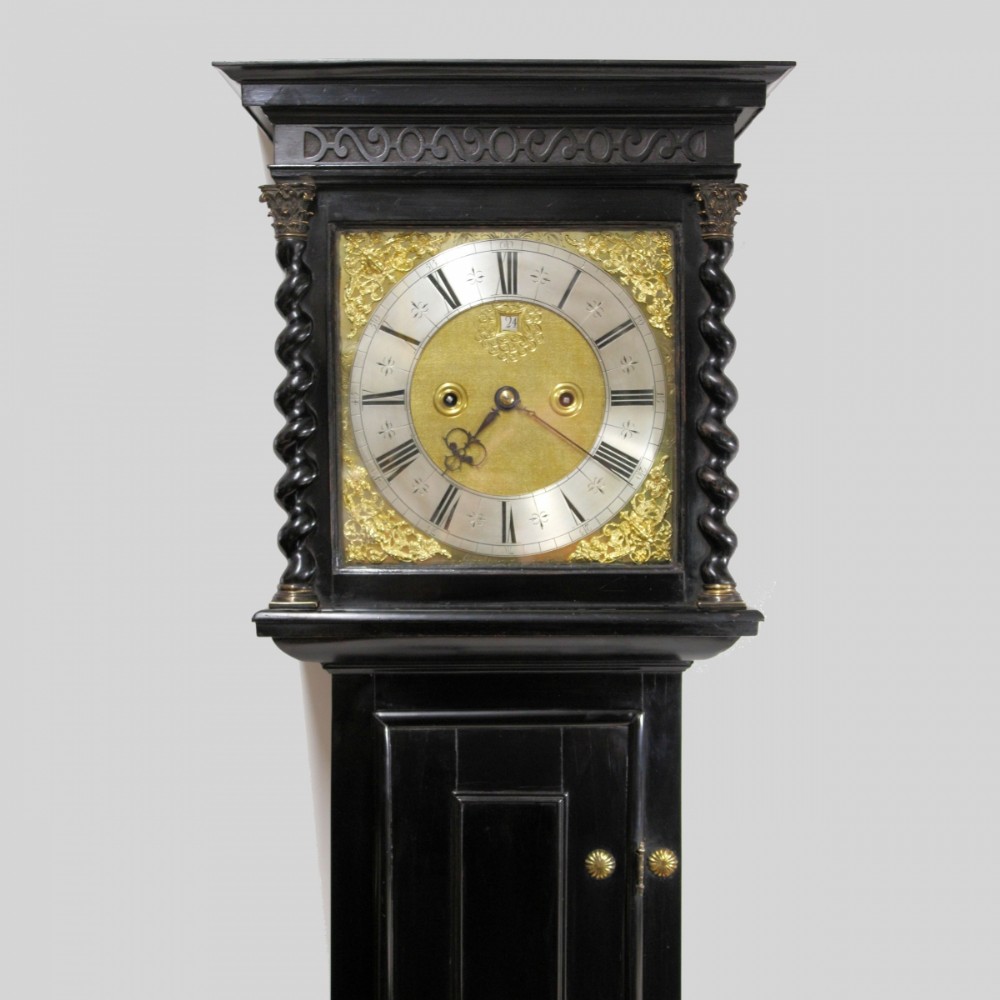
A Fine and Early English, Panelled Ebony Longcase Clock by John Drew, London. Circa 1685. (Long Case)
M. C. Taylor
for sale €32,760     $35,560
£28,000
M. C. Taylor

M. C. Taylor

Sellingantiques Verified Since Oct 2021
View Dealers Stock Page
  • About Us
    Clockmakers and restorers established 1987
Id #SA923001
PDF SHARE
SAVE

A Fine and Early English, Panelled Ebony Longcase Clock by John Drew, London. Circa 1685. (Long Case)

17th century
For Sale by M. C. Taylor
Description

This is an outstanding example of a small, early longcase clock in 'Museum condition'.

Movement.

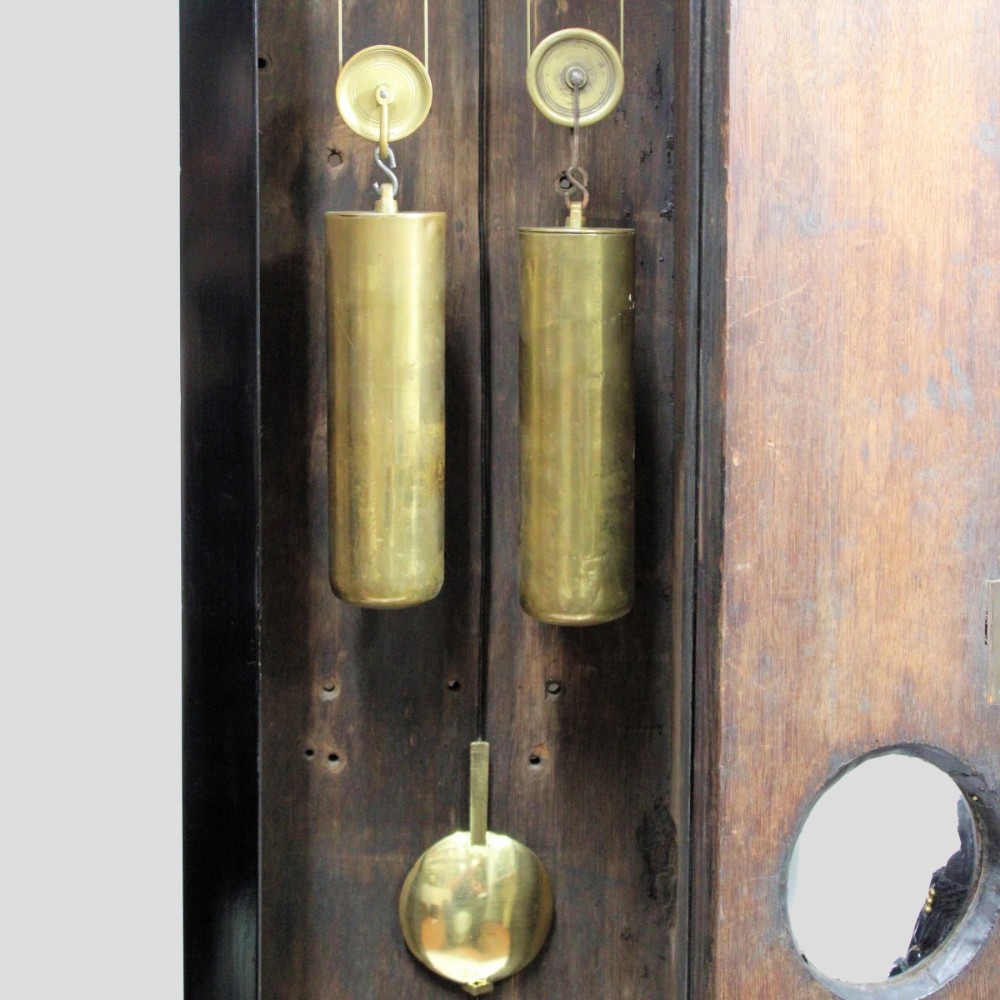
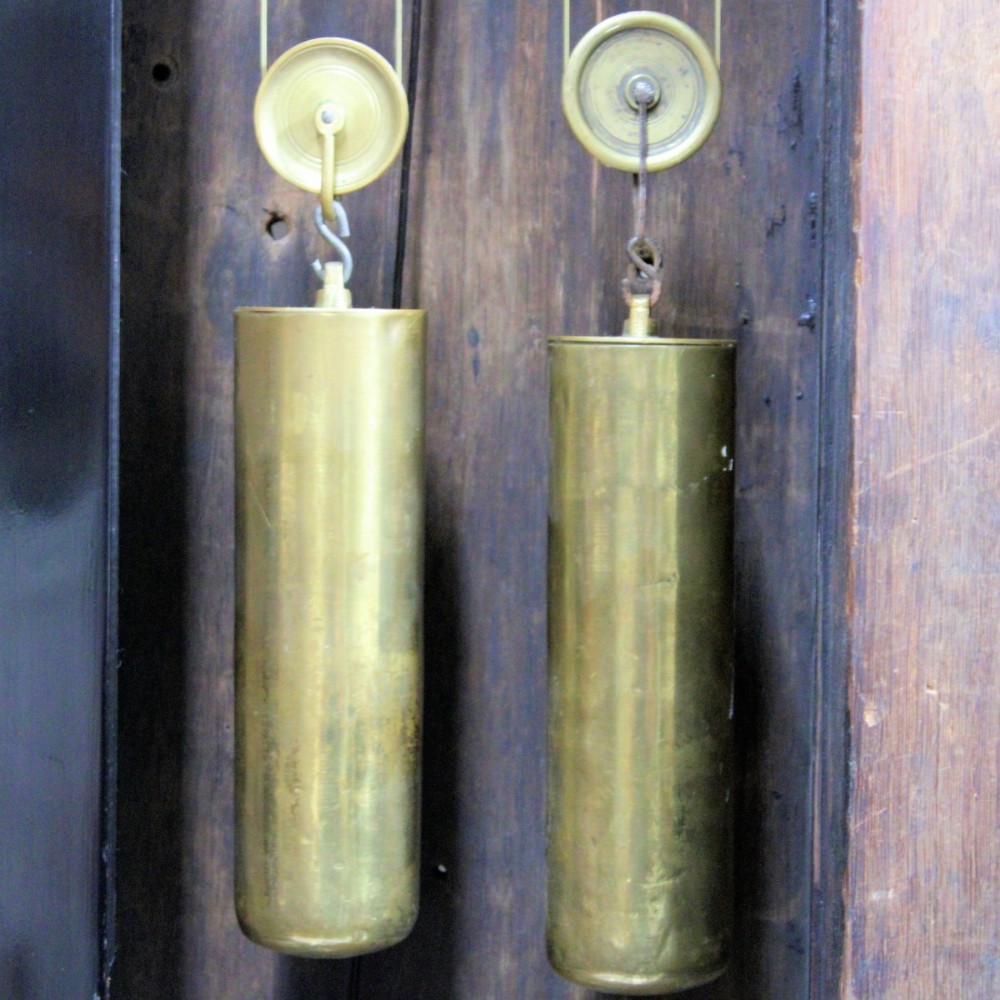
Tall, eight day duration, 5 shaped pillars and being partially latched. Having an Anchor Recoil escapement and outside, crossed-out countwheel striking the hours on a large top-mounted bell. Also having an early 'upside down' backcock. The weights are brass-cased.
Dial.

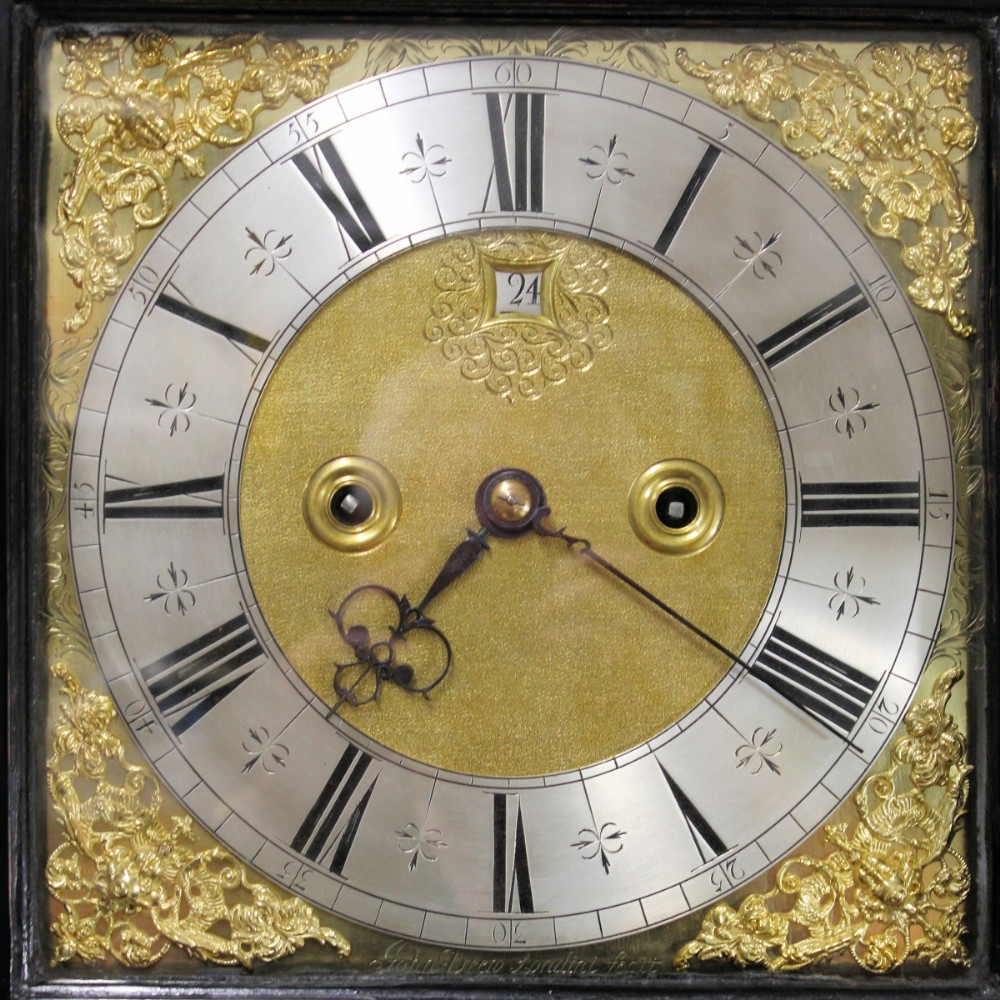
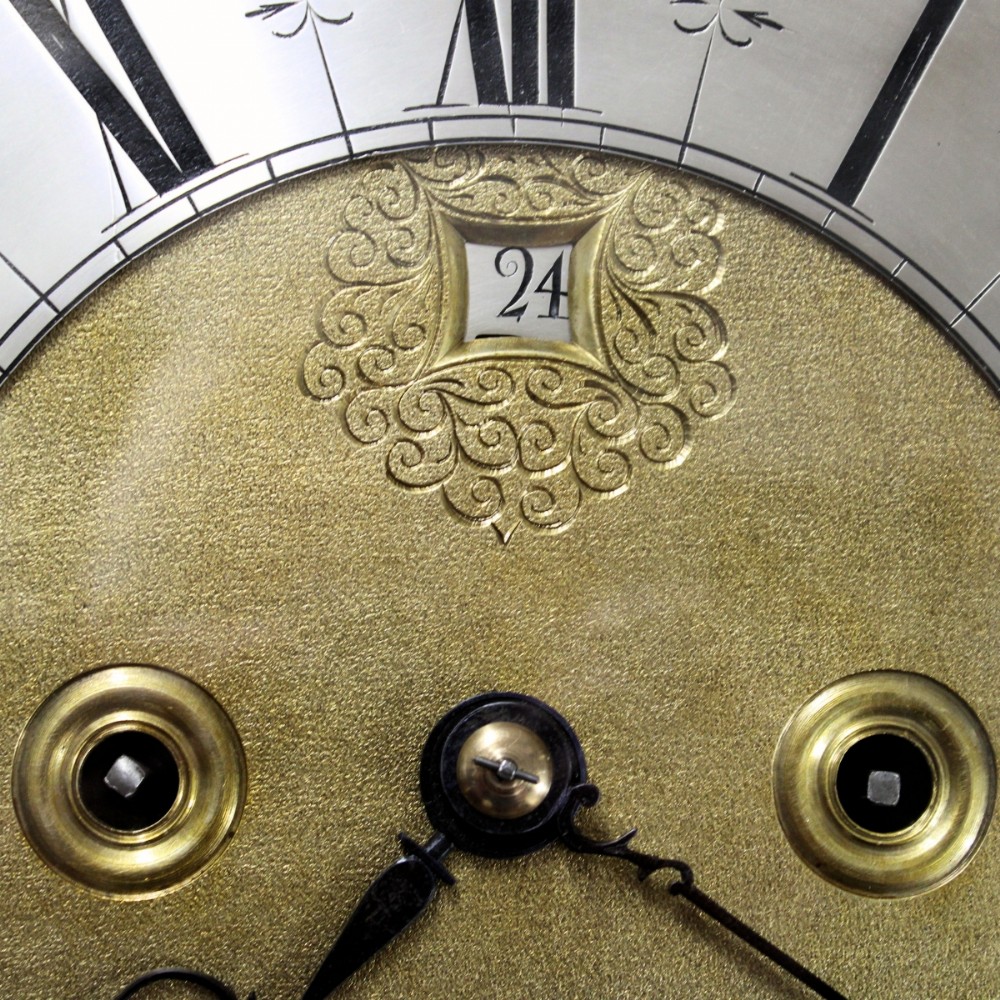
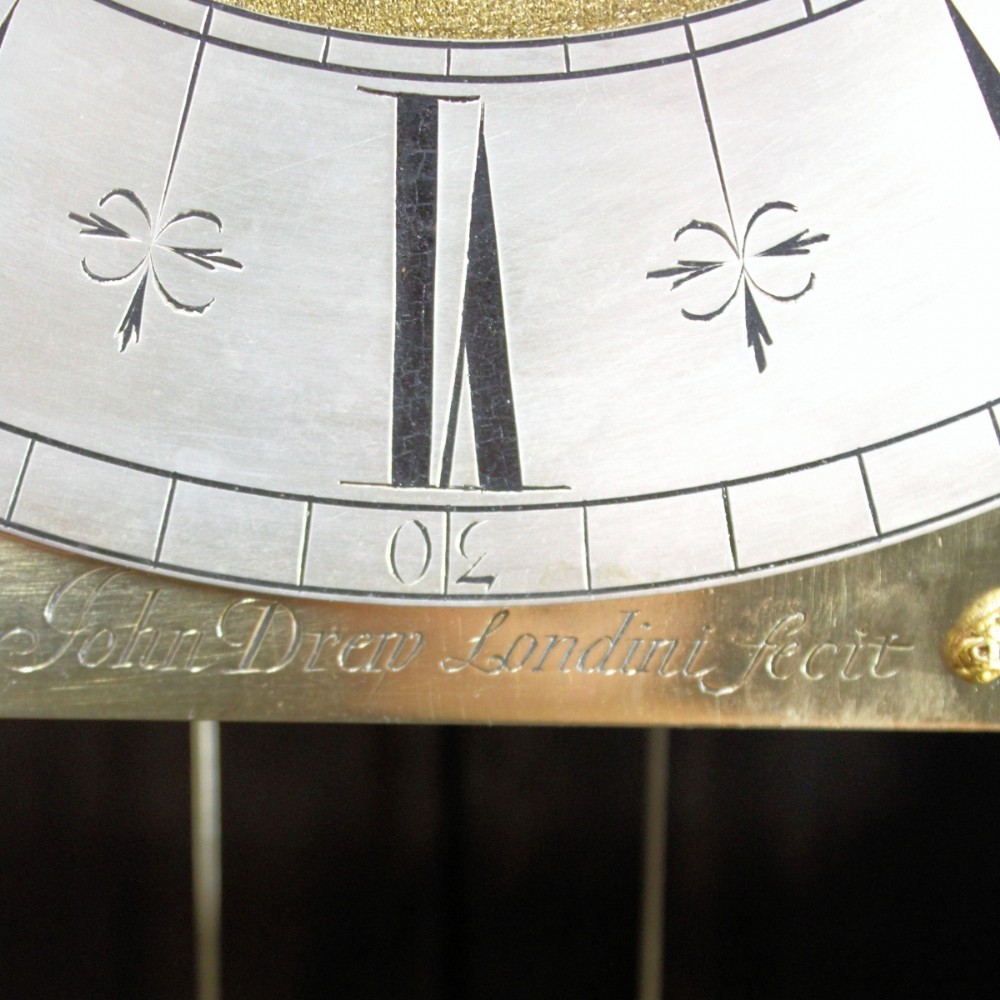
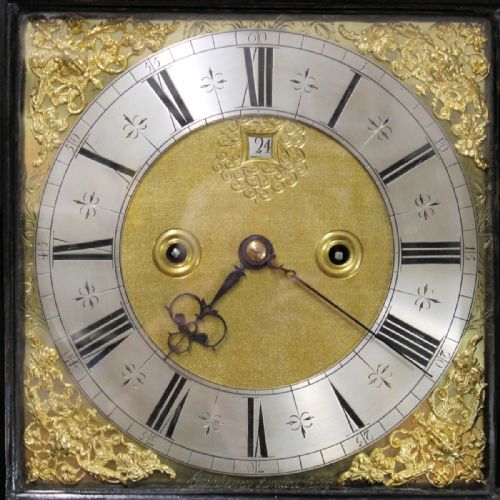
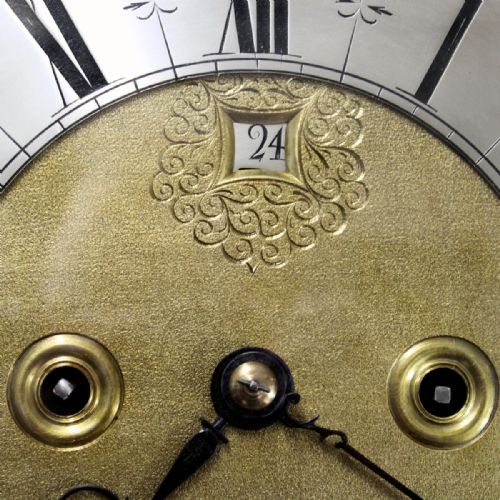
Square, 11" brass dial with well-cast elaborated winged putti corner spandrels, a finely matted centre with ringed winding holes and an upside down curved and chamfered edged square calendar aperture, this has scrollwork engraving surrounding it. The silvered chapter ring has an outer divided minute track with small Arabic 5's, Roman hour numerals, half hour cruciform divisions and an inner quarter track. There is floral engraving between the spandrels and the bottom space bears the maker's signature "John Drew, Londini fecit". The very fine and blued steel hands extremely precise and sit beautifully.
Case.

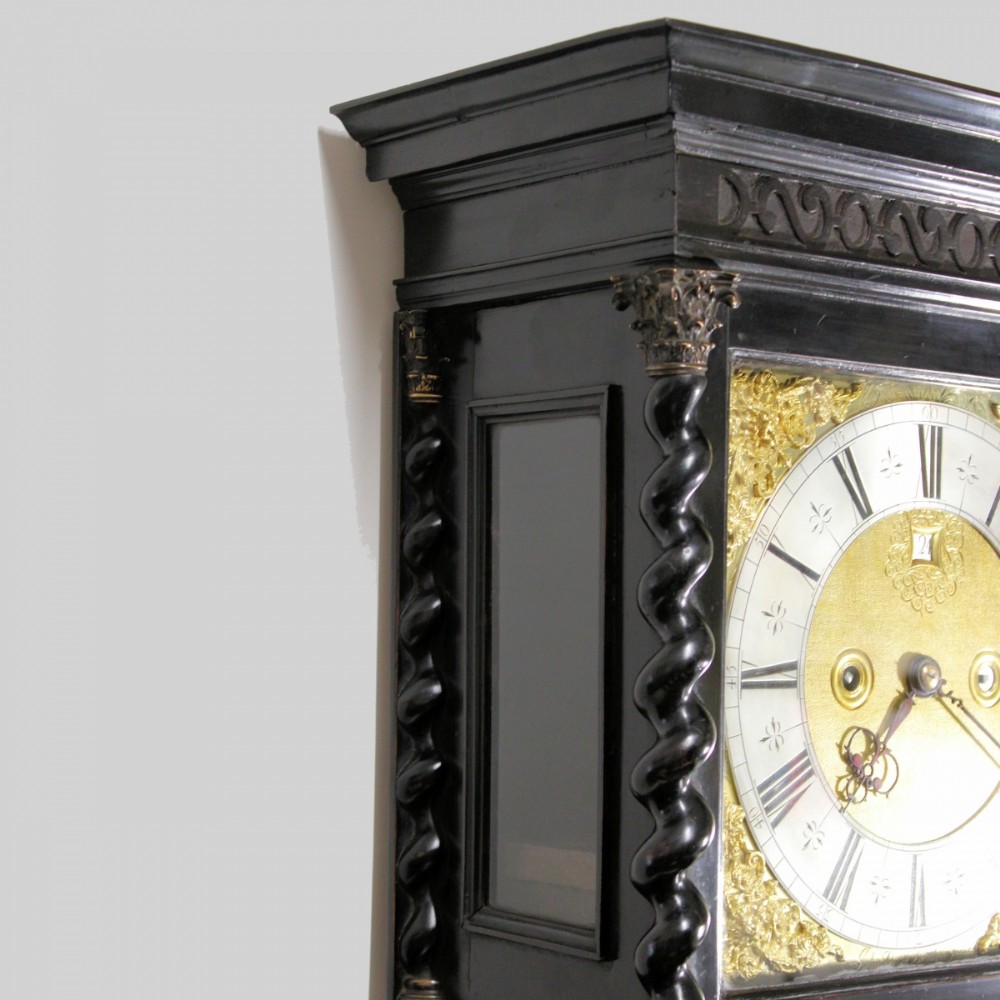
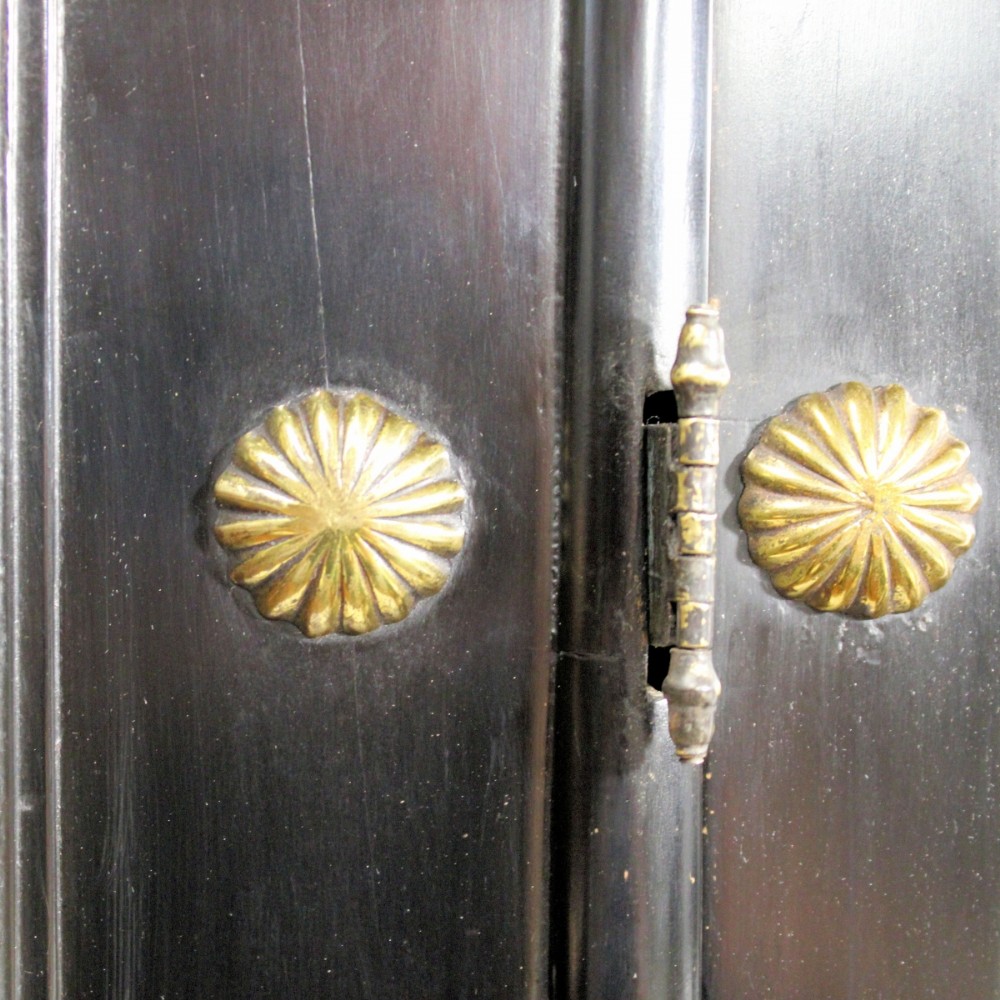
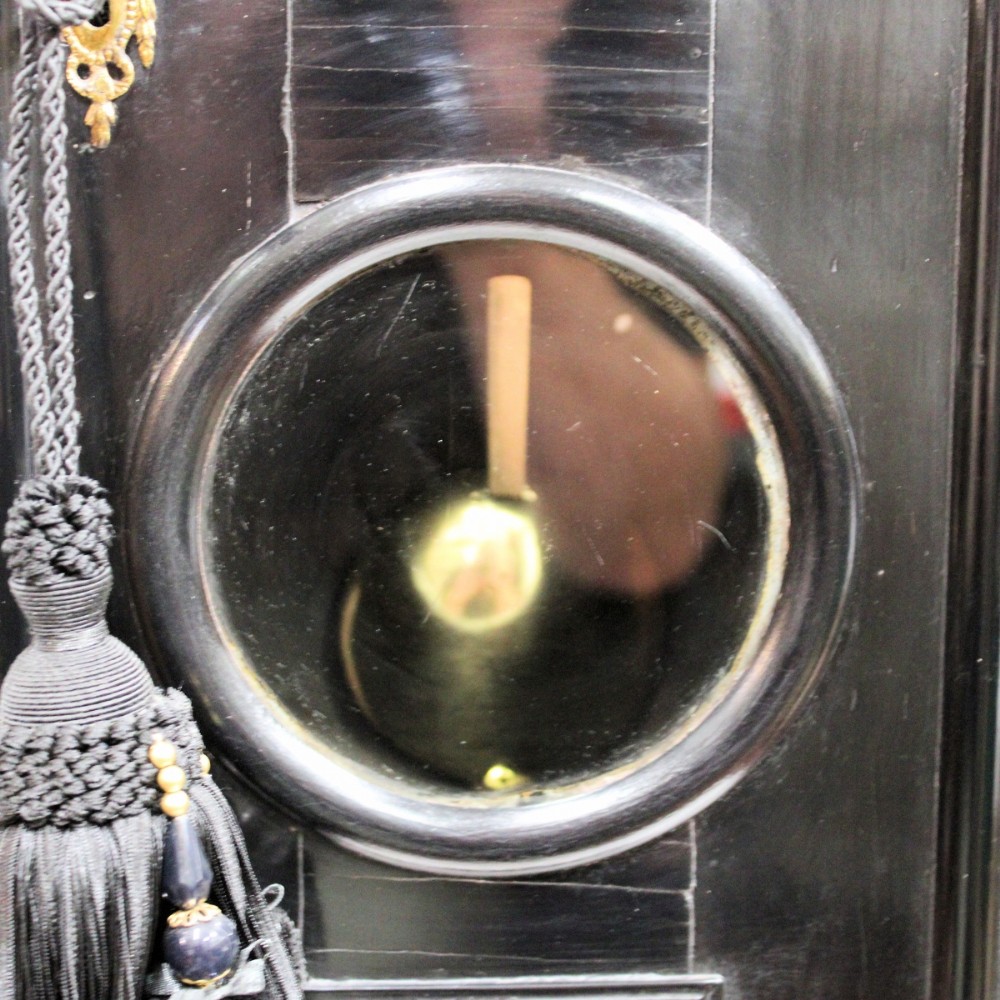
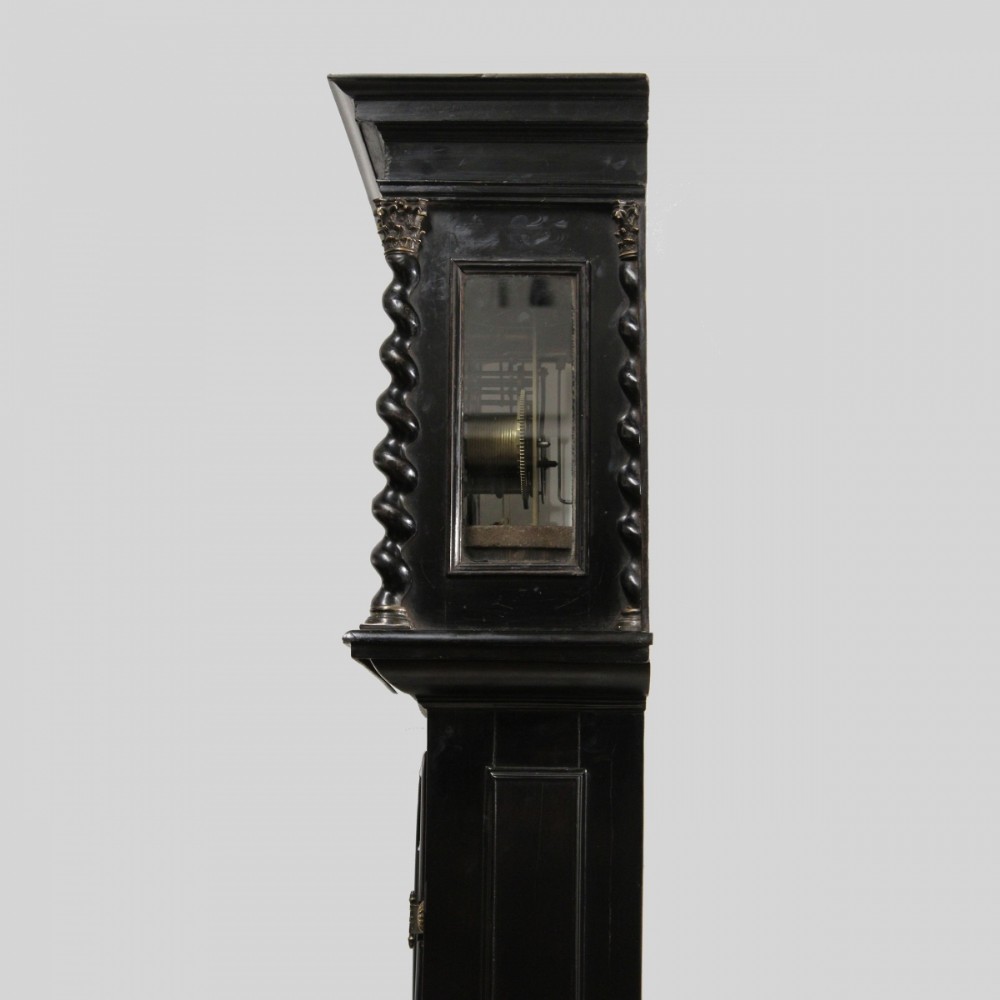
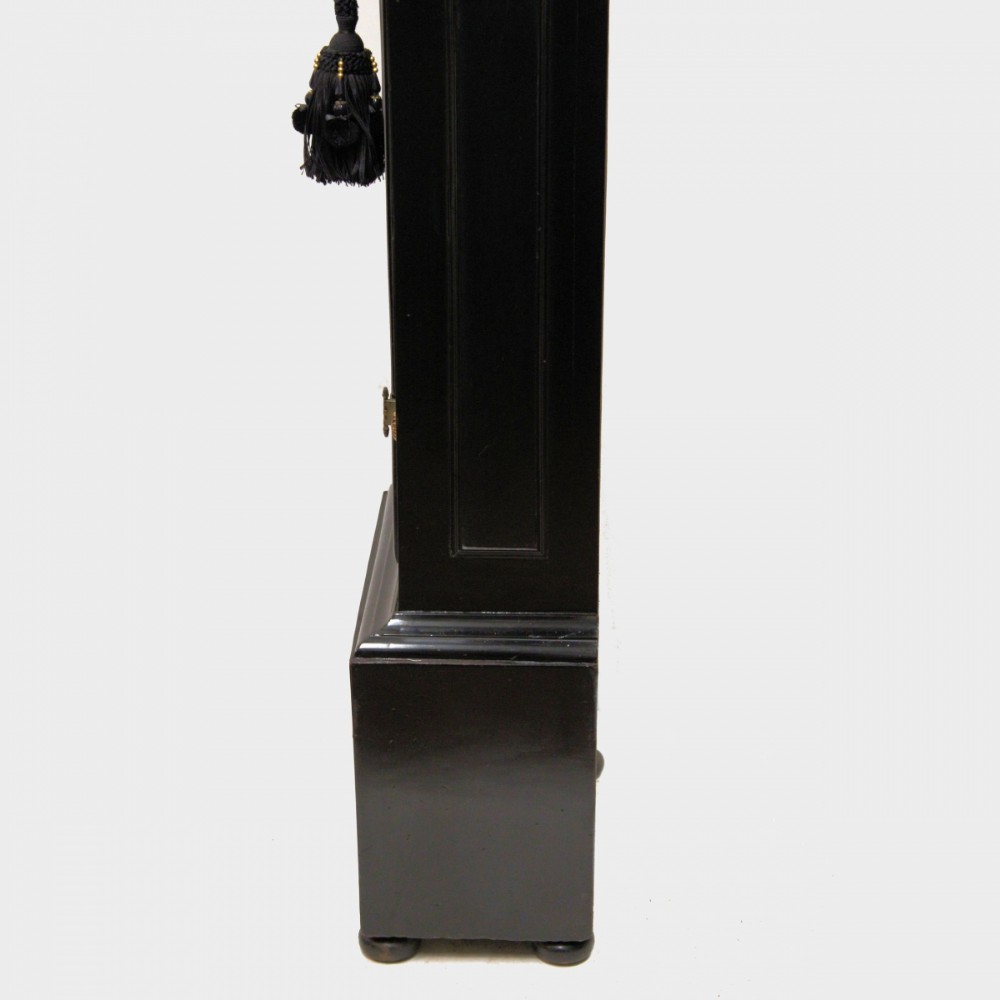
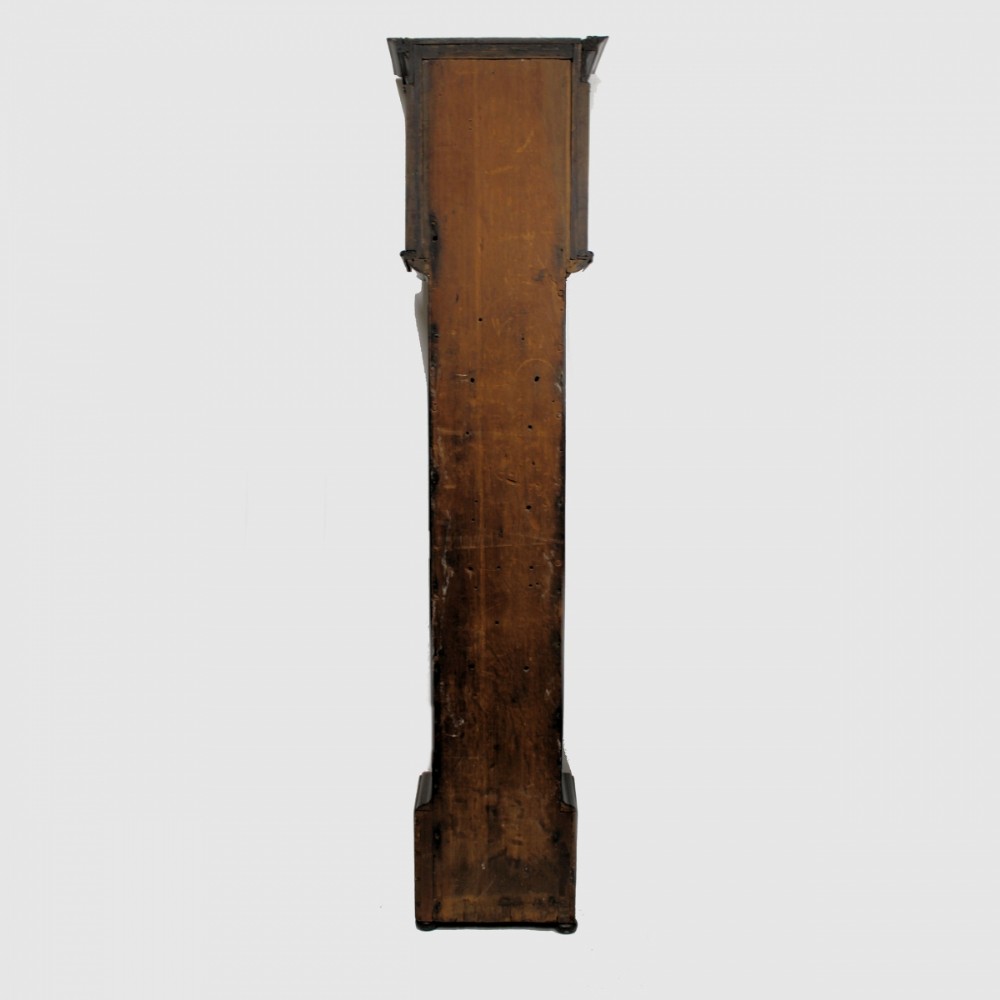
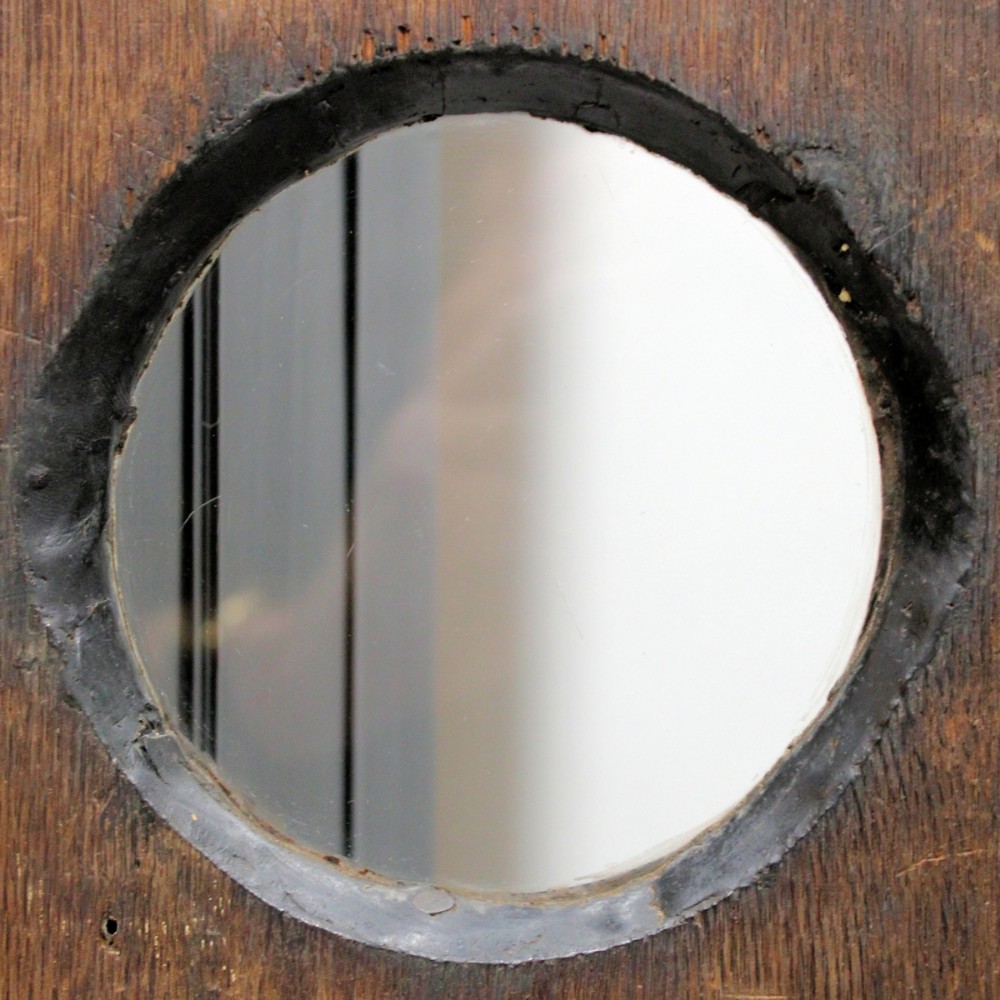
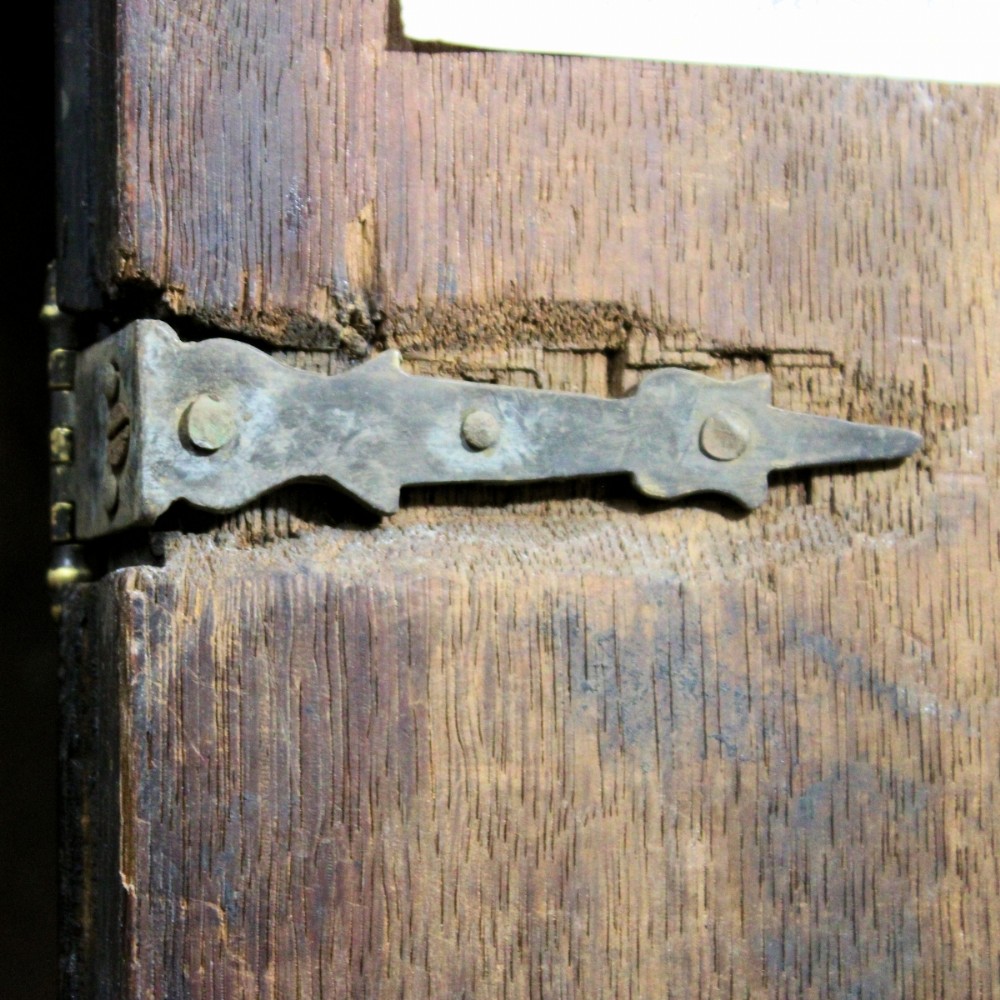
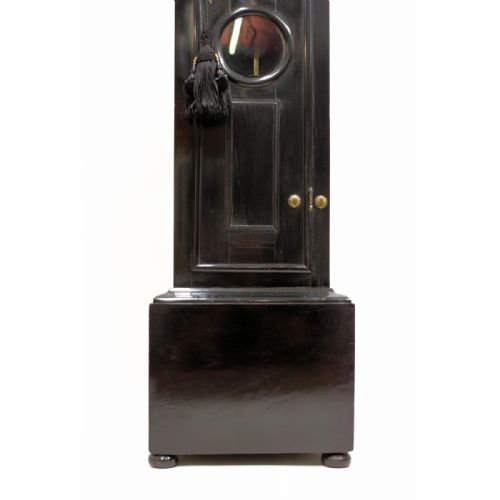
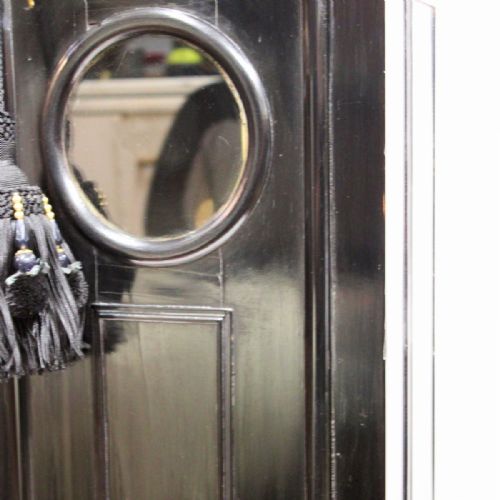
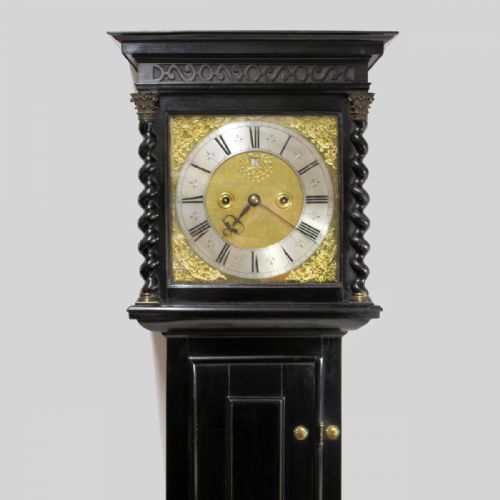
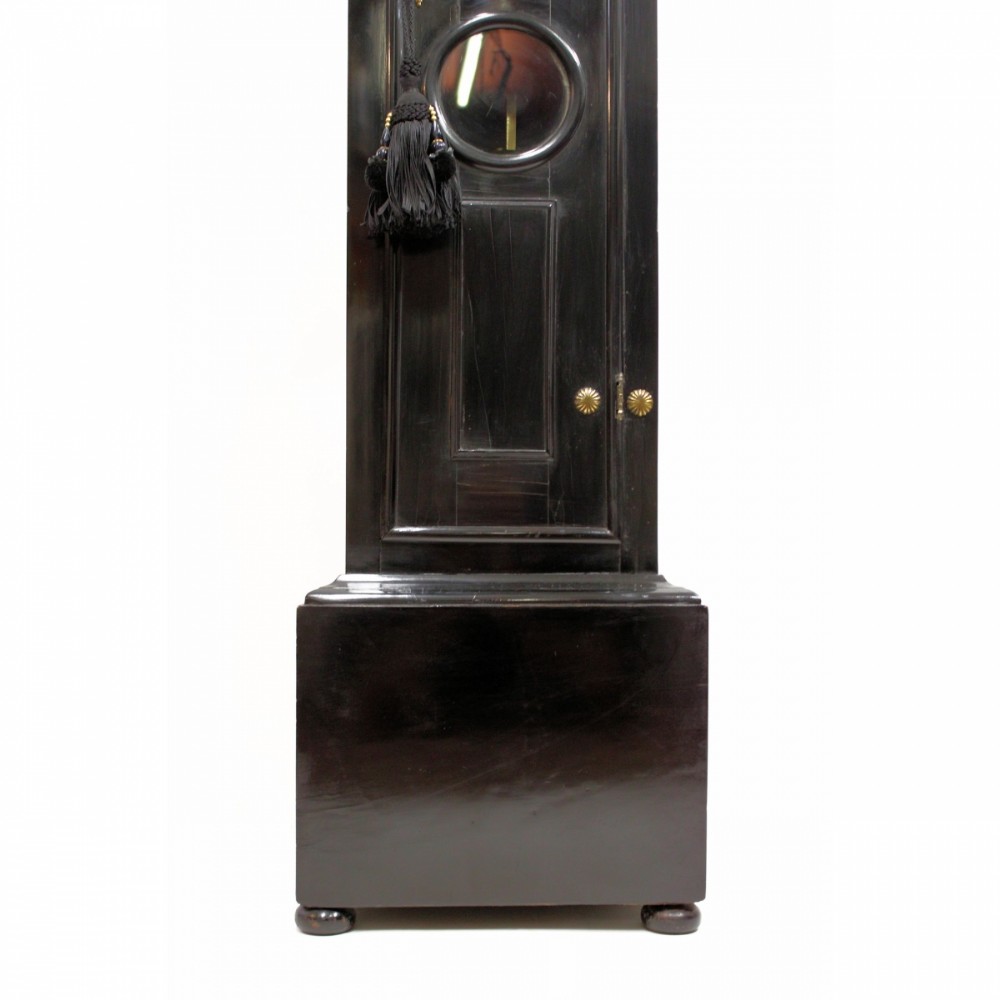
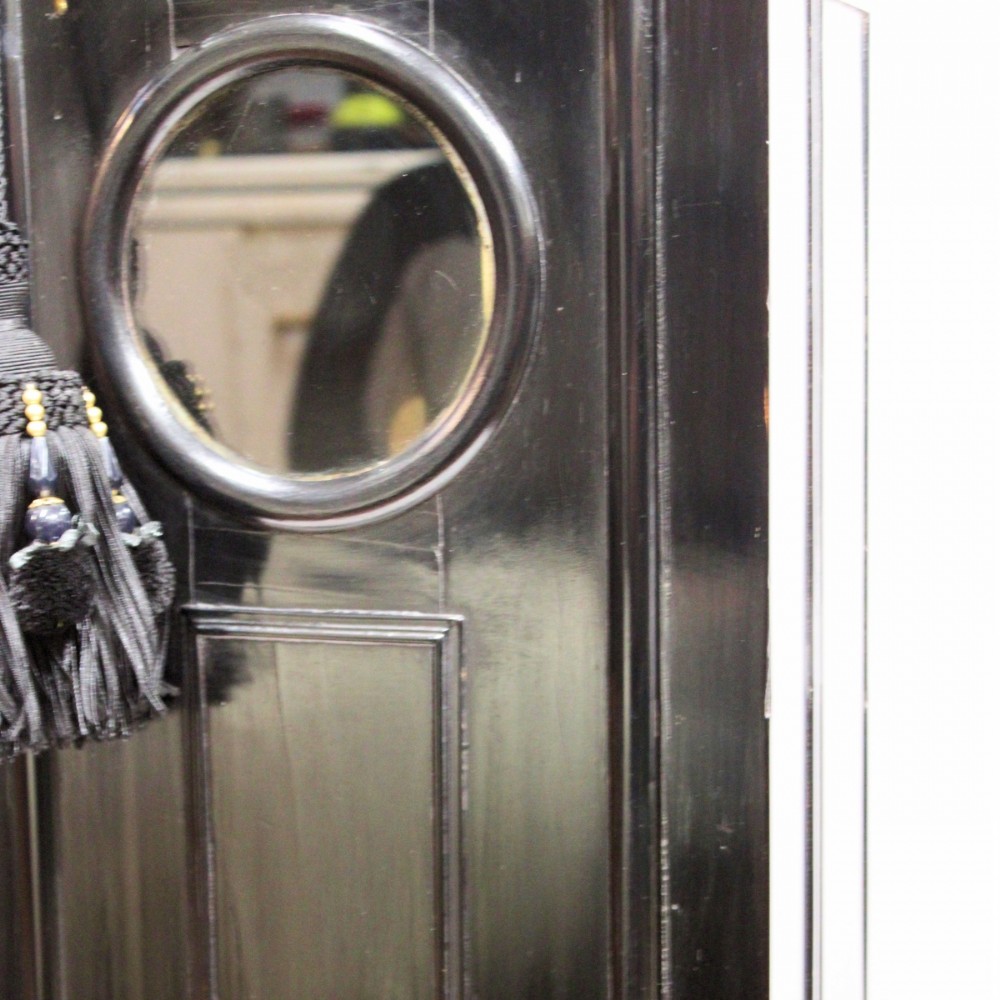
The extremely heavy case is classed as 'panelled ebony' with an oak carcass, thick ebony veneer and ebonised areas. The rising hood has a flat top with a small moulding over a 'drip ledge'. There is a further small moulding over a classic 'Knibb style' blind sound fret to the front. The front is fixed and glazed with integral barley-twist columns, these have cast brass Corinthian top capitals and Doric lower capitals, this is repeated in quarters to the rear again flat ears. The sides have high, framed and glazed viewing apertures. The hood sits upon a large convex moulding that in turn is upon a small moulding. The trunk has a full-length door that is panelled, edged with a half-round moulding and has a circular and glazed lenticle also with half-round moulding. The keyhole has an ornate brass escutcheon and the hinges are flanked with extremely rare brass rosettes (see page 77 in Tom Robinson's book 'The Longcase Clock'). The sides of the trunk are also panelled and the plain plinth has a contradictory top moulding and sits upon four bun feet. The thick oak backboard has several fixing holes and continues all the way to the bottom.
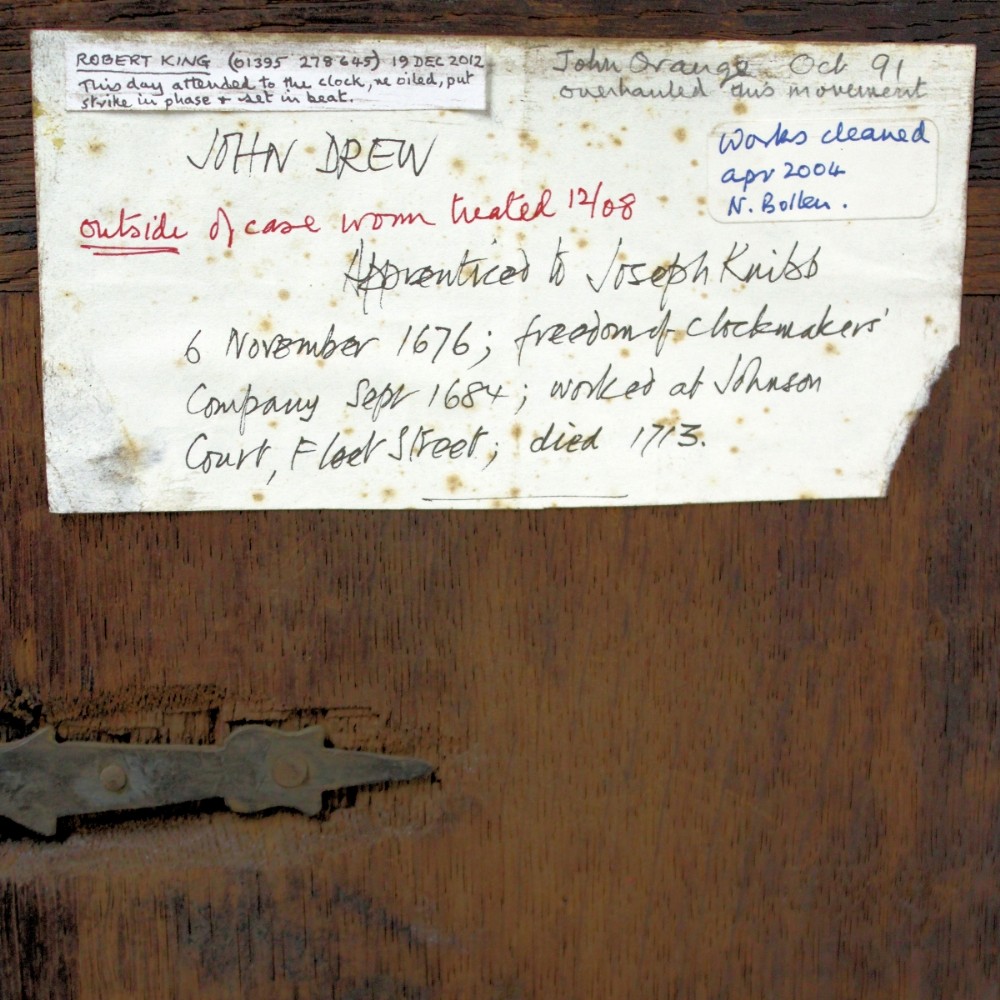
John Drew was apprenticed to the famous clockmaker Joseph Knibb of London in September 1676. He was freed in September 1684 when his address is recorded as Johnson Court in Fleet Street. He was appointed to the position of Beadle in the Clockmakers Company in April 1712 with a duty to keep order during meetings. The position of beadle was often given to members in poor health or in some financial difficulty being a paid position. John Drew received charitable payments from the Clockmakers Company from January 1713 until he died in the autumn of that year, just two years after his Master, Joseph Knibb.
This example of Drew's work is exceptionally good, the movement closely resembles that of Knibb as one would expect and the case must have been made by Knibb's casemaker because of its construction and general appearance. The most important fact of this clock in my mind is that in over 325 years it has never been poorly repaired or maintained. I have restored over 2,000 longcase clocks to date and I have never seen or expected to see an early example that has not been 'botched'. The incredible condition of this clock is very important and should not be understated. If clocks ever attain the value of fine paintings by old masters, this example will be a long way up the list - it is truly a 'purest collector's' clock.
Condition: The movement is very original and well-maintained. The escapement has been replaced probably due to wear as has the pendulum suspension assembly. The datework is orginal as are the rest of the parts and it is all in full working order. However, it has been several years since receiving maintenance and would benefit from an overhaul. This clock has never had damaging or inferior work carried out on it.

For further information please contact us at

info@bournemouthclocks.co.uk

Physical Dimensions
Height
191.4cm (75.35")
Width
45.1cm (17.76")
Depth
24.8cm (9.76")
Declaration

M. C. Taylor has dated this Antique Ebony Longcase Clock to the 17th Century.

Reference Numbers
Sellingantiques Reference
SA923001
Dealers Internal Reference
SA14432
Description
This is an outstanding example of a small, early longcase clock in 'Museum condition'.

Movement.

Tall, eight day duration, 5 shaped pillars and being partially latched.

Having an Anchor Recoil escapement and outside, crossed-out countwheel striking the hours on a large top-mounted bell.
M. C. Taylor

Also having an early 'upside down' backcock. The weights are brass-cased.

fig 1. A late 17th-century ebonised longcase clock with a square brass dial, barley twist columns, and a panelled trunk door.
fig 1. A Fine and Early English, Panelled Ebony Longcase Clock by John Drew, London. Circa 1685. (Long Case)

Dial.

Square, 11" brass dial with well-cast elaborated winged putti corner spandrels, a finely matted centre with ringed winding holes and an upside down curved and chamfered edged square calendar aperture, this has scrollwork engraving surrounding it. The silvered chapter ring has an outer divided minute track with small Arabic 5's, Roman hour numerals, half hour cruciform divisions and an inner quarter track. There is floral engraving between the spandrels and the bottom space bears the maker's signature "John Drew, Londini fecit". The very fine and blued steel hands extremely precise and sit beautifully.

fig 2. A late 17th-century ebonised longcase clock with a square brass dial, barley twist columns, and a panelled trunk door.
fig 2. A Fine and Early English, Panelled Ebony Longcase Clock by John Drew, London. Circa 1685. (Long Case)

Case.

The extremely heavy case is classed as 'panelled ebony' with an oak carcass, thick ebony veneer and ebonised areas. The rising hood has a flat top with a small moulding over a 'drip ledge'. There is a further small moulding over a classic 'Knibb style' blind sound fret to the front. The front is fixed and glazed with integral barley-twist columns, these have cast brass Corinthian top capitals and Doric lower capitals, this is repeated in quarters to the rear again flat ears. The sides have high, framed and glazed viewing apertures. The hood sits upon a large convex moulding that in turn is upon a small moulding. The trunk has a full-length door that is panelled, edged with a half-round moulding and has a circular and glazed lenticle also with half-round moulding. The keyhole has an ornate brass escutcheon and the hinges are flanked with extremely rare brass rosettes (see page 77 in Tom Robinson's book 'The Longcase Clock'). The sides of the trunk are also panelled and the plain plinth has a contradictory top moulding and sits upon four bun feet. The thick oak backboard has several fixing holes and continues all the way to the bottom.

fig 3. A late 17th-century ebonised longcase clock with a square brass dial, barley twist columns, and a panelled trunk door.
fig 3. A Fine and Early English, Panelled Ebony Longcase Clock by John Drew, London. Circa 1685. (Long Case)

John Drew was apprenticed to the famous clockmaker Joseph Knibb of London in September 1676. He was freed in September 1684 when his address is recorded as Johnson Court in Fleet Street. He was appointed to the position of Beadle in the Clockmakers Company in April 1712 with a duty to keep order during meetings. The position of beadle was often given to members in poor health or in some financial difficulty being a paid position. John Drew received charitable payments from the Clockmakers Company from January 1713 until he died in the autumn of that year, just two years after his Master, Joseph Knibb.

fig 4. A late 17th-century ebonised longcase clock with a square brass dial, barley twist columns, and a panelled trunk door.
fig 4. A Fine and Early English, Panelled Ebony Longcase Clock by John Drew, London. Circa 1685. (Long Case)

This example of Drew's work is exceptionally good, the movement closely resembles that of Knibb as one would expect and the case must have been made by Knibb's casemaker because of its construction and general appearance. The most important fact of this clock in my mind is that in over 325 years it has never been poorly repaired or maintained. I have restored over 2,000 longcase clocks to date and I have never seen or expected to see an early example that has not been 'botched'. The incredible condition of this clock is very important and should not be understated. If clocks ever attain the value of fine paintings by old masters, this example will be a long way up the list - it is truly a 'purest collector's' clock.

fig 5. A late 17th-century ebonised longcase clock with a square brass dial, barley twist columns, and a panelled trunk door.
fig 5. A Fine and Early English, Panelled Ebony Longcase Clock by John Drew, London. Circa 1685. (Long Case)

Condition: The movement is very original and well-maintained. The escapement has been replaced probably due to wear as has the pendulum suspension assembly. The datework is orginal as are the rest of the parts and it is all in full working order. However, it has been several years since receiving maintenance and would benefit from an overhaul. This clock has never had damaging or inferior work carried out on it.

For further information please contact us at

info@bournemouthclocks.co.uk

Height
191.4cm (75.35")
Width
45.1cm (17.76")
Depth
24.8cm (9.76")
Date of Manufacture

M. C. Taylor has dated this Antique Ebony Longcase Clock to the 17th Century.

Reference Numbers
Sellingantiques Ref
SA923001
Dealers Internal Ref
SA14432
M. C. Taylor
M. C. Taylor
Sellingantiques verified Since Oct 2021

Clockmakers and restorers established 1987

Dealer Profile

You can view the stock and full dealer information on the M. C. Taylor Profile Page

PDF SHARE
SAVE
A late 17th-century ebonised longcase clock with a square brass dial, barley twist columns, and a panelled trunk door.
1 / 19
Archive I A late 17th-century ebonised longcase clock with a square brass dial, barley twist columns, and a panelled trunk door.

A Fine and Early English, Panelled Ebony Longcase Clock by John Drew, London. Circa 1685. (Long Case)
Archive II A late 17th-century ebonised longcase clock with a square brass dial, barley twist columns, and a panelled trunk door. View II
Archive III A late 17th-century ebonised longcase clock with a square brass dial, barley twist columns, and a panelled trunk door. View III
Archive IV A late 17th-century ebonised longcase clock with a square brass dial, barley twist columns, and a panelled trunk door. View IV
Archive V A late 17th-century ebonised longcase clock with a square brass dial, barley twist columns, and a panelled trunk door. View V
Archive VI A late 17th-century ebonised longcase clock with a square brass dial, barley twist columns, and a panelled trunk door. View VI
Archive VII A late 17th-century ebonised longcase clock with a square brass dial, barley twist columns, and a panelled trunk door. View VII
Archive VIII A late 17th-century ebonised longcase clock with a square brass dial, barley twist columns, and a panelled trunk door. View VIII
Archive IX A late 17th-century ebonised longcase clock with a square brass dial, barley twist columns, and a panelled trunk door. View IX
Archive X A late 17th-century ebonised longcase clock with a square brass dial, barley twist columns, and a panelled trunk door. View X
Archive XI A late 17th-century ebonised longcase clock with a square brass dial, barley twist columns, and a panelled trunk door. View XI
Archive XII A late 17th-century ebonised longcase clock with a square brass dial, barley twist columns, and a panelled trunk door. View XII
Archive XIII A late 17th-century ebonised longcase clock with a square brass dial, barley twist columns, and a panelled trunk door. View XIII
Archive XIV A late 17th-century ebonised longcase clock with a square brass dial, barley twist columns, and a panelled trunk door. View XIV
Archive XV A late 17th-century ebonised longcase clock with a square brass dial, barley twist columns, and a panelled trunk door. View XV
Archive XVI A late 17th-century ebonised longcase clock with a square brass dial, barley twist columns, and a panelled trunk door. View XVI
Archive XVII A late 17th-century ebonised longcase clock with a square brass dial, barley twist columns, and a panelled trunk door. View XVII
Archive XVIII A late 17th-century ebonised longcase clock with a square brass dial, barley twist columns, and a panelled trunk door. View XVIII
Archive XIX A late 17th-century ebonised longcase clock with a square brass dial, barley twist columns, and a panelled trunk door. View XIX
Enlarged Archival View
Telephone 01202 429718
Location
995 Christchurch Road
Bournemouth
Dorset
BH7 6BB
United Kingdom
Verified Since Oct 2021
Items For Sale 68
Items Sold 139
M. C. Taylor
M. C. Taylor
Verified Since Oct 2021
View Dealer Info
Location: 995 Christchurch Road, Bournemouth, Dorset, BH7 6BB, United Kingdom
Verified
Oct 2021
For Sale
68
Sold
139
A late 17th-century ebonised longcase clock with a square brass dial, barley twist columns, and a panelled trunk door.
A FINE AND EARLY ENGLISH, PANELLED EBONY LONGCASE CLOCK BY JOHN DREW, LONDON. CIRCA 1685. (LONG CASE)
Ref: SA923001
A late 17th-century ebonised longcase clock with a square brass dial, barley twist columns, and a panelled trunk door.
Detail View 1
Detail View 2
Detail View 3
Detail View 4
Detail View 5
Detail View 6
Detail View 7
Detail View 8
Detail View 9
Detail View 10
Detail View 11
Detail View 12
Detail View 13
Detail View 14
Detail View 15
Detail View 16
Detail View 17
Detail View 18
Archival Detail
Every single antique dealer on our platform is individually approved by our internal team. We verify their professional trade history, ethical standards, and photographic quality to ensure a secure, high-standard buying environment. Upon joining, every dealer agrees to a strict 9-point code of conduct. While issues can occasionally arise, our dealers typically resolve them swiftly and directly with the buyer. In fact, since our founding in 2002, Sellingantiques has only had to step in to help resolve an issue on roughly five occasions—a true testament to the quality of our dealers and their dedication to your happiness.
Our dealers are highly experienced in packing and shipping fragile, high-value antiques. Because you are in direct contact with the dealer, you will be able to easily go through all available shipping and insurance options together to ensure your item arrives safely.
Antiques are the ultimate green purchase. By choosing historical pieces over newly manufactured goods, you completely eliminate the carbon footprint of modern mass production while preserving exceptional, timeless craftsmanship.

Longcase clocks from the Restoration period (circa 16601700) typically feature slim architectural proportions, square brass dials, spandrels at the corners, and hoods framed by turned barley-twist columns. Cases were frequently crafted from ebonised fruitwood, walnut, or precious veneers such as ebony.

Early longcase clocks were constructed using oak carcass wood veneered in native walnut, imported ebony, or ebonised woods. The movements were hand-forged from brass and iron, featuring engraved brass dials and cast brass spandrels.

Authentic 17th-century longcase clocks usually feature a small square brass dial (often 10 to 11 inches across), a narrow trunk, a lenticle glass window in the door to view the pendulum, latching movements, and early spandrel designs such as single cherub heads.

A dark ebonised longcase clock creates visual structure in an entryway, formal hallway, or library. Placing the clock against pale architectural plasterwork or alongside contemporary minimalist artwork creates a sophisticated juxtaposition of eras.

The clock case should be kept away from direct heat sources and maintained at stable humidity levels to prevent wood shrinkage. The mechanical movement requires professional horological servicing and lubrication every five to seven years.
items
Add keywords to the filter
Price
£100
£250000
Era
Movements
Material
Origin
Stock Location
Freshness
Online Payments
Categories