32,837  PAGES BROWSED TODAY PAGES TODAY • 145 ANTIQUES UPLOADED TODAYNEW ARRIVALS
GIFTS
145 ITEMS ADDED TODAY
Sort Order
Items Per Page
Antiques dealer?
Join as a Seller
Browse Categories
Sort order
Relevant Links
Items per page
sold SA772814
Sorry, but this item has been sold.
Regent Antiques

Regent Antiques

Sellingantiques Verified Since Sep 2016
Browse dealers 639 items
  • About Us
    We specialise in english and continental furniture, silver, porcelain and decorative items.
  • Trade Associations
    Regent Antiques is a registered member of LAPADA  CINOA
Id #SA772814
SHARE
SAVE

Antique Pair French Ormolu Mounted Bleu Celeste Sevres Vases 19th C

19th century
Sold 5 January 2026 · Regent Antiques
This “Antique Pair French Ormolu Mounted Bleu Celeste Sevres Vases 19th C ” found a buyer.

It was listed by Regent Antiques. Sold pieces stay on Sellingantiques as a record of what has passed through, and the next one is rarely far away.

Description

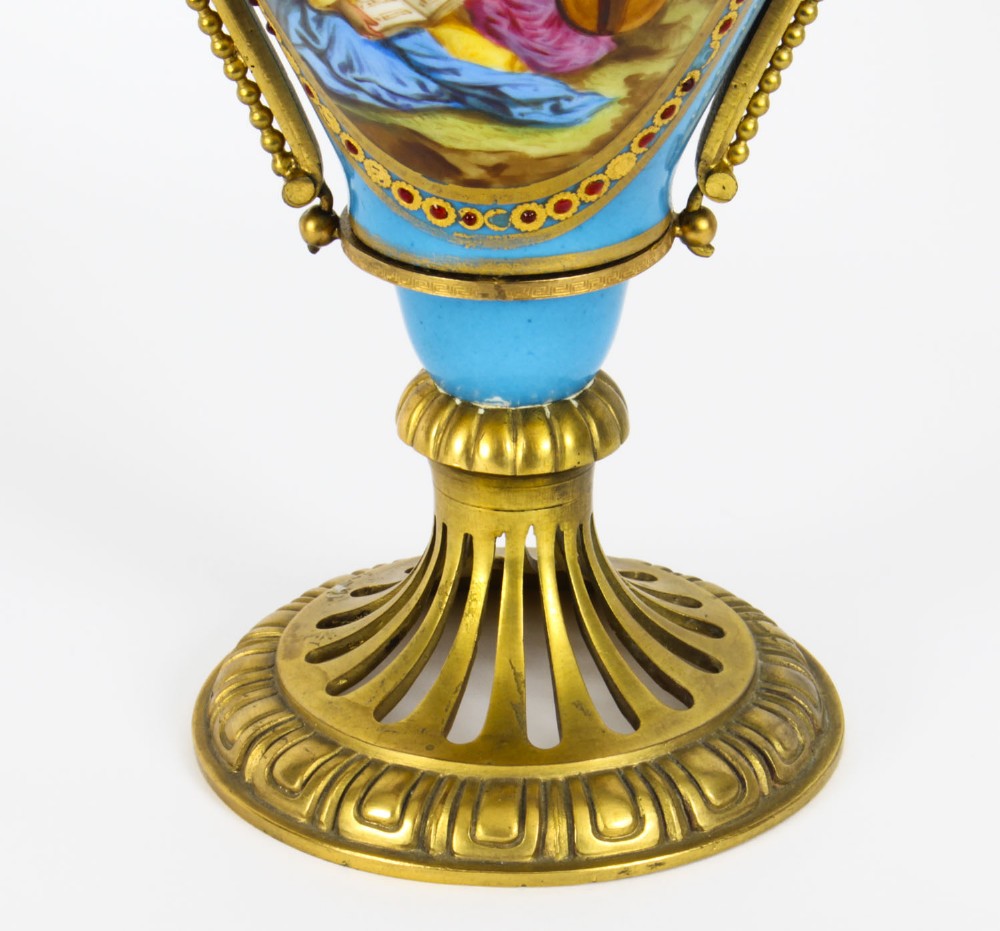
This is a beautiful antique pair of French Louis Revival Sevres "Bleu Celeste" porcelain and ormolu mounted twin handled vases, Circa 1880 in date.

They are superbly decorated in the Sevres manner with hand painted floral bouquets on one side and ovals with figures on the other. The porcelain with gilded decoration the vases are raised on stunning pierced ormolu bases.

They are delightful objects which will look superb in any surroundings.

Condition:

In excellent condition with no chips or damage, please see photos for confirmation.

Dimensions in cm:

Height 28 x Width 13 x Depth 10

Dimensions in inches:

Height 11.0 x Width 5.1 x Depth 3.9

Sevres Porcelain traces its roots in France to early craftsmen who had small manufacturing operations in such places as Lille, Rouen. St. Cloud, and most notably Chantilly. It is from Chantilly that a cadre of workers migrated to the Chateau de Vincennes near Paris to form a larger porcelain manufactory in 1738.

French King Louis XV, perhaps inspired by his rumoured relationship with mistress Madame de Pompadour, took an intense interest in porcelain and moved the operation in 1756 to even larger quarters in the Paris suburb of Sevres. Sevres was also conveniently near the home of Madame de Pompadour and the King's own Palace at Versailles.

From the outset the king's clear aim was to produce Sevres Porcelain that surpassed the established Saxony works of Meissen and Dresden. Though the French lacked an ample supply of kaolin, a required ingredient for hard-paste porcelain (pate dure), their soft-paste porcelain (pate tendre) was fired at a lower temperature and was thus compatible with a wider variety of colours and glazes that in many cases were also richer and more vivid. Unglazed white Sevres Porcelain "biscuit" figurines were also a great success. However, soft-paste Sevres Porcelain was more easily broken. Therefore, early pieces of Sevres Porcelain that remain intact have become rare indeed.

The Sevres Porcelain manufactory always seemed to be in dire financial straits despite the incredibly fine works it produced. In fact, the king's insistence that only the finest items be created may have contributed to the difficulties. Only a limited number of European nobility could afford the extravagant prices demanded for such works. King Louis XV and eventually his heir, the ill-fated Louis XVI, were obliged to invest heavily in the enterprise. Ultimately, the Sevres Porcelain Factory produced items under the name of "Royal" and thus the well-known Sevres mark was born. King Louis XV even mandated laws that severely restricted other porcelain production in France so as to retain a near monopoly for his Sevres Porcelain. The king even willingly became chief salesman for the finest of his products, hosting an annual New Year's Day showing for French nobility in his private quarters at Versailles. He eagerly circulated among potential buyers, pitching the merits of ownership and policing the occasional light-fingered guest.

Sevres Porcelain may have indeed given the makers of Meissen and Dresden a run for their money by the end of the 18th Century but for the French Revolution. By 1800, the Sevres Porcelain Works were practically out of business due to the economic devastation of the new French Republic.

About the time when Napoleon Bonaparte named himself Emperor of France (1804), a new director was named for the Sevres Porcelain Manufactory. Alexandre Brongniart, highly educated in many fields, resurrected Sevres Porcelain. Soft-paste porcelain was eliminated altogether thanks to the earlier discovery of kaolin near Limoges. For four decades until his death, Brongniart presided over monumental progress for Sevres Porcelain, catering not only to Napoleon himself, but at last to include the more financially profitable mid-priced market in the emerging

Date of Manufacture

Regent Antiques has dated these French Ormolu Sevres Vases to the 19th Century.

Physical Dimensions
Height
28cm (11.02")
Width
13cm (5.12")
Depth
10cm (3.94")
Reference Numbers
Sellingantiques Reference
SA772814
Dealers Internal Reference
A1699
A pair of nineteenth-century French porcelain vases in bright blue with hand-painted pastoral scenes and ornate gilt bronze ormolu mounts against a plain background.Detail view 1Detail view 2Detail view 3Detail view 4Detail view 5Detail view 6Detail view 7Detail view 8Detail view 9Detail view 10Detail view 11Detail view 12Detail view 13Detail view 14Detail view 15Detail view 16Detail view 17Detail view 18
SOLD6+ MONTHS AGO
1 / 19
19th Century · SA772814
Antique Pair French Ormolu Mounted Bleu Celeste Sevres Vases 19th C
Sorry, but this item has been sold.
Description
This is a beautiful antique pair of French Louis Revival Sevres "Bleu Celeste" porcelain and ormolu mounted twin handled vases, Circa 1880 in date.

They are superbly decorated in the Sevres manner with hand painted floral bouquets on one side and ovals with figures on the other. The porcelain with gilded decoration the vases are raised on stunning pierced ormolu bases.

They are delightful objects which will look superb in any surroundings.

Condition:

In excellent condition with no chips or damage, please see photos for confirmation.

Dimensions in cm:

Height 28 x Width 13 x Depth 10

Dimensions in inches:

Height 11.0 x Width 5.1 x Depth 3.9

Sevres Porcelain traces its roots in France to early craftsmen who had small manufacturing operations in such places as Lille, Rouen. St. Cloud, and most notably Chantilly. It is from Chantilly that a cadre of workers migrated to the Chateau de Vincennes near Paris to form a larger porcelain manufactory in 1738.

French King Louis XV, perhaps inspired by his rumoured relationship with mistress Madame de Pompadour, took an intense interest in porcelain and moved the operation in 1756 to even larger quarters in the Paris suburb of Sevres. Sevres was also conveniently near the home of Madame de Pompadour and the King's own Palace at Versailles.

From the outset the king's clear aim was to produce Sevres Porcelain that surpassed the established Saxony works of Meissen and Dresden. Though the French lacked an ample supply of kaolin, a required ingredient for hard-paste porcelain (pate dure), their soft-paste porcelain (pate tendre) was fired at a lower temperature and was thus compatible with a wider variety of colours and glazes that in many cases were also richer and more vivid. Unglazed white Sevres Porcelain "biscuit" figurines were also a great success. However, soft-paste Sevres Porcelain was more easily broken. Therefore, early pieces of Sevres Porcelain that remain intact have become rare indeed.

The Sevres Porcelain manufactory always seemed to be in dire financial straits despite the incredibly fine works it produced. In fact, the king's insistence that only the finest items be created may have contributed to the difficulties. Only a limited number of European nobility could afford the extravagant prices demanded for such works. King Louis XV and eventually his heir, the ill-fated Louis XVI, were obliged to invest heavily in the enterprise. Ultimately, the Sevres Porcelain Factory produced items under the name of "Royal" and thus the well-known Sevres mark was born. King Louis XV even mandated laws that severely restricted other porcelain production in France so as to retain a near monopoly for his Sevres Porcelain. The king even willingly became chief salesman for the finest of his products, hosting an annual New Year's Day showing for French nobility in his private quarters at Versailles. He eagerly circulated among potential buyers, pitching the merits of ownership and policing the occasional light-fingered guest.

Sevres Porcelain may have indeed given the makers of Meissen and Dresden a run for their money by the end of the 18th Century but for the French Revolution. By 1800, the Sevres Porcelain Works were practically out of business due to the economic devastation of the new French Republic.

About the time when Napoleon Bonaparte named himself Emperor of France (1804), a new director was named for the Sevres Porcelain Manufactory. Alexandre Brongniart, highly educated in many fields, resurrected Sevres Porcelain. Soft-paste porcelain was eliminated altogether thanks to the earlier discovery of kaolin near Limoges. For four decades until his death, Brongniart presided over monumental progress for Sevres Porcelain, catering not only to Napoleon himself, but at last to include the more financially profitable mid-priced market in the emerging
Date19th Century
Height28cm (11.02")
Width13cm (5.12")
Depth10cm (3.94")
ReferenceSA772814
Dealer's referenceA1699
Regent Antiques
Regent AntiquesSellingantiques verified since Sep 2016

We specialise in english and continental furniture, silver, porcelain and decorative items.

Member of LAPADA CINOA

SHARE
SAVE
Archive I A pair of nineteenth-century French porcelain vases in bright blue with hand-painted pastoral scenes and ornate gilt bronze ormolu mounts against a plain background. SOLD6+ MONTHS AGO

Antique Pair French Ormolu Mounted Bleu Celeste Sevres Vases 19th C

Archive II A pair of nineteenth-century French porcelain vases in bright blue with hand-painted pastoral scenes and ornate gilt bronze ormolu mounts against a plain background. View II
Archive III A pair of nineteenth-century French porcelain vases in bright blue with hand-painted pastoral scenes and ornate gilt bronze ormolu mounts against a plain background. View III
Archive IV A pair of nineteenth-century French porcelain vases in bright blue with hand-painted pastoral scenes and ornate gilt bronze ormolu mounts against a plain background. View IV
Archive V A pair of nineteenth-century French porcelain vases in bright blue with hand-painted pastoral scenes and ornate gilt bronze ormolu mounts against a plain background. View V
Archive VI A pair of nineteenth-century French porcelain vases in bright blue with hand-painted pastoral scenes and ornate gilt bronze ormolu mounts against a plain background. View VI
Archive VII A pair of nineteenth-century French porcelain vases in bright blue with hand-painted pastoral scenes and ornate gilt bronze ormolu mounts against a plain background. View VII
Archive VIII A pair of nineteenth-century French porcelain vases in bright blue with hand-painted pastoral scenes and ornate gilt bronze ormolu mounts against a plain background. View VIII
Archive IX A pair of nineteenth-century French porcelain vases in bright blue with hand-painted pastoral scenes and ornate gilt bronze ormolu mounts against a plain background. View IX
Archive X A pair of nineteenth-century French porcelain vases in bright blue with hand-painted pastoral scenes and ornate gilt bronze ormolu mounts against a plain background. View X
Archive XI A pair of nineteenth-century French porcelain vases in bright blue with hand-painted pastoral scenes and ornate gilt bronze ormolu mounts against a plain background. View XI
Archive XII A pair of nineteenth-century French porcelain vases in bright blue with hand-painted pastoral scenes and ornate gilt bronze ormolu mounts against a plain background. View XII
Archive XIII A pair of nineteenth-century French porcelain vases in bright blue with hand-painted pastoral scenes and ornate gilt bronze ormolu mounts against a plain background. View XIII
Archive XIV A pair of nineteenth-century French porcelain vases in bright blue with hand-painted pastoral scenes and ornate gilt bronze ormolu mounts against a plain background. View XIV
Archive XV A pair of nineteenth-century French porcelain vases in bright blue with hand-painted pastoral scenes and ornate gilt bronze ormolu mounts against a plain background. View XV
Archive XVI A pair of nineteenth-century French porcelain vases in bright blue with hand-painted pastoral scenes and ornate gilt bronze ormolu mounts against a plain background. View XVI
Archive XVII A pair of nineteenth-century French porcelain vases in bright blue with hand-painted pastoral scenes and ornate gilt bronze ormolu mounts against a plain background. View XVII
Archive XVIII A pair of nineteenth-century French porcelain vases in bright blue with hand-painted pastoral scenes and ornate gilt bronze ormolu mounts against a plain background. View XVIII
Archive XIX A pair of nineteenth-century French porcelain vases in bright blue with hand-painted pastoral scenes and ornate gilt bronze ormolu mounts against a plain background. View XIX
Enlarged Archival View
Location
Manor Warehouse
318 Green Lanes
London
N4 1BX
United Kingdom
Verified Since Sep 2016
Items For Sale 639
Items Sold 2,756
Regent Antiques
Regent Antiques
Verified Since Sep 2016
View Dealer Info
Location: Manor Warehouse, 318 Green Lanes, London, N4 1BX, United Kingdom
Verified
Sep 2016
For Sale
639
Sold
2,756
A pair of nineteenth-century French porcelain vases in bright blue with hand-painted pastoral scenes and ornate gilt bronze ormolu mounts against a plain background.
Antique Pair French Ormolu Mounted Bleu Celeste Sevres Vases 19th C
Ref: SA772814
A pair of nineteenth-century French porcelain vases in bright blue with hand-painted pastoral scenes and ornate gilt bronze ormolu mounts against a plain background.
Detail View 1
Detail View 2
Detail View 3
Detail View 4
Detail View 5
Detail View 6
Detail View 7
Detail View 8
Detail View 9
Detail View 10
Detail View 11
Detail View 12
Detail View 13
Detail View 14
Detail View 15
Detail View 16
Detail View 17
Detail View 18
Archival Detail
Every single antique dealer on our platform is individually approved by our internal team. We verify their professional trade history, ethical standards, and photographic quality to ensure a secure, high-standard buying environment. Upon joining, every dealer agrees to a strict 9-point code of conduct. While issues can occasionally arise, our dealers typically resolve them swiftly and directly with the buyer. In fact, since our founding in 2002, Sellingantiques has only had to step in to help resolve an issue on roughly five occasions—a true testament to the quality of our dealers and their dedication to your happiness.
Our dealers are highly experienced in packing and shipping fragile, high-value antiques. Because you are in direct contact with the dealer, you will be able to easily go through all available shipping and insurance options together to ensure your item arrives safely.
Antiques are the ultimate green purchase. By choosing historical pieces over newly manufactured goods, you completely eliminate the carbon footprint of modern mass production while preserving exceptional, timeless craftsmanship.
Written by Sellingantiques from the dealer’s photographs and listing
  • ObjectVases
  • Period19th century
  • StyleFrench Second Empire
  • MaterialPorcelain, Ormolu, Gilt Bronze
  • ColourBlue
  • MotifsHand-painted pastoral figures, Gilt bronze scroll handles, Chased ormolu mounts
  • SizeH 28 cm (11 in) x W 13 cm (5 in) x D 10 cm (4 in)

Sevres porcelain originated from the royal French manufactory established in the 18th century, renowned for soft-paste porcelain and distinctive colours like bleu celeste. During the 19th century, earlier pieces were often retrofitted or inspired designs were created incorporating ornate cast and gilt bronze, known as ormolu, to appeal to wealthy collectors.

These items typically combine hard or soft-paste ceramic bodies featuring hand-painted enamel figural scenes and gilding, set within cast, chased, and gilded brass or bronze mounts. The mounts are mechanically secured to the porcelain body using specialized pins, screws, or flanges.

Authentic pieces often feature underglaze blue cipher marks on the ceramic base, sometimes accompanied by decorator or gilder marks. The ormolu mounts should exhibit crisp chisel work, fine detail, and proper weight consistent with period brass casting techniques, rather than modern electroplated finishes.

These decorative objects work effectively as focal points on symmetrical mantelpieces, console tables, or enclosed display cabinets. Pairing them with understated surroundings allows the intricate gilding and painted ceramic details to stand out without visual competition.

Maintenance requires gentle dusting with a soft, dry brush to avoid abrading the delicate enamel paint and gilding. Chemical cleaners and water should be avoided on both the porous ceramic surfaces and the ormolu mounts to prevent oxidation or damage to the historical finishes.
items
Add keywords to the filter
Price
£100
£250000
Era
Period
Style
Material
Origin
Stock Location
Recently Added
Online Payments
Categories