


A 2026 Guide by Sellingantiques
Giant Rouge Marble Carriage Clock, 19th Century
Priced at £3,875 from Chalfont Clocks
Designed to replace cumbersome coaching clocks. Abraham-Louis Breguet developed the first carriage clocks in Paris around 1812.
French workshops dominated the trade throughout the nineteenth century. Production centred around Saint-Nicolas-d'Aliermont and Paris.
Look at the boom period between 1860 and 1900. Middle-class travellers demanded reliable portable timekeepers for railway journeys across Europe.
English examples are rare. Those that survive often have heavier cases and fusee movements rather than the standard French going barrel.
Paul Garnier patented the characteristic chaff-cutter escapement in 1830. His Paris workshop helped establish the standard rectangular case format.
Working in Paris from the mid-nineteenth century until roughly 1900. Henri Jacot stamped his clocks with a recognised parrot logo.
Drocourt operated between 1860 and 1900. This major French manufacturer regularly sent carriage clocks to international exhibitions.

Drocourt Striking/alarm Carriage Circa 1880, Victorian
Priced at £1,250 from Frank Craig Antiques
The 2026 retail price guide for Antique Carriage Clocks is drawn from a proprietary archive of over 1.1 million retail prices indexed by Sellingantiques since 2003. This guide relies exclusively on their own internal data; no external sources or auction records are used.
Analysing nearly 25 years of UK antique market history alongside current retail values, the data indicates that typical UK retail prices for Antique Carriage Clocks range between £500 and £3,000. Entry-level prices generally fall under £500 and premium examples upwards of £3,000.
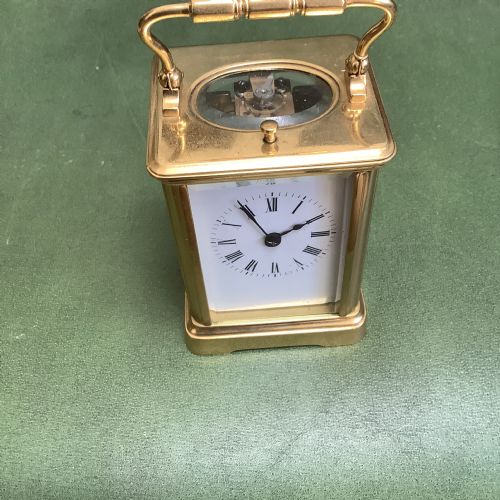
A sturdy handle sits flat on top of the case. It pivots upwards to allow easy carrying between rooms.
Look through the top window. You can watch the balance wheel oscillating on the platform escapement while the antique carriage clock runs.
Striking mechanisms often include a repeat button. Pressing it sounds the last hour again in the dark.

Antique Victorian Quality Brass Carriage Clock, 1880
Priced at £625 from London City Antiques
Early examples show extensive hand-finishing on the plates. Makers filed the brass flat before spotting or gilding the hidden surfaces.
Heating screws over brass filings blued them. This traditional process provided rust resistance alongside a distinct dark finish.
Notice the shift in case parts. They evolved from individually cast sections to mass-produced extruded brass profiles to lower production costs.
"Many basic models run for eight days on a single wind. They easily lasted a week of travel without attention."
"Original leather travelling cases sometimes survive alongside the clocks. These outer boxes often feature a sliding shutter to protect the dial glass."
"Certain high-end examples include built-in alarm mechanisms. The alarm runs off a separate small mainspring wound from the back plate."
Based on almost 25 years of Sellingantiques UK antique market data, Antique Carriage Clocks appeared 3203 times (out of 1,100,000 antiques) which gives it a rarity score of 53/100.
This score measures scarcity within the Sellingantiques archive only and is not a survey of the entire antiques market, so these statistics may not be indicative of the general availability of Antique Carriage Clocks elsewhere.
Most antique carriage clocks need winding once a week. You use the double-ended key provided, applying it to both the time and strike arbors on the back plate. Turn the key clockwise until you feel firm resistance.
Do not force it past this point. Winding on a regular schedule, like a Sunday morning, keeps the mainspring power delivery consistent.
That is the repeater button. It links to the striking mechanism inside the case. When pressed, the clock strikes the last hour on a wire gong or a bell.
Travellers used this feature at night to check the time without lighting a candle. It only works if the clock has a striking train, rather than just a basic timepiece movement.
Open the back door to locate the small square arbor. Use the smaller end of your key to move the hands forward.
Never turn them backwards on a striking clock. It jams the lifting pins.
Yes, those are bevelled glass panels. Makers cut the edges at an angle to fit securely into the rebates of the brass framework. The bevelling also catches the light and highlights the mechanical movement inside.
Finding original glass is a bonus. Replacement panels sometimes lack the precise bevel depth of the nineteenth-century originals.
Please note: This Antique Carriage Clocks guide and its associated pricing data are provided for general informational purposes only. It does not constitute formal financial, investment, or appraisal advice and should not be relied upon as the sole basis for any commercial activity, purchasing, or sales decisions. Sellingantiques.co.uk accepts no liability for any actions taken in reliance on this information. Always consult with a qualified professional or independent appraiser.
