
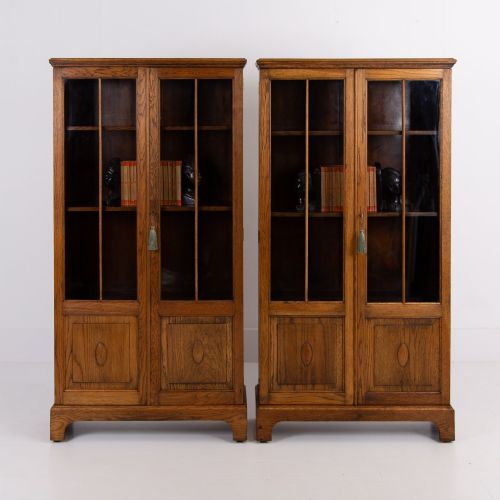
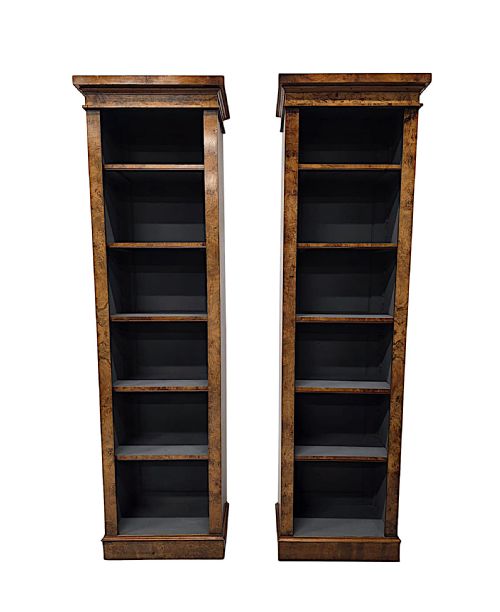
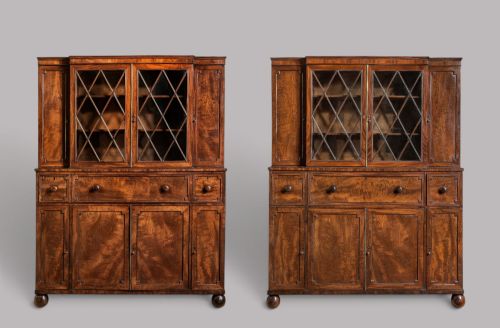
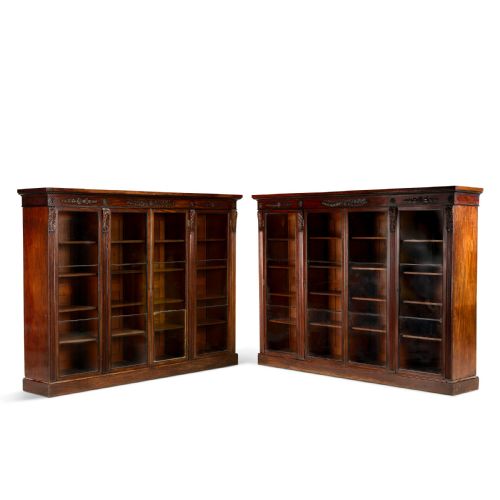





Antique Pair of Bookcases
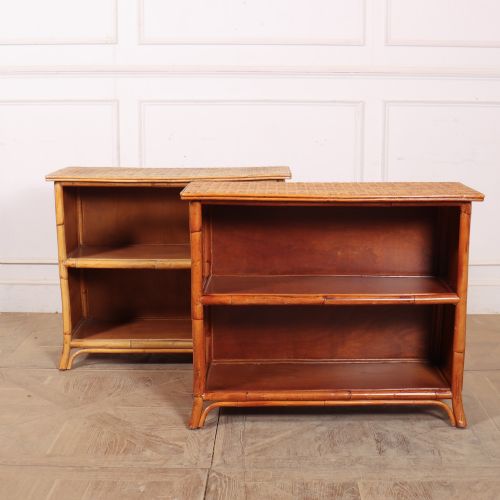
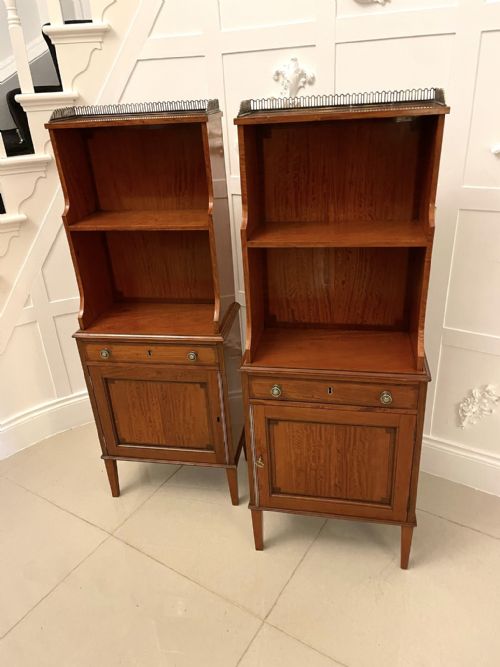
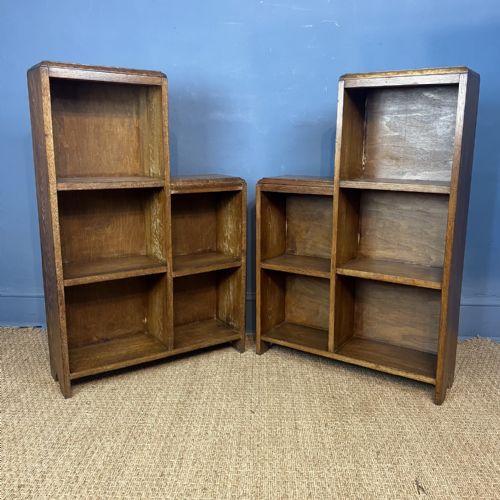
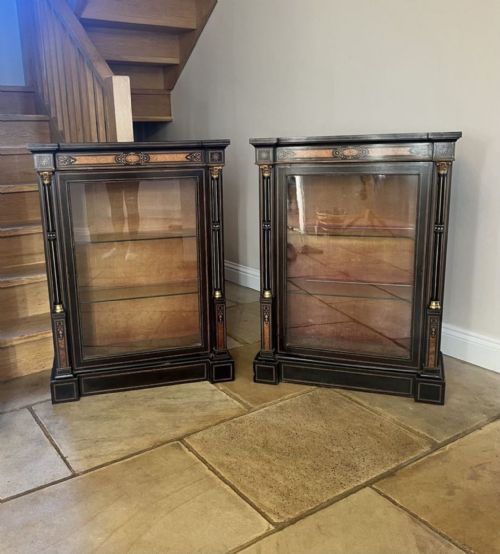
Two matching bookcases sold as one lot, made to flank a chimney breast, a door or a window in a library or living room.
What You're Looking At
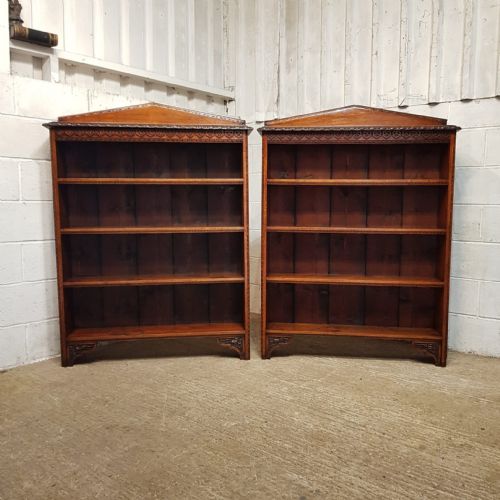
The word that dominates this category is "open": shelved cases with no doors and no glazing, in oak or mahogany, sold in twos. Open appears in 143 of 495 titles, and oak leads the timbers at 163, with mahogany at 130 and walnut at 51. That modest freestanding open pair is the version you're most likely to meet.
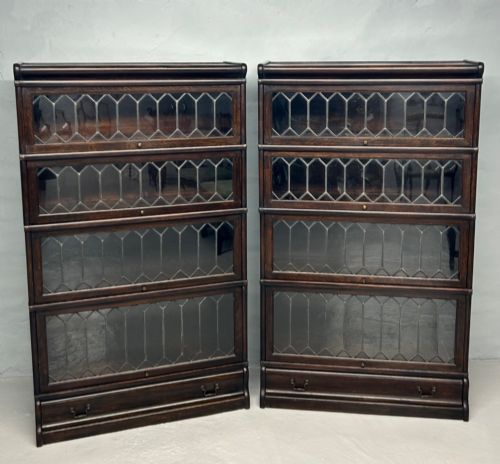
The second body of the category is the stacking sectional, better known as the barrister bookcase: separate glazed tiers built up into a tower, offered as two matching stacks. Titles quote the tier count from three up to seven, six being the most often named. These run heavily to oak.
Dating sits firmly in the early twentieth century. The 1920s is the busiest decade at 90 listings, the 1910s close behind at 80, with Edwardian a further 44. Style words in titles are a different matter: Regency-titled pairs carry dated years of 1900 and 1920, so read those labels as a description of form rather than proof of age.
Smaller groups run alongside. Waterfall pairs, whose shelves step forward in graduated depth, turn up throughout at 22 titles. Glazed and cabinet-fronted pairs number 20, painted pairs 19, and French titles 22, with Swedish, Biedermeier and Anglo-Indian pieces appearing once or twice. Book troughs, book stands and revolving book tables get absorbed here too when they come in pairs.
Top And Bottom
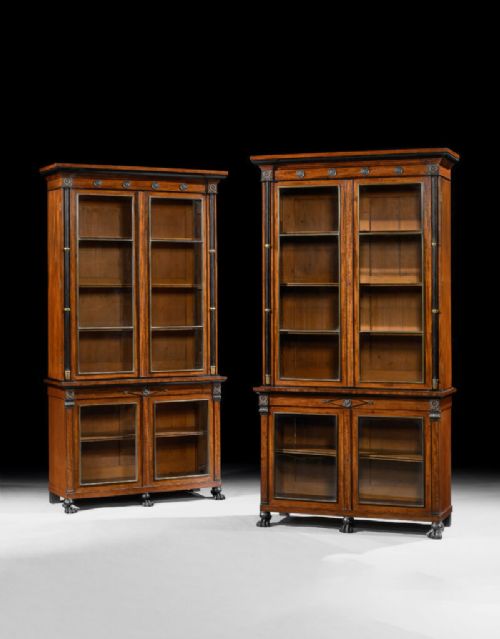
Timber does most of the work. Plain oak is the commonest thing in the category and anchors the bottom of the range, while rosewood, satinwood, birds eye maple, burr walnut and yew appear almost only in the upper part of it. Decoration pulls the same way: inlay, crossbanding, ormolu mounts, boulle and carved Gothic work concentrate in the upper half, and painted library bookcases sit at the very top, though small painted pine cases sit at the bottom.
Within the sectional stacks, height is money. Three and four-section pairs sit well below five, six and seven-section towers, so the tier count quoted in a title tells you a good deal before you read anything else. Scale works the same way across the whole category, with tall and large recurring among the higher entries and small oak examples at the floor.
Then there's how well the two halves agree. Dealers spell this out plainly, using "matching pair", "matched pair", "very close pair", "near pair" and sometimes just "2 Available". A true made-as-one pair carries more than two similar cases brought together later, and the wording in the title is where that distinction is made.
Retail Price Guide 2026
Typical UK retail prices for pair of bookcases, calculated from the Sellingantiques database of over a million retail prices indexed since 2003. This retail price guide relies exclusively on Sellingantiques data; no external sources or auction records are used, so the figures do not describe the wider market.
The 1920s is the period label used most on Sellingantiques for pairs of bookcases, with the 1910s next and the 19th century third.
William Baker & Co of Oxford
The Antique Pair of Bookcases Glossary
- Open bookcase
- A shelved case with no doors and no glazing. The commonest form in this category, named in 143 titles.
- Sectional or stacking bookcase
- Built from separate stackable tiers rather than a single carcass, and sold as two towers when it appears here.
- Barrister bookcase
- The everyday name for a glazed stacking sectional unit. Titles use it interchangeably with sectional.
- Waterfall
- An open bookcase whose shelves step forward in graduated depth, so the lowest shelf is the deepest. Twenty-two titles.
- Dwarf
- A low bookcase, chest height or under. Recurs across the category, and often paired with alcove or pier cases made to fill a recess.
- Astragal glazed
- A glazed door with moulded bars dividing the panes, found on the cabinet-fronted end of the category.
Frequently Asked Questions
How many pairs of bookcases come up each year?
Around fifty pairs come to market in a year on Sellingantiques, listed by 123 different dealers over the life of the archive.
That spread tells you it's a category almost every general furniture dealer touches occasionally, rather than anyone's specialism.
What does a near pair mean in these listings?
It means two closely similar cases that weren't made as one set. Dealers here are unusually candid about it, using "near pair", "matched pair" and "very close pair" as separate descriptions.
A few listings go further and simply say "2 Available", which is as plain as it gets.
Which timbers turn up most often?
Oak leads with 163 titles, mahogany follows at 130 and walnut at 51. Between them they account for the bulk of the category.
Beyond the headline three, the archive carries satinwood, rosewood, yew, birds eye maple, burr maple, satin birch, teak, pitch pine and plain pine. The exotic ones cluster near the top of the range.
Are barrister bookcases common as pairs?
Yes. Stacking sectional pairs make up roughly a fifth of the category, and they're heavily oak.
Globe Wernicke appears in 69 titles, often as "Globe Wernicke style" rather than as an attribution.
What period do most of these date from?
The dated field runs from 1790 to 1960, but the weight is early twentieth century. The 1920s is the fullest decade at 90 listings, the 1910s next at 80, and the 1900s at 56.
Only 322 of 495 listings give a clean year. The rest carry style or reign labels instead: 69 say only "19th Century", 44 Edwardian, 28 Victorian and 11 Regency.
Do unusual forms ever appear in this category?
They do, though only once or twice each. Book troughs, extending novel rests, revolving book tables with a brass gallery, marble-topped open bookshelves and mirrored bookcases have all passed through.
One pair carried bronze glazing bars. Continental and colonial origins are the rarest of all, with single appearances by Swedish, Scandinavian painted, Biedermeier, Anglo-Indian and Irish pairs against 22 French titles.