961  PAGES BROWSED TODAY PAGES TODAY 0 ANTIQUES UPLOADED TODAYNEW ARRIVALS
Breakfront Bookcases
LATEST STOCK
Sort Order
Items Per Page
Browse Categories
Sort order
Items per page

Antique Breakfront Bookcases

185 items · page 1 of 12
Page 1 of 12

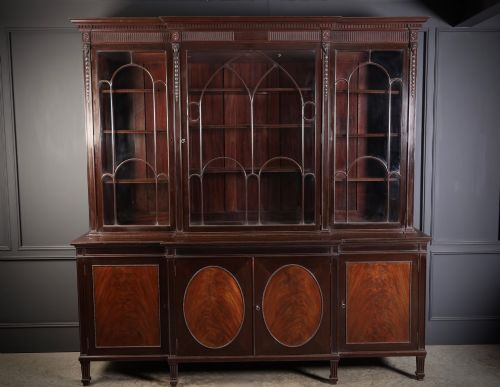
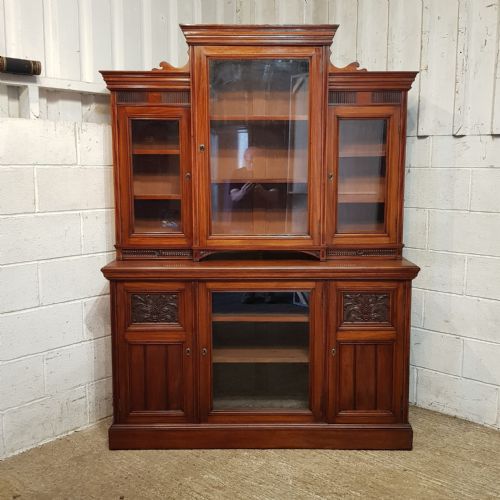
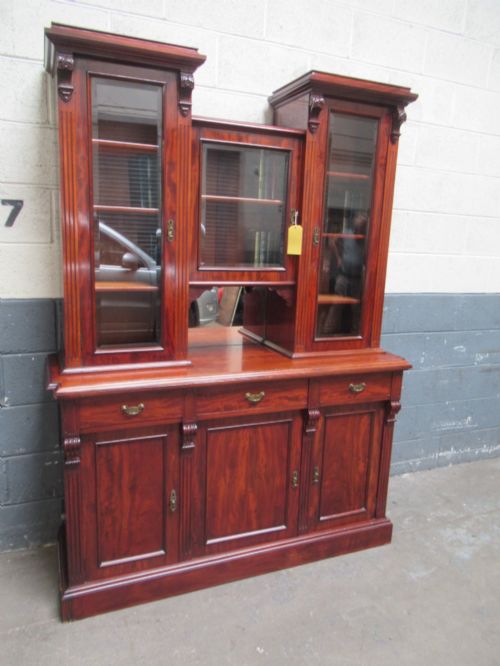
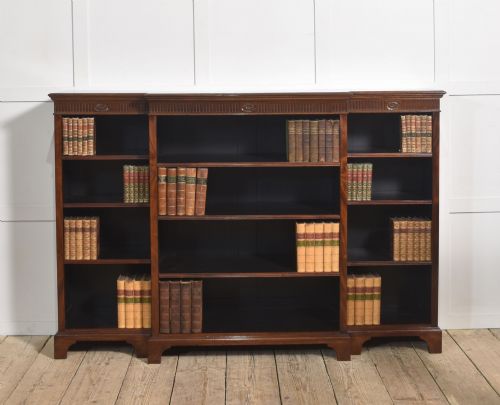
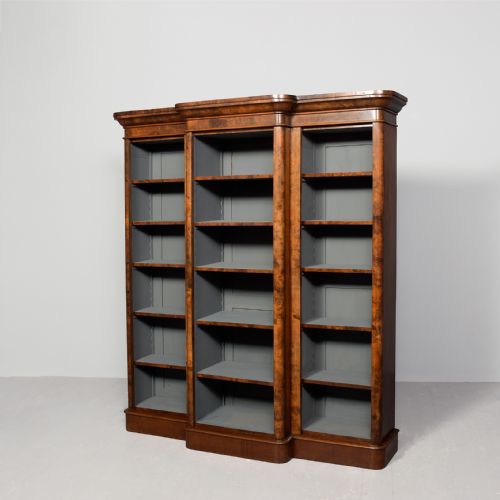
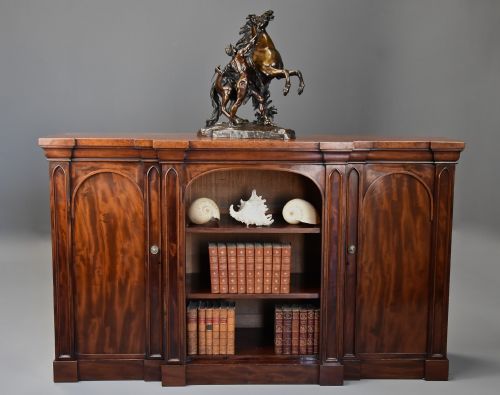
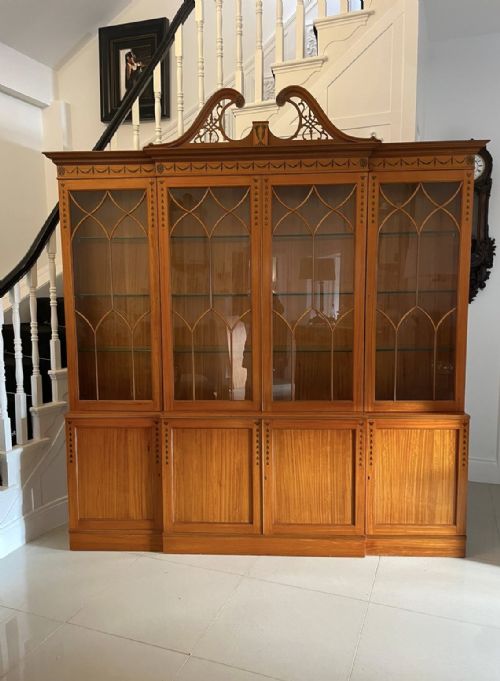
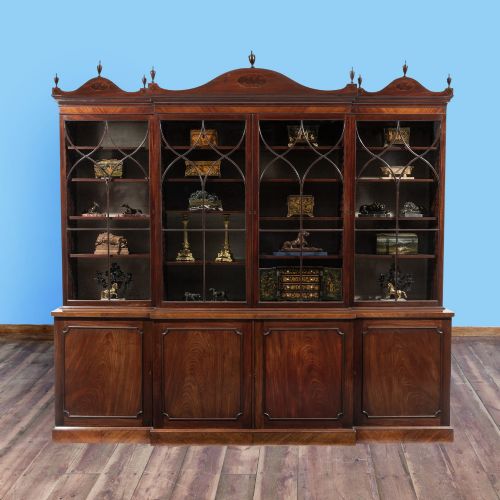
A breakfront bookcase is a wide case with a stepped front, the centre section standing forward of the wings, built to hold a library's worth of books along a long wall.

£2,850
2 DAYS AGO
bookcases
£8,500
9 DAYS AGO
bookcases
£2,650
2 WEEKS AGO
bookcases
£2,245
2 WEEKS AGO
bookcases
£16,000
2 WEEKS AGO
bookcases

Mahogany is named in almost half the breakfront bookcase titles on Sellingantiques. Walnut, oak, rosewood, satinwood and pine share what's left.

£1,695
2 WEEKS AGO
bookcases
£2,495
1 MONTH AGO
bookcases
1 2 3 4 5 ... 12
Sellingantiques  ·  Guide 3492026/2027 edition
Bookcases

Antique Breakfront Bookcases

A breakfront bookcase is a wide case with a stepped front, the centre section standing forward of the wings, built to hold a library's worth of books along a long wall.

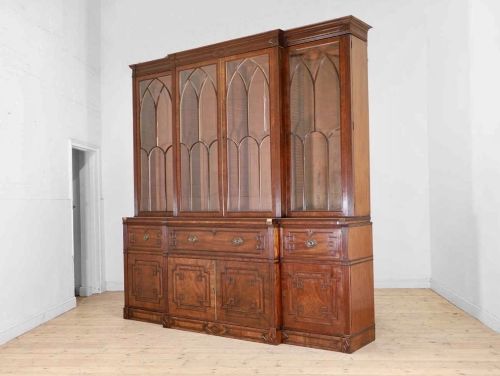
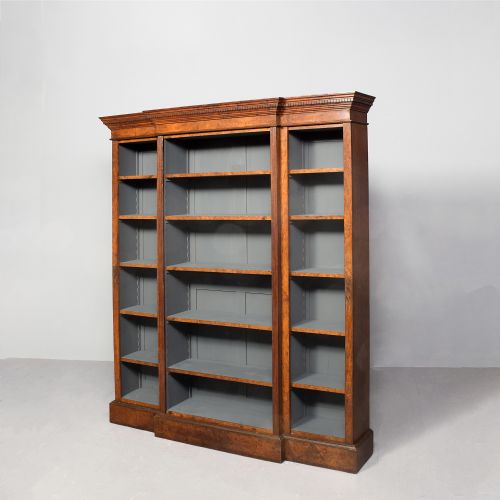
4 Door Profusely Carved Mahogany Bookcase
Plate I  ·  4 Door Profusely Carved Mahogany Bookcase, 19th CenturyGeorgian Antiques
The category

What Is A Breakfront Bookcase?

The name describes the front. The centre projects forward of the flanking sections, which breaks up a very wide flat face and lets the middle carry deeper shelves or a writing drawer. A handful of listings run the arrangement the other way and call it inverted or reverse breakfront. The form was taken up for large library bookcases in the eighteenth century and made steadily through the nineteenth and early twentieth.

Mahogany is named in almost exactly half of all titles, so everything else is a minority timber: walnut, oak, rosewood, satinwood and painted pine account for most of the remainder. The piece you are most likely to meet is a Victorian or Edwardian mahogany breakfront, three or four sections wide, with Victorian appearing in around a fifth of titles.

Types divide about evenly. On one side sit the enclosed pieces with glazed or panelled doors above and cupboard bases, described as library bookcases, cabinets or display cabinets. On the other sit open breakfronts with no doors at all, which turn up in almost one title in five, more than glazing, doors and display cabinets put together.

Smaller branches run through the whole archive. Dwarf and low breakfronts, made to sit under a window or dado, account for twenty-six titles. Secretaire versions, with one section fitted as a fall-front writing drawer, appear in twenty-two. At the twentieth-century end, revival labels such as Georgian Revival, Queen Anne Revival and various 'in the style of' descriptions cluster in the 1900s to 1930s.

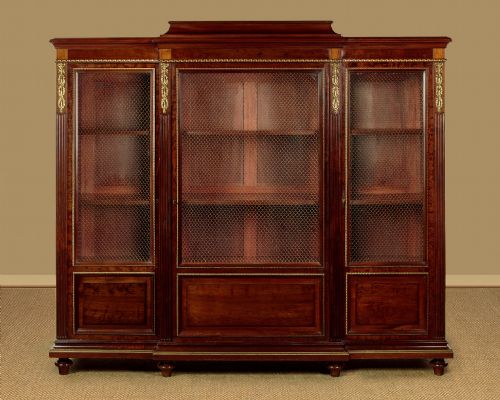
Exhibition Quality Regency 4 Door Cabinet Bookcase
Plate II  ·  Exhibition Quality Regency 4 Door Cabinet Bookcase, 19th CenturyGeorgian Antiques
What sets them apart

Where The Range Splits

Timber and figure do a lot of the work. Plain mahogany and oak fill the lower half of the range. Flame mahogany, burr walnut, satinwood and pollard oak sit higher, and one-off timbers such as laburnum, birds eye maple, goncalo alves, satin birch, golden elm and padouk each surface once or twice near the top.

Scale follows the same direction. Large appears in over eighty titles, and the pieces stated at nine or ten feet wide, or with five and four doors, sit high in the range. Neat, compact and small-proportioned descriptions, along with the dwarf and low bookcases, sit at the lower end without disappearing from it.

Period and decoration separate the rest. Georgian, George III, Regency and William IV titles concentrate in the upper part, while Edwardian and 1910s to 1930s examples concentrate below them. Inlay, carving, painted decoration, brass mounts and marquetry recur among the higher-placed pieces, as do the few titles that name a cabinetmaking firm or carry an attribution.

The market

Retail Price Guide 2026

Entry-levelUnder £1,700
Typical prices£1,700 – £12,800
Premium examplesOver £12,800

Typical UK retail prices for breakfront bookcases, calculated from the Sellingantiques database of over a million retail prices indexed since 2003. This retail price guide relies exclusively on Sellingantiques data; no external sources or auction records are used, so the figures do not describe the wider market.

From the Sellingantiques archive

About seventy-eight breakfront bookcases are listed on Sellingantiques each year, spread across one hundred and forty-one different dealers.

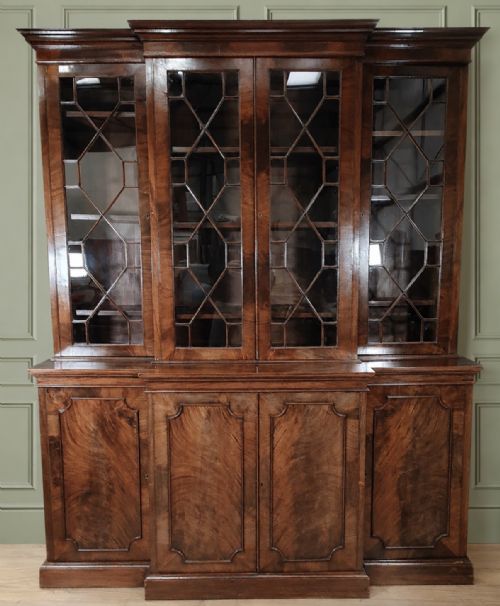
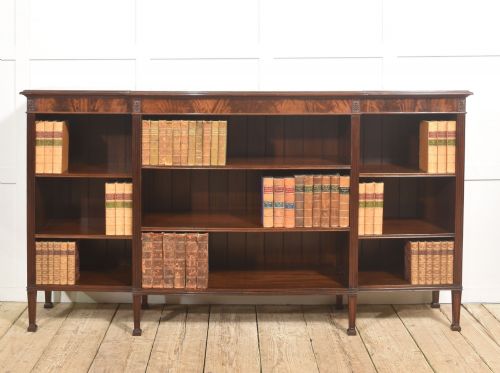
Regency/Early Victorian mahogany library bookcase.
Plate III  ·  Regency/early Victorian Mahogany Library BookcaseRupert Hitchcox Antiques
Terms antiques dealers use

The Antique Breakfront Bookcases Glossary

Breakfront
A front in which the centre section projects forward of the flanking sections. The term describes the shape of the case, not its age or timber.
Open bookcase
Shelves with no doors. It is the commonest qualifier after the timber, used in around one title in five.
Library bookcase
Dealer shorthand for the tall, wide, multi-section type, used in ninety-eight titles.
Secretaire bookcase
One section fitted with a fall-front writing drawer that pulls out and drops down to give a writing surface.
Astragal glazing
Slender moulded bars dividing the panes of a glazed door into a pattern.
Dwarf bookcase
A short breakfront made to sit beneath a window or against a dado rail rather than run floor to ceiling.
Questions people ask

Frequently Asked Questions

How many breakfront bookcases come up in a year?

Around seventy-eight are listed on Sellingantiques in a year, spread across a hundred and forty-one different dealers.

That spread means no single dealer defines the category, and the mix of timbers, sizes and periods stays wide from month to month.

What period do most of these date from?

The dated field runs from 1745 to 1960. The two largest labels are '19th Century' and 'Victorian', both eras rather than years, so a good deal of the dating is approximate by the dealer's own choice.

Where decades are given, they cluster in the 1910s, 1920s and 1900s, alongside the 1880s and 1860s. Eighteenth-century pieces are present but scarce, with '18th' appearing in only ten titles.

Are open breakfront bookcases common?

Yes. Open bookcases with no doors account for a hundred and forty-two of seven hundred and eighty-six titles.

That is more than the titles mentioning glazing, doors and display cabinets put together. Several open examples are described with adjustable shelves on movable bearers.

Which timbers turn up besides mahogany?

Walnut, oak, rosewood, satinwood and painted pine make up most of the non-mahogany entries. Burr walnut alone is named in thirty-six titles.

Beyond those, unusual timbers surface once or twice each: laburnum, goncalo alves, satin birch, birds eye maple, golden elm, padouk and pollard oak.

Do breakfront bookcases come in pairs?

Several titles offer a pair or near-pair of matching breakfronts, including pairs of waterfall and open bookcases.

They are a genuine curiosity in the archive rather than a regular occurrence.

Are these bookcases all English?

The great majority are English. Other origins are rare but real.

Italian, French, Flemish, Irish, Scottish, Northern European and Anglo-Indian examples each appear a handful of times, along with one Burmese carved piece.

65,829
Antiques For Sale
0
Antiques Approved Today
1,666
Antique Uploads This Month
438,940
Total Antiques Sold
items
Add keywords to the filter
Price
£100
£250000
Era
Movements
Material
Origin
Stock Location
Freshness
Online Payments
Categories