7,044  PAGES BROWSED TODAY PAGES TODAY 0  ANTIQUES UPLOADED TODAY NEW ARRIVALS
ID #SA866038
FOR SALE
£14,500
Email Buy
Save
An Important George III Mahogany Longcase London Clock. Thomas Mudge, London Circa 1765
David Wolfenden Antiques
for sale €16,965     $18,415
£14,500
David Wolfenden Antiques

David Wolfenden Antiques

Sellingantiques Verified Since May 2010
View Dealers Stock Page
  • About Us
    The home of fine antiques.
Id #SA866038
PDF SHARE
SAVE

An Important George III Mahogany Longcase London Clock. Thomas Mudge, London Circa 1765

18th century
Description

Fabulous Georgian Antique London Longcase Grandfather Clock.Thomas Mudge,London Circa 1765

Thomas Mudge (1715 – 14 November 1794, London) was an English horologist who invented the lever escapement, a technological improvement to the pocket watch.

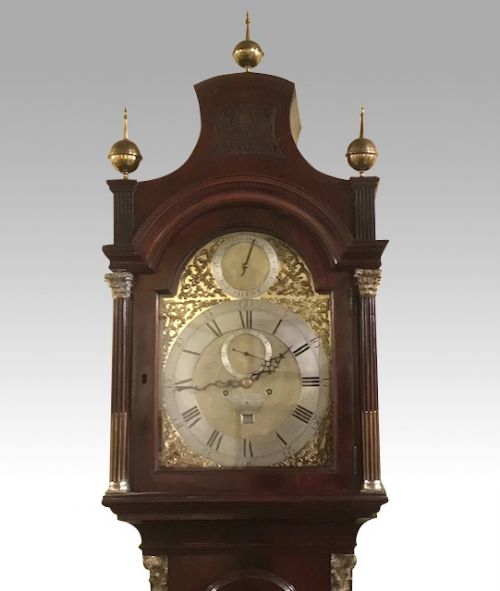
The spectacular mahogany case has a long trunk door and is flanked by reeded and brass inlaid quarter pillars. The base has raised shaped panel and typical double shaped plinth. Both the trunk door and base panel have superb flame veneers of the highest quality. The hood with separate brass capped and brass inlaid angle pillars below a pagoda top with a shaped sound fret and surmounted with three brass finials .

Dial

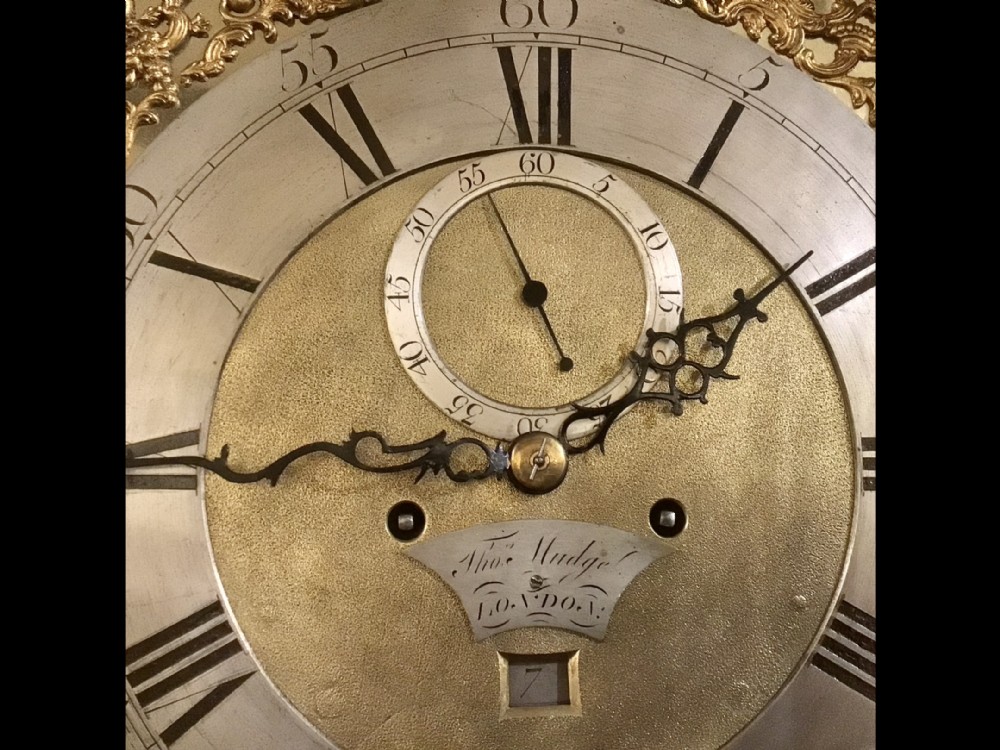
12 inch break arch brass dial with silvered subsidiary strike/silent dial to the arch flanked by pierced foliate spandrels. Finely matted centre with calendar aperture ring and large subsidiary seconds dial, shaped cartouche signed Thomas Mudge London. Silvered chapter ring with Roman and Arabic numerals. Blued steel hands.

Movement

Substantial eight day movement with thick plates, five baluster pillars, anchor escapement and large backcock for the iron-rod pendulum with T-bar suspension and heavy lenticular brass-faced bob. Striking the hours on bell.

Height 98ins x 19.5ins x 9ins deep.

(249cm x 50cm x 23cm) approx.

Thomas Mudge (1715-1794) was born in Exeter in 1715 and was apprenticed to the celebrated clock and watch maker George Graham. In 1738, Thomas Mudge became a Freeman Clockmakers' Company. In 1750, just before his former master's death, Mudge opened his business at the 'Dial and One Crown' in Fleet Street. William Dutton joined him, another of Graham's apprentices, into partnership in circa 1765.

In the eighteenth-century Thomas Mudge ranks highly as one of the most accomplished clock and watch makers. The firm of Mudge and Dutton made clocks and watches of high quality, undoubtedly it is Mudge's individual pieces which have placed him in horological history. Of particular note are his perpetual calendar watch and the equation watches made for John Ellicott to sell to the Spanish Royal court. Probably his most celebrated is the marine timekeeper of 1754 with the first detached lever escapement.

Thomas Mudge was one of the greatest clock and watchmakers of his day, he invented the lever escapement - the greatest single improvement ever applied to watches and used in nearly all modern wristwatches.

Physical Dimensions
Height
249cm (98.03")
Width
50cm (19.69")
Depth
23cm (9.06")
Declaration

David Wolfenden Antiques has dated this George III Mahogany Longcase Clock to the 1750s.
Reference Numbers
Sellingantiques Reference
SA866038
Dealers Notes

Delivery and Insurance to most parts of UK and Ireland is included in price.

Description
Fabulous Georgian Antique London Longcase Grandfather Clock.Thomas Mudge,London Circa 1765
Thomas Mudge (1715 – 14 November 1794, London) was an English horologist who invented the lever escapement, a technological improvement to the pocket watch.
David Wolfenden Antiques
fig 1. A George III mahogany longcase clock featuring an arched brass dial with spandrels, fluted Corinthian columns, and a pagoda hood topped with brass finials.
fig 1. An Important George III Mahogany Longcase London Clock. Thomas Mudge, London Circa 1765

The spectacular mahogany case has a long trunk door and is flanked by reeded and brass inlaid quarter pillars. The base has raised shaped panel and typical double shaped plinth. Both the trunk door and base panel have superb flame veneers of the highest quality. The hood with separate brass capped and brass inlaid angle pillars below a pagoda top with a shaped sound fret and surmounted with three brass finials .
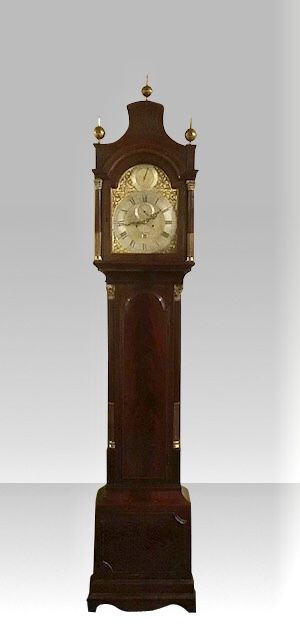
fig 2. A George III mahogany longcase clock featuring an arched brass dial with spandrels, fluted Corinthian columns, and a pagoda hood topped with brass finials.
fig 2. An Important George III Mahogany Longcase London Clock. Thomas Mudge, London Circa 1765

Dial

12 inch break arch brass dial with silvered subsidiary strike/silent dial to the arch flanked by pierced foliate spandrels. Finely matted centre with calendar aperture ring and large subsidiary seconds dial, shaped cartouche signed Thomas Mudge London. Silvered chapter ring with Roman and Arabic numerals. Blued steel hands.
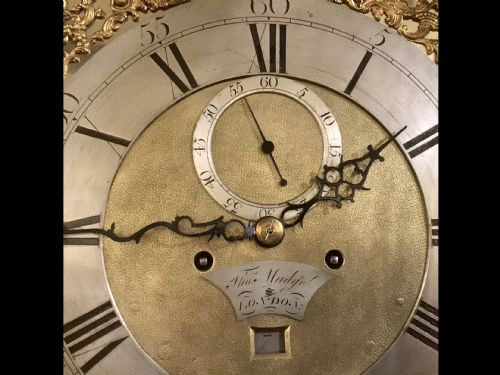
fig 3. A George III mahogany longcase clock featuring an arched brass dial with spandrels, fluted Corinthian columns, and a pagoda hood topped with brass finials.
fig 3. An Important George III Mahogany Longcase London Clock. Thomas Mudge, London Circa 1765

Movement

Substantial eight day movement with thick plates, five baluster pillars, anchor escapement and large backcock for the iron-rod pendulum with T-bar suspension and heavy lenticular brass-faced bob. Striking the hours on bell.
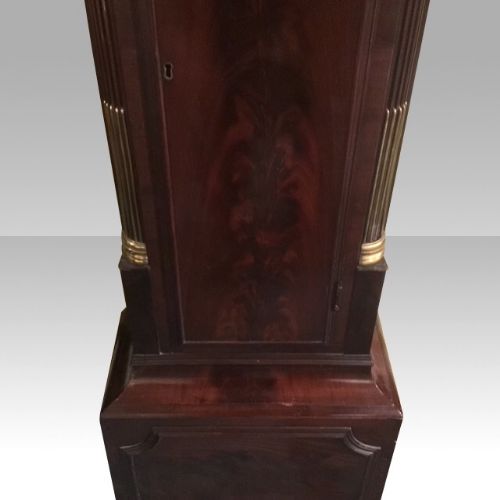
fig 4. A George III mahogany longcase clock featuring an arched brass dial with spandrels, fluted Corinthian columns, and a pagoda hood topped with brass finials.
fig 4. An Important George III Mahogany Longcase London Clock. Thomas Mudge, London Circa 1765

Height 98ins x 19.5ins x 9ins deep.

(249cm x 50cm x 23cm) approx.

Thomas Mudge (1715-1794) was born in Exeter in 1715 and was apprenticed to the celebrated clock and watch maker George Graham. In 1738, Thomas Mudge became a Freeman Clockmakers' Company. In 1750, just before his former master's death, Mudge opened his business at the 'Dial and One Crown' in Fleet Street. William Dutton joined him, another of Graham's apprentices, into partnership in circa 1765.

In the eighteenth-century Thomas Mudge ranks highly as one of the most accomplished clock and watch makers. The firm of Mudge and Dutton made clocks and watches of high quality, undoubtedly it is Mudge's individual pieces which have placed him in horological history. Of particular note are his perpetual calendar watch and the equation watches made for John Ellicott to sell to the Spanish Royal court. Probably his most celebrated is the marine timekeeper of 1754 with the first detached lever escapement.

Thomas Mudge was one of the greatest clock and watchmakers of his day, he invented the lever escapement - the greatest single improvement ever applied to watches and used in nearly all modern wristwatches.

Height
249cm (98.03")
Width
50cm (19.69")
Depth
23cm (9.06")
Date of Manufacture

David Wolfenden Antiques has dated this George III Mahogany Longcase Clock to the 1750s.

Reference Numbers
Sellingantiques Ref
SA866038
David Wolfenden Antiques
Sellingantiques verified Since May 2010

The home of fine antiques.

Dealer Profile

You can view the stock and full dealer information on the David Wolfenden Antiques Profile Page

PDF SHARE
SAVE
A George III mahogany longcase clock featuring an arched brass dial with spandrels, fluted Corinthian columns, and a pagoda hood topped with brass finials.
1 / 5
Archive I A George III mahogany longcase clock featuring an arched brass dial with spandrels, fluted Corinthian columns, and a pagoda hood topped with brass finials.

An Important George III Mahogany Longcase London Clock. Thomas Mudge, London Circa 1765
Archive II A George III mahogany longcase clock featuring an arched brass dial with spandrels, fluted Corinthian columns, and a pagoda hood topped with brass finials. View II
Archive III A George III mahogany longcase clock featuring an arched brass dial with spandrels, fluted Corinthian columns, and a pagoda hood topped with brass finials. View III
Archive IV A George III mahogany longcase clock featuring an arched brass dial with spandrels, fluted Corinthian columns, and a pagoda hood topped with brass finials. View IV
Archive V A George III mahogany longcase clock featuring an arched brass dial with spandrels, fluted Corinthian columns, and a pagoda hood topped with brass finials. View V
Enlarged Archival View
Location
219b Lisnevenagh Road
Antrim
Co. Antrim
Northern Ireland
BT41 2JT
United Kingdom
Dealer Profile Page sellingantiques.co.uk/dw
Verified Since May 2010
Items For Sale 128
Items Sold 880
David Wolfenden Antiques
Verified Since May 2010
View Dealer Info
Location: 219b Lisnevenagh Road, Antrim, Co. Antrim, Northern Ireland, BT41 2JT, United Kingdom
Verified
May 2010
For Sale
128
Sold
880
A George III mahogany longcase clock featuring an arched brass dial with spandrels, fluted Corinthian columns, and a pagoda hood topped with brass finials.
An Important George III Mahogany Longcase London Clock. Thomas Mudge, London Circa 1765
Ref: SA866038
A George III mahogany longcase clock featuring an arched brass dial with spandrels, fluted Corinthian columns, and a pagoda hood topped with brass finials.
Detail View 1
Detail View 2
Detail View 3
Detail View 4
Archival Detail
Every single antique dealer on our platform is individually approved by our internal team. We verify their professional trade history, ethical standards, and photographic quality to ensure a secure, high-standard buying environment. Upon joining, every dealer agrees to a strict 9-point code of conduct. While issues can occasionally arise, our dealers typically resolve them swiftly and directly with the buyer. In fact, since our founding in 2002, Sellingantiques has only had to step in to help resolve an issue on roughly five occasions—a true testament to the quality of our dealers and their dedication to your happiness.
Our dealers are highly experienced in packing and shipping fragile, high-value antiques. Because you are in direct contact with the dealer, you will be able to easily go through all available shipping and insurance options together to ensure your item arrives safely.
Antiques are the ultimate green purchase. By choosing historical pieces over newly manufactured goods, you completely eliminate the carbon footprint of modern mass production while preserving exceptional, timeless craftsmanship.

Produced during the reign of King George III between 1760 and 1820, these longcase clocks are characterised by refined mahogany casework, architectural hood pediments, and sophisticated brass or painted dials reflecting the peak of British horological craftsmanship.

London makers predominantly utilised dense flame mahogany veneers over oak carcases, with brass used for movements, dials, spandrels, and decorative finials, alongside cast iron weights and steel pendulum rods.

Authenticity is checked by examining the dial engraving, movement construction, and case joinery. Original period features include hand-cut gear teeth, cast brass corner spandrels, correct maker signatures, and period-appropriate wood patination and construction techniques.

A tall case clock serves as an architectural anchor in a hallway, dining room, or study, providing visual height and textural contrast against modern paint schemes, minimalist panelling, or crisp masonry walls.

Keep the clock in a climate-controlled environment away from direct sunlight and heat sources to prevent wood shrinkage. Clean the brass elements lightly without harsh polish, apply high-grade beeswax to the timber annually, and have the mechanical movement serviced by a qualified horologist every five to seven years.
items
Add keywords to the filter
Price
£100
£250000
Era
Movements
Material
Origin
Stock Location
Freshness
Online Payments
Categories