73,199  PAGES BROWSED TODAY PAGES TODAY • 246 ANTIQUES UPLOADED TODAYNEW ARRIVALS
GIFTSNEW
246 ITEMS ADDED TODAY
Sort Order
Items Per Page
Browse Categories
Sort order
Relevant Links
Items per page
ID #SA1094217
FOR SALE
£200
Email Phone
Save
Antique Small Hand Painted Vases, Kutani, Japan, Meiji Period
For sale by Gillers Antiques Ltd
Id #SA1094217
PDF SHARE
SAVE

Antique Small Hand Painted Vases, Kutani, Japan, Meiji Period

19th century
Description

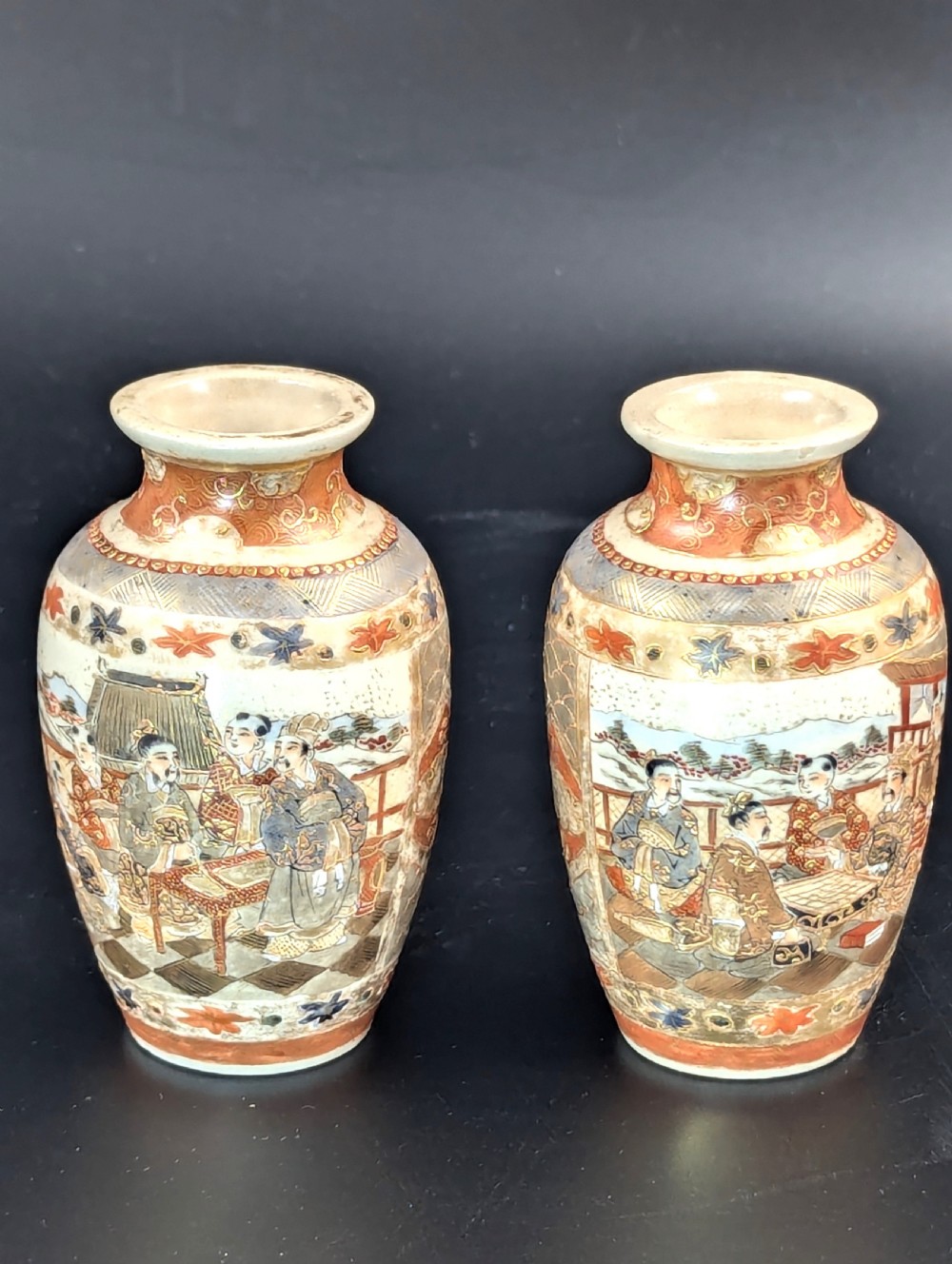
A pair of antique miniature Kutani hand-painted earthenware vases of baluster form with flared necks showcases the elegance of traditional Japanese pottery. The vases' bodies feature continuous scenes depicting a Japanese teacher and his students, all dressed in traditional attire, against a serene natural backdrop with a river. The intricate gilded patterns and highlights enhance the richness of the design. The necks of each vase are painted in Kutani's signature coral or brownish-red hues, with gilded accents that add a touch of luxury. Kutani ware, a distinct style of Japanese pottery, is known for its vibrant overglaze painting. Similar to Imari ware, it is made from clay that is dried before firing and adorned with intricate pictorial ornamentation and vivid, sharp lines. Kutani's origins trace back to 1655 in Kaga, Ishikawa, when the first kiln was established. However, production halted at the end of the 17th century and was not revived until the 19th century during the Meiji period, a time when Japan re-opened its borders to international trade. Kutani ware became one of the first Japanese pottery styles to be exported. Kutani pottery is classified by its production period. The earliest, known as Ko-Kutani, is extremely rare, while the Saiko-Kutani period in the 19th century marked a revival. Kutani wares from this era, also known as Kaga-style wares, are renowned for their rich use of brownish-red, muddy yellow and intense green on a greyish ground. They include a wide variety of items, often created for the Western market, such as tea and coffee sets, dishes, bowls, incense burners, and small decorative objects. These vases embody the beauty and craftsmanship of this treasured Japanese tradition.

Dimensions: height 8.8 cm, diameter in the wide part of 5.4 cm.

Condition: excellent - only minor losses of gilding and coloring. Due to its age the glaze on the bottom is covered with a thin mesh of craquelure

Please study the accompanying photographs carefully as they form an integral part of this description. The item will be shipped with full tracking and insurance. It is important to note that shipping costs include labour, packaging and postage

Declaration

Gillers Antiques Ltd has dated these Japanese Kutani Porcelain Vases to the 19th Century.

Reference Numbers
Sellingantiques Reference
SA1094217
Description
A pair of antique miniature Kutani hand-painted earthenware vases of baluster form with flared necks showcases the elegance of traditional Japanese pottery.
“
The vases' bodies feature continuous scenes depicting a Japanese teacher and his students, all dressed in traditional attire, against a serene natural backdrop with a river.
Gillers Antiques Ltd

The intricate gilded patterns and highlights enhance the richness of the design. The necks of each vase are painted in Kutani's signature coral or brownish-red hues, with gilded accents that add a touch of luxury. Kutani ware, a distinct style of Japanese pottery, is known for its vibrant overglaze painting. Similar to Imari ware, it is made from clay that is dried before firing and adorned with intricate pictorial ornamentation and vivid, sharp lines. Kutani's origins trace back to 1655 in Kaga, Ishikawa, when the first kiln was established. However, production halted at the end of the 17th century and was not revived until the 19th century during the Meiji period, a time when Japan re-opened its borders to international trade. Kutani ware became one of the first Japanese pottery styles to be exported. Kutani pottery is classified by its production period. The earliest, known as Ko-Kutani, is extremely rare, while the Saiko-Kutani period in the 19th century marked a revival. Kutani wares from this era, also known as Kaga-style wares, are renowned for their rich use of brownish-red, muddy yellow and intense green on a greyish ground. They include a wide variety of items, often created for the Western market, such as tea and coffee sets, dishes, bowls, incense burners, and small decorative objects. These vases embody the beauty and craftsmanship of this treasured Japanese tradition.

fig 1. A pair of small Japanese Kutani porcelain vases featuring figurative narrative panels framed by iron-red and gold leaf borders.
fig 1. Antique Small Hand Painted Vases, Kutani, Japan, Meiji Period

Dimensions: height 8.8 cm, diameter in the wide part of 5.4 cm.

Condition: excellent - only minor losses of gilding and coloring. Due to its age the glaze on the bottom is covered with a thin mesh of craquelure

fig 2. A pair of small Japanese Kutani porcelain vases featuring figurative narrative panels framed by iron-red and gold leaf borders.
fig 2. Antique Small Hand Painted Vases, Kutani, Japan, Meiji Period

Please study the accompanying photographs carefully as they form an integral part of this description. The item will be shipped with full tracking and insurance. It is important to note that shipping costs include labour, packaging and postage

Date of Manufacture

Gillers Antiques Ltd has dated these Japanese Kutani Porcelain Vases to the 19th Century.

Reference Numbers
Sellingantiques Ref
SA1094217
Gillers Antiques Ltd
Sellingantiques verified Since Mar 2023
Dealer Profile

You can view the stock and full dealer information on the Gillers Antiques Ltd Profile Page
PDF SHARE
SAVE
A pair of small Japanese Kutani porcelain vases featuring figurative narrative panels framed by iron-red and gold leaf borders.
1 / 8
Archive I A pair of small Japanese Kutani porcelain vases featuring figurative narrative panels framed by iron-red and gold leaf borders.

Antique Small Hand Painted Vases, Kutani, Japan, Meiji Period

Archive II A pair of small Japanese Kutani porcelain vases featuring figurative narrative panels framed by iron-red and gold leaf borders. View II
Archive III A pair of small Japanese Kutani porcelain vases featuring figurative narrative panels framed by iron-red and gold leaf borders. View III
Archive IV A pair of small Japanese Kutani porcelain vases featuring figurative narrative panels framed by iron-red and gold leaf borders. View IV
Archive V A pair of small Japanese Kutani porcelain vases featuring figurative narrative panels framed by iron-red and gold leaf borders. View V
Archive VI A pair of small Japanese Kutani porcelain vases featuring figurative narrative panels framed by iron-red and gold leaf borders. View VI
Archive VII A pair of small Japanese Kutani porcelain vases featuring figurative narrative panels framed by iron-red and gold leaf borders. View VII
Archive VIII A pair of small Japanese Kutani porcelain vases featuring figurative narrative panels framed by iron-red and gold leaf borders. View VIII
Enlarged Archival View
Telephone 07738 009924
Location
Buckland House
Buntingford
Hertfordshire
SG9 0PY
United Kingdom
Verified Since Mar 2023
Items For Sale 401
Items Sold 574
Gillers Antiques Ltd
Verified Since Mar 2023
View Dealer Info
Location: Buckland House, Buntingford, Hertfordshire, SG9 0PY, United Kingdom
Verified
Mar 2023
For Sale
401
Sold
574
A pair of small Japanese Kutani porcelain vases featuring figurative narrative panels framed by iron-red and gold leaf borders.
Antique Small Hand Painted Vases, Kutani, Japan, Meiji Period
Ref: SA1094217
A pair of small Japanese Kutani porcelain vases featuring figurative narrative panels framed by iron-red and gold leaf borders.
Detail View 1
Detail View 2
Detail View 3
Detail View 4
Detail View 5
Detail View 6
Detail View 7
Archival Detail
Every single antique dealer on our platform is individually approved by our internal team. We verify their professional trade history, ethical standards, and photographic quality to ensure a secure, high-standard buying environment. Upon joining, every dealer agrees to a strict 9-point code of conduct. While issues can occasionally arise, our dealers typically resolve them swiftly and directly with the buyer. In fact, since our founding in 2002, Sellingantiques has only had to step in to help resolve an issue on roughly five occasions—a true testament to the quality of our dealers and their dedication to your happiness.
Our dealers are highly experienced in packing and shipping fragile, high-value antiques. Because you are in direct contact with the dealer, you will be able to easily go through all available shipping and insurance options together to ensure your item arrives safely.
Antiques are the ultimate green purchase. By choosing historical pieces over newly manufactured goods, you completely eliminate the carbon footprint of modern mass production while preserving exceptional, timeless craftsmanship.
Written by Sellingantiques from the dealer’s photographs and listing
  • ObjectVases
  • Period19th century
  • StyleMeiji Period
  • MaterialPorcelain, Enamel, Gold Leaf
  • ColourTerracotta and Gold
  • MotifsFigurative narrative panels, Iron-red scrollwork, Gilded detailing, Geometric neck borders

These two miniature porcelain vases are Japanese Kutani pieces from the 19th-century Meiji period. Each baluster vase has a flared neck, a white background, and a glossy overglaze finish decorated with terracotta, blue, green, and gold leaf colours. The bodies display figurative narrative panels showing a teacher with students wearing traditional garments near a river, surrounded by geometric neck borders, iron-red scrollwork, and gilded highlights. Minor losses of gilding and colouring are present, and the glaze on the bottom shows a thin mesh of craquelure due to age. Each vase stands 8.8 cm in height with a diameter of 5.4 cm at the widest part. Such small decorative objects suit a gentleman's library and sit comfortably on a mantelpiece. Collectors place them on wooden display shelves or side tables to highlight their detailed pictorial ornamentation. Regular dusting with a soft, dry cloth preserves the delicate enamel and gold leaf finish. The pair brings traditional Japanese pottery design into domestic interiors without requiring extensive display space.

Kutani porcelain from the Meiji period (18681912) is recognised for its iron-red enamel ground, elaborate gilded highlights, and detailed figurative panels illustrating narrative scenes or landscapes.

Craftsmen produce Kutani ware using refined porcelain clay decorated with multi-coloured overglaze enamels, iron-oxide red paint, and thin applications of gold leaf before undergoing secondary kiln firings.

Authentic pieces exhibit hand-painted brushwork, slight irregularities in hand-thrown forms, age-appropriate wear to gilding, and often feature handwritten iron-red or gold maker marks on the base.

Positioning a pair of Kutani vases on a mantelpiece, console, or shelf introduces rich terracotta tones, intricate geometry, and historical narrative elements into minimalist or eclectic room settings.

Dust surfaces gently using a dry, soft-bristled brush or clean microfibre cloth, avoiding harsh chemicals, moisture immersion, or abrasive rubbing that can remove fragile overglaze enamels and surface gilding.
items
Add keywords to the filter
Price
£100
£250000
Era
Period
Style
Material
Origin
Stock Location
Recently Added
Online Payments
Categories